
All-Black Solar Panels: Pros, Cons and Buying Guide

The short answer: all-black solar panels are monocrystalline panels built with black cells, a black backsheet and a black aluminium frame, giving the whole panel one smooth, uniform dark finish. The honest breakdown of the all black solar panels pros cons is this — on the plus side you get a sleek, premium look and the higher-efficiency cell technology of monocrystalline silicon; on the minus side you pay more than you would for classic blue polycrystalline panels, dust and dirt show up more visibly, and the black surface absorbs extra heat. For most Pakistani rooftops, the choice between black and blue comes down to looks, budget and available roof space.
If you have been scrolling through photos of rooftop installations and wondering why some panels look like dark glass while others have that familiar speckled blue finish, this guide explains exactly what you are looking at, where the real differences lie, and how to buy with confidence.
What Are All-Black Solar Panels?
A solar panel has three visible parts: the silicon cells that convert sunlight into electricity, the backsheet behind them, and the aluminium frame holding everything together. On a conventional panel these parts are different colours — dark cells, a white or silver backsheet, and a silver frame. An all-black panel makes all three parts black: black monocrystalline cells, a black backsheet and a black anodised frame. The result is a panel that looks like a single slab of dark glass from a few metres away.
It is worth knowing the distinction between a true all-black panel and a panel that merely has a black frame. Many manufacturers sell standard panels with black frames for a slightly smarter look, but the white backsheet still shows between the cells, giving a patchwork appearance. A genuine all-black panel hides the cell gaps entirely because the backsheet behind them is black too. When a dealer in Pakistan offers you an “all-black” panel, ask specifically whether the backsheet is black — that is what defines the look.
Almost every all-black panel on the market uses monocrystalline silicon cells. As EnergySage explains, black panels are comprised of monocrystalline cells, while blue panels use polycrystalline cells — the colour difference comes from how light interacts with the two cell types. Because the cells themselves are black, the all-black finish is a natural extension of monocrystalline technology rather than a coat of paint.
All Black vs Blue Solar Panels: The Core Difference
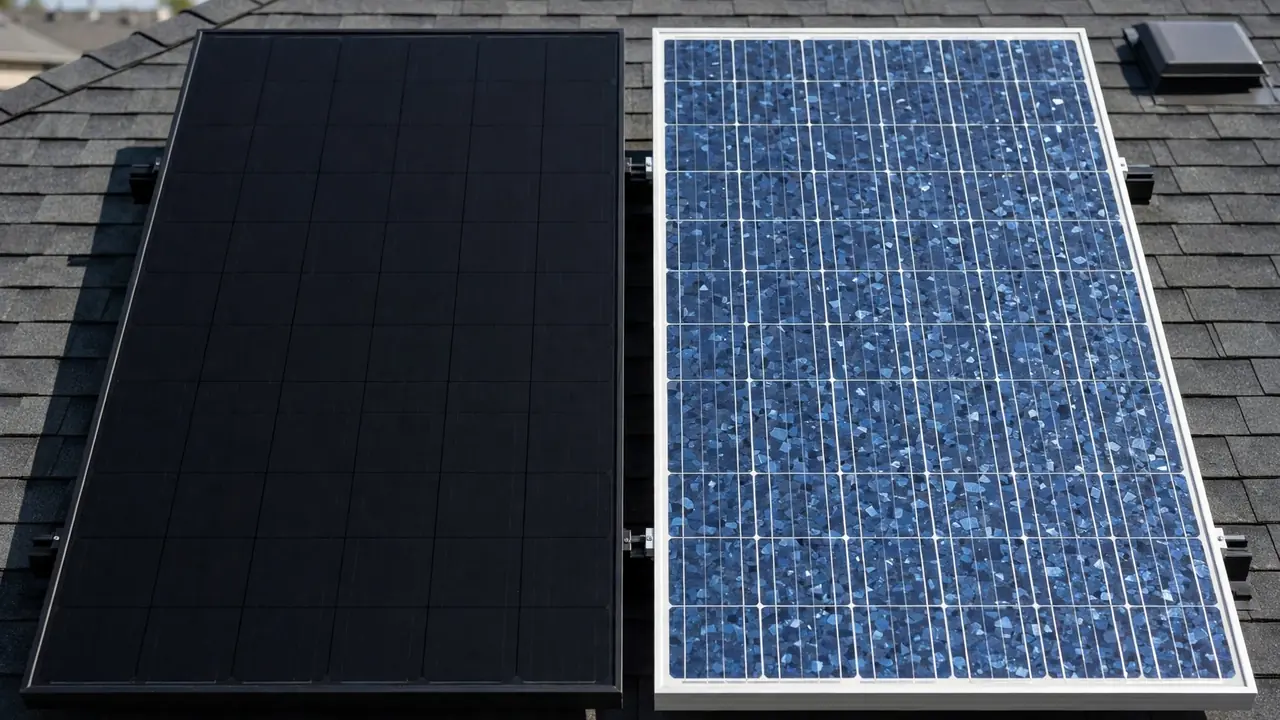
The black-versus-blue question is really a question about cell technology. Blue panels are polycrystalline (also called multicrystalline): their silicon is melted and poured into a mould, forming many crystals that reflect light in different directions and create the speckled blue look. Black panels are monocrystalline: their silicon is grown as one continuous crystal, which absorbs light more uniformly and appears black.
That structural difference is what drives the practical differences:
- Efficiency: monocrystalline cells convert a higher share of sunlight into electricity than polycrystalline cells. EnergySage notes typical monocrystalline efficiencies of 20–23%, which is why a black panel usually produces more power from the same roof area than a blue one of the same size.
- Manufacturing cost: growing a single silicon crystal is energy-intensive and wastes some silicon in the process, so monocrystalline panels cost more to produce than polycrystalline panels — and that shows in the selling price.
- Appearance: blue panels have a shimmering, textured look; black panels are smooth and uniform. The all-black variant takes this a step further with the black backsheet and frame.
One clarification that matters: the all-black finish itself does not make a panel more efficient than a standard monocrystalline panel with a white backsheet. The efficiency comes from the monocrystalline cells inside. You are paying for the cells’ performance plus the premium look — the black backsheet is cosmetic.
Pros of All-Black Solar Panels
1. A sleek, uniform appearance
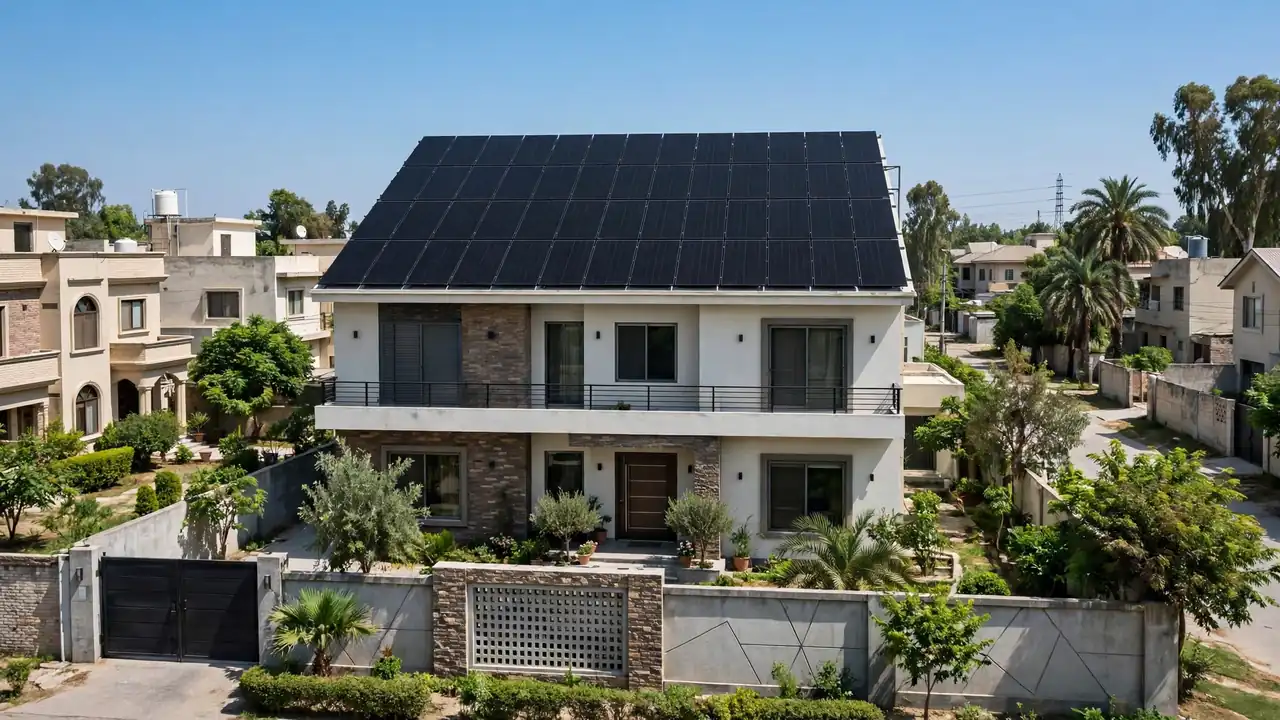
This is the main reason people choose all-black panels. A row of all-black panels looks like dark glass stretching across the roof, with no silver grid lines or white gaps breaking up the surface. On homes with dark roofing sheets, grey concrete or modern facades — increasingly common in new Pakistani housing societies — they blend in far better than blue panels. If your housing society has exterior-appearance rules, or you simply want the installation to look intentional rather than industrial, all-black is the tidiest option.
2. Higher-efficiency cell technology
Because all-black panels are built on monocrystalline cells, you get the performance advantages of that technology: higher efficiency per square metre and better output in limited roof space. For a typical Pakistani home where the usable, shade-free roof area is small, generating more power per panel matters. Pair this with our guide to monocrystalline solar panels to understand the cell technology in more depth.
3. Matches modern panel technologies
Most of the latest cell technologies — N-type cells, TOPCon and half-cut designs — are sold primarily in all-black or black-frame formats by leading manufacturers. Choosing all-black usually means you are buying from the current generation of panel technology rather than leftover older stock. Our comparison of N-type vs P-type panel technologies explains why the industry has moved in this direction.
Cons of All-Black Solar Panels
1. They cost more to manufacture — and to buy
The single-crystal growing process behind monocrystalline cells is more energy-intensive and produces more waste silicon than the polycrystalline process, so black panels are inherently more expensive to make. On top of that, the all-black backsheet and anodised black frame are premium finishes that add to the cost. If your budget is tight and roof space is generous, standard blue or silver-frame panels can deliver the system size you need for less money. Check our homepage for today’s updated panel prices to compare what the difference looks like in the current market.
2. Dust and dirt show more visibly
This is a genuinely practical issue in Pakistan. A thin layer of dust on a blue panel is barely noticeable; the same layer on an all-black panel stands out clearly against the dark surface. The dust itself reduces output on any panel colour equally, but on black panels you will see the problem sooner — which is actually a useful early warning, though it does mean you will feel the urge to clean more often. In dusty areas near construction sites or main roads, factor in slightly more frequent cleaning.
3. Black surfaces absorb more heat
Basic physics: dark surfaces absorb more solar radiation and run hotter than light ones. An all-black panel operates at a slightly higher cell temperature than an equivalent panel with a white backsheet, and every panel loses a small amount of output as temperature rises. In practice the difference between a black-backsheet and white-backsheet mono panel is modest, and a proper air gap under the panels does far more for cooling than the backsheet colour. Still, in cities like Multan, Jacobabad or Sibi where summer temperatures are extreme, mounting height and ventilation deserve extra attention.
4. Beware of fake “all-black” panels
Because the look commands a premium, some low-quality panels are cosmetically darkened — tinted glass or coloured coatings — to imitate the all-black appearance without the monocrystalline cells inside. These coatings can actually reduce light transmission and efficiency. A genuine all-black panel’s darkness comes from the cells and backsheet themselves, never from a coating on the glass. This is one more reason to verify your panels before paying, especially when buying from an unfamiliar dealer.
Do Black Panels Run Hotter in Pakistan’s Summers?
Yes, slightly — but the effect is smaller than most people fear. The black backsheet absorbs more heat than a white one, raising the cell temperature by a small margin. What matters far more for summer performance is the panel’s temperature coefficient (listed on every genuine datasheet) and the installation itself. Panels mounted with a proper ventilation gap underneath run noticeably cooler than panels fixed flush to a hot roof, regardless of colour.
Practical takeaway: if you are installing in a very hot region, prioritise a panel with a good (low) temperature coefficient and insist your installer leaves adequate airflow beneath the array. The backsheet colour is a secondary factor. And remember that even with the slight heat penalty, a monocrystalline all-black panel still outperforms a blue polycrystalline panel in hot weather, because the underlying cell technology is more efficient to begin with.
Buying Guide: How to Choose All-Black Panels in Pakistan
Stick to known manufacturers
All-black finishes are offered by most Tier-1 manufacturers as part of their residential product lines. Buying a recognised brand means the panel’s datasheet, warranty terms and certifications actually exist and can be checked. Avoid unbranded “German technology” or “American cell” panels with no verifiable manufacturer — the all-black look is easy to fake and hard to verify without paperwork.
Confirm it is genuinely all-black
Ask the dealer to show you the panel from the front and the back. The backsheet visible between and around the cells should be black, not white or grey. The frame should be black anodised aluminium, not silver. If only the frame is black, you are looking at a black-frame panel, not an all-black panel — still attractive, but not the premium product and not worth a premium price.
Check the datasheet before you pay
Every genuine panel ships with a datasheet listing wattage, efficiency, temperature coefficient, dimensions and certifications. Match the model number on the panel’s label with the manufacturer’s published datasheet. If the dealer cannot produce a datasheet, or the numbers do not match, walk away. Reputable dealers in Lahore, Karachi and Islamabad will share datasheets without hesitation.
Verify serial numbers and buy A-grade
Counterfeit and B-grade panels are a real problem in the Pakistani market. Verify the panel’s serial number through the manufacturer’s official verification channel where available, and insist on A-grade panels from an authorised distributor. Our solar panel verification guide walks through the exact steps for the major brands.
Compare warranty terms, not just wattage
Two panels with the same wattage can have very different warranty coverage. Check both the product warranty (covering manufacturing defects) and the performance warranty (guaranteeing output over 25–30 years). A longer, clearly documented warranty from an established brand is worth more than a slightly higher wattage figure on a no-name panel.
Cleaning and Maintenance Tips for Black Panels
All-black panels need the same care as any panels, with one difference: you will notice the dirt sooner. In most Pakistani cities, a light dust film builds up within a couple of weeks, faster near roads and construction. Clean early in the morning or in the evening when the panels are cool — cold water on hot glass can cause thermal stress. Use clean water and a soft sponge or microfibre cloth; avoid harsh detergents and abrasive brushes that can scratch the anti-reflective coating.
Because soiling is more visible on the dark surface, many owners find black panels easier to maintain in practice: you can see exactly when cleaning is due instead of guessing. After cleaning, the deep black finish returns immediately, which makes it simple to confirm the job is done properly. For a full routine, see our maintenance checklist linked from the homepage.
Like the all-black look? Check the solar panel price in pakistan for all-black models against the solar plate price in pakistan per watt on our homepage’s daily tables.
Further reading: EnergySage’s explainer on why some solar panels are blue and others black covers the cell-technology science behind the colour difference, and our bifacial solar panel guide looks at another premium panel format worth comparing before you decide.
Frequently Asked Questions (FAQs)
What does all-black mean in a solar panel?
An all-black panel has black monocrystalline cells, a black backsheet and a black aluminium frame, so the whole panel looks like one uniform slab of dark glass. A panel with only a black frame but a white backsheet still shows a patchwork pattern between the cells — it is a black-frame panel, not a true all-black panel.
Are all-black solar panels more efficient than blue ones?
The all-black finish itself adds no efficiency — the advantage comes from the monocrystalline cells inside, which convert more sunlight into electricity than older blue polycrystalline cells. A standard monocrystalline panel with a white backsheet performs essentially the same as its all-black sibling; you are paying for the cells’ performance plus the premium look.
Do black solar panels get hotter in summer?
Slightly, yes — black surfaces absorb more heat than light ones. In practice the difference is modest, and a proper ventilation gap under the panels plus a good temperature coefficient (check the datasheet) matters far more for summer performance than the backsheet colour. Even with the small heat penalty, monocrystalline black panels still outperform blue polycrystalline panels in hot weather.
Do all-black panels need more frequent cleaning?
They need the same cleaning as any panel, but you will notice the dirt sooner because dust stands out clearly against the dark surface. In dusty Pakistani cities this is actually a useful early warning — clean with water and a soft cloth early in the morning or evening when the panels are cool, and avoid abrasive brushes.
How can I tell a genuine all-black panel from a fake one?
Check three things: the backsheet visible around the cells must be black (not white or grey), the model number must match the manufacturer’s published datasheet, and the serial number should verify through an official channel. Be cautious of panels darkened with tinted glass or coloured coatings — genuine all-black colour comes from the cells and backsheet, never from a coating.
Are all-black panels worth it for a home in Pakistan?
Choose all-black if the installation’s appearance matters to you — for example in a housing society with exterior rules or a modern home where blue panels would clash — and your roof space is limited, since the monocrystalline cells give more power per square metre. If budget is the priority and you have generous roof space, conventional panels deliver the system size you need for less.