
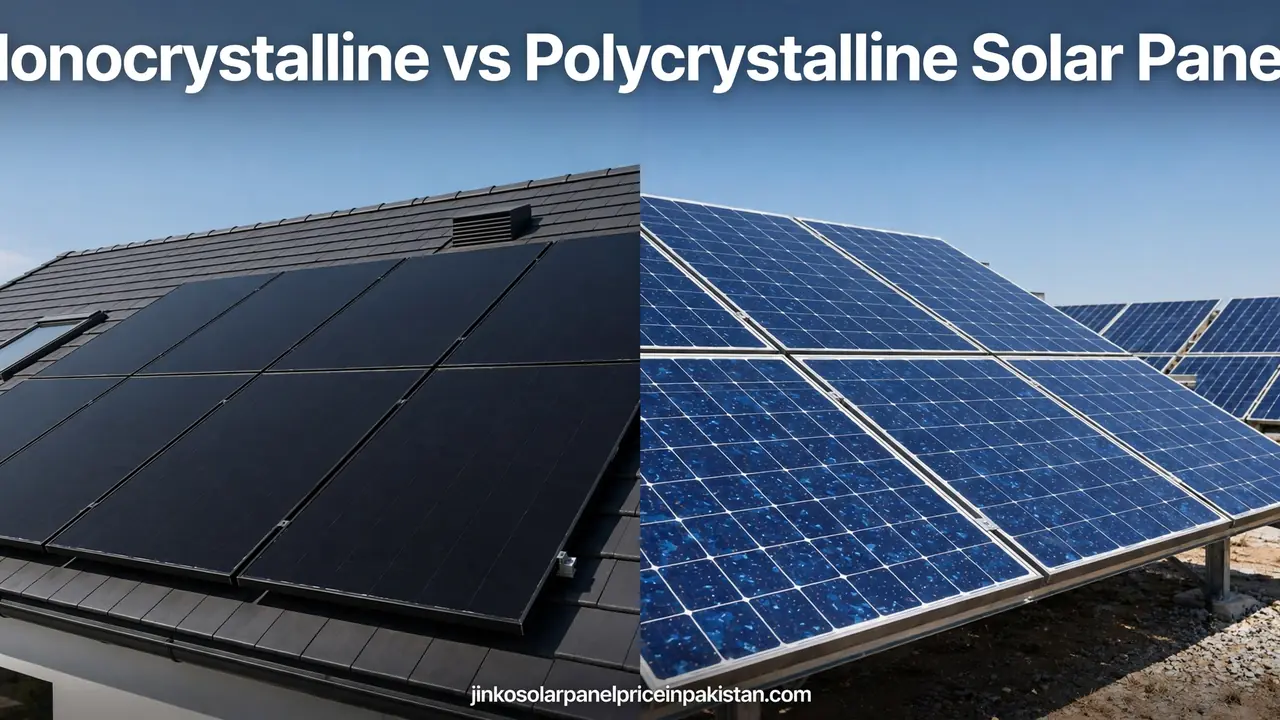
Monocrystalline vs Polycrystalline Solar Panels: Which Is Better?

Monocrystalline solar panels are the better choice for almost every new rooftop installation in Pakistan. They convert more sunlight into electricity from the same roof area, hold up better in high summer temperatures, and look cleaner on the roof. Polycrystalline panels are not bad products — millions of older systems run on them perfectly well — but the market has moved on: most major manufacturers now build their residential panels exclusively with monocrystalline cells, and the old price advantage of polycrystalline has largely disappeared. That is the verdict of the wider industry too: for a traditional rooftop system, monocrystalline is the right choice for nearly every homeowner, according to EnergySage’s panel-type guide.
If you are comparing the two before buying, this guide walks through how monocrystalline and polycrystalline panels differ in manufacturing, efficiency, heat performance, appearance, and lifespan — and which one makes sense for Pakistani rooftops.
What Is a Monocrystalline Solar Panel?
A monocrystalline solar panel is made from solar cells cut from a single, pure silicon crystal. The crystal is grown in a high-temperature process known as the Czochralski method: a seed crystal is dipped into molten silicon and slowly pulled upward, forming one continuous crystal ingot. That ingot is then sliced into thin wafers, and each wafer becomes a solar cell.
Because every cell comes from one uniform crystal, electrons flow through it with very little resistance. That is the physical reason behind the two traits monocrystalline panels are known for: higher efficiency and a uniform dark appearance. Monocrystalline panels are almost always black or very dark grey, which is also why they have become the default look of modern rooftop installations.
Most of the advanced cell technologies on the market today — PERC, TOPCon, and HJT — are built on monocrystalline wafers. If you read about high-efficiency panels, you are almost certainly reading about monocrystalline ones.
What Is a Polycrystalline Solar Panel?
A polycrystalline solar panel is made from cells cast from many silicon fragments melted together. Instead of growing a single crystal, manufacturers pour molten silicon into a square mould and let it cool into an ingot made of many small crystals. That ingot is sliced into wafers the same way, but each wafer contains multiple crystal grains pointing in different directions.
The boundaries between those crystal grains — the seams where one crystal fragment meets the next — create resistance that slows the flow of electrons. That is why polycrystalline cells convert slightly less sunlight into electricity than monocrystalline cells of the same size. Visually, the fragmented crystals give polycrystalline panels their distinctive speckled blue appearance, with silver frames and usually white or silver backsheets.
Polycrystalline was the budget workhorse of the solar industry for years. It dominated residential installations through the 2010s because the simpler manufacturing process made it cheaper to produce. That era has ended: as monocrystalline manufacturing scaled up and its prices fell, the cost gap closed and manufacturers shifted their residential lines to monocrystalline.
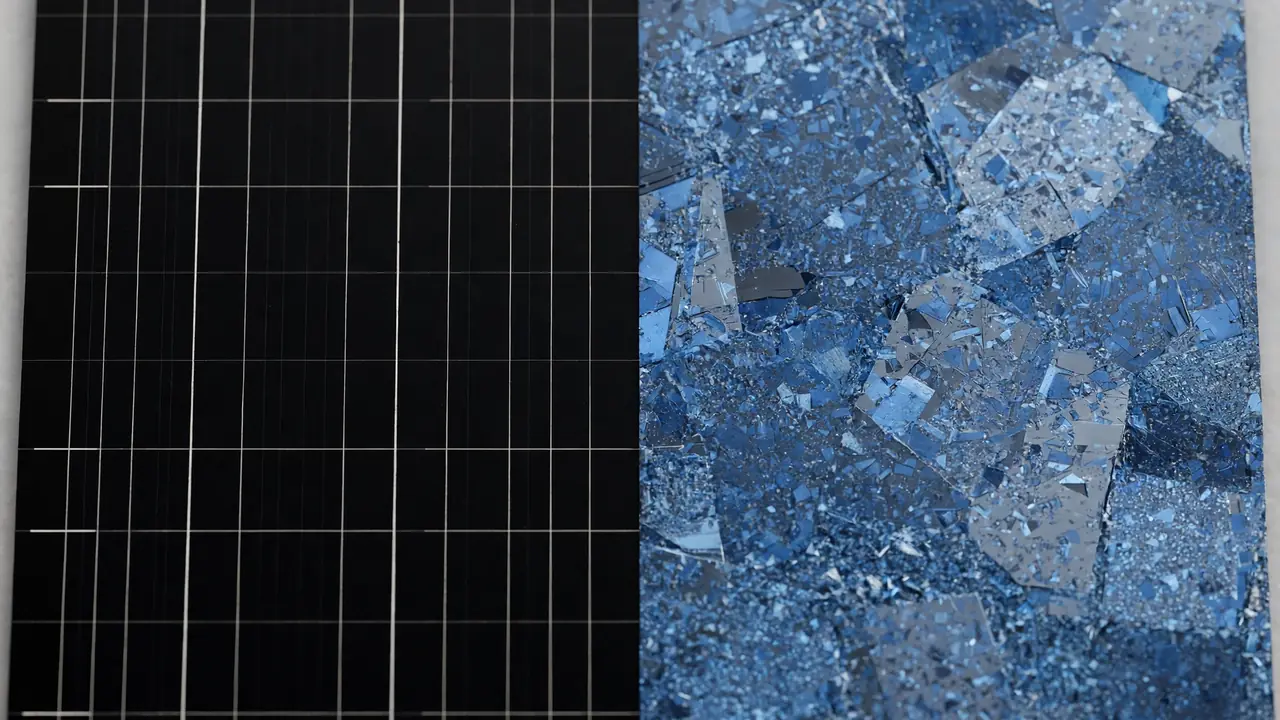
How the Two Are Made — and Why It Matters
The difference between mono and poly starts at the silicon level, and it explains nearly every performance gap that follows.
The monocrystalline crystal
Growing a single crystal is slow and energy-intensive, and cutting the round ingot into square-ish wafers produces some silicon waste. (That leftover silicon is melted down and reused for polycrystalline cells, so it is not truly wasted.) The payoff is a perfectly ordered crystal lattice: electrons generated by sunlight travel in straight, unobstructed paths to the cell’s contacts, which means more of the sun’s energy becomes electricity.
The polycrystalline cast ingot
Casting is faster and cheaper, with less waste and no clipped corners on the cells. But every grain boundary inside the wafer is a small obstacle. Add up thousands of those boundaries across a panel and you get the measurable efficiency gap between the two technologies. The process is simpler, but the physics is less forgiving.
This is also why you can identify the two types at a glance: uniform black means a single crystal; speckled blue means many crystals. No datasheet needed for the first guess — though you should always confirm with the datasheet before buying, as explained below.
Monocrystalline vs Polycrystalline: Head-to-Head Comparison
Efficiency
Efficiency — the share of sunlight a panel converts into electricity — is the biggest practical difference. According to EnergySage, today’s residential monocrystalline panels typically reach efficiencies of 20 to 23 percent, while polycrystalline panels typically sit between 15 and 17 percent. In plain terms, a monocrystalline panel produces noticeably more electricity from the same square foot of roof.
That gap is why efficiency-focused buyers almost always land on monocrystalline. If you want to understand what the efficiency percentage on a datasheet actually means for your roof, read our solar panel efficiency guide.
Heat performance
Solar panels lose some output as they heat up — a behaviour measured by the temperature coefficient. Monocrystalline panels generally have better (lower) temperature coefficients than polycrystalline panels, so they keep more of their rated output on hot afternoons. In Pakistan, where rooftop panels bake through long, intense summers, that difference shows up directly in your daily units.
We have covered this in detail in our temperature coefficient guide — worth a read if you are sizing a system for cities like Multan, Jacobabad, or Karachi, where summer heat is extreme.
Appearance
Monocrystalline panels are uniform black; polycrystalline panels are speckled blue with silver frames. On a modern home, black panels blend into the roof far more discreetly. All-black variants — black cells, black frame, black backsheet — are monocrystalline by nature and have become a popular aesthetic choice; our all-black panels guide covers their pros and cons. If looks matter to you, monocrystalline wins without a contest.
Roof space needed
Because monocrystalline panels produce more watts per square foot, you need fewer of them — and less roof area — to hit the same system size. On a typical Pakistani home with a crowded flat roof (water tanks, stair bulkheads, parapet walls), that space saving is often the deciding factor. A system that needs twelve monocrystalline panels might need fourteen or fifteen polycrystalline panels for the same output.
Lifespan and degradation
This is the one category where the two are essentially tied. Both monocrystalline and polycrystalline panels degrade very slowly — well under one percent per year in real-world conditions — and both typically carry long performance warranties of around 25 years. A polycrystalline system installed ten years ago is not “worn out” because of its cell type; it is simply producing at the efficiency level of its era. For a deeper look at how panels age, see our guide on solar panel degradation rates.
Cost per watt
Polycrystalline used to be the clear budget option. That is no longer true. As monocrystalline manufacturing scaled and its efficiency kept climbing, the cost-per-watt gap between the two shrank to the point where polycrystalline’s efficiency disadvantage became hard to justify — which is exactly why most major manufacturers moved their residential lines to monocrystalline cells. For new purchases, the “poly is cheaper” argument survives mostly in the second-hand market, where old blue panels sell at a discount. Panel prices change frequently, so always check current figures rather than relying on old assumptions.
Which Type Should You Buy in Pakistan?
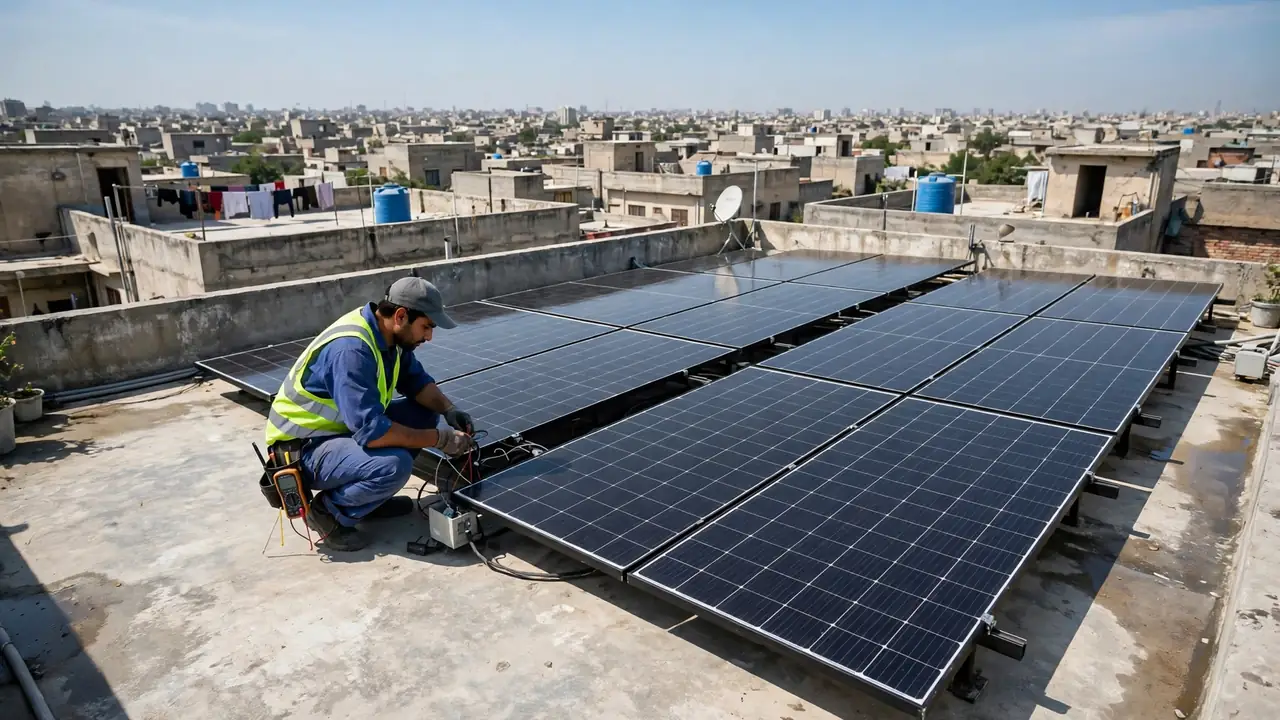
For a new rooftop system in Pakistan, the answer is straightforward: buy monocrystalline. Here is how the decision breaks down in practice:
- New home system, any size: monocrystalline. It is what reputable installers stock, it uses your roof space best, and it handles summer heat better.
- Limited or crowded roof: monocrystalline, without question. When every square foot counts, efficiency is everything.
- Hot cities (Multan, Sukkur, Karachi, Lahore summers): monocrystalline, for its better temperature performance.
- You already own a polycrystalline system: keep it. It will serve you well for years. There is no reason to replace working panels just because the technology moved on.
- Someone offers you cheap used blue panels: be cautious. Old polycrystalline panels can be a reasonable deal for a ground-mounted farm setup, but verify their age, brand, and output before paying. Counterfeit and B-grade panels are a known problem in the Pakistani market — run every panel through our solar panel verification checklist and the serial-number check guide before you commit.
Also remember that cell type is only one part of the quality picture. A Tier-1 monocrystalline panel from a bankable manufacturer with a strong warranty is a very different product from an unknown-brand monocrystalline panel with no verifiable datasheet. Our Tier-1 explainer and best solar panel brands in Pakistan guide will help you judge the manufacturer, not just the cell type.
Common Myths About Mono vs Poly
Myth 1: “Polycrystalline is always much cheaper.” It was, a decade ago. Today the per-watt difference on new modules has largely vanished, and installers rarely offer polycrystalline for new residential systems at all.
Myth 2: “Blue panels are low quality.” Polycrystalline panels are not low quality — they are simply an older, less efficient technology. Many carry solid warranties and perform reliably for decades. The blue colour is just what fragmented silicon looks like.
Myth 3: “Monocrystalline works far better in shade.” Shade hurts both types. Partial shading can drag down a whole string of panels regardless of cell type, which is why a proper shading analysis before installation matters more than the mono-vs-poly choice.
Myth 4: “Higher wattage always means monocrystalline.” Wattage depends on panel size and efficiency together. A large polycrystalline panel can carry a higher wattage label than a small monocrystalline one — but per square foot, monocrystalline still produces more.
How to Confirm the Panel Type Before You Buy
Do not take the dealer’s word for it — confirm the cell type yourself with these three checks:
- Read the datasheet. Every genuine panel has a manufacturer datasheet that states the cell type (“mono-crystalline” or “poly-crystalline”) along with efficiency, temperature coefficient, and warranty terms. No datasheet is itself a red flag.
- Look at the cells. Uniform black cells mean monocrystalline; speckled blue cells mean polycrystalline. If the panel looks blue but the dealer claims it is mono, walk away.
- Verify the serial number. Check the panel’s serial number on the manufacturer’s official website to confirm the model exists and matches what is printed on the label. Our verification guide walks through the full process step by step.
The Bottom Line
Monocrystalline vs polycrystalline is one of the few solar debates the market has genuinely settled. Monocrystalline panels are more efficient, handle heat better, use roof space more effectively, and look better — and they no longer carry the price premium that once made polycrystalline attractive. For any new rooftop installation in Pakistan, monocrystalline is the right choice. Polycrystalline deserves respect as the technology that built the early rooftop solar market, and existing poly systems will keep generating for years — but when you are buying new, buy mono, verify the panels are genuine, and check the day’s prices before you sign anything.
Frequently Asked Questions (FAQs)
Which is better: monocrystalline or polycrystalline solar panels?
For a new installation, monocrystalline is better. Mono panels are more efficient, perform better in heat, need less roof space for the same output, and are now the standard that most manufacturers build. Polycrystalline panels still work fine, but they are rarely offered for new residential systems anymore.
How can I tell monocrystalline and polycrystalline panels apart visually?
Monocrystalline panels are uniform black or very dark grey; polycrystalline panels have a speckled blue appearance with visible crystal fragments. Black cells mean a single crystal, blue speckled cells mean many crystals. Always confirm with the datasheet as well.
Do polycrystalline panels still work well?
Yes. Polycrystalline panels installed years ago continue to generate electricity reliably and degrade very slowly, just like monocrystalline panels. The technology is older and less efficient per square foot, but existing systems have no reason to be replaced purely because of cell type.
Which panel type handles Pakistan’s summer heat better?
Monocrystalline. Mono panels generally have better (lower) temperature coefficients, meaning they lose less output as panel temperature rises. On hot afternoons in cities like Multan, Lahore, or Karachi, that translates into measurably higher daily generation.
Do monocrystalline panels last longer than polycrystalline panels?
Not meaningfully. Both types degrade very slowly — well under one percent per year in real-world conditions — and both typically carry long performance warranties of around 25 years. Lifespan is not a reason to choose one over the other.
Can I mix monocrystalline and polycrystalline panels in one system?
It is not recommended. Panels with different electrical characteristics in the same string can drag down the whole string’s output and complicate inverter matching. If you are expanding an older polycrystalline system, consult your installer about separate strings or a compatible configuration.
Are all black solar panels monocrystalline?
Almost certainly. The uniform black appearance comes from the single pure silicon crystal. If a panel looks blue and speckled, it is polycrystalline regardless of what the seller claims — which is why a visual check plus the datasheet is a reliable verification step before buying.