
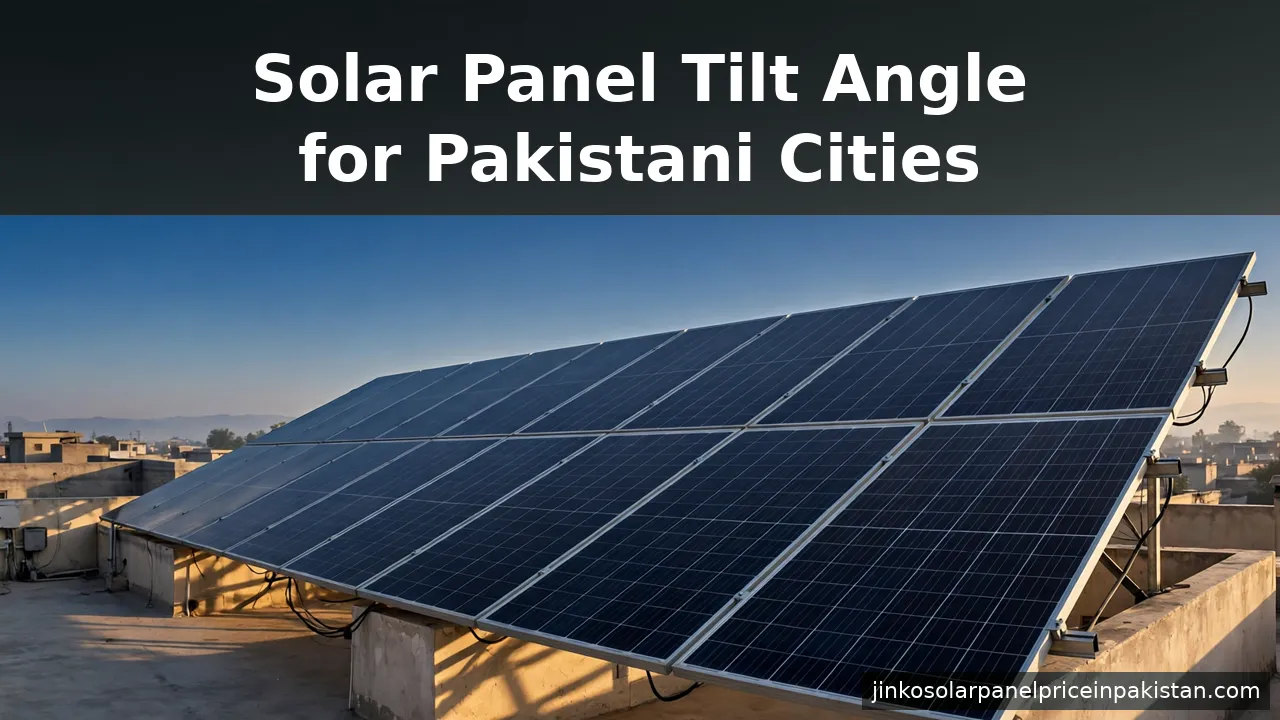
Solar Panel Tilt Angle for Pakistani Cities: Complete Chart

The best solar panel tilt angle for your city is roughly equal to your city’s latitude. In Lahore that means about 32 degrees, in Karachi about 25 degrees, and in Islamabad about 34 degrees — always with the panels facing true south. Set the tilt right and sunlight strikes the panel surface almost straight-on at midday, which is when a solar system produces most of its energy. This guide gives you the complete city-by-city tilt chart for Pakistan, the seasonal adjustments worth knowing, and the tilt mistakes Pakistani installers make most often.
Tilt is one of the few things about a solar installation that is decided once, costs nothing extra, and quietly affects output for the next twenty-plus years. A panel installed a few degrees off is not a disaster — but a panel laid flat, or one copying a tilt meant for another country, quietly gives up free electricity every single day.
What Is Solar Panel Tilt Angle and Why It Matters
Tilt angle is the angle between the panel surface and the ground (or the roof it sits on). A panel lying flat has a tilt of 0 degrees; a panel standing vertical has a tilt of 90 degrees. The angle matters because a solar panel produces the most power when sunlight hits its surface perpendicularly — straight on.
When sunlight arrives at an angle, the same amount of light spreads over a larger area of the panel. Physicists call this the cosine effect: at a 15-degree misalignment you lose only a few percent, but at a 40-degree misalignment the loss becomes obvious. Because the sun’s height in the sky changes through the day and the year, no fixed panel can be perfectly perpendicular all the time — the tilt angle is simply the best compromise for your location.
There are two side effects beyond pure geometry. A steeper tilt sheds dust and rainwater more easily, which matters a great deal on dusty Pakistani rooftops. A flatter tilt catches more wind uplift and needs stronger anchoring. Getting the tilt right is therefore not just about squeezing out extra units — it is about keeping the system clean, safe, and productive.
The Simple Rule: Tilt = Your Latitude
Pakistan lies in the Northern Hemisphere, where the midday sun always sits toward the south. The widely used rule of thumb is: set your fixed tilt angle equal to your city’s latitude, and face the panels true south. This positions the panel surface so that, averaged across the whole year, sunlight strikes it as close to perpendicular as possible.
Your city’s latitude is its distance from the equator in degrees — Karachi sits at about 25°N, Lahore at about 31.5°N, and Gilgit at about 36°N. That is why one universal tilt angle cannot work for the whole country: a panel angle that is optimal in Karachi underperforms in Islamabad, and vice versa.
Seasonal fine-tuning follows a second simple rule. In summer the sun rides higher in the sky, so a flatter angle (latitude minus 15 degrees) catches it best. In winter the sun stays lower, so a steeper angle (latitude plus 15 degrees) is better. These seasonal numbers only help if your mounting structure is adjustable; for the fixed mounts most Pakistani homes use, the latitude value itself is the right year-round answer.
Both rules are geometry, not guesswork, and free tools confirm them. The European Commission’s PVGIS solar tool lets you enter any location and calculates the optimal panel slope for it — try your own city there and you will see it lands within a degree or two of the latitude rule.
Solar Panel Tilt Angle Chart for Pakistani Cities
The chart below lists the best fixed tilt for year-round production, plus the summer and winter settings for adjustable mounts. “Fixed” is the number to use on ordinary residential installations where the frame is welded at one angle and never touched again.
| City | Approx. Latitude | Best Fixed Tilt | Summer Tilt | Winter Tilt |
|---|---|---|---|---|
| Karachi | 24.9°N | 25° | 10° | 40° |
| Gwadar | 25.1°N | 25° | 10° | 40° |
| Turbat | 25.2°N | 25° | 10° | 40° |
| Hyderabad | 25.4°N | 25° | 10° | 40° |
| Sukkur | 27.7°N | 28° | 13° | 43° |
| Bahawalpur | 29.4°N | 29° | 14° | 44° |
| Multan | 30.2°N | 30° | 15° | 45° |
| Dera Ghazi Khan | 30.0°N | 30° | 15° | 45° |
| Quetta | 30.2°N | 30° | 15° | 45° |
| Faisalabad | 31.5°N | 31° | 16° | 46° |
| Lahore | 31.6°N | 32° | 17° | 47° |
| Sargodha | 32.1°N | 32° | 17° | 47° |
| Gujranwala | 32.2°N | 32° | 17° | 47° |
| Sialkot | 32.5°N | 32° | 17° | 47° |
| Rawalpindi | 33.6°N | 34° | 19° | 49° |
| Islamabad | 33.7°N | 34° | 19° | 49° |
| Peshawar | 34.0°N | 34° | 19° | 49° |
| Abbottabad | 34.2°N | 34° | 19° | 49° |
| Mardan | 34.2°N | 34° | 19° | 49° |
| Muzaffarabad | 34.4°N | 34° | 19° | 49° |
| Skardu | 35.3°N | 35° | 20° | 50° |
| Gilgit | 35.9°N | 36° | 21° | 51° |
Your city is not listed? Use the latitude rule directly: round your latitude to the nearest whole number for the fixed tilt, subtract 15 for summer, and add 15 for winter. Any smartphone compass app shows your current latitude, or you can look it up on any map service.
Summer vs Winter: Should You Change the Tilt?
On a fixed mount, you do nothing — the latitude tilt is already the best year-round compromise. The question only matters if you are considering an adjustable structure, where the panel angle is changed twice a year: flatter around April–May for the summer sun path, steeper around October–November for the winter sun path.
The gain from seasonal adjustment is real but modest — typically a low single-digit percentage improvement in annual output over a well-set fixed tilt. Whether it is worth it depends on your setup:
- Adjustable frames cost more and add maintenance. Every joint is a point that can loosen in strong wind, and someone has to climb up and adjust each row twice a year.
- They suit accessible flat roofs where rows are reachable without acrobatics — not steep or cluttered rooftops.
- The winter setting matters most for homes that depend on winter daytime generation, since winter days are short and every unit counts.
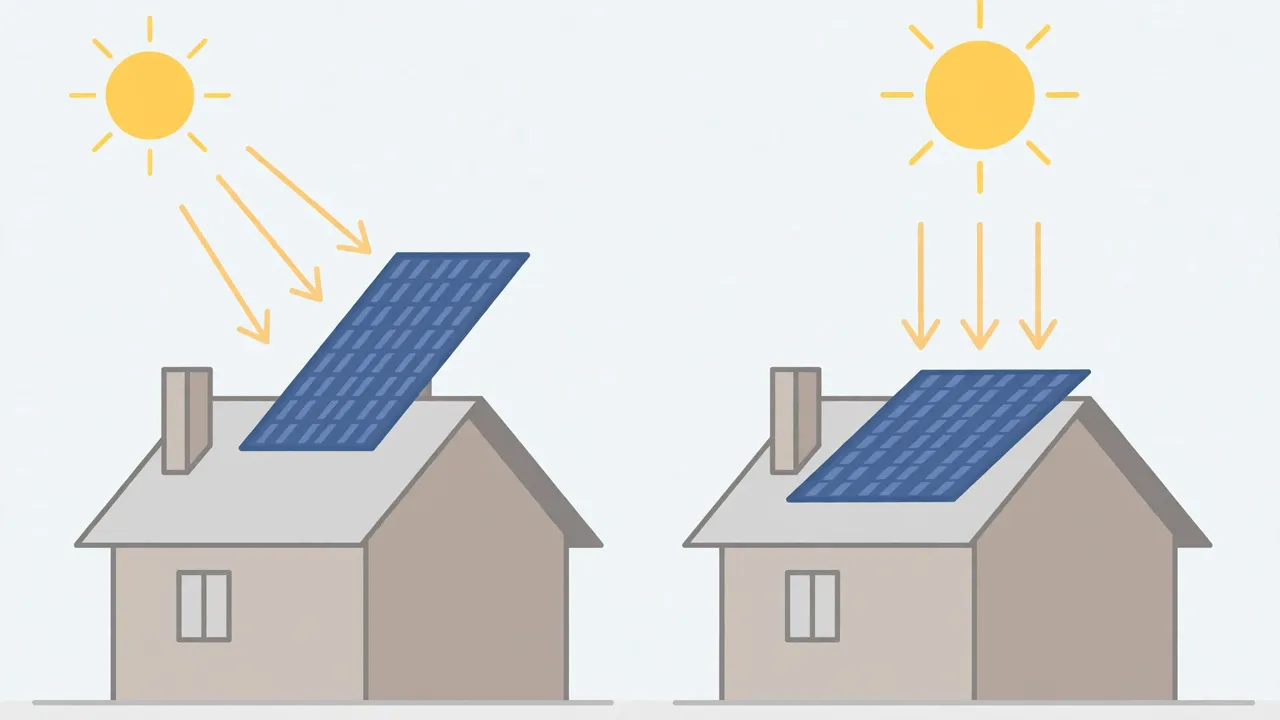
For the large majority of Pakistani homes, a fixed structure set to the chart’s fixed value is the right choice. It is cheaper, sturdier, and maintenance-free — and it already captures the bulk of what the correct angle delivers.
What About Flat Roofs? Minimum Tilt for Dust and Rain
Most Pakistani houses have flat concrete roofs, and this is actually an advantage: your installer builds the tilt you need with galvanized steel frames, rather than inheriting whatever angle a sloped roof happened to have. Two rules apply on flat roofs:
First, never go below about 10 degrees. Panels laid nearly flat hold dust, bird droppings, and monsoon grime instead of shedding them. Rain on a flat panel pools in the frame’s lower edge and dries into mud lines that shade the bottom row of cells. A minimum tilt of roughly 10° lets rain wash the surface, keeps air flowing underneath to cool the panels, and costs nothing extra on a fresh installation. In practice, the chart’s fixed values for Pakistani cities (25° to 36°) are all well above this minimum, so a flat roof never forces a compromise — the frame simply sets the chart angle directly.
Second, use proper ballasted frames. On a flat roof, tilted panels catch wind like sails. Reputable installers use galvanized MS frames with concrete ballast blocks (no roof drilling, no leaks) sized for local wind loads, and leave an air gap beneath the panels for cooling. Our solar panel mounting structures guide explains the frame types, materials, and wind-loading basics in detail.
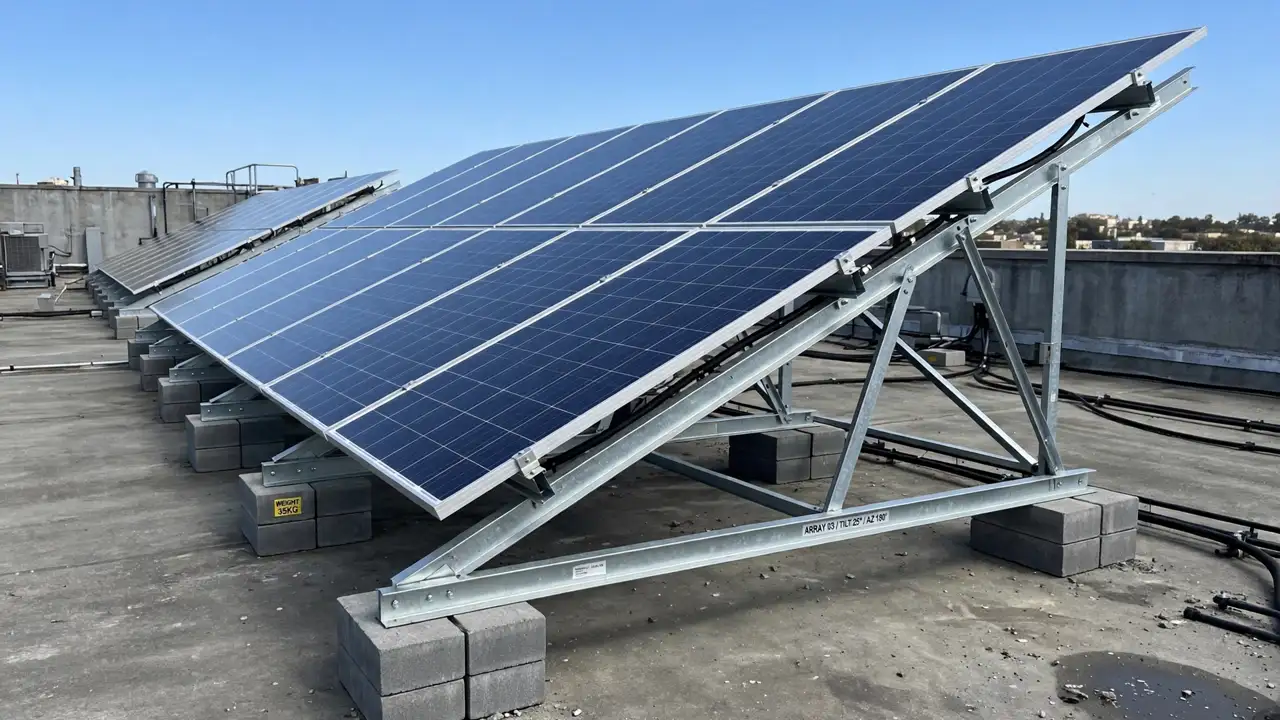
Homes short on shadow-free space sometimes use elevated structures, which raise the panels above the mumty, water tanks, and parapet walls. These give the installer full freedom to set the exact tilt and true-south orientation regardless of what sits on the roof.
Direction Matters Too: Face True South
Tilt only helps if the panel faces the right way. In the Northern Hemisphere — all of Pakistan — panels should face true south (azimuth 180°) so they track the sun’s arc from sunrise to sunset as evenly as possible.
A few practical notes:
- True south is not what your phone compass shows. Phone compasses point to magnetic south, which differs from true south by a degree or two in Pakistan — small enough not to worry about, but do not overthink the last degree.
- East or west facing loses the midday peak. A south-east facing panel starts strong and fades early; a south-west one starts late. Accept a slight deviation only if your roof geometry forces it, and never settle for north-facing.
- Watch the parapet shadow. On Pakistani rooftops, the mumty (stairwell room), water tanks, and boundary walls cast long shadows in winter. The best tilt in the world cannot fix shading — place the rows where winter shadows never reach.
Common Tilt Angle Mistakes in Pakistan
1. Copying a foreign tilt chart. Charts made for the US or Europe assume latitudes of 40°–50°. A “standard 40°” from a foreign manual over-tilts panels in Karachi (needs 25°) and even in Lahore (needs 32°). Always use a Pakistan-specific chart like the one above.
2. Laying panels flat on the roof slab. Sometimes done to “save” on structure cost, this is the worst possible choice: zero self-cleaning, pooled rainwater, higher operating temperature, and measurable yield loss. The structure is a small part of a system — skipping it to save a little money costs far more in lost output over the years.
3. Guessing south. “The sun sets that way, so south must be there” is how panels end up facing south-west. Take ten seconds with a compass app.
4. Over-tilting for winter and leaving it. Some installers set a steep winter angle on a fixed frame, which then underperforms all summer. Fixed means fixed — use the year-round latitude value.
5. Fiddling with a non-adjustable frame. Loosening clamps to “seasonally adjust” a fixed structure invites wind damage. Only adjust frames that were designed to be adjustable.
How to Set the Right Tilt on Your Roof
When your installer arrives, the conversation takes five minutes if you know what to ask. Brief them with this checklist:
- The number: read your city’s fixed tilt from the chart above and tell the installer exactly what angle you expect — in Lahore, that is 32 degrees.
- The direction: panels face true south, verified with a compass, not by eyeballing the street layout.
- The measurement: ask them to verify the finished angle with an inclinometer or a smartphone level app — a proper installer carries one.
- The structure: galvanized steel frame with concrete ballast blocks on flat roofs, tightened to specification, with an air gap under the panels.
- The shading check: confirm the rows sit clear of mumty, tank, and parapet shadows in winter, when shadows are longest.
Get these five right and your panels spend their whole working life catching sunlight the way they were designed to. The mounting structures guide covers frame materials, corrosion protection, and spacing rules if you want to go deeper.
Frequently Asked Questions (FAQs)
What is the best tilt angle for solar panels in Lahore?
The best fixed tilt angle for Lahore is about 32 degrees, facing true south — roughly equal to Lahore’s latitude. If you have an adjustable mounting structure, use about 17 degrees in summer and 47 degrees in winter. For ordinary fixed frames, leave it at 32 degrees year-round.
What tilt angle should solar panels be in Karachi?
In Karachi the best fixed tilt is about 25 degrees facing true south, matching the city’s latitude. With an adjustable mount you can drop to about 10 degrees in summer and raise to about 40 degrees in winter, but most homes do perfectly well with a fixed 25-degree frame.
Which direction should solar panels face in Pakistan?
Solar panels in Pakistan should face true south (azimuth 180 degrees), because Pakistan is in the Northern Hemisphere and the midday sun always sits toward the south. Avoid north-facing installations entirely, and accept east or west facing only if your roof geometry leaves no choice.
Should solar panels be tilted or laid flat?
Solar panels should always be tilted — never laid flat on a roof slab. Flat panels collect dust and standing water, run hotter, and lose noticeable output. On a flat roof, use a galvanized steel frame that holds the panels at your city’s recommended tilt angle.
Do I need to change my solar panel tilt in summer and winter?
Only if your mounting structure is adjustable. A fixed frame set to your city’s latitude is the best year-round compromise and needs no touching. Adjustable mounts can gain a small extra by going about 15 degrees flatter in summer and 15 degrees steeper in winter.
Is the tilt angle the same for every city in Pakistan?
No. The optimal tilt follows each city’s latitude, so it ranges from about 25 degrees in Karachi to about 36 degrees in Gilgit. Always use a Pakistan-specific chart rather than a foreign one — charts made for Europe or the US assume much higher latitudes.
What is the minimum tilt angle for solar panels on a flat roof?
Keep at least about 10 degrees of tilt even where the latitude rule would allow less. That minimum lets rain wash dust off the surface and allows cooling airflow under the panels. In practice, every Pakistani city’s recommended fixed tilt is already above 10 degrees.
Can my installer set the correct tilt on a flat roof?
Yes. Installers build the tilt with galvanized steel frames held by concrete ballast blocks — no roof drilling needed. Ask for your city’s chart angle measured with an inclinometer, true-south orientation, and a shading check against the mumty, water tanks, and parapet walls.