
What Can a 1kW Solar System Run in Pakistan?

A 1kW solar system can comfortably run a set of small, everyday appliances in a Pakistani home — LED lights, ceiling fans, an LED TV, a Wi-Fi router, laptop and phone charging, and a small refrigerator. It cannot run heavy appliances such as air conditioners, electric geysers, electric irons, washing machines or water pumps. In short: a 1kW system covers the basics of a small household, not the full load of an average family home.
If you are deciding whether a 1kW system is enough for your home, this guide maps exactly what it can and cannot run, how to plan your load, and when you should size up instead.
What Does “1kW” Actually Mean?
A 1kW (1 kilowatt) solar system is a small residential setup whose panels are rated to produce up to 1,000 watts of power under ideal sunlight conditions. That number is the maximum instantaneous output — not what the system delivers all day. Real-world output moves up and down with sunlight intensity, panel temperature, shading and the angle of installation.
As an independent benchmark, EcoFlow’s guide to 1kW solar systems notes that a 1kW system typically produces around 4 to 5 kWh (units) per day in most areas with decent sunlight — and Pakistan, with its long sunny days, sits comfortably in that range.
The second thing to understand is the difference between rated capacity and safe continuous load. Although the panels can peak at 1,000W, practical solar guides recommend keeping the continuous connected load at around 60–80% of the system’s capacity — roughly 600 to 800W — because appliance startup surges (a refrigerator compressor, for example, briefly draws two to three times its running wattage), fluctuating sunlight and inverter efficiency all eat into the headroom. A small buffer keeps the inverter happy and the system stable.
How Much Energy Does a 1kW System Produce Daily in Pakistan?
Energy produced over a day matters more than the peak watt number, because it decides how many hours your appliances can run. Under typical Pakistani conditions — clear skies, south-facing panels at the right tilt — a 1kW system generates roughly 4 to 5 units (kWh) of electricity per day, consistent with the EcoFlow benchmark above.
That daily energy budget has to be shared among everything you run. On a grid-connected (on-grid or hybrid) system, daytime appliance use draws directly from the panels while excess goes to the grid or charges batteries; at night, you either rely on battery storage or fall back to the grid. An off-grid 1kW system without enough battery storage can only serve you while the sun is up.
The exact daily yield varies with the season and the city — winter days are shorter and the sun sits lower, so expect noticeably less output in December and January than in May and June.
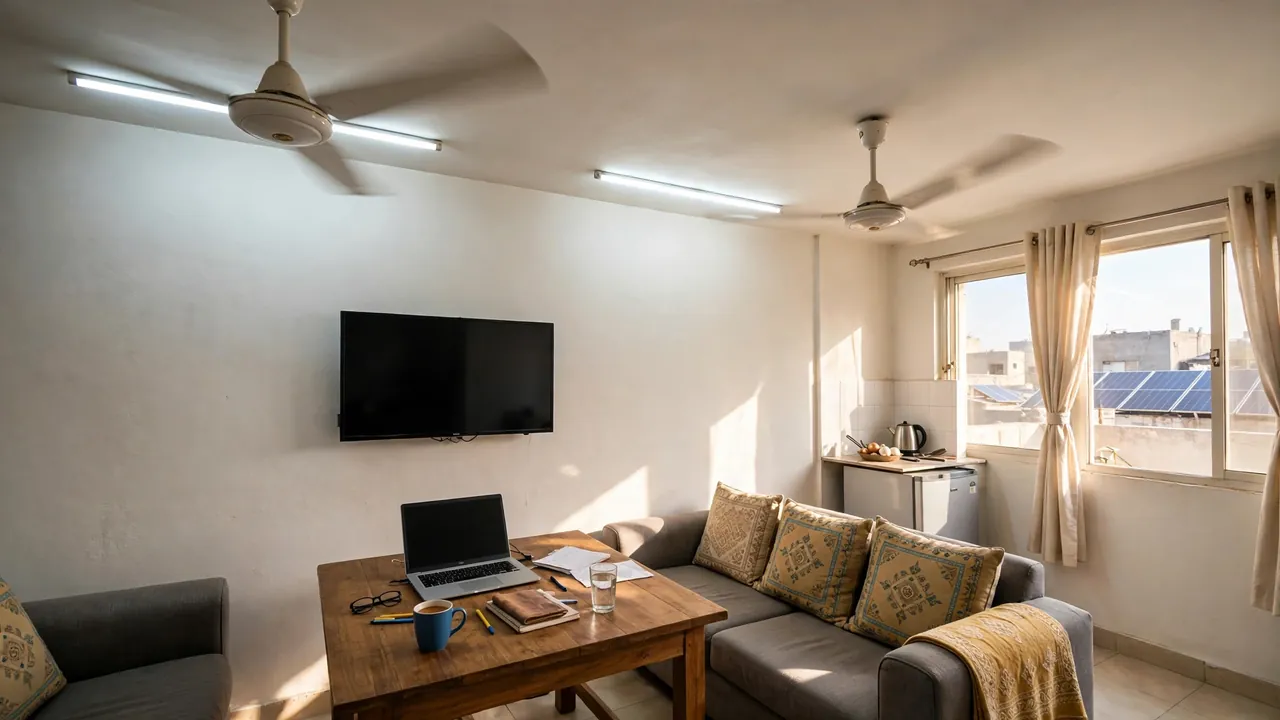
Appliances a 1kW Solar System Can Run
Here is how common Pakistani household appliances line up against a 1kW system’s capacity. Wattages below are typical running values — actual consumption varies by brand, size and energy rating.
| Appliance | Typical Power | Can a 1kW System Run It? |
|---|---|---|
| LED bulbs (each) | 9–12W | Yes — several at once |
| Ceiling fan (each) | 60–75W | Yes — 3 to 4 comfortably |
| Wi-Fi router | 10–20W | Yes — negligible load |
| Phone/tablet charging | 5–15W | Yes |
| Laptop | 45–90W | Yes |
| LED TV (32–50 inch) | 60–120W | Yes — one TV |
| Small refrigerator (modern inverter-type) | 120–200W running | Yes — with load planning |
| RO water purifier | 25–60W | Yes |
| Mixer grinder / blender (short bursts) | 350–500W | Yes — briefly, on its own |
The recurring theme is clear: anything with low or moderate wattage and no big heating element fits. Lights, fans, entertainment and charging are the natural territory of a 1kW system.
Realistic Daytime Scenarios
How many of these appliances can run at the same time? That is the question that actually decides comfort. Here are three realistic load combinations that stay within the safe 600–800W continuous band:
Scenario 1: Basic home essentials
- 3 LED bulbs — 30W
- 2 ceiling fans — 140W
- 1 Wi-Fi router — 10W
- 1 laptop — 60W
- 1 LED TV — 100W
- Total: around 340W — well within capacity, with room to spare.
Scenario 2: Work-from-home daytime setup
- 2 LED bulbs — 20W
- 1 ceiling fan — 70W
- 1 laptop + phone charger — 75W
- 1 LED TV — 100W
- 1 small refrigerator (cycling) — ~150W average
- Total: around 415W — comfortable, and the fridge compressor surge stays manageable.
Scenario 3: Evening hours with battery backup
A 1kW system with batteries can carry lights, fans and a TV through the evening, provided the battery bank is sized for the backup hours you need. Evening is also when you should avoid switching on anything heavy — which brings us to the limits.
What a 1kW System Cannot Run
Some appliances draw far more than a 1kW system can deliver, either continuously or in startup surges. Running them on this system will overload the inverter, shorten battery life and can damage equipment:
- Air conditioner (1–1.5 ton): draws 900–1,800W or more — beyond the system’s safe capacity.
- Electric geyser / water heater: 1,500–2,000W, a purely resistive heating load.
- Electric iron: typically 1,000W+ on its own, leaving no headroom.
- Electric kettle / microwave: 1,200–1,500W+ — short use, but too heavy for this system.
- Washing machine (heating cycle): 500–1,000W plus motor surges; risky on a 1kW inverter.
- Water pump (0.5 HP and above): high startup surge that can trip a small inverter.
- Induction cooktop / electric stove: 2,000W+ — out of the question.
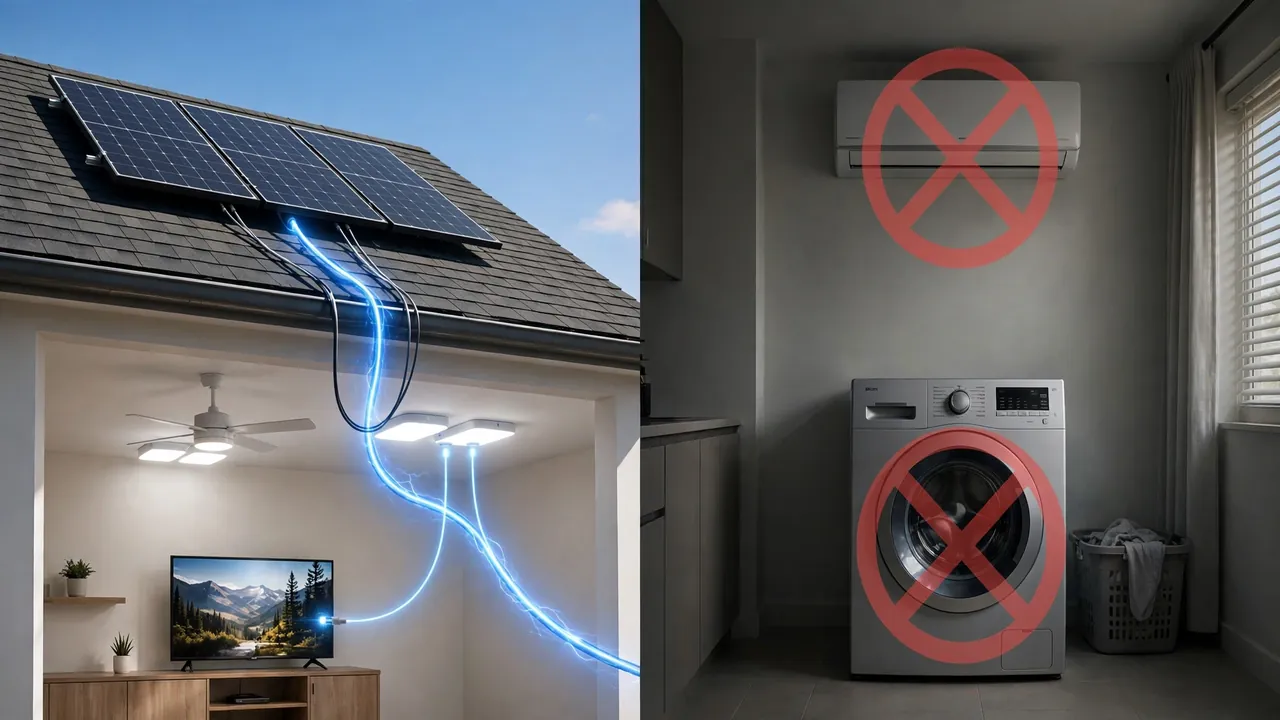
The dividing line is simple: if it heats, cools a room, or has a big motor, a 1kW system is not the right tool for it. Each of these appliances alone could nearly max out the system — which is why honest appliance mapping matters more than the panel wattage headline.
On-Grid, Off-Grid or Hybrid: Which 1kW Setup?
A 1kW array behaves very differently depending on the system type:
- On-grid: the cheapest configuration. Panels feed your daytime load and export surplus to the grid through net metering; at night you use grid power. There is no backup during load shedding without batteries.
- Off-grid: pairs the 1kW array with batteries and a charge controller so you have power after sunset. The battery bank must be sized to store the day’s 4–5 kWh if you want full-evening coverage.
- Hybrid: the flexible middle ground — runs daytime loads, stores energy in batteries for the evening, and keeps the grid as backup. Many hybrid inverters can even run without batteries in a grid-connected setup, though you then lose backup during outages.
For most Pakistani homes dealing with load shedding, the hybrid route with at least a modest battery bank is the practical choice — solar by day, stored power in the evening, grid as the safety net.
Inverter and Battery Sizing for a 1kW System
The panels are only one part. Two components decide whether your 1kW system actually performs:
- Inverter: typically paired in the 1.2–1.6 kVA range for a 1kW array, giving enough headroom for appliance startup surges without running at full load all day. Oversizing slightly also leaves room to add more panels later if you expand.
- Batteries: capacity depends entirely on how many backup hours you want. If you need the evening essentials (fans, lights, TV) for several hours, the battery bank must cover that energy plus a reserve — and the type and depth of discharge you choose affect usable capacity. Our guide on calculating solar battery backup time walks through the math.
Tips to Get the Most Out of a 1kW System
- Stagger heavy loads: never switch on the TV, fridge compressor restart and mixer grinder at the same moment — sequence them and the inverter stays in its comfort zone.
- Use the sun’s hours: run the washing machine or any occasional heavy-ish task (like the mixer grinder) around midday when panel output peaks.
- Choose efficient appliances: inverter-technology fans and refrigerators, LED lighting throughout, and a laptop instead of a desktop PC stretch the same 1kW much further.
- Keep panels clean and unshaded: dust and partial shading are the silent output killers on small systems, where every watt counts.
- Plan before you buy: list your appliances with their wattages and daily hours, then total the load — our step-by-step guide to calculating your home’s electricity load for solar makes this straightforward.
Who Is a 1kW Solar System Right For?
A 1kW system is the right fit when:
- You live in a small house, portion or flat with modest electricity needs (roughly 120–150 units per month).
- You want to cut your daytime electricity bill and keep essentials running during load shedding.
- You need basic power for a shop, office cabin or farm outbuilding — lights, fans, charging and a small fridge.
- You are starting small on purpose: learn how solar behaves on your roof, then expand the system later.
It is the wrong fit if your priority loads include an air conditioner, electric geyser or water pump — in that case, size up to 3kW or more rather than fighting the limits of a 1kW array.
Know what a 1kW system can run? Next, look at the solar system price in pakistan for 1kW and the solar panel price in pakistan on our homepage’s daily tables to see if it fits your budget.
Frequently Asked Questions (FAQs)
What can a 1kW solar system run in Pakistan?
u003cpu003eA 1kW solar system can run small everyday appliances in a Pakistani home: LED lights, ceiling fans, an LED TV, Wi-Fi router, laptop and phone charging, and a small refrigerator. It is designed for basic loads, not for a full household.u003c/pu003e
Can a 1kW solar system run an air conditioner?
u003cpu003eNo. A 1kW solar system cannot reliably run an air conditioner. A 1 to 1.5 ton AC draws 900 to 1,800W or more, which exceeds the system’s safe continuous capacity of roughly 600 to 800W. You would need a larger system for air conditioning.u003c/pu003e
How much load can a 1kW solar system handle safely?
u003cpu003eAlthough panels are rated at 1,000W peak, the safe continuous load is around 60 to 80 percent of capacity — roughly 600 to 800W. Keeping a buffer handles appliance startup surges, sunlight fluctuations and inverter efficiency.u003c/pu003e
Can a 1kW solar system run a refrigerator?
u003cpu003eYes, a modern small refrigerator can run on a 1kW solar system, since it typically draws 120 to 200W while running. The key is load planning: the fridge compressor’s startup surge is brief, and other heavy appliances should not run at the same moment.u003c/pu003e
Does a 1kW solar system work at night?
u003cpu003eOnly with battery storage. An on-grid 1kW system produces power during daylight hours; at night it falls back to the grid. A hybrid or off-grid setup with properly sized batteries can carry lights, fans and a TV through the evening.u003c/pu003e
What size inverter is needed for a 1kW solar system?
u003cpu003eA 1kW solar array is typically paired with an inverter in the 1.2 to 1.6 kVA range. This gives enough headroom for appliance startup surges and keeps the inverter running in its efficient zone rather than at full load all day.u003c/pu003e