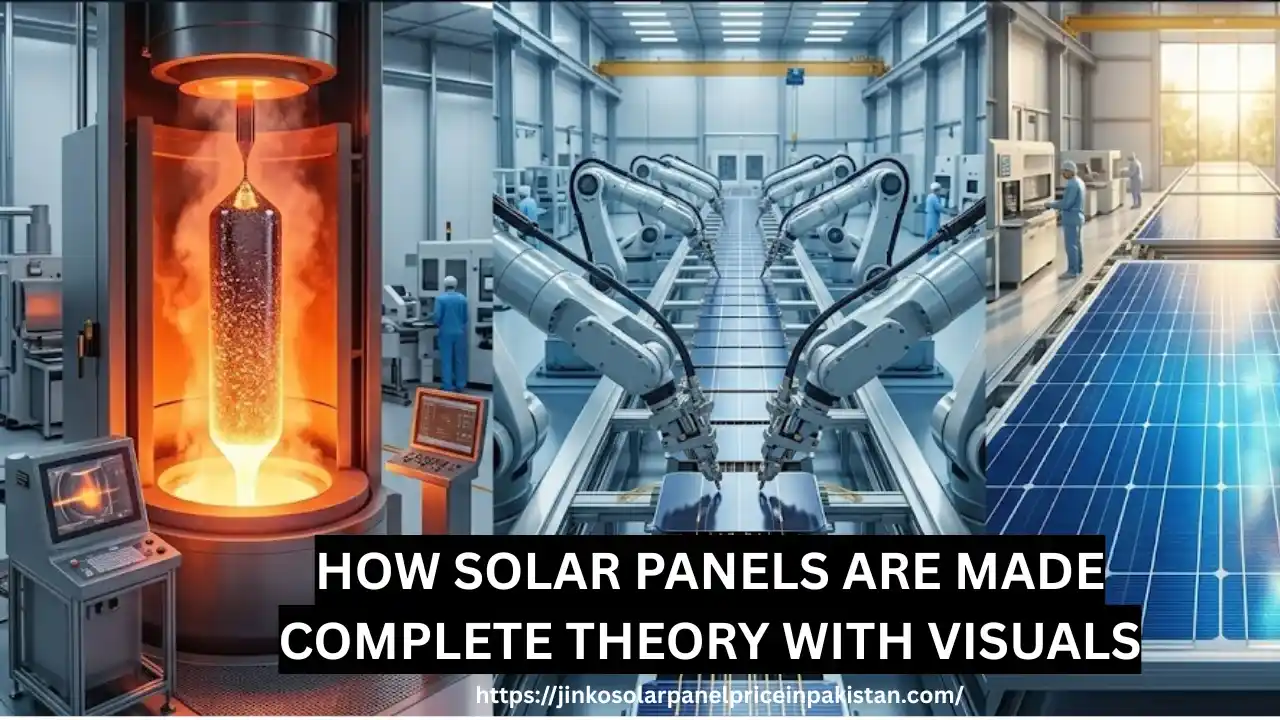
How solar panels are made complete Theory with Visuals

Table of Content
Table of Contents
1. Introduction — The Journey from Sand to Solar Panel
Every solar panel on a rooftop, in a solar farm, or powering a remote village began its life as ordinary sand. The journey from raw silica to a high-efficiency photovoltaic panel is one of the most remarkable manufacturing stories of the modern era. Understanding how solar panels are made gives you a deeper appreciation for the technology powering the global renewable energy transition.
The entire process takes approximately 3-4 days from raw material to finished panel in a modern factory. It involves extreme temperatures exceeding 1,400°C, precision cutting to micrometer tolerances, cleanroom environments stricter than hospital operating rooms, and rigorous quality testing at every stage.
This guide walks you through every major step of how solar panels are made — from sand purification to the final quality inspection before panels ship to customers worldwide. When you check the latest Solar Panel Price in Pakistan or anywhere else, you are looking at the end result of this sophisticated global manufacturing chain.
2. Raw Materials — What Are Solar Panels Made Of?
Before diving into the manufacturing steps, it helps to understand the raw ingredients that go into a solar panel.
| Component | Material | Purpose | Percentage of Panel Weight |
|---|---|---|---|
| Solar Cells | Silicon (metallurgical grade → purified) | Converts sunlight to electricity | ~5-7% |
| Glass | Low-iron tempered glass | Protects cells, allows light transmission | ~70-75% |
| Frame | Anodized aluminum | Structural support, mounting | ~10-15% |
| Encapsulant | EVA (Ethylene Vinyl Acetate) | Bonds cells to glass and backsheet | ~5-7% |
| Backsheet | Multi-layer polymer (PVF/PET) | Electrical insulation, weather protection | ~3-5% |
| Junction Box | UV-resistant polymer + copper | Electrical connection point | ~1-2% |
| Soldering/Ribbons | Tin-coated copper | Cell interconnection | ~0.5-1% |
Silicon is the star of the show. It is the second most abundant element in the Earth’s crust after oxygen, making up about 28% of the planet’s surface. But the silicon in sand is silicon dioxide (SiO₂). Transforming it into pure silicon suitable for solar cells is where the manufacturing journey begins. For understanding different panel technologies, read our Monocrystalline Solar Panel guide.
3. Step 1: From Sand to Pure Silicon
Silica Mining and Purification
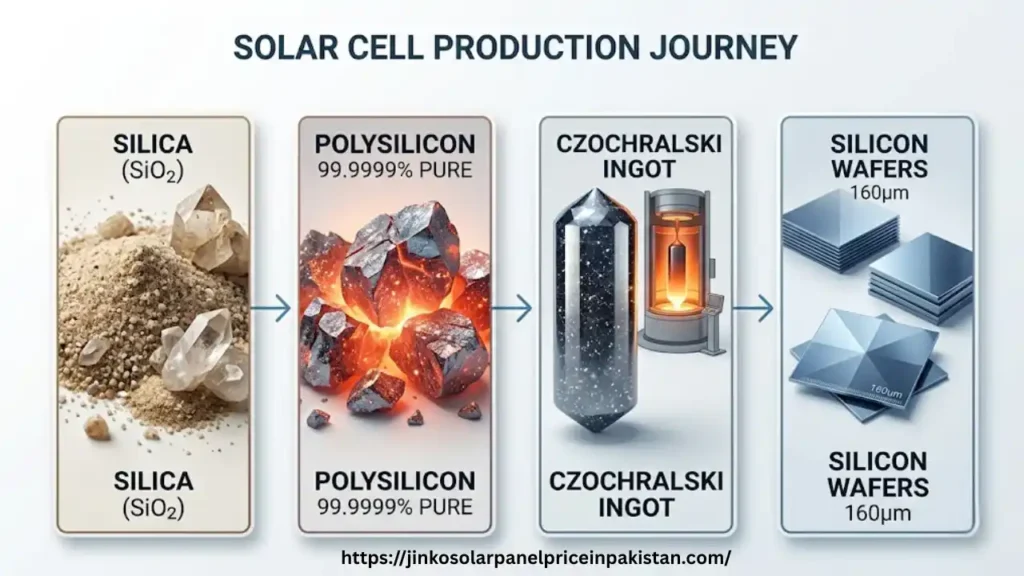
The journey of how solar panels are made starts with mining high-purity quartzite or silica sand. This raw material contains silicon dioxide along with various impurities like iron, aluminum, and calcium.
The mined quartz is loaded into massive electric arc furnaces along with carbon sources like coal, coke, and wood chips. The furnace heats the mixture to approximately 1,900-2,100°C. At these extreme temperatures, a chemical reaction occurs:
SiO₂ + 2C → Si + 2CO
The carbon strips oxygen atoms away from the silicon dioxide, leaving behind molten silicon. This produces metallurgical-grade silicon with approximately 98-99% purity — not nearly pure enough for solar cells, which require 99.9999% (six nines) purity.
Government schemes ki Urdu images, awareness banners, application forms aur social media posts ko professional look dene ke liye high quality Urdu fonts ka use bohat zaroori hota hai. Stylish aur free Urdu fonts download karne ke liye visit karein https://urdufontss.net/ jabke professional Nastaleeq Urdu writing ke liye sab se popular Jameel Noori font yahan se download kar sakte hain: https://urdufontss.net/jameel-noori-nastaleeq-urdu-font-download/
Siemens Process — Achieving Solar-Grade Purity
The metallurgical-grade silicon undergoes the Siemens process to become polysilicon. The silicon is crushed into a fine powder and reacted with hydrogen chloride gas at 300°C, producing trichlorosilane (SiHCl₃) gas. This gas is then purified through multiple distillation columns to remove impurities.
The purified trichlorosilane gas flows into a reactor chamber containing thin silicon rods heated to approximately 1,150°C. The gas decomposes and deposits pure silicon atoms onto these rods, growing them thicker over 200-300 hours. The result is ultra-pure polysilicon rods with 99.9999% purity — suitable for solar cell manufacturing.
4. Step 2: Silicon Ingot Formation (Czochralski Process)
Growing the Crystal
The purified polysilicon chunks are loaded into a quartz crucible inside a Czochralski (CZ) crystal growth furnace. The furnace heats the silicon above its melting point of 1,414°C until it becomes a completely liquid melt.
A precisely oriented single-crystal silicon seed rod is lowered until it just touches the surface of the molten silicon. The seed rod is then slowly pulled upward while rotating. As it rises, molten silicon atoms attach to the seed crystal, continuing its perfect crystalline structure. The pulling speed and temperature are carefully controlled — typically 1-2 mm per minute.
The Result: Monocrystalline Ingot
After 24-48 hours of continuous pulling and controlled cooling, the result is a large cylindrical monocrystalline silicon ingot. These ingots typically weigh 200-400 kg and measure 200-300 mm in diameter. The ingot has a perfectly uniform crystal structure throughout — this is what gives monocrystalline panels their characteristic uniform dark appearance and higher efficiency.
For polycrystalline panels, a simpler casting process is used where molten silicon is poured into square molds and allowed to cool, creating multiple crystal structures. This is faster and cheaper but produces slightly less efficient cells.
5. Step 3: Wafer Slicing & Surface Treatment
Ingot Preparation
Before slicing, the cylindrical monocrystalline ingot undergoes squaring — its round edges are cut off to create a pseudo-square shape that maximizes the surface area in the final panel. The resulting blocks are then ground and polished on all sides.
Wire Saw Slicing
The squared silicon block is mounted on a wire saw machine. A web of ultra-thin diamond-coated steel wires, each about 100-120 micrometers in diameter, slices through the silicon block like an egg slicer. Modern wire saws can cut an entire ingot into thousands of wafers in a single 6-8 hour run.
Each resulting wafer is extremely thin — typically 160-180 micrometers, about twice the thickness of a human hair. However, up to 40-50% of the silicon is lost as sawdust (kerf loss) during this step, which is one reason silicon wafers are expensive.
Surface Treatment
The freshly cut wafers have saw marks and surface damage. They undergo chemical etching using potassium hydroxide (KOH) or a mixture of hydrofluoric and nitric acid to remove approximately 10-20 micrometers of damaged surface material. This etching also creates a textured surface with microscopic pyramids that help trap more light inside the cell — a critical step for achieving high efficiency.
The wafers are then thoroughly cleaned in multiple chemical baths to remove all contaminants before moving to the cell manufacturing stage.
6. Step 4: Solar Cell Manufacturing (Doping & Coating)
This is where the silicon wafer becomes a functioning solar cell — the heart of how solar panels are made.
Texturing (If Not Done Before)
For monocrystalline cells, a second texturing step using alkaline solution creates a pyramid-textured surface that reduces light reflection from over 30% to less than 10%. This is why monocrystalline panels appear darker — their textured surface traps light instead of reflecting it.
Phosphorus Diffusion (Creating the P-N Junction)
The wafers are loaded into a high-temperature diffusion furnace at 800-900°C. Phosphorus oxychloride (POCl₃) gas is introduced, and phosphorus atoms diffuse into the top surface of the silicon wafer. Since silicon is doped with boron (p-type) in its base form, the phosphorus creates an n-type layer on top. The boundary between these two layers is the P-N junction — the fundamental structure that makes photovoltaic conversion possible.
Edge Isolation
After diffusion, phosphorus coats all surfaces of the wafer, creating unwanted electrical paths around the edges. Plasma etching or laser isolation removes this phosphorus layer from the wafer edges, ensuring electricity flows correctly through the cell.
Anti-Reflective Coating (ARC)
Silicon naturally reflects about 30% of the light hitting it. To minimize this, a thin layer of silicon nitride (Si₃N₄) is deposited on the cell surface using plasma-enhanced chemical vapor deposition (PECVD). This coating serves two purposes: it reduces reflection to less than 5%, and it passivates the silicon surface, improving electrical performance. This coating is what gives solar cells their characteristic blue or black appearance.
Metallization (Printing the Contacts)
The final cell manufacturing step is creating the electrical contacts. Silver paste is screen-printed onto the front surface in a fine grid pattern — these are the thin metal lines you see on solar cells. Aluminum paste is printed on the entire back surface. The cell then passes through a firing furnace at 800-900°C, where the metal pastes form ohmic contact with the silicon.
7. Step 5: Solar Cell Testing & Sorting
Every manufactured solar cell undergoes individual testing under standardized conditions. A solar simulator flashes calibrated light (1,000 W/m², AM 1.5 spectrum) at 25°C, measuring each cell’s current-voltage (IV) curve.
Key parameters measured:
- Efficiency: Percentage of light converted to electricity
- Maximum Power (Pmax): Watts output under standard conditions
- Open Circuit Voltage (Voc): Voltage at zero current
- Short Circuit Current (Isc): Current at zero voltage
- Fill Factor (FF): Ratio of actual to theoretical maximum power
Cells are sorted into bins based on their efficiency and current. A typical sorting system uses 0.1% efficiency steps and 0.1 amp current steps. Cells in a single solar panel must be closely matched in current. If a panel contains mismatched cells, the weakest cell limits the current of the entire string — a principle similar to water flowing through pipes of different diameters.
8. Step 6: Solar Panel Assembly (Stringing & Layup)
Stringing
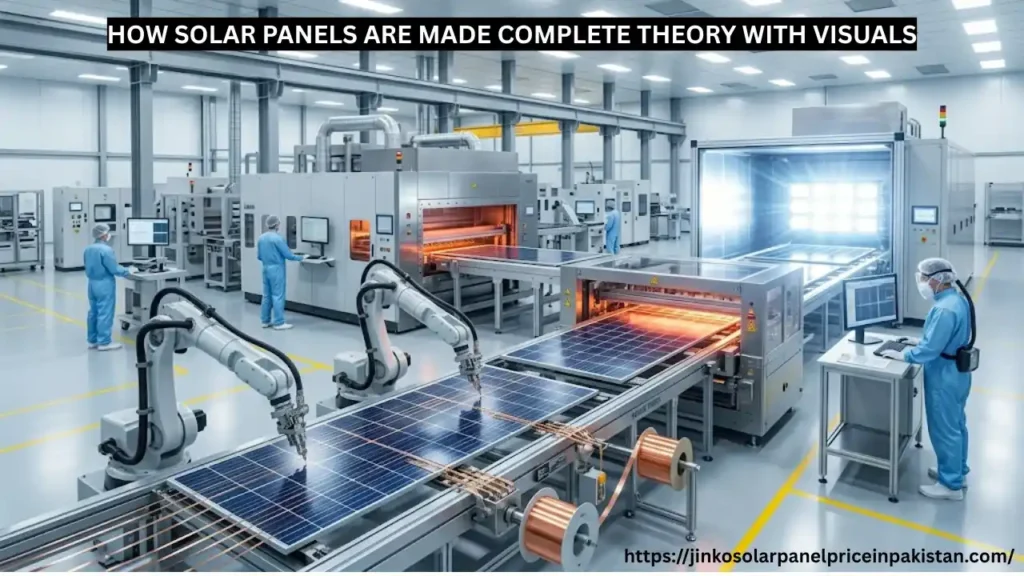
Multiple solar cells are connected in series to form strings. A fully automated stringer machine picks up individual cells and solders thin tin-coated copper ribbons (typically 5-6 per cell) across the front busbars of one cell to the back contacts of the next cell. Modern stringers process one cell every 1.2-1.5 seconds.
A string typically contains 10-12 cells connected in series. For a standard 60-cell residential panel (like the popular 585W models ), six strings of 10 cells each are prepared.
Layup
The panel layup station assembles all layers in order from bottom to top:
- Glass: Low-iron tempered glass sheet, typically 3.2mm thick
- EVA Sheet: First encapsulant layer
- Cell Matrix: Strings arranged in the correct pattern with bus ribbon interconnections
- EVA Sheet: Second encapsulant layer
- Backsheet: Weather-resistant polymer sheet
This sandwich of materials is carefully aligned and prepared for lamination.
9. Step 7: Lamination & Framing
The Lamination Process
The assembled layup enters a laminator machine — essentially a large vacuum oven. The process occurs at approximately 140-150°C for 15-20 minutes. Under vacuum and heat, the EVA sheets melt and flow around the solar cells, then cross-link (cure) to form a permanent, transparent, waterproof seal.
The lamination process is critical to panel longevity. Any air bubbles, incomplete melting, or contamination at this stage creates weak points where moisture can eventually enter. Proper lamination is what allows panels to survive 25+ years of outdoor exposure. This manufacturing quality directly relates to why premium panels command higher prices — check current rates at Solar Panel Price in Pakistan to compare brand pricing.
Framing
After lamination and cooling, the panel edges are trimmed. An anodized aluminum frame is fitted around the perimeter. The frame provides:
- Structural rigidity for handling and mounting
- Protection for the glass edges
- Mounting holes for installation
- Grounding points for electrical safety
Silicone sealant is applied between the glass and frame to prevent water ingress. The frame corners are connected with corner keys and screws.
10. Step 8: Junction Box & Final Assembly
Junction Box Installation
The junction box is attached to the back of the panel, usually centered or offset depending on cell layout. The copper ribbon ends from the cell strings pass through holes in the backsheet and are soldered to the junction box terminals.
Inside the junction box are:
- Bypass Diodes: Protect cells from damage during partial shading
- Terminal Connections: Where external cables connect
- Potting Material: Silicone gel that waterproofs all internal connections
Cable and Connector Attachment
Weatherproof cables with MC4-compatible connectors are attached. Cable length is standardized (typically 1 meter positive, 1 meter negative) to allow easy series connection between panels during installation. Understanding this connection process is useful for anyone planning their own Solar Panel Installation Timeline .
Label and Serial Number Application
Each panel receives its nameplate label showing electrical specifications, certifications, and a unique serial number. This serial number is essential for warranty claims and authenticity verification — learn how to check it in our Jinko Solar Panel Serial Number Check guide.
11. Step 9: Quality Testing & Certification
Factory Testing
Every finished panel undergoes a flash test — the same IV curve measurement as individual cells but at the panel level. The panel is exposed to calibrated light and its power output is measured and recorded. This data is stored against the panel’s serial number for warranty reference.
Electroluminescence (EL) Testing
EL testing is like an X-ray for solar panels. They pass an electrical current through the panel in a dark chamber and photograph it with an infrared-sensitive camera. Cracks, broken cells, poor solder joints, and other invisible defects show up as dark areas. Panels failing EL inspection are rejected or repaired.
Reliability Testing (Sample Basis)
Production samples undergo accelerated life testing:
- Thermal Cycling: 200 cycles between -40°C and +85°C
- Damp Heat: 1,000 hours at 85°C and 85% humidity
- Mechanical Load: 2,400 Pa wind load and 5,400 Pa snow load
- Hail Impact: 25mm ice balls at 23 m/s
Panels must pass IEC 61215 (crystalline silicon) and IEC 61730 (safety) standards to be sold in most global markets. For understanding how panels hold up in real-world conditions like hailstorms, read our guide on how to Protect Solar Panels from Hails .
12. Monocrystalline vs Polycrystalline — Manufacturing Differences
The manufacturing process explains why monocrystalline and polycrystalline panels differ in both appearance and performance.
| Factor | Monocrystalline | Polycrystalline |
|---|---|---|
| Silicon Purity | 99.9999% polysilicon | 99.999% polysilicon |
| Crystal Growth | Czochralski (single crystal) | Casting (multiple crystals) |
| Ingot Shape | Cylindrical (squared off) | Square from mold |
| Wafer Appearance | Uniform dark color | Multiple crystal domains visible |
| Efficiency | 21-23% | 18-20% |
| Manufacturing Cost | Higher (slower process) | Lower (simpler process) |
| Silicon Waste | Higher (round ingot squared) | Lower (already square) |
| Temperature Coefficient | Better | Good |
The visible difference in appearance — monocrystalline panels look dark and uniform, while polycrystalline panels have a blue, speckled appearance — comes directly from their crystal structure. For a deeper comparison of panel technologies, including the latest N-Type options, read our N-Type vs P-Type Solar Panels guide.
13. Global Solar Manufacturing Leaders
Understanding how solar panels are made also means knowing who makes them. As of 2025-2026, global solar manufacturing is heavily concentrated:
Polysilicon Production
China dominates with approximately 80% of global polysilicon production. Major producers include Tongwei, GCL Technology, and Daqo New Energy. Germany (Wacker Chemie) and the United States (Hemlock Semiconductor) are significant non-Chinese producers.
Wafer Production
China produces over 95% of the world’s solar wafers. Companies like LONGi Green Energy and TCL Zhonghuan are industry leaders. LONGi alone produced over 85 GW of wafers in 2024.
Cell and Panel Manufacturing
The top global manufacturers by shipment volume include:
- JinkoSolar: World’s largest panel manufacturer
- LONGi Green Energy: Leader in monocrystalline technology
- Trina Solar: Pioneer of 210mm wafer-based modules
- JA Solar: Major global manufacturer
- Canadian Solar: Major manufacturer with global distribution
All five are Tier-1 brands with significant presence in markets worldwide. For verification of authentic panels from these manufacturers, use our Solar Panel Verification in Pakistan guide or equivalent resources in your region.
14. Environmental Impact of Solar Panel Manufacturing
No discussion of how solar panels are made is complete without addressing environmental considerations.
Energy Payback Time
Solar panels do consume energy during manufacturing — particularly during silicon purification and ingot growth, which require high temperatures. However, the energy payback time (EPBT) — how long a panel must operate to generate the energy used in its production — is remarkably short:
| Panel Type | Energy Payback Time |
|---|---|
| Monocrystalline | 1.5-2.5 years |
| Polycrystalline | 1.3-2.0 years |
| Thin-film (CdTe) | 0.7-1.2 years |
Given a 25-30 year lifespan, solar panels generate 10-20 times more energy than was used to manufacture them. This positive energy balance is central to understanding whether solar panels are worth the investment .
Recycling
Solar panels are approximately 95% recyclable by weight. The aluminum frame, glass, copper wiring, and silicon cells can all be recovered. The European Union requires manufacturers to finance collection and recycling under WEEE (Waste Electrical and Electronic Equipment) regulations. Similar programs are developing in other regions.
Carbon Footprint
The carbon footprint of solar panel manufacturing has decreased significantly as factories become more efficient and use cleaner energy sources. Modern panels have a lifecycle carbon footprint of approximately 20-40 grams of CO₂ per kilowatt-hour, compared to 400-1,000 grams for natural gas and 800-1,200 grams for coal-generated electricity.
15. From Factory to Your Rooftop — The Supply Chain
Once manufactured and tested, solar panels begin their journey to installation sites.
Packaging and Shipping
Finished panels are packaged in sturdy cardboard boxes with foam separators, typically 26-31 panels per pallet for standard residential sizes. Pallets are stretch-wrapped and strapped for stability. Panels ship in standard shipping containers — approximately 600-700 residential panels per 40-foot container.
Distribution
From the factory (predominantly in China, Southeast Asia, or increasingly India and the US), panels travel by sea freight to destination ports. From ports, they move by truck to distributor warehouses and then to installation sites. The total transit time from factory to rooftop is typically 4-8 weeks, depending on origin and destination.
Working with Distributors
For buyers, working with authorized distributors ensures genuine products with valid warranties. Counterfeit panels are a real problem in many markets. Our guide to Authorized Solar Panel Distributor in Pakistan helps verify legitimate sellers. Always insist on documentation, factory flash test reports, and serial number verification.
16. Frequently Asked Questions
What materials are solar panels made of?
Solar panels are primarily made of silicon cells (5-7%), low-iron tempered glass (70-75%), anodized aluminum frame (10-15%), EVA encapsulant, polymer backsheet, and copper/silver electrical components.
How long does it take to manufacture a solar panel?
From raw polysilicon to finished panel takes approximately 3-4 days in a modern factory. The longest step is the Czochralski crystal growth, which takes 24-48 hours for a single ingot.
What is the difference between monocrystalline and polycrystalline manufacturing?
Monocrystalline uses the Czochralski process to grow a single uniform crystal, producing more efficient but more expensive cells. Polycrystalline uses casting, which is simpler and cheaper but produces slightly less efficient cells with a speckled blue appearance.
How pure does silicon need to be for solar panels?
Solar-grade silicon requires 99.9999% (six nines) purity. This is achieved through the Siemens process, which converts metallurgical-grade silicon to polysilicon via trichlorosilane gas distillation.
Are solar panels made in cleanrooms?
Yes, cell manufacturing and lamination occur in cleanroom environments. Dust particles can cause short circuits or create weak points in the EVA encapsulation, so controlled environments are essential.
How are solar panels tested before shipping?
Every panel undergoes a flash test (IV curve measurement under calibrated sunlight) and many factories also perform electroluminescence testing to detect invisible cracks or defects.
What certifications do solar panels need?
Panels must meet IEC 61215 (design qualification) and IEC 61730 (safety qualification) to be sold internationally. Additional certifications like UL (US), TÜV (Europe), and CQC (China) apply in specific markets.
How much energy is used to make a solar panel versus what it generates?
A solar panel generates 10-20 times more energy over its 25-30 year lifespan than was used to manufacture it. The energy payback time is only 1.3-2.5 years.
Can solar panels be recycled?
Yes, approximately 95% of a solar panel’s materials by weight are recyclable. Glass, aluminum, copper, and silicon can all be recovered through specialized recycling processes.
Why are most solar panels manufactured in China?
China invested heavily in solar manufacturing starting in the 2000s, building massive scale, developing expertise, and securing the polysilicon supply chain. This scale advantage, combined with lower energy and labor costs, makes Chinese manufacturing highly cost-competitive. For more on where the industry is heading, read our Future of Solar Energy analysis.
17. Conclusion
Understanding how solar panels are made reveals the extraordinary engineering behind this clean energy technology. What begins as ordinary quartz sand ends as a sophisticated semiconductor device capable of generating electricity from sunlight for 25-30 years with no moving parts and minimal maintenance.
The manufacturing process combines high-temperature chemistry, precision mechanical engineering, semiconductor physics, and rigorous quality control. From the 1,900°C electric arc furnaces that first purify silicon to the cleanroom cell manufacturing and automated assembly lines, every step is optimized for quality and efficiency.
This manufacturing sophistication explains why solar panels are not a trivial purchase. They are precision-engineered energy generators that perform reliably for decades. When you invest in solar, you are buying decades of research, billions of dollars of manufacturing infrastructure, and the cumulative knowledge of thousands of engineers and scientists.
For maintenance tips to protect this investment, read Do I Need to Clean My Solar Panels . For the latest panel prices, check Solar Panel Price in Pakistan . For any questions about solar technology or manufacturing, visit our FAQs or Contact Us .
