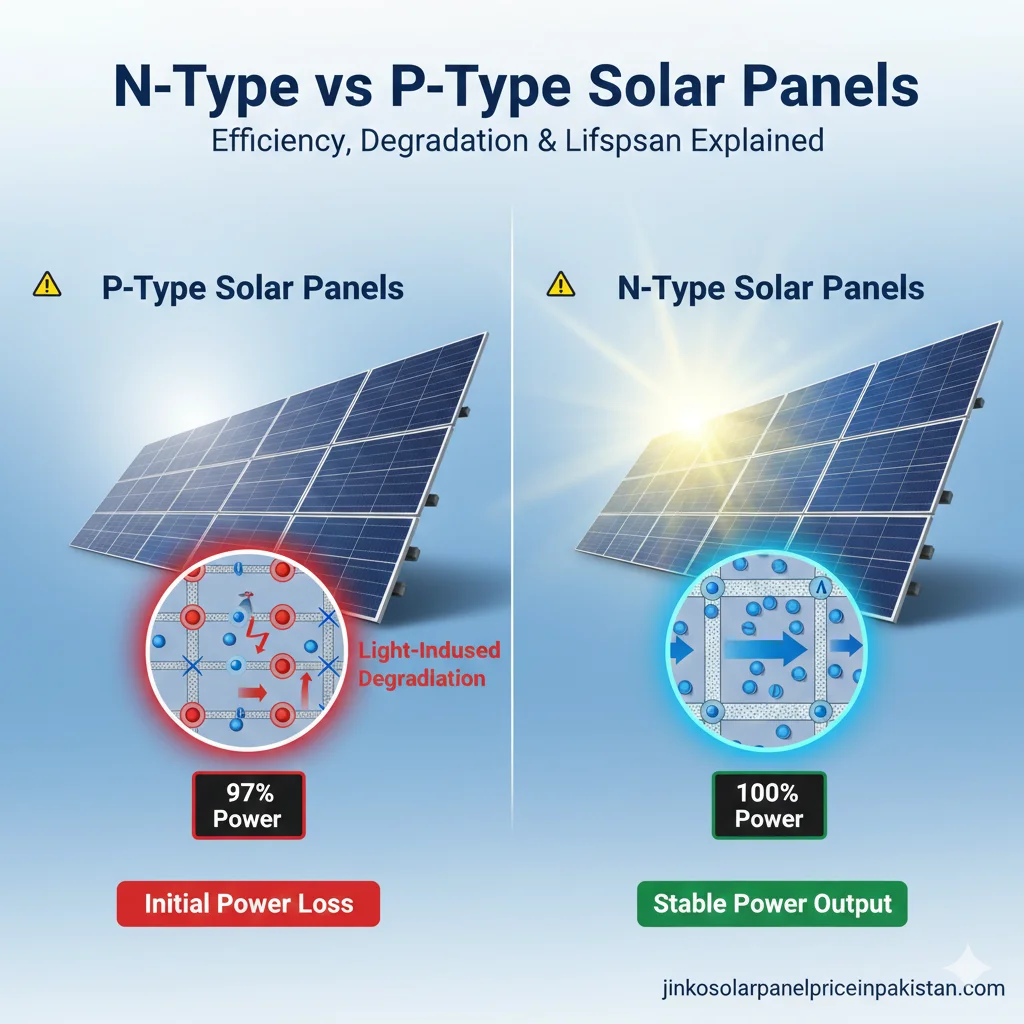
Difference Between N-Type vs P-Type Solar Panels

Table of Content
Table of Contents
What Will You Learn in This Article?
In this guide, you will learn:
- What N-Type and P-Type solar panels actually are
- How they are manufactured at the cell level
- How efficiency, degradation, heat performance, and lifespan differ
- Which type is better for homes, businesses, and hot climates
- Whether the higher cost of N-Type panels is worth it
This article assumes zero prior knowledge and builds your understanding step by step.
Readmore: Rural Solar Energy Solutions Transforming Small Town Communities
What Are Solar Cells and Why Do N-Type and P-Type Matter?
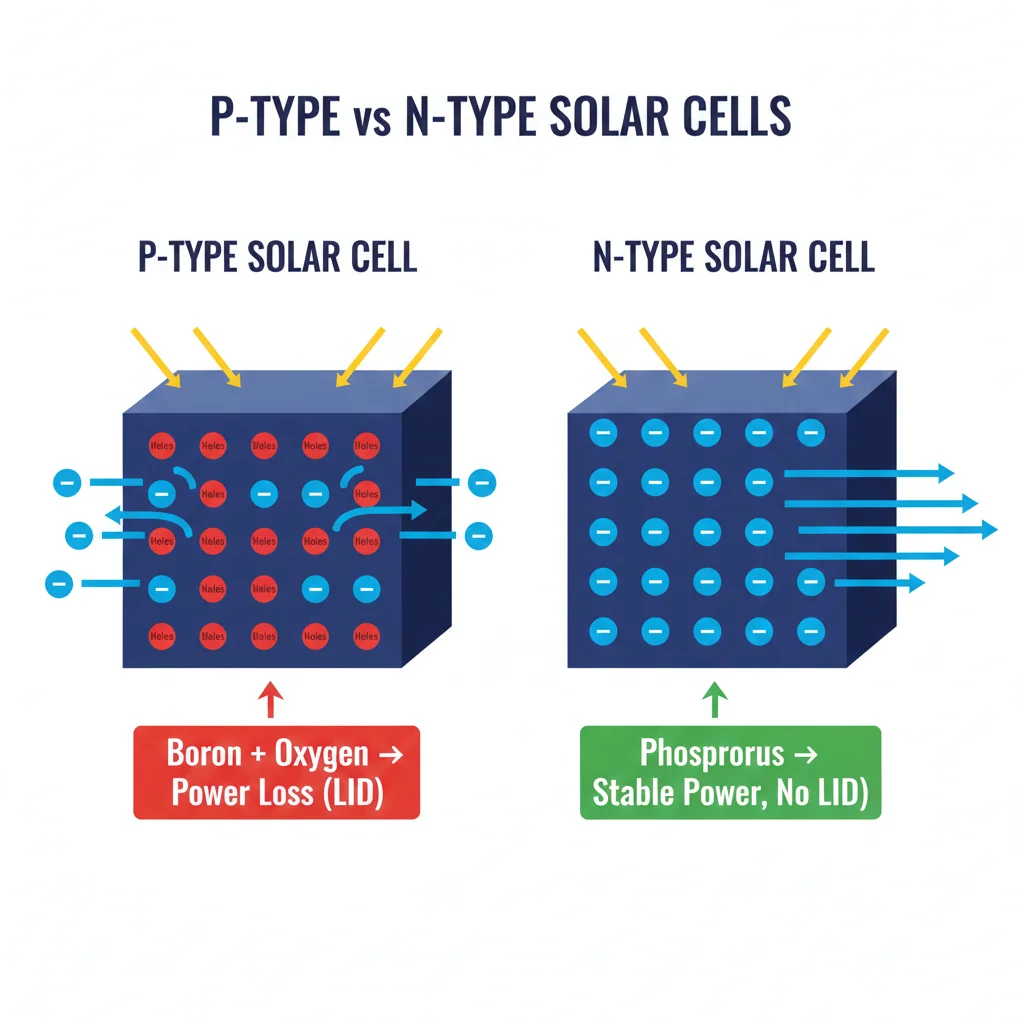
Solar panels are made of solar cells, and solar cells are made from silicon. Pure silicon cannot generate electricity efficiently on its own, so manufacturers dope it with small amounts of other elements. This doping process creates N-Type or P-Type solar cells.
Readmore: The Rising Future of Solar Energy: Opportunities and Adoption in Pakistan and Beyond
What Are P-Type Solar Panels?
P-Type solar panels are made from silicon that has been mixed with a small amount of boron. Silicon by itself cannot produce electricity efficiently. That is why manufacturers add boron to it.
Why Is Boron Added to Silicon?
Boron creates positive empty spaces inside the silicon material. These empty spaces are called “holes.” Because these holes carry a positive charge, the solar cell is called P-Type (Positive Type).
How Do P-Type Solar Cells Generate Electricity?
Here is the process in very simple steps:
- Sunlight hits the solar panel
- Sunlight gives energy to electrons inside the silicon
- The electrons start moving
- The electrons move toward the holes created by boron
- This movement of electrons creates electric current
👉 Moving electrons = electricity
Easy Real-World Example
Imagine a room with:
- People = electrons
- Empty chairs = holes
When the lights turn on (sunlight):
- People move to sit on empty chairs
- This movement is similar to how electricity flows in a solar cell
Why Are P-Type Solar Panels So Common?
1️⃣ They Are Easier and Cheaper to Make
- Boron is easy to use in manufacturing
- Production costs are lower
- This makes P-Type panels more affordable
2️⃣ They Are a Mature and Proven Technology
- Used for more than 30 years
- Tested in many climates and conditions
- Manufacturers fully understand this technology
3️⃣ They Are Widely Available
- Used in homes
- Used in commercial buildings
- Used in large solar power plants
You can find many brands, sizes, and price options.
Readmore: Solar Panel Installation Timeline: What to Expect and How Long It Takes
What Are N-Type Solar Panels?
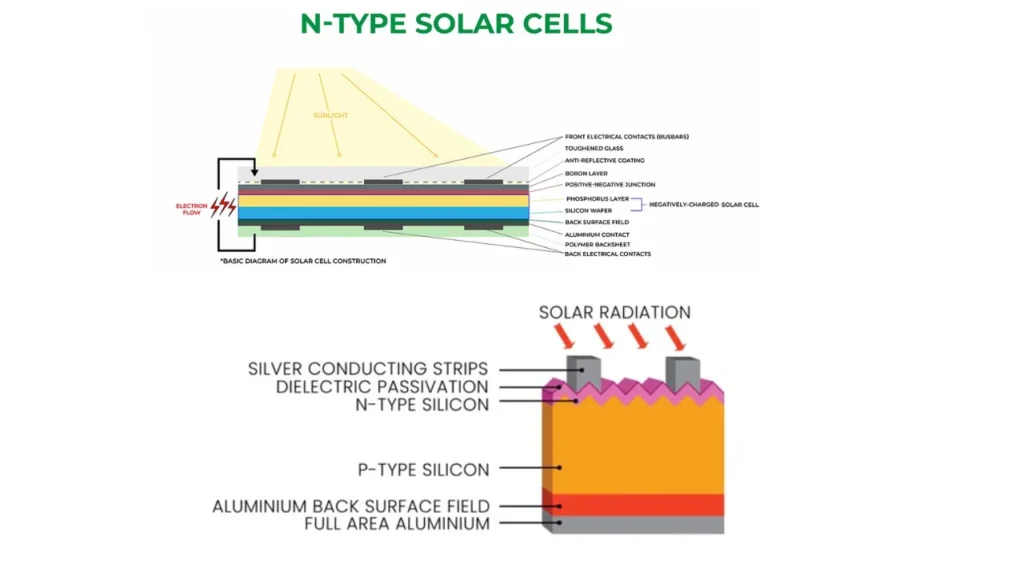
N-Type solar panels are made from silicon that has been mixed with a small amount of phosphorus. Silicon alone cannot produce electricity efficiently. So phosphorus is added to improve how electricity flows inside the solar cell.
Why Is Phosphorus Added to Silicon?
Phosphorus adds extra free electrons to the silicon. Electrons carry a negative charge, which is why this type of solar cell is called N-Type (Negative Type). These extra electrons make it easier for electricity to move through the cell.
How Do N-Type Solar Cells Generate Electricity?
Here is the process in very simple steps:
- Sunlight hits the solar panel
- Sunlight energizes the electrons inside the silicon
- Because phosphorus has added extra electrons, there are more electrons available to move
- These free electrons flow smoothly through the cell
- This smooth flow creates strong and stable electric current
👉 More free electrons = higher electricity output
Easy Real-World Example
Imagine a highway:
- Cars = electrons
- Extra lanes = extra electrons from phosphorus
When traffic starts (sunlight):
- Cars move faster because there are more lanes
- Traffic flows smoothly without congestion
This smooth traffic flow is like electricity flowing in an N-Type solar cell.
Why Are N-Type Solar Panels Considered Advanced?
1️⃣ Lower Defects in Silicon
- N-Type silicon has fewer internal defects
- Fewer defects means electrons do not get trapped
- This improves efficiency and reliability
2️⃣ Higher Resistance to Long-Term Degradation
- N-Type panels do not suffer from Light Induced Degradation (LID)
- They lose less power over time
- Performance stays stable for many years
3️⃣ Better Performance in Extreme Conditions
- Work better in high temperatures
- Perform well in low-light and cloudy conditions
- Ideal for hot climates and long-term use
What Is the Core Difference Between N-Type vs P-Type Solar Panels?
| Feature | N-Type Solar Panels | P-Type Solar Panels |
|---|---|---|
| Dopant Material | Phosphorus | Boron |
| Charge Carrier | Electrons | Holes |
| Efficiency Potential | Higher | Moderate |
| Degradation | Very Low | Higher |
| Heat Performance | Excellent | Average |
| Cost | Higher | Lower |
Readmore: Bifacial Solar Panel in Pakistan – Top Reasons Why They Are Perfect for Your Home
How Do N-Type vs P-Type Solar Panels Compare in Efficiency?
Efficiency determines how much sunlight is converted into usable electricity.
N-Type Panel Efficiency
- Typically 21%–23%
- More stable output over decades
- Better low-light performance
P-Type Panel Efficiency
- Typically 18%–21%
- Slightly faster efficiency loss
- Still very reliable for most users
Winner: N-Type solar panels
Readmore: Solar Panel Wholesale Market in Karachi – Top Authorized Dealers & Prices (2026 Update)
What Is Light Induced Degradation (LID) and Why Does It Matter?
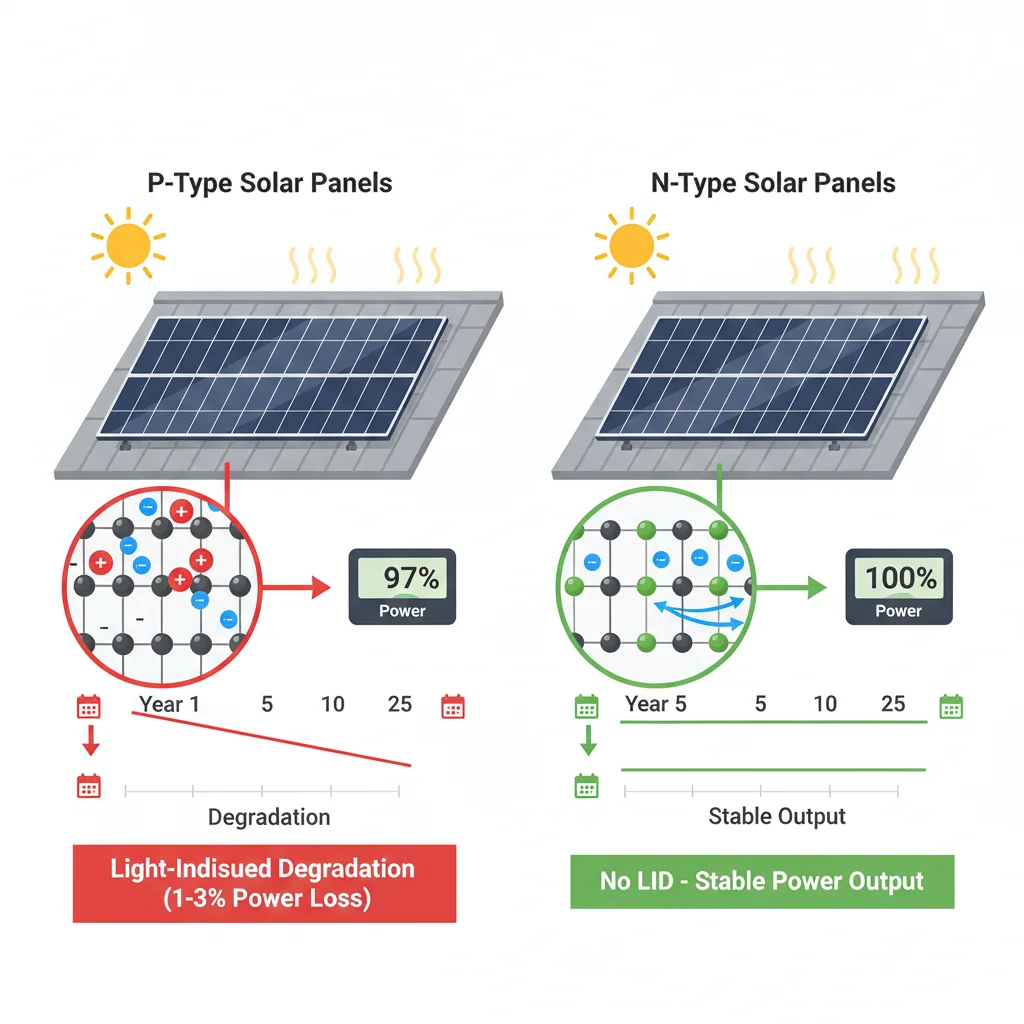
LID means a solar panel loses some power when it is used for the first time in sunlight.
Do P-Type Solar Panels Have LID?
Yes.
- P-Type panels use boron
- When sunlight hits the panel:
- Boron reacts with oxygen
- This creates small problems inside the cell
- Because of this, the panel loses 1–3% power in the first year
👉 This power loss is permanent.
Do N-Type Solar Panels Have LID?
No.
- N-Type panels use phosphorus
- Phosphorus does not react with oxygen
- So no power loss happens when sunlight hits the panel
👉 N-Type panels keep their original power.
Why Is This Important?
- P-Type panels start producing slightly less power after one year
- N-Type panels stay stable for many years
- This makes N-Type panels better for long-term use
Readmore: Top 3 Inverter brands in Pakistan – Complete Guide for 2025
How Do N-Type vs P-Type Solar Panels Perform in Hot Climates?
Heat reduces solar panel output.
Temperature Performance Comparison
| Factor | N-Type | P-Type |
|---|---|---|
| Temperature Coefficient | Lower loss | Higher loss |
| Output in Hot Weather | More stable | Drops faster |
Best Choice for Hot Regions: N-Type solar panels
Which Solar Panel Type Lasts Longer?
Lifespan Comparison
- N-Type Panels: 30–40 years
- P-Type Panels: 25–30 years
Degradation Rate
- N-Type: ~0.3% per year
- P-Type: ~0.5–0.7% per year
Over 25 years, N-Type panels can produce 10–15% more total energy.
Readmore: Monocrystalline Solar Panel: Top Reasons They’re Perfect for Your Home in 2026
Are N-Type Solar Panels More Expensive?
Yes, but context matters.
Cost Comparison
| Factor | N-Type | P-Type |
|---|---|---|
| Initial Cost | Higher | Lower |
| Long-Term ROI | Higher | Moderate |
| Maintenance | Lower | Slightly higher |
Real-World Example:
If roof space is limited, higher efficiency N-Type panels can generate more energy using fewer panels.
Readmore: Hybrid Photovoltaic Concept: The Ultimate Guide for Pakistan
Readmore: If you are considering a 585W model, check our latest Jinko Solar Panel Price in Pakistan 585 Watt guide for current rates, specifications and buying details. Jinko Solar Panel Price in Pakistan 585 Watt
Which Solar Panel Type Is Better for Homes?
Choose P-Type Panels If:
- Budget is limited
- Roof space is large
- Shorter payback period is preferred
Choose N-Type Panels If:
- Long-term energy savings matter
- Roof space is limited
- You live in a hot climate
- You want premium performance
Readmore: Battery-Based Hybrid Systems – Working, Components, and Benefits Explained
Are N-Type Solar Panels Worth It in 2026 and Beyond?
Yes.
As manufacturing scales:
- Prices are decreasing
- Efficiency continues to improve
- Warranty periods are expanding
N-Type technology is rapidly becoming the new industry standard.
🟧 FAQs – Jinko N-Type vs P-Type Solar Panels
What are N-type solar panels best used for?
High-efficiency residential, commercial, and bifacial installations.
Are P-type solar panels still good?
YYes, they remain reliable and cost-effective for most homes.
Do N-type panels work better in low light?
Yes, they perform better in cloudy and early-morning conditions.
Which solar panels degrade faster?
P-Type solar panels degrade faster over time.
Can N-type and P-type panels be mixed?
Not recommended due to electrical mismatch.
Read More: Government of Pakistan increase Tax on Solar panels for complete information visit 10% Tax on Solar Panels from July 2025 in Pakistan

Main solar panel ke liye aapka application Dena chahta hun ke 10 solar panel aur ek aisi de de aapka bahut bahut shukriya hoga
apply kren