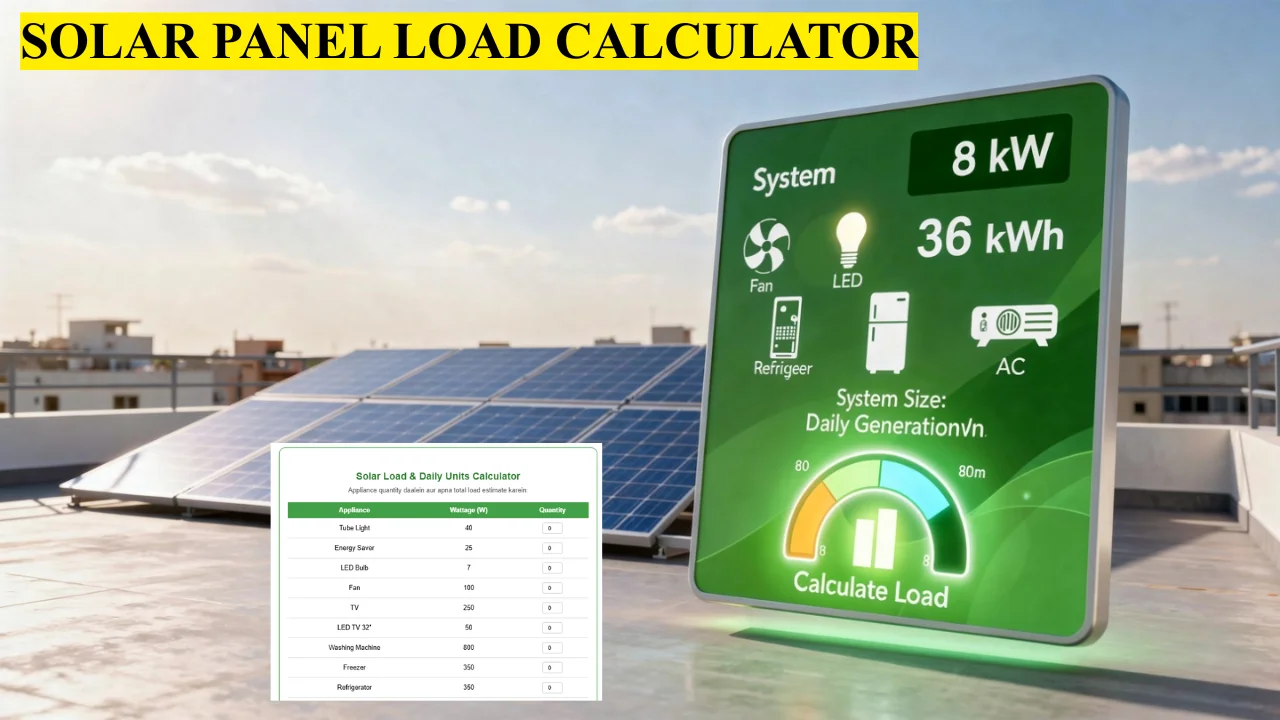
Calculate solar panel load

Solar Load & Daily Units Calculator
Appliance quantity daalein aur apna total load estimate karein:
| Appliance | Wattage (W) | Quantity |
|---|---|---|
| Tube Light | 40 | |
| Energy Saver | 25 | |
| LED Bulb | 7 | |
| Fan | 100 | |
| TV | 250 | |
| LED TV 32″ | 50 | |
| Washing Machine | 800 | |
| Freezer | 350 | |
| Refrigerator | 350 | |
| Computer | 250 | |
| Water Pump 1HP | 700 | |
| Iron | 1000 | |
| Split AC 1 Ton | 1800 | |
| Split AC 1.5 Ton | 2400 | |
| Split AC 2 Ton | 3000 | |
| Split AC 3.5 Ton | 7500 | |
| Split AC 4 Ton | 8000 | |
| Inverter AC 1 Ton | 1000 | |
| Inverter AC 1.5 Ton | 1500 | |
| Inverter AC 2 Ton | 2000 |
⚡ Total Load: 0 W
🔋 Recommended System Size: 0 kW
☀️ Estimated Daily Units Generation: 0 kWh
Table of Content
Table of Contents
1. What is a calculate solar panel load?
A solar panel load calculator is an essential tool that helps you determine the exact size of the solar system your home or business needs. Instead of guessing or relying on generic recommendations, this calculator takes your specific appliances, their wattage, and how many of each you own to calculate your total electrical load in watts.
The calculator then converts this load into a recommended solar system size in kilowatts (kW) and estimates your daily electricity generation potential. This is the foundation of any solar installation — get this wrong, and you either overspend on an unnecessarily large system or end up with an undersized system that cannot meet your needs.
When you check the latest Solar Panel Price in Pakistan, you will notice that system prices vary dramatically by size. A 3kW system costs much less than a 10kW system. Using a proper solar panel load calculator ensures you invest exactly the right amount — not a rupee more, not a rupee less.
Many people ask me: “Is solar even worth it for my home?” The answer depends entirely on your load calculation. Read Is Solar Panels Worth It after you finish this guide, and you will have a complete financial picture.
2. Why Accurate Load Calculation Matters
In my 5 years of experience in the Pakistani solar industry, I have seen two common tragedies play out repeatedly.
Tragedy 1: The Undersized System
A family in Lahore installed a 3kW system because their neighbor did the same. The neighbor had no ACs and used gas for cooking. This family had two split ACs, an electric oven, and a water pump. Their 3kW system generated only 13-14 units daily, but they consumed 25+. They still received massive WAPDA bills. They blamed solar technology. The real culprit was skipping the solar panel load calculator step.
Tragedy 2: The Oversized System
A businessman in Karachi, excited about going green, installed a 15kW system for his 5-bedroom home. His actual load was only 6kW. He spent Rs. 18 lakh when Rs. 8 lakh would have sufficed. The excess generation went to net metering, but the payback period stretched from 3 years to 7 years. He could have invested that money elsewhere.
An accurate solar panel load calculator prevents both scenarios. It gives you a data-driven answer based on your actual usage, not assumptions.
3. How to calculate solar panel load — Step-by-Step Guide
Let me walk you through the exact methodology I use when designing solar systems for clients. This is the same logic built into our solar panel load calculator tool below.
Step 1: List Every Electrical Appliance in Your Home
Walk through every room. Note down every appliance: lights, fans, TV, fridge, freezer, washing machine, iron, water pump, computers, and air conditioners. Do not forget occasional-use items like microwave, toaster, and vacuum cleaner.
Step 2: Find the Wattage of Each Appliance
Every appliance has a wattage rating on its label or in its manual. If you cannot find it, use standard values. Our Monocrystalline Solar Panel guide explains panel efficiency, but understanding appliance consumption is equally important.
Step 3: Count How Many of Each Appliance You Own
This matters more than you think. A home with 10 LED bulbs is very different from a home with 20 energy savers. Be precise.
Step 4: Multiply Wattage × Quantity for Each Appliance Type
For example: 5 fans × 100 watts = 500 watts. 2 split ACs (1.5 ton) × 2,400 watts = 4,800 watts.
Step 5: Sum All Appliance Loads
Add up all the wattages. This gives you your total connected load in watts.
Step 6: Apply a Demand Factor
Not all appliances run simultaneously. You do not run the iron, microwave, and all ACs at the same time. Residential systems typically apply a 0.7-0.8 demand factor. Our calculator uses a conservative approach and considers peak load scenarios.
Step 7: Convert to Kilowatts
Divide total watts by 1,000. This is your recommended solar system size in kW. For detailed system sizing once you know your load, use our Solar Panel Load Calculator .
4. Understanding Your Appliances and Their Wattage
Different appliances consume power differently. Understanding these patterns helps you interpret your solar panel load calculator results more intelligently.
Continuous Load Appliances
These run for hours at a stretch:
- Refrigerator: 350W, runs 8-12 hours daily
- Freezer: 350W, similar cycle
- Fans: 100W each, can run 12-18 hours in summer
- LED bulbs: 7W each, minimal but numerous
Intermittent Load Appliances
These run for short periods:
- Washing machine: 800W, 1-2 hours daily
- Iron: 1,000W, 30-60 minutes
- Water pump: 700W, 30-60 minutes
- Microwave: 1,000W+, minutes only
Heavy Load Appliances
These are the big consumers:
- Split AC 1.5 Ton: 2,400W, 6-10 hours in summer
- Inverter AC 1.5 Ton: 1,500W, more efficient
- Split AC 2 Ton: 3,000W
The difference between inverter and non-inverter ACs significantly impacts your load. Two inverter ACs (1.5 ton each) consume 3,000W together. Two non-inverter ACs of the same capacity consume 4,800W — a 60% increase. This is why the solar panel load calculator asks for specific AC types.
For guidance on the complete installation process after load calculation, refer to our Solar Panel Installation Timeline .
5. Interactive Solar Panel Load Calculator Tool
Now that you understand the methodology, use our interactive solar panel load calculator below. Enter the quantity of each appliance type you own. The tool instantly calculates your total load, recommended system size, and estimated daily generation.
This tool follows the exact steps described above. The wattage values used are standard for the Pakistani market, verified through our work with Authorized Solar Panel Distributors in Pakistan .
⚡ Solar Load & Daily Units Calculator
[Insert aap ka calculator tool yahan]
How to use this tool:
- Go through each appliance row.
- Enter the quantity of each appliance in your home.
- Click “Calculate Load.”
- Read your results: Total Load, Recommended System Size, and Estimated Daily Generation.
This solar panel load calculator is designed for typical Pakistani homes. For large commercial installations, a professional energy audit is recommended. Contact us via our Contact Us page for commercial consultations.
6. How to Interpret Calculator Results
Your solar panel load calculator gives three key outputs. Here is what each means and how to use the information.
Result 1: Total Load (Watts)
This is the sum of all your appliance wattages. For example, 6,500W. This represents your peak consumption if all appliances run simultaneously.
Result 2: Recommended System Size (kW)
This is your total load converted to kilowatts. For 6,500W, the recommendation is 6.5 kW. In practice, solar installers round this to the nearest standard system size: 5kW, 6kW, 8kW, or 10kW. For a 6.5 kW load, an 8kW system provides comfortable headroom. Check Jinko 6 kW Solar Panel System Price and Jinko 8 kW Solar Panel System Price in Pakistan to compare options.
Result 3: Estimated Daily Units Generation (kWh)
This is calculated using Pakistan’s average peak sun hours (4.5-5.5 hours daily, depending on city). For a 6.5 kW system: 6.5 × 4.5 = 29.25 kWh per day. This estimate helps you compare against your current electricity bill. Use our Latest Electricity Unit Price in Pakistan page to calculate your potential savings in rupees.
Important: This is estimated generation under ideal conditions. Actual generation varies with weather, panel angle, dust, and shading.
7. Real-World Example — 5kW System Calculation
Let me walk you through a real Lahore home example so you can see the solar panel load calculator in action.
The Ahmed Family Home — Lahore
| Appliance | Wattage | Quantity | Total Watts |
|---|---|---|---|
| LED Bulbs | 7W | 12 | 84W |
| Energy Savers | 25W | 4 | 100W |
| Ceiling Fans | 100W | 5 | 500W |
| Refrigerator | 350W | 1 | 350W |
| Freezer | 350W | 1 | 350W |
| LED TV 32″ | 50W | 2 | 100W |
| Computer | 250W | 1 | 250W |
| Iron | 1,000W | 1 | 1,000W |
| Washing Machine | 800W | 1 | 800W |
| Water Pump 1HP | 700W | 1 | 700W |
| Inverter AC 1.5 Ton | 1,500W | 2 | 3,000W |
| Total Load | 7,234W |
Calculator Result:
- Total Load: 7,234 W
- Recommended System Size: 7.23 kW → Rounded to 8 kW
- Estimated Daily Generation: 8 × 4.5 = 36 kWh per day
The Ahmed family’s monthly electricity bill was 900 units. At Rs. 45/unit (average), their bill was Rs. 40,500. A 8kW system generating approximately 36 units daily (1,080 monthly) completely eliminates this bill and provides surplus for net metering.
This is the power of accurate solar panel load calculator usage. Without it, the Ahmed family might have installed a 5kW system and remained stuck with partial bills.
8. Common Load Calculation Mistakes to Avoid
In my experience, these are the errors I see most frequently when reviewing client load calculations.
Mistake 1: Forgetting Seasonal Appliances
You are not running ACs in January, but you need them in June. Design your system for your peak load month. A system that only meets your winter load will disappoint you in summer.
Mistake 2: Using Wrong Wattage Values
An old non-inverter refrigerator may consume 500W, not the 350W of a modern unit. An old water pump may draw 1,200W instead of 700W. Use actual appliance ratings when possible.
Mistake 3: Ignoring Startup Surge
Appliances with motors (ACs, pumps, refrigerators) draw 2-3 times their rated wattage for a few seconds during startup. While the solar panel load calculator focuses on running load, your inverter and battery must handle surge. This is why inverter sizing matters — read our Top 5 Best Hybrid Inverters guide.
Mistake 4: Not Planning for Future Load
Planning to add an electric vehicle charger in 2 years? Adding a second AC? Build these into your system sizing now, or ensure your system is expandable. Future-proofing is part of smart Solar Panel Installation Timeline planning.
9. How Load Calculation Affects Battery Selection
Your load calculation directly determines your battery requirements. This is where the lithium battery vs dry battery decision intersects with your solar panel load calculator results.
Calculating Battery Size from Your Load
Step 1: Determine your nighttime usage. Identify which appliances run at night (fans, lights, fridge, maybe one AC).
Step 2: Calculate nighttime watt-hours. Example: 5 fans × 100W × 8 hours + 10 LEDs × 7W × 8 hours + fridge 350W × 3 hours active = 4,000 + 560 + 1,050 = 5,610 watt-hours = 5.61 kWh.
Step 3: Apply Depth of Discharge.
- Lithium battery (90% DoD): 5.61 ÷ 0.9 = 6.23 kWh battery needed
- Dry battery (50% DoD): 5.61 ÷ 0.5 = 11.22 kWh battery needed
This is why our Lithium Battery vs Dry Battery Guide emphasizes the DoD factor. A lithium battery costs more upfront but requires half the rated capacity for the same usable energy.
10. How Load Calculation Affects Inverter Selection
Your solar panel load calculator result also determines your inverter size.
| System Size | Recommended Inverter | Inverter Type |
|---|---|---|
| 3 kW | 3 kW | On-Grid or Hybrid |
| 5 kW | 5 kW | Hybrid recommended |
| 6 kW | 6 kW | Hybrid |
| 8 kW | 8 kW | Hybrid |
| 10 kW | 10 kW | Hybrid or multiple units |
| 15 kW+ | Multiple inverters | Commercial |
The inverter must match or slightly exceed your system’s kW rating. Undersizing the inverter creates a bottleneck — your panels can generate, but the inverter cannot process the power. For on-grid systems, consult Top 5 Best On-Grid Inverters . For off-grid, see Top 5 Best Off-Grid Inverters .
11. Solar Panel Load Calculator vs Professional Energy Audit
| Factor | Solar Panel Load Calculator | Professional Energy Audit |
|---|---|---|
| Cost | Free | Rs. 5,000-15,000 |
| Time | 5-10 minutes | 2-4 hours on-site |
| Accuracy | Good for residential | Excellent, includes shading analysis |
| Equipment Used | None | Thermal camera, data logger |
| Best For | Initial sizing, budgeting | Final design, large commercial |
| Customization | Standard wattage values | Actual measured consumption |
Our solar panel load calculator is an excellent starting point. It gives you a solid estimate for budgeting and initial planning. For large homes (10kW+) or commercial installations, I recommend following up with a professional energy audit. The calculator gets you 85-90% accuracy, which is sufficient for most residential decisions.
For those investing in premium panels like Bifacial Solar Panels , an audit ensures optimal placement and tilt for maximum bifacial gain.
12. Frequently Asked Questions
How accurate is the solar panel load calculator?
Very accurate for standard residential applications using standard wattage values. For precise results, use your appliance’s actual wattage rating from its label.
What is a good solar system size for a 3-bedroom house?
Typically 5-6 kW without heavy AC usage. Use the calculator above for a precise figure based on your specific appliances.
How many ACs can a 5kW solar system run?
Approximately 2 inverter ACs (1.5 ton each) or 1 non-inverter AC (1.5 ton) with other household load. Use the calculator to model your exact scenario.
Does the calculator account for surge current?
No. The calculator addresses running load. Your inverter must handle surge. Our Top 5 Best Hybrid Inverters guide addresses surge capacity.
Can I use this calculator for commercial buildings?
It provides a rough estimate. Commercial buildings have different load patterns and demand factors. A professional audit is recommended.
How do I calculate my monthly savings?
Multiply daily units by 30, then multiply by your electricity rate. Use Latest Electricity Unit Price in Pakistan for current rates.
What if my calculated load is between standard system sizes?
Round up. A 6.5 kW load warrants an 8kW system. The small premium buys headroom for future appliances and cloudy days.
Is net metering considered in the calculator?
The estimated generation figure represents what you can offset or export via net metering. For net metering eligibility, check CM Punjab Free Solar Panel Scheme .
How often should I recalculate my load?
Whenever you add major appliances (AC, EV charger, pool pump). Minor additions like a few LEDs do not require recalculation.
Can this calculator help me verify an installer’s recommendation?
Absolutely. Use it as an independent check. If an installer recommends 10kW and your calculated load is 4kW, ask serious questions.
13. Conclusion — Start Your Solar Journey
A solar panel load calculator is the foundation of a successful solar investment. It transforms guesswork into data, prevents costly sizing errors, and ensures every rupee of your solar investment is optimized.
Use the calculator above. Write down your total load and recommended system size. Then explore:
- Current Solar Panel Price in Pakistan to budget your system
- Our Lithium Battery vs Dry Battery Guide for storage decisions
- How to Protect Solar Panels from Hails for long-term protection
Solar is the best financial decision most Pakistani families can make in 2026. Start with accurate data. Start with the solar panel load calculator. And for any questions, visit our FAQs or Contact Us directly.