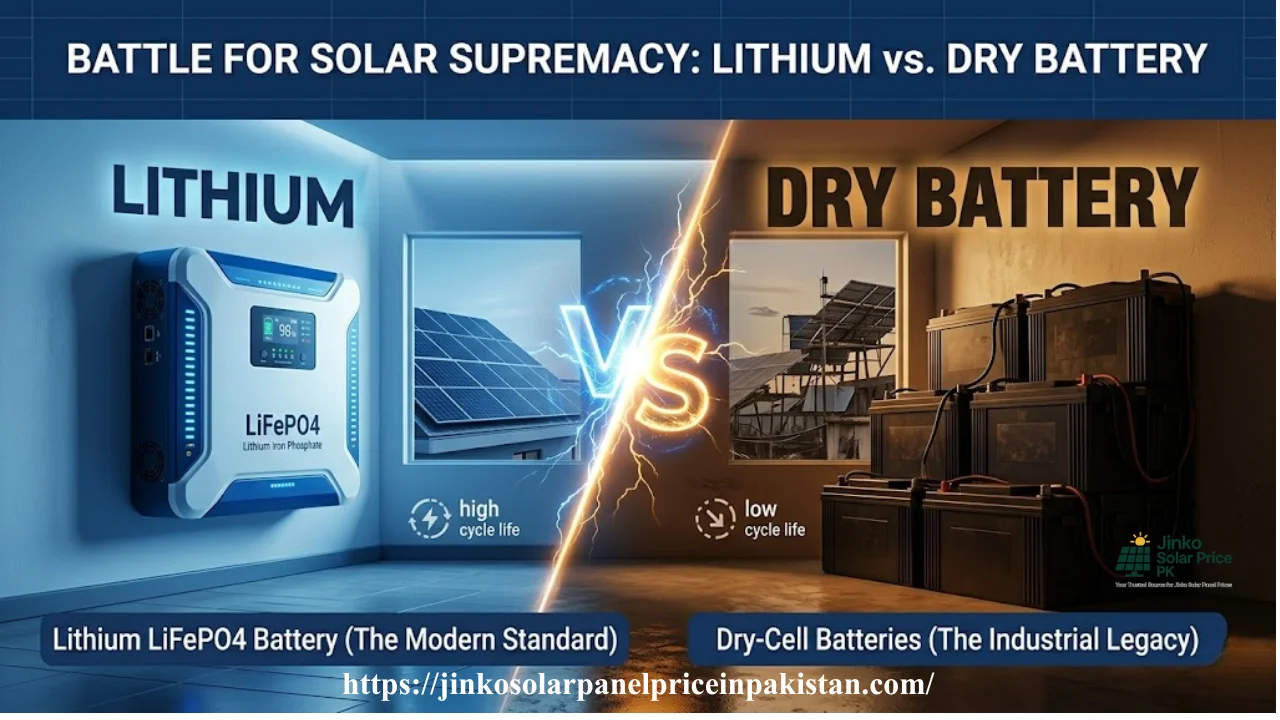
Lithium Battery vs Dry Battery — The Ultimate Solar Battery Guide

Table of Content
Table of Contents
1. Introduction — Why Battery Choice Matters
Solar panels generate electricity during the day. But what happens when the sun goes down? The answer is batteries. Your solar battery is the backbone of your off-grid or hybrid solar system. Without the right battery, even the most efficient solar panels will leave you in the dark at night or during load shedding.
The two most common battery types for solar systems in Pakistan are lithium batteries and dry batteries (also known as sealed lead-acid or VRLA batteries). Each has its strengths, weaknesses, and ideal use cases. This comprehensive guide compares lithium battery vs dry battery across every factor that matters: price, lifespan, maintenance, performance, safety, and real-world value.
Choosing the wrong battery can cost you thousands in replacement costs and lost energy over the system’s lifetime. Choosing the right one means reliable power for 5-15 years with minimal headaches. When you check the latest Solar Panel Price in Pakistan, remember that the battery is an equally important investment that deserves equal research.
Understanding the lithium battery vs dry battery comparison is essential whether you are installing a new solar system or upgrading an existing one. This guide gives you all the facts so you can make the right decision for your home, budget, and energy needs.
2. What is a Lithium Battery?
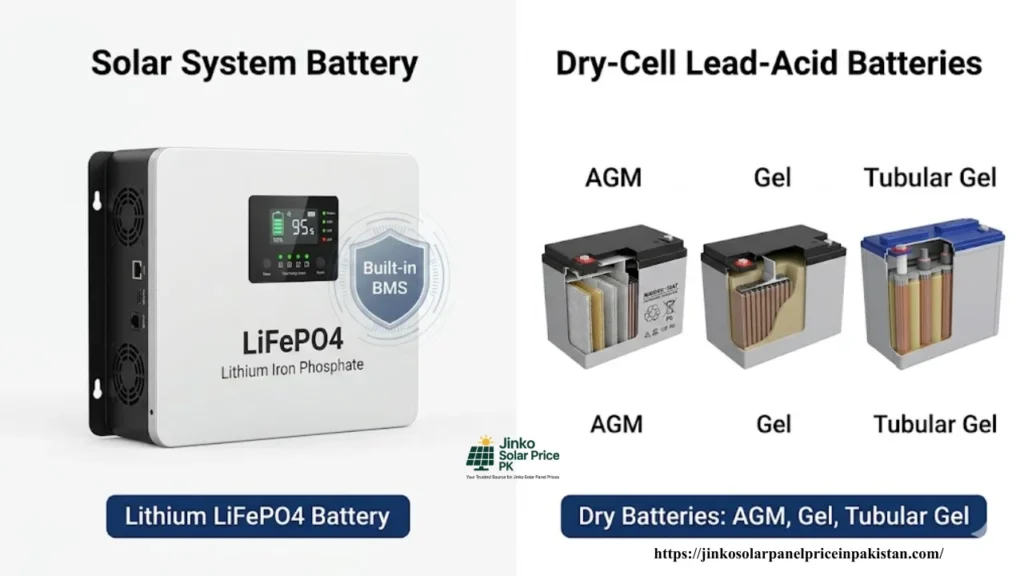
A lithium battery for solar systems is most commonly a Lithium Iron Phosphate (LiFePO₄) battery. This is different from the lithium-ion batteries found in phones and laptops — LiFePO₄ chemistry is specifically designed for stationary energy storage with superior safety and longevity.
Key Components:
- Cathode: Lithium Iron Phosphate (LiFePO₄)
- Anode: Graphite
- Electrolyte: Lithium salt in organic solvent
- BMS (Battery Management System): Built-in electronic controller that manages charging, discharging, temperature, and cell balancing
How It Works:
During charging, lithium ions move from the cathode through the electrolyte to the anode, storing energy. During discharging, the ions move back, releasing stored energy. The BMS continuously monitors every cell to prevent overcharging, over-discharging, and overheating.
Types of Lithium Batteries for Solar:
- LiFePO₄ (Lithium Iron Phosphate): The gold standard for solar storage. Safe, 4,000-7,000 cycles, 10-15 year lifespan.
- NMC (Nickel Manganese Cobalt): Higher energy density but shorter lifespan and more expensive. Less common for stationary storage.
- LTO (Lithium Titanate): Ultra-long life (15,000+ cycles) but very expensive. Rare in residential applications.
For solar systems, LiFePO₄ is the recommended lithium battery type. It offers the best balance of safety, lifespan, and cost. Understanding different battery technologies helps when comparing overall Solar Panel Installation Timeline requirements.
3. What is a Dry Battery?
A dry battery for solar systems is technically a Sealed Lead-Acid (SLA) battery, also known as a Valve Regulated Lead-Acid (VRLA) battery. The term “dry” refers to the fact that the electrolyte is immobilized — either in a gel form (Gel battery) or absorbed in a glass mat (AGM battery). Unlike traditional flooded lead-acid batteries, dry batteries require no water topping and emit minimal gases.
Key Components:
- Plates: Lead dioxide (positive) and sponge lead (negative)
- Electrolyte: Sulfuric acid, immobilized in gel or absorbed glass mat (AGM)
- Valve: Pressure relief valve for gas release
- Casing: Sealed plastic container
How It Works:
The lead-acid chemical reaction is well-established, dating back over 150 years. During charging, lead sulfate converts back to lead and lead dioxide while the electrolyte becomes more concentrated. During discharging, the opposite occurs.
Types of Dry Batteries:
Type 1: AGM Battery (Absorbent Glass Mat)
Think of it like a sponge that soaks up water. In an AGM battery, the electrolyte (acid) is absorbed into fiberglass mats — just like a sponge holds water. It is completely soaked, but there is no free-flowing liquid anywhere.
What does this mean in simple terms?
- You can tilt the battery slightly — no problem. The acid will not spill out because it is trapped in the sponge-like material.
- Charging is a bit faster — just like a dry sponge absorbs water quickly.
- Performance is slightly better than other dry batteries.
- Price is a bit higher — you pay a premium for the quality.
Where is it used? UPS systems, emergency backup, and smaller solar setups.
Type 2: Gel Battery
Now AGM was like a sponge. Gel battery is different. In this type, silica powder is mixed into the electrolyte, turning it into a thick gel — exactly like gel toothpaste. It is thick, it is jammed, it does not flow.
What does this mean in simple terms?
- It can handle a bit more abuse — if you accidentally discharge it too much, it tolerates it slightly better than AGM.
- Charging is a bit slower — because the gel is thick, electrons move through it more slowly.
- It performs slightly better in heat — the gel structure stays more stable.
Where is it used? Solar systems that cycle daily — quite common in Pakistan.
Type 3: Tubular Gel Battery
This is the upgraded version of the gel battery. We just learned about gel. Now let me explain the “tubular” part.
Normal battery plate: It is flat — like a sheet of paper.
Tubular battery plate: It is made of cylindrical tubes — like long pencil-shaped rods.
Now think about it: if you have a flat plate, the acid only reacts with the surface. But if you have tubular plates, the acid reacts with the inside and outside of the tube — more surface area, more reaction, more power.
What does this mean in simple terms?
- Longer lifespan — tubular plates can survive more charge-discharge cycles.
- Better deep discharge handling — if you discharge 50-60% daily, this will last longer than a regular gel battery.
- In Pakistan, this is the most popular solar dry battery — because solar systems need daily charging and discharging.
Easy Summary Table:
| Battery Type | Simple Example | Key Point |
|---|---|---|
| AGM | Like a sponge — acid absorbed in fiberglass | Fast charging, safe, slightly pricey |
| Gel | Like toothpaste — thick gel electrolyte | Tolerates deeper discharge |
| Tubular Gel | Like pencil tubes — more surface area | Long life, best for daily solar cycling |
What Is The Situation in Pakistan?
Dry batteries have been the backbone of solar in Pakistan for a very long time. Every small shop, every neighborhood electrician has dry batteries available. People know them, recognize them, and the price is accessible.
But remember one thing — dry batteries have their limits. They were not originally designed for heavy daily use. If you discharge them more than 50% every single day, they will be finished in 3-4 years. That is why new-age lithium batteries are now challenging them — but we will learn about that in the next section.
4. Lithium Battery vs Dry Battery — Head-to-Head Comparison
This is the core lithium battery vs dry battery comparison table that summarizes every key difference.
| Parameter | Lithium Battery (LiFePO₄) | Dry Battery (AGM/Gel) |
|---|---|---|
| Chemistry | Lithium Iron Phosphate | Lead-Acid (Sealed) |
| Usable Capacity (DoD) | 80-100% | 50% (recommended) |
| Cycle Life | 4,000-7,000 cycles | 600-1,200 cycles |
| Lifespan | 10-15 years | 3-5 years |
| Efficiency (Round-Trip) | 95-98% | 80-85% |
| Weight (per kWh) | 8-12 kg | 25-35 kg |
| Space Required | Compact | Bulky |
| Maintenance | Zero | Minimal |
| Charging Speed | Fast (1-3 hours) | Slow (6-10 hours) |
| Temperature Sensitivity | Low (works well in heat) | High (degrades in heat) |
| Safety | Very safe (LiFePO₄) | Safe (sealed) |
| Price per kWh (Pakistan) | Rs. 45,000-65,000 | Rs. 18,000-30,000 |
| 10-Year Cost | Lower | Higher |
| Warranty | 5-10 years | 1-2 years |
These differences may seem technical, but each one affects your daily experience and long-term wallet. The next sections explain each parameter in detail so you understand the real-world impact of choosing between lithium battery vs dry battery.
5. Depth of Discharge (DoD) Explained
Depth of Discharge (DoD) is perhaps the most important concept in the lithium battery vs dry battery comparison. It determines how much of the battery’s total capacity you can actually use.
What is DoD?
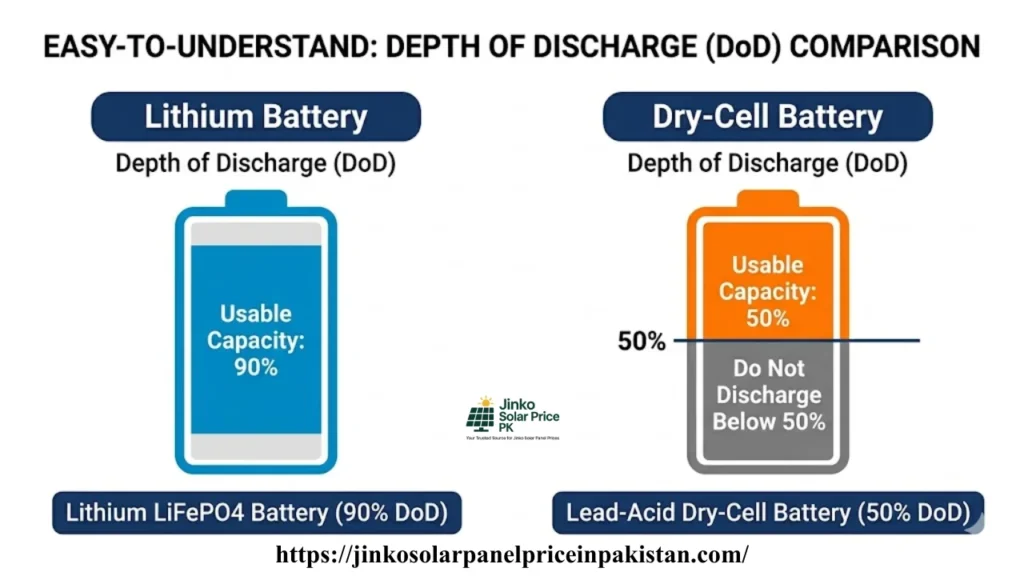
If a battery is rated at 100 Ah and you use 50 Ah, the DoD is 50%. A battery’s recommended DoD tells you how deeply you can discharge it without damaging its lifespan.
Lithium Battery DoD: 80-100%
A LiFePO₄ lithium battery can be discharged to 80-100% of its rated capacity without significant lifespan impact. A 100 Ah lithium battery provides 80-100 Ah of usable energy. Some premium models support 100% DoD.
Dry Battery DoD: 50%
A dry battery should ideally be discharged no more than 50% to achieve its rated cycle life. Going below 50% regularly can cut lifespan by 50-70%. A 100 Ah dry battery provides only 50 Ah of usable energy.
Real-World Impact:
To get 5 kWh of usable energy:
- Lithium: You need approximately 5-6 kWh of rated battery capacity.
- Dry Battery: You need 10 kWh of rated battery capacity — nearly double.
This means the actual usable cost per kWh of dry batteries is much closer to lithium than the headline price suggests. When you calculate your total system needs using a Solar Panel Load Calculator, factor in DoD to get accurate battery sizing.
6. Cycle Life — Which Battery Lasts Longer?
Cycle life is the number of complete charge-discharge cycles a battery can perform before its capacity drops below 80% of its original rating. This is where the lithium battery vs dry battery gap becomes dramatic.
Lithium Battery Cycle Life: 4,000-7,000 Cycles
A quality LiFePO₄ lithium battery delivers 4,000 to 7,000 cycles at 80% DoD. Premium models from top manufacturers can reach 10,000 cycles at lower DoD.
- 4,000 cycles = 10.9 years of daily cycling
- 7,000 cycles = 19.2 years of daily cycling
Dry Battery Cycle Life: 600-1,200 Cycles
A dry battery typically delivers 600 to 1,200 cycles at 50% DoD. Higher-end tubular gel models may reach 1,500 cycles under ideal conditions.
- 600 cycles = 1.6 years of daily cycling
- 1,200 cycles = 3.3 years of daily cycling
What This Means for You:
Over a 10-year period, you would replace dry batteries 2-4 times. A lithium battery would still be running on its first unit — possibly lasting the full 10-15 years without replacement. This replacement cost and hassle is the hidden expense in the lithium battery vs dry battery equation. For those wondering about long-term value, this ties directly to whether solar is worth the investment .
7. Efficiency — Charge & Discharge Losses
Round-trip efficiency measures how much energy you get back from a battery compared to how much you put in. Every battery loses some energy during charging and discharging.
Lithium Battery Efficiency: 95-98%
If you put 100 units of electricity into a lithium battery, you get 95-98 units back. Losses are minimal due to the efficient LiFePO₄ chemistry and low internal resistance.
Dry Battery Efficiency: 80-85%
If you put 100 units into a dry battery, you only get 80-85 units back. The remaining 15-20% is lost as heat, especially during charging.
Annual Impact:
For a home consuming 10 kWh daily from batteries:
- Lithium: Loses approximately 0.2-0.5 kWh daily. Over a year: 73-183 kWh lost.
- Dry Battery: Loses approximately 1.5-2.0 kWh daily. Over a year: 548-730 kWh lost.
At current electricity rates (check Latest Electricity Unit Price in Pakistan ), these efficiency losses translate to real money. The lithium battery saves 400-600 additional kWh annually — worth thousands of rupees.
8. Maintenance Requirements
This is one of the clearest differentiators in the lithium battery vs dry battery comparison.
Lithium Battery Maintenance: Zero
LiFePO₄ lithium batteries require absolutely no maintenance. The BMS handles everything automatically:
- No water topping
- No terminal cleaning
- No equalization charging
- No specific gravity checks
Install and forget. Check the BMS app occasionally for peace of mind.
Dry Battery Maintenance: Minimal But Important
While called “dry” and “maintenance-free,” dry batteries still need some attention:
- Terminal inspection and cleaning every 3-6 months
- Visual inspection for swelling or cracks
- Ensuring proper ventilation (they can emit small amounts of hydrogen)
- Voltage checks if not under regular use
Dry batteries are far easier than flooded batteries (which need regular water topping), but they are not zero-maintenance. For those interested in overall system maintenance, read Do I Need to Clean My Solar Panels for the panel side of maintenance.
9. Weight & Space Comparison
Weight Comparison (per kWh of Rated Capacity):
| Battery Type | Weight per kWh | 5 kWh System Weight |
|---|---|---|
| Lithium (LiFePO₄) | 8-12 kg | 40-60 kg |
| Dry Battery (AGM) | 25-30 kg | 125-150 kg |
| Dry Battery (Gel) | 28-35 kg | 140-175 kg |
Lithium batteries weigh approximately one-third of equivalent dry batteries. This matters for:
- Rooftop or upper-floor installations
- Transport and handling
- Structural load on flooring
Space Comparison:
Lithium batteries are compact — a 5 kWh lithium battery is typically the size of a small suitcase. Dry batteries for the same usable capacity require 2-3 times the space because you need double the rated capacity (due to 50% DoD). In cramped Pakistani homes or apartments, this space saving can be decisive.
10. Safety Considerations
Safety is a valid concern in the lithium battery vs dry battery debate, but the facts may surprise you.
Lithium Battery (LiFePO₄) Safety:
LiFePO₄ lithium batteries are the safest lithium chemistry available:
- Thermally stable: No thermal runaway risk below 200°C
- Non-toxic: No cobalt, no heavy metals
- No gas emission: Completely sealed, no hydrogen
- BMS protection: Electronic protection against overcharge, over-discharge, short circuit, and temperature extremes
Note: This applies to LiFePO₄ specifically. Other lithium chemistries (like those in phones) have different risk profiles. Quality solar lithium batteries use exclusively LiFePO₄.
Dry Battery Safety:
Dry batteries are generally safe but have some risks:
- Hydrogen emission: Under overcharging, small amounts of hydrogen gas can accumulate — ventilation is required
- Acid leakage: Though sealed, cracked cases can leak sulfuric acid
- Lead toxicity: Lead is hazardous; proper disposal is essential
Both battery types are safe when quality products are used and basic precautions are followed. Lithium LiFePO₄ has a slight edge due to zero gas emission and electronic protection.
11. Temperature Performance in Pakistan
Pakistan’s climate — especially in cities like Multan, Lahore, Karachi, and interior Sindh — can be punishingly hot. Temperature directly affects battery performance and lifespan.
Lithium Battery in Heat:
LiFePO₄ lithium batteries handle heat well:
- Operating range: -20°C to 60°C
- Optimal range: 15°C to 35°C
- Heat impact: Minor efficiency loss at high temperatures (2-5%). Lifespan impact is minimal with built-in BMS thermal management.
- Cold impact: Charging below 0°C requires BMS with low-temperature protection (standard in quality models).
Dry Battery in Heat:
Dry batteries are more sensitive to heat:
- Operating range: -15°C to 50°C
- Optimal range: 20°C to 25°C
- Heat impact: Significant. For every 8-10°C above 25°C, lifespan halves. In 40°C+ Pakistani summers, a dry battery’s lifespan can drop from 5 years to 2-3 years.
- Cold impact: Less affected by cold than lithium.
For Pakistani conditions, lithium batteries are better suited to handle summer heat without dramatic lifespan reduction. This is why understanding how to protect solar panels from hails and other environmental factors matters for the whole system.
12. Price Comparison in Pakistan 2026
This is the most looked-at section in the lithium battery vs dry battery guide. Here are the real market prices.
Lithium Battery Prices (LiFePO₄):
| Capacity | Voltage | Usable Energy | Price Range | Price per Usable kWh |
|---|---|---|---|---|
| 50 Ah | 12V | ~0.5 kWh | Rs. 25,000-35,000 | Rs. 50,000-70,000 |
| 100 Ah | 12V | ~1.0 kWh | Rs. 45,000-60,000 | Rs. 45,000-60,000 |
| 100 Ah | 24V | ~2.0 kWh | Rs. 90,000-120,000 | Rs. 45,000-60,000 |
| 200 Ah | 12V | ~2.0 kWh | Rs. 85,000-115,000 | Rs. 42,500-57,500 |
| 5 kWh Wall-Mount | 48V | ~5.0 kWh | Rs. 220,000-300,000 | Rs. 44,000-60,000 |
| 10 kWh Wall-Mount | 48V | ~10.0 kWh | Rs. 420,000-550,000 | Rs. 42,000-55,000 |
Dry Battery Prices (AGM/Gel):
| Capacity | Voltage | Rated Energy | Usable Energy (50% DoD) | Price Range |
|---|---|---|---|---|
| 100 Ah | 12V | 1.2 kWh | 0.6 kWh | Rs. 18,000-25,000 |
| 150 Ah | 12V | 1.8 kWh | 0.9 kWh | Rs. 25,000-35,000 |
| 200 Ah | 12V | 2.4 kWh | 1.2 kWh | Rs. 32,000-45,000 |
| 4-Battery Bank (48V, 200Ah) | 48V | 9.6 kWh | 4.8 kWh | Rs. 128,000-180,000 |
The Key Insight:
When you compare price per usable kWh, the gap narrows significantly. A lithium battery at Rs. 45,000 per usable kWh vs a dry battery at Rs. 30,000-37,500 per usable kWh. The lithium premium is about 20-50% upfront — but it lasts 3-4 times longer. For authentic products, always buy from an Authorized Solar Panel Distributor in Pakistan .
13. Cost Analysis — 10-Year Ownership
Let’s settle the lithium battery vs dry battery cost debate with real numbers over a 10-year period.
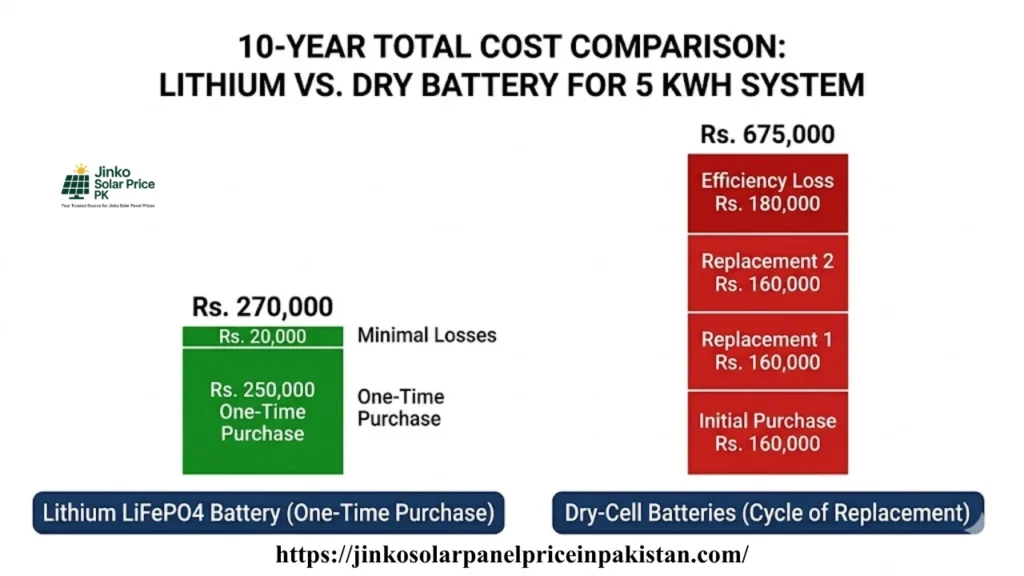
Scenario: 5 kWh Usable Storage Needed
| Cost Factor | Lithium (LiFePO₄) | Dry Battery (AGM) |
|---|---|---|
| Initial Purchase | Rs. 250,000 (5 kWh usable) | Rs. 160,000 (10 kWh rated → 5 kWh usable) |
| Replacements (10 years) | 0 | 2 replacements |
| Replacement Cost | Rs. 0 | Rs. 320,000 (2 × Rs. 160,000) |
| Total Battery Cost | Rs. 250,000 | Rs. 480,000 |
| Efficiency Loss (10 years) | ~500-1,000 kWh | ~5,000-7,000 kWh |
| Value of Efficiency Loss | ~Rs. 15,000-30,000 | ~Rs. 150,000-210,000 |
| Maintenance (10 years) | Rs. 0 | Rs. 10,000-20,000 |
| 10-Year Total Cost | ~Rs. 265,000-280,000 | ~Rs. 640,000-710,000 |
Conclusion:
Over 10 years, the lithium battery costs approximately 60% less than dry batteries despite being more expensive upfront. The longer you own the system, the more lithium wins. For those asking Is Solar Panels Worth It, pairing solar with lithium storage dramatically improves the financial case.
14. Best Applications for Each Battery Type
Lithium Battery is Best For:
- Daily cycling homes: Homes using battery power every night
- Hybrid systems: Frequent charge/discharge with grid charging
- High-temperature areas: Multan, interior Sindh, hot regions
- Space-constrained installations: Apartments, small homes
- Long-term investment: Owners planning 10+ years in same home
- Zero-maintenance preference: People who want install-and-forget
Dry Battery is Best For:
- Backup-only systems: Batteries used only during occasional load shedding
- Tight initial budget: Lower upfront cost
- Small systems: 1-2 kWh storage needs
- Temporary installations: Rental properties, short-term setups
- Where lithium unavailable: Remote areas with limited supply
15. Lithium Battery vs Dry Battery — Pros & Cons Summary
Lithium Battery (LiFePO₄)
| Pros | Cons |
|---|---|
| Long lifespan (10-15 years) | Higher upfront cost |
| High usable capacity (80-100% DoD) | Requires compatible inverter |
| Zero maintenance | Limited availability in remote areas |
| Excellent efficiency (95-98%) | Some cheap models lack good BMS |
| Lightweight and compact | Initial investment is significant |
| Works well in heat | Counterfeit products in market |
| Built-in BMS protection | |
| No gas emission | |
| 5-10 year warranty |
Dry Battery (AGM/Gel)
| Pros | Cons |
|---|---|
| Low upfront cost | Short lifespan (3-5 years) |
| Widely available | Low usable capacity (50% DoD) |
| Proven technology | Lower efficiency (80-85%) |
| Compatible with most inverters | Heavy and bulky |
| Simple installation | Performance degrades in heat |
| No BMS complexity | Requires ventilation |
| 1-2 year warranty | |
| Needs replacement 2-4 times in 10 years |
16. Top Battery Brands Available in Pakistan
Lithium Battery Brands:
| Brand | Origin | Warranty | Price Level |
|---|---|---|---|
| Inverex | Pakistan/China | 5-7 years | Mid-Range |
| Pylontech | China | 5-10 years | Mid-Range |
| BYD | China | 10 years | Premium |
| Narada | China | 5-7 years | Mid-Range |
| Ziewnic | Pakistan/China | 5 years | Budget-Mid |
| LG Energy | South Korea | 10 years | Premium |
| Tesla Powerwall | USA | 10 years | Premium |
Dry Battery Brands:
| Brand | Origin | Warranty | Price Level |
|---|---|---|---|
| AGS | Pakistan | 1-2 years | Budget |
| Osaka | Japan/Pakistan | 1-2 years | Mid-Range |
| Volta | Pakistan | 1-2 years | Budget |
| Phoenix | Pakistan | 1-2 years | Budget-Mid |
| Exide | India/Global | 1-3 years | Mid-Range |
For panel authenticity verification, similar principles apply — use Solar Panel Verification in Pakistan and Jinko Solar Panel Serial Number Check guides.
17. How to Choose the Right Battery for Your Solar System
Step 1: Calculate Your Nighttime Energy Need
List appliances running at night: fans, lights, fridge, AC. Calculate total watt-hours. Use a Solar Panel Load Calculator for accuracy.
Step 2: Apply DoD
- If choosing lithium: Divide nighttime need by 0.8-0.9
- If choosing dry battery: Divide nighttime need by 0.5
Step 3: Check Budget
- Can you afford the lithium upfront cost? If yes, choose lithium — it is cheaper long-term.
- Is budget tight and usage is backup-only? Dry battery may work.
Step 4: Consider Your Inverter
Some older inverters are not compatible with lithium BMS communication. Check before purchasing. New hybrid inverters almost universally support lithium.
Step 5: Plan for the Future
If you plan to expand your solar system later, lithium is modular and easier to scale. Adding dry batteries to an old bank reduces performance.
Step 6: Buy from Authorized Dealers
Counterfeit batteries exist. Use Authorized Solar Panel Distributor in Pakistan lists for trusted sellers.
18. Frequently Asked Questions
Which is better for solar — lithium battery or dry battery?
Lithium (LiFePO₄) is objectively better in every performance metric: lifespan, usable capacity, efficiency, weight, and long-term cost. Dry batteries win only on initial purchase price.
How long does a lithium battery last compared to dry battery?
Lithium: 10-15 years (4,000-7,000 cycles). Dry battery: 3-5 years (600-1,200 cycles). Lithium lasts 3-4 times longer.
Can I replace my dry battery with a lithium battery?
Yes, but ensure your inverter supports lithium BMS communication. Many older inverters need a firmware update or external BMS adapter. Consult your inverter manufacturer.
Are lithium batteries safe in Pakistani homes?
Yes. LiFePO₄ lithium batteries are thermally stable, emit no gases, and have built-in BMS protection. They are safer than dry batteries which can emit hydrogen and contain lead.
What is the price of a lithium battery in Pakistan?
Approximately Rs. 45,000-65,000 per kWh of rated capacity as of 2026. A 5 kWh lithium battery costs Rs. 220,000-300,000.
What is the price of a dry battery in Pakistan?
Approximately Rs. 18,000-30,000 per kWh of rated capacity. But remember only 50% is usable, so usable cost is Rs. 36,000-60,000 per kWh.
Can lithium batteries handle Pakistani summers?
Yes. LiFePO₄ lithium batteries operate well up to 60°C with minimal performance loss. Dry batteries degrade significantly in sustained heat above 35°C.
Do I need ventilation for lithium or dry batteries?
Lithium: No ventilation needed — zero gas emission. Dry battery: Yes, some ventilation recommended as hydrogen can accumulate under fault conditions.
Which battery is lighter — lithium or dry?
Lithium weighs 8-12 kg per kWh. Dry battery weighs 25-35 kg per kWh. Lithium is approximately one-third the weight.
What warranty do lithium and dry batteries come with?
Lithium: Typically 5-10 years. Dry battery: Typically 1-2 years. Always check warranty terms before purchase.
Is the higher cost of lithium battery worth it?
Yes. Over a 10-year period, lithium costs about 60% less than dry batteries despite higher upfront cost. The payback on the lithium premium is achieved within 3-5 years through avoided replacements.
Can I use lithium batteries with any solar inverter?
Not automatically. Lithium batteries communicate with inverters via BMS protocols. Check compatibility. Most modern hybrid inverters (Inverex, Solis, Growatt, GoodWe) support lithium. For inverter guidance, see Top 5 Best Hybrid Inverters .
19. Conclusion — Final Verdict
The lithium battery vs dry battery debate has a clear winner: lithium is the superior choice for almost every solar application. The only reason to choose dry batteries in 2026 is a tight initial budget for a backup-only system.
Choose Lithium Battery If:
- ✅ You cycle your battery daily
- ✅ You want install-and-forget (zero maintenance)
- ✅ You plan to stay in your home 5+ years
- ✅ You have space constraints
- ✅ You live in a hot region of Pakistan
- ✅ You understand that cheaper upfront ≠ cheaper overall
Choose Dry Battery If:
- ✅ Your budget is severely limited right now
- ✅ You only need backup for occasional load shedding
- ✅ Your existing inverter does not support lithium
- ✅ You are setting up a temporary system
The Bottom Line:
Lithium batteries represent the Future of Solar Energy storage. They are the standard in new installations globally. In Pakistan, the transition is accelerating as prices continue to fall and awareness grows. For a typical Pakistani home with a 5kW solar system, a 5 kWh lithium battery paired with a quality hybrid inverter provides reliable, maintenance-free power for 10-15 years.
For any questions about battery selection, system design, or compatibility, visit our FAQs or Contact Us . And for the latest solar panel and battery prices, always check the homepage at Solar Panel Price in Pakistan .
