
Pakistan Solar Market Updates 2026: New Net Metering Policy, Panel Rates & System Costs

Table of Content
Table of Contents
Introduction – Let Me Explain What’s Happening in Pakistan’s Solar Market
The solar energy landscape in Pakistan has undergone massive structural changes in June 2026. From the implementation of NEPRA’s new Prosumer Regulations to fluctuating Tier-1 solar panel prices per watt, navigating the transition to renewable energy requires updated, data-backed insights.
Whether you are looking to install a new residential solar setup or upgrade an existing commercial system, this comprehensive market analysis covers current hardware rates, inverter specifications, and policy updates.
📌 For the latest solar panel prices: 👉 Jinko Solar Panel Price in Pakistan
📌 Check our complete guide to the latest Net Metering Policy june 2026: 👉 latest Net Metering Policy june 2026
NEPRA New Net Metering Policy 2026 – Shift to Net Billing
NEPRA has officially implemented the “NEPRA Prosumer Regulations 2026” , introducing a paradigm shift from traditional net metering to a Net Billing mechanism. This policy directly impacts the Return on Investment (ROI) for solar consumers across all DISCOs (LESCO, K-Electric, IESCO, MEPCO, FESCO).
Let me explain the key policy transitions.
The Death of 1:1 Unit Swap
Solar consumers can no longer exchange exported daytime units with imported nighttime units on an equal 1:1 basis.
Slashed Buyback Rates
New net metering connections will export excess electricity to the national grid at a significantly reduced rate of Rs. 10 – 13 per unit. Conversely, peak and off-peak nighttime electricity imports remain high at Rs. 40 – 55 per unit (excluding structural taxes and fuel adjustment charges).
Grandfather Clause for Existing Users
Solar consumers with active net metering agreements signed prior to February 9, 2026, are legally protected. They will continue to receive legacy buyback rates until their current contract expires.
Reduced Contract Validity
The standard distribution license agreement duration for new applicants has been shortened from 7 years to 5 years.
Fixed Monthly Sanctioned Load Charges
A mandatory fixed monthly fee (starting from Rs. 1,687 for 5kW systems ) is now levied on 3-phase domestic meters, independent of actual energy consumption.
📌 Read about the latest electricity unit prices: 👉 Latest Electricity Unit Price in Pakistan
📌 Learn about Roshan Gharana government scheme: 👉 CM Punjab Free Solar Panel Scheme
government scheme : Solarization Program for Agri Tubewells
Solar Panel Prices in Pakistan – Per Watt Rates June 2026
Following fiscal adjustments in the Budget 2026-27 and supply-chain realignments, the market pricing for Tier-1 photovoltaic (PV) modules has stabilized. Current retail and wholesale trends show an upward trajectory compared to previous quarters.
Panel Technology Type Comparison
| Panel Technology Type | Current Price Range (Per Watt) | Technical Context & Market Reason |
|---|---|---|
| P-Type Mono PERC | Rs. 40 – 43 | Phasing out standard technology; lower manufacturing priority; higher annual degradation rates |
| N-Type TOPCon | Rs. 44 – 48 | Current market mainstream (e.g., Jinko Tiger Neo, Longi Hi-MO X10); enhanced temperature coefficient |
| Bifacial Double-Glass | Rs. 46 – 51 | Dual-sided power generation; optimal choice for maximum yield in high-albedo commercial installations |
City-Wise 585W Module Price Comparison
Lahore:
- Jinko 585W: Rs. 26,500 – 27,150
- Longi 585W: Rs. 27,495 – 29,000
- Canadian 585W: Rs. 21,645 – 22,500
Karachi:
- Jinko 585W: Rs. 26,200 – 26,800
- Longi 585W: Rs. 27,100 – 28,500
- Canadian 585W: Rs. 21,200 – 22,100
Islamabad:
- Jinko 585W: Rs. 26,700 – 27,350
- Longi 585W: Rs. 27,600 – 29,200
- Canadian 585W: Rs. 21,800 – 22,700
- 📌 Check specific Jinko panel prices: 👉 Jinko 585 Watt Solar Panel Price
- 📌 Compare with Canadian Solar: 👉 Canadian Solar Panel Price in Pakistan
- 📌 Compare with Longi Solar: 👉 Longi Solar Panel Price in Pakistan
- 📌 Compare with Trina Solar: 👉 Trina Solar Panel Price in Pakistan
Solar Inverter Price List 2026 – Hybrid, On-Grid & Off-Grid
Inverter choices now dictate the overall feasibility of solar systems. Increased competition among global manufacturers has optimized the pricing structures for residential and commercial smart inverters.
Inverter Price Comparison Table
| Inverter Type | Top Verified Brands | Supported Capacity | Current Market Price Range |
|---|---|---|---|
| Hybrid Inverter | Inverex (Nitrox), Solis, Growatt, GoodWe, Deye | 3kW – 15kW | Rs. 1.8 – 8.5 Lakh |
| Off-Grid Inverter | Ziewnic, Axpert, Must | 3kW – 10kW | Rs. 0.8 – 3.9 Lakh |
| On-Grid Inverter | Sungrow, GoodWe, Huawei, Solis | 3kW – 50kW | Rs. 1.6 – 7.3 Lakh |
- 📌 Check our top inverter recommendations: 👉 Top 5 Best Hybrid Inverter
- 📌 Read about off-grid inverter options: 👉 Top 5 Best Off-Grid Inverters
- 📌 Check on-grid inverter options: 👉 Top 5 Best On-Grid Inverters
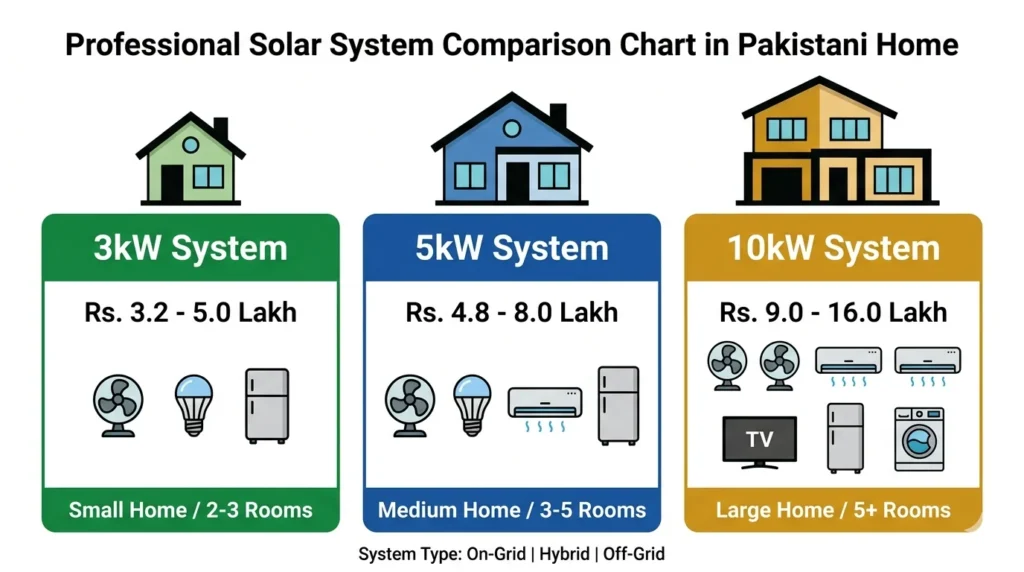
Complete Solar System Installation Costs in Pakistan
The capital expenditure (CAPEX) for complete turnkey solar systems inclusive of A-Grade panels, standard mounting structures, AC/DC premium wiring, and basic installation labor costs is categorized below.
3kW Solar System
| System Type | Cost Range | Suitability |
|---|---|---|
| On-Grid Cost | Rs. 3.2 – 3.8 Lakh | Small residential units (2-3 rooms running fans, LED lights, and a single inverter refrigerator) |
| Hybrid Cost | Rs. 4.0 – 4.8 Lakh | |
| Off-Grid Cost | Rs. 4.2 – 5.0 Lakh |
5kW Solar System
| System Type | Cost Range | Suitability |
|---|---|---|
| On-Grid Cost | Rs. 4.8 – 5.5 Lakh | Medium-sized homes (capable of sustaining 1 inverter air conditioner alongside basic domestic load) |
| Hybrid Cost | Rs. 6.5 – 7.5 Lakh | |
| Off-Grid Cost | Rs. 7.0 – 8.0 Lakh |
📌 Check our complete 5kW system guide: 👉 Jinko 6 kW Solar Panel System Price
10kW Solar System
| System Type | Cost Range | Suitability |
|---|---|---|
| On-Grid Cost | Rs. 9.0 – 10.5 Lakh | Large residential homes or small commercial offices (managing 3 to 4 air conditioners simultaneously) |
| Hybrid Cost | Rs. 13.5 – 15.5 Lakh | |
| Off-Grid Cost | Rs. 14.0 – 16.0 Lakh |
📌 Check our complete 8kW system guide: 👉 Jinko 8 kW Solar Panel System Price
📌 Calculate your exact power needs: 👉 Calculate Solar Panel Load
Strategic Expert Recommendation for Solar Consumers
Under the “Net Billing” framework of 2026, relying purely on On-Grid systems has extended the financial payback period from 2.5 years to 4.5 – 5.5 years. To maximize the economic efficiency of your solar asset, adopt these semantic optimization strategies.
Prioritize Self-Consumption
Program high-load appliances (water pumps, washing machines, and air conditioners) to run strictly during peak sunlight hours. This minimizes low-tariff daytime exports to the grid.
📌 Read our AC solar requirement guide: 👉 How Many Solar Panels Required for 1 Ton AC
Transition to Hybrid Energy Storage Systems (HESS)
Investing in Lithium Iron Phosphate (LiFePO4) batteries allows you to capture surplus daytime solar energy and deploy it during high-tariff evening hours, completely bypassing expensive grid imports.
📌 Learn about battery-based systems: 👉 Battery-Based Hybrid System
Verify Compliance
Ensure your chosen hybrid or on-grid inverter is actively listed on the NEPRA Approved Inverter List to prevent regulatory delays during green meter inspections.
📌 Read about solar panel verification: 👉 Solar Panel Verification Pakistan
📌 Contact authorized distributors: 👉 Authorized Solar Panel Distributor in Pakistan
Conclusion – What Does This Mean for You?
The latest Net Metering Policy june 2026 has changed the solar market in Pakistan. Here is what you need to know:
| Key Takeaway | Details |
|---|---|
| New Policy | Net Billing instead of Net Metering |
| Buyback Rate | Rs. 10-13 per unit (from Rs. 27 previously) |
| Existing Users Protected | Yes, until contract expires |
| Fixed Monthly Charge | Rs. 1,687 for 5kW systems |
| Best Option Now | Hybrid systems with battery storage |
| Payback Period | 4.5 to 5.5 years for on-grid systems |
📌 For the latest solar panel prices: 👉 Jinko Solar Panel Price in Pakistan
📌 Read the complete guide to the latest Net Metering Policy june 2026: 👉 latest Net Metering Policy june 2026
📌 Read more FAQs: 👉 FAQs – Solar Panel Guide
FAQs About Latest Net Metering Policy june 2026
Let me answer some common questions about the latest Net Metering Policy june 2026.
What is the difference between Net Metering and Net Billing?
Under Net Metering, you get 1:1 unit exchange. Under Net Billing, you sell excess power at a lower rate (Rs. 10-13 per unit) and buy at higher rates (Rs. 40-55 per unit). This is the key change in the latest Net Metering Policy june 2026.
Is the latest Net Metering Policy june 2026 applicable to existing users?
No. Existing users with agreements signed before February 9, 2026 are protected under the grandfather clause. They will continue with old rates until their contract expires.
What is the new buyback rate under the latest Net Metering Policy june 2026?
The new buyback rate is Rs. 10 to 13 per unit for new connections.
How long is the new net metering agreement valid under the latest Net Metering Policy june 2026?
The new agreement validity is reduced from 7 years to 5 years.
What is the fixed monthly charge under the latest Net Metering Policy june 2026?
A mandatory fixed monthly fee starting from Rs. 1,687 for 5kW systems is now levied on 3-phase domestic meters.
Should I install solar after the latest Net Metering Policy june 2026?
Yes, but you should consider hybrid systems with battery storage instead of pure on-grid systems to maximize savings.
How has the latest Net Metering Policy june 2026 affected payback period?
The payback period has increased from 2.5 years to 4.5-5.5 years for on-grid systems.
What is the current price of Jinko 585W panels under the latest Net Metering Policy june 2026?
Jinko 585W panels are priced at Rs. 26,200 to Rs. 27,350 depending on the city (Karachi, Lahore, Islamabad).
What inverter types work best with the latest Net Metering Policy june 2026?
Hybrid inverters are recommended to maximize self-consumption and reduce grid imports during peak tariff hours.
Is the latest Net Metering Policy june 2026 beneficial for commercial users?
The policy applies to all consumers. Commercial users should consider hybrid systems with storage to avoid high peak tariffs.
📌 Read more FAQs: 👉 FAQs – Solar Panel Guide
