Solar Panel Elevated Structure — Complete Global Guide

Table of Content
Table of Contents
1. What is a Solar Panel Elevated Structure?
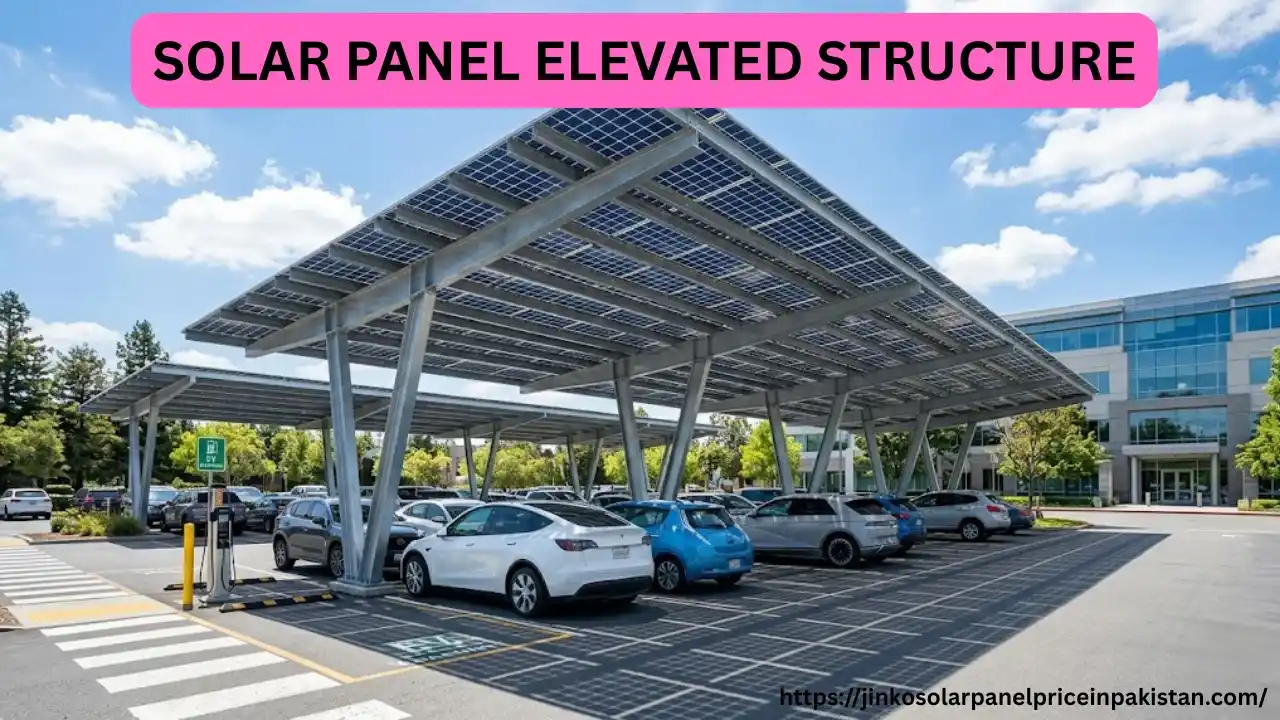
A solar panel elevated structure is a specially engineered mounting system that raises solar panels significantly above ground level or an existing surface, creating usable space underneath. Unlike standard rooftop mounts that sit just a few inches above the roof, or ground-mounted systems that sit close to the earth, an elevated structure lifts panels high enough for people, vehicles, or activities to exist comfortably beneath them.
Think of it as a solar carport, a solar canopy, or a solar pergola. These structures turn otherwise single-purpose solar installations into dual-purpose spaces. They generate clean electricity above while providing shade, shelter, or working space below.
The concept has gained massive traction globally over the past decade. From massive solar carports at corporate headquarters in Silicon Valley to elevated solar structures providing shade for livestock in Australia, the applications are diverse and growing rapidly.
When planning your solar journey, understanding your Solar Panel Installation Timeline helps you budget time for elevated structures, which typically require more engineering and installation days compared to standard rooftop mounts.
2. Why Choose an Elevated Structure for Solar Panels?
The simple answer: dual land use. In a world where space is increasingly precious, a solar panel elevated structure makes every square meter work twice. You are not sacrificing parking space, garden area, or walkways for solar panels. Instead, you are enhancing them.
Standard ground-mounted solar requires dedicating land exclusively to panels—land that could have been used for parking, farming, or recreation. Rooftop solar uses existing roof space but offers no additional utility. Elevated solar structures solve both limitations simultaneously.
Another major driver is thermal performance. When solar panels sit just inches above a hot rooftop or bare ground, they trap heat. This reduces their efficiency because solar panels lose approximately 0.3% to 0.5% of their power output for every degree Celsius above 25°C. An elevated structure allows air to circulate freely beneath the panels, keeping them cooler and more productive. For those considering whether solar is worth it, this efficiency gain matters — check Is Solar Panels Worth It to see how every percentage point affects your ROI.
3. 10 Key Benefits of Solar Panel Elevated Structure
| # | Benefit | What It Means |
|---|---|---|
| 1 | Dual-Purpose Land Use | Generate power above, park cars or host activities below |
| 2 | Improved Airflow & Cooling | Panels stay 5-10°C cooler, boosting efficiency 3-5% |
| 3 | Enhanced Shade Creation | Natural cooling for parked vehicles or outdoor areas |
| 4 | Weather Protection | Protects vehicles from hail, sun, rain, and snow |
| 5 | Easier Maintenance Access | Technicians can work standing upright beneath panels |
| 6 | Better Dirt & Dust Management | Higher elevation means less ground dust accumulation |
| 7 | Flood Protection | Panels remain safe above flood water levels |
| 8 | Agricultural Integration | Agrivoltaics — crops or livestock thrive under partial shade |
| 9 | Improved Property Value | Solar carports and canopies boost commercial property appeal |
| 10 | Longer Panel Life | Less heat stress means slower panel degradation rate |
The cooling benefit alone is substantial. Research shows that elevated panels with unrestricted airflow can operate 5-10°C cooler than flush-mounted rooftop panels. This translates to 3-5% more energy production annually. When you want to protect solar panels from hails, an elevated structure with proper overhead protection can serve double duty.
4. Applications of Solar Panel Elevated Structure Worldwide
Residential Applications
Homeowners worldwide are embracing solar panel elevated structures as solar pergolas and patio covers. These structures transform outdoor living spaces into shaded, energy-producing areas. A family in Spain might install an elevated solar pergola over their terrace, enjoying afternoon shade while generating electricity. In Japan, where space is premium, elevated solar carports for single homes are increasingly common.
Commercial Applications
Corporate campuses and shopping centers represent the fastest-growing segment. Mega-retailers across North America and Europe install elevated solar carports covering thousands of parking spaces. Employees and customers park under shade, vehicles stay cool, and the business offsets significant electricity costs. These installations also send a powerful sustainability message that customers appreciate.
Agricultural Applications (Agrivoltaics)
This is perhaps the most exciting application. Elevated solar structures allow farming to continue beneath the panels. In France, vineyards use elevated solar panels to provide partial shade for grape vines during increasingly hot summers. In Japan, farmers grow mushrooms and leafy greens under elevated solar structures. In Australia, sheep graze freely under solar panels elevated 2-3 meters above ground. This approach is part of the broader Future of Solar Energy trend toward integrated, multi-purpose solar.
Public Infrastructure
Airport parking lots, university campuses, stadium parking, and highway rest stops increasingly feature solar panel elevated structures. These public installations serve as highly visible demonstrations of renewable energy commitment while providing practical shade and shelter.
5. Types of Solar Panel Elevated Structure
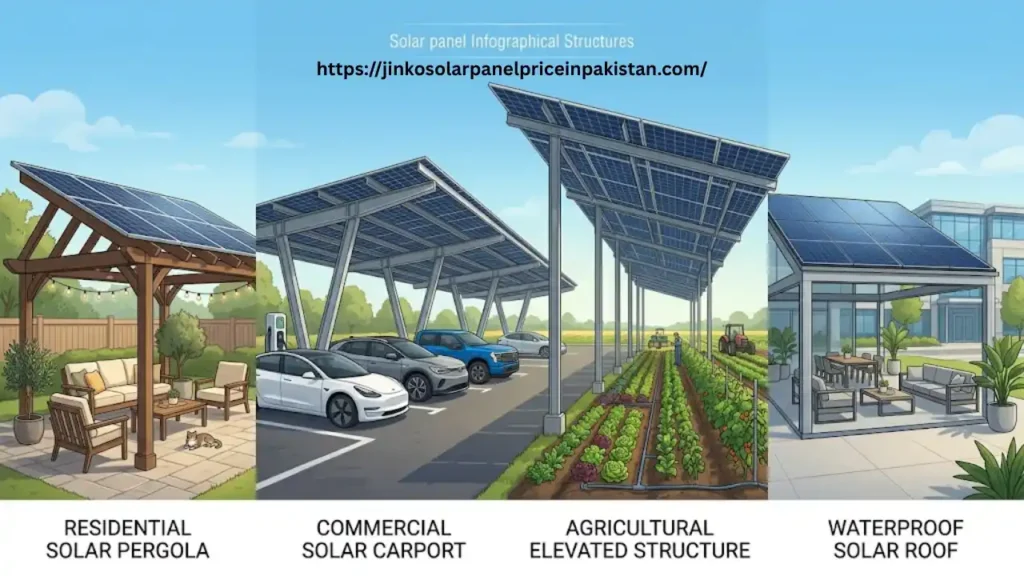
Solar Carports (Cantilever Style)
The most common commercial application globally. Single columns support a canopy of panels, maximizing parking space underneath. These structures can be single-row (covering one row of parking) or double-cantilever (covering two rows from a central column).
Solar Canopies (Tee-Style)
A single I-beam post supports a roof of solar panels. Tee-style structures are the most cost-effective for medium spans (15-25 feet). They provide unobstructed space beneath with minimal column footprint.
Solar Pergolas (Residential)
Designed for aesthetics and outdoor living. Residential solar pergolas combine the architectural beauty of a pergola with the functionality of solar panels. They are commonly installed over patios, decks, or garden seating areas.
Truss-Style Structures
For longer spans (25-40+ feet) where columns would obstruct space, truss-style elevated structures provide beam strength without intermediate supports. Common in industrial yards, loading bays, and large commercial spaces.
Waterproof Solar Roofs
The premium option. These solar panel elevated structures create a completely watertight roof using specialized interlocking panel frames and sealing systems. They transform outdoor areas into all-weather usable spaces with the added benefit of power generation.
Inverted V-Style (Butterfly Design)
Panels are angled in a V-shape, often used in regions with high rainfall. Water drains to the center and is collected for reuse. The V-design also provides an architectural focal point.
6. Materials Used in solar panel elevated structure
Structural Steel
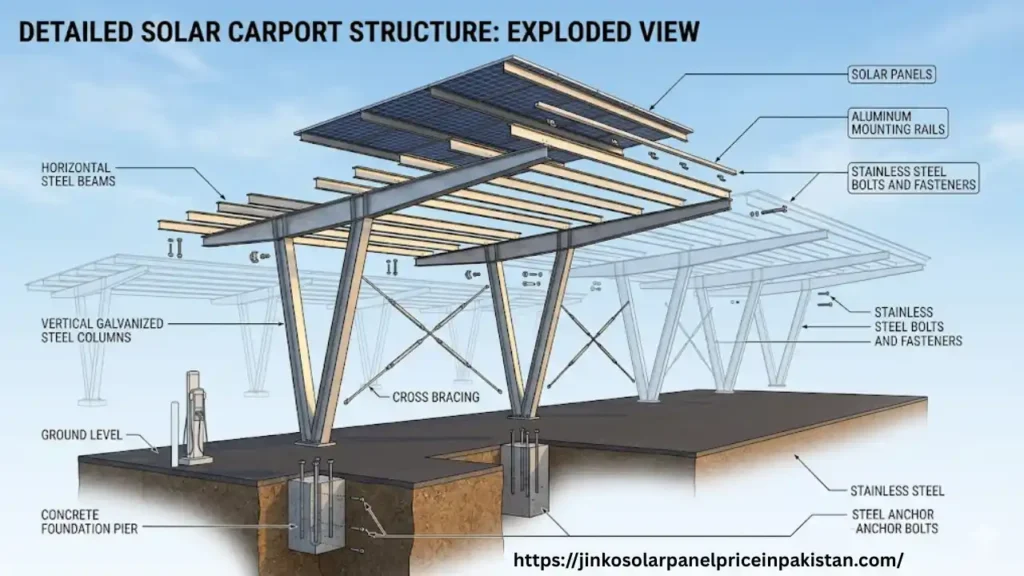
Hot-dip galvanized steel is the industry standard for large commercial solar panel elevated structures. It provides exceptional strength-to-cost ratio, can span long distances, and with proper galvanization, resists corrosion for 25+ years. Cold-formed galvanized steel pipes are commonly used for vertical members in structures engineered for wind speeds up to 170 km/h.
Aluminum
Premium residential and light commercial structures often use anodized aluminum. It is naturally corrosion-resistant, lighter than steel, and offers a cleaner aesthetic. Aluminum structures are preferred in coastal regions due to superior salt-air resistance. For corrosion protection in coastal areas, the material choice is critical — similar considerations apply when selecting Monocrystalline Solar Panel frames.
Stainless Steel Hardware
All bolts, nuts, washers, and fasteners must be stainless steel (SS304 or SS316 grade). Using regular steel hardware creates galvanic corrosion points that weaken the entire structure over time.
Concrete Foundations
Most elevated structures use reinforced concrete piers or footings. The foundation design depends on soil conditions, wind load requirements, and local building codes. In seismic zones, foundations require additional engineering for earthquake resistance.
7. Height and Design Considerations
International Height Standards
The definition of an elevated solar structure varies by application and jurisdiction. According to the International Building Code, an elevated PV support structure designed with usable space underneath must have a minimum clear height of 7 feet 6 inches (2286 mm). This allows safe pedestrian passage or vehicle parking beneath the panels.
For agricultural applications, heights range from 2 meters (for small livestock) to 4+ meters (for machinery access). In some jurisdictions, rooftop solar systems cannot exceed 2.5 meters in total height, with those above 1.5 meters requiring structural engineer certification.
Key Design Factors
| Factor | Consideration |
|---|---|
| Wind Load | Taller structures catch more wind. Engineering must account for local maximum wind speeds |
| Snow Load | In cold climates, elevated structures must support heavy, wet snow accumulation |
| Seismic Activity | Earthquake-prone regions require flexible joints and specialized foundation design |
| Panel Tilt Angle | The structure height must accommodate optimal panel tilt for the latitude |
| Drainage | Water must flow freely off panels and away from the useable space below |
| Access | Maintenance crews need safe access paths to all panels |
| Aesthetics | Residential structures must complement home architecture |
8. Global Cost Analysis of solar panel elevated structure
Costs vary significantly by region, material choice, and structure complexity. The following provides global ranges to set expectations.
| Structure Type | Global Cost Range (USD per watt) | Notes |
|---|---|---|
| Residential Solar Pergola | 0.40—0.80/W | Aluminum frame, aesthetic finish |
| Commercial Carport (Single Row) | 0.35—0.65/W | Galvanized steel, cantilever design |
| Commercial Carport (Double Row) | 0.30—0.55/W | Central column, two parking rows |
| Waterproof Solar Roof | 0.60—1.20/W | Premium interlocking system |
| Agricultural Elevated (Simple) | 0.25—0.50/W | Basic steel, higher clearance |
| Agricultural Elevated (Tracking) | 0.50—0.90/W | Adds single or dual-axis tracking |
Important: These costs represent the elevated structure only — not including solar panels, inverters, or electrical work. A complete installed system cost adds 0.50−1.00/W for panels, inverters, wiring, and labor. For understanding panel pricing separately, always check the latest Solar Panel Price in Pakistan or your local market rates.
Compared to standard ground-mounted structures (typically 0.10−0.25/W for the mounting structure alone), elevated systems have a higher upfront cost. However, the dual-use benefit and efficiency gains often deliver better lifetime ROI. To calculate your system size and understand the full economics, use a Solar Panel Load Calculator .
9. Elevated vs Ground-Mounted vs Rooftop — Full Comparison
| Factor | Elevated Structure | Ground-Mounted (Standard) | Rooftop |
|---|---|---|---|
| Space Underneath | Fully usable (parking, farming, living) | None (dedicated land) | None (roof only) |
| Panel Cooling | Excellent airflow | Good airflow | Poor (heat trapped) |
| Efficiency Gain | 3-5% | 2-3% | 0% (baseline) |
| Installation Complexity | High (needs foundation, engineering) | Medium (basic foundation) | Low-Medium |
| Structure Cost | 0.30−1.20/W | 0.10−0.25/W | 0.05−0.15/W |
| Maintenance Access | Easiest (walk underneath) | Easy (walk around) | Difficult (rooftop work) |
| Wind Vulnerability | Higher (catches wind) | Medium | Low-Medium |
| Aesthetic Appeal | High (architectural feature) | Low (industrial look) | Low (barely visible) |
| Best For | Commercial, agrivoltaics, premium homes | Utility-scale, rural homes | Urban homes with limited land |
The choice depends on your priorities. If land is abundant and cost is the primary concern, standard ground-mounted wins. If space is limited or dual-use is desired, a solar panel elevated structure is the clear winner despite the higher upfront investment.
10. Installation Guide — Step-by-Step
Installing a solar panel elevated structure is significantly more complex than standard mounts. It requires structural engineering, foundation work, and careful coordination.
Step 1: Site Assessment & Engineering
A structural engineer evaluates soil conditions, wind loads, snow loads, and seismic requirements. The design must comply with local building codes. This step produces stamped engineering drawings.
Step 2: Permitting
Submit engineering plans to local building authorities. Approval timelines vary from weeks to months depending on jurisdiction.
Step 3: Foundation Work
Dig and pour reinforced concrete footings or piers. In some cases, driven piles are used instead of concrete. Foundation must cure fully (typically 7-14 days) before proceeding.
Step 4: Steel/Frame Erection
Vertical columns are anchored to foundations. Horizontal beams are bolted into place. The skeleton of the structure is completed and checked for alignment.
Step 5: Panel Rails & Mounting Hardware
Aluminum or steel rails are attached to the frame. These rails will hold the solar panels in precise alignment.
Step 6: Solar Panel Installation
Panels are lifted and secured onto rails. Proper torque specifications are followed for all clamps and bolts.
Step 7: Electrical Work
Inverters, wiring, conduit, and grid connection are completed by licensed electricians. All connections must be weatherproof.
Step 8: Inspection & Commissioning
Local authority inspects the structure and electrical work. System is energized and tested.
Typical timeline: 4-12 weeks from engineering to commissioning, depending on project size. For details on panel-level installation steps, see our Solar Panel Installation Timeline .
11. Wind & Weather Resistance
Elevated structures face greater wind exposure than ground or rooftop mounts. Proper engineering is critical.
Wind Load Design
Structures must be engineered for the maximum wind speed expected in the location over a 50-year period. In hurricane-prone regions (Florida, Caribbean, Philippines), this can exceed 250 km/h. The structure uses thicker steel, deeper foundations, and additional bracing.
Hail Protection
An elevated structure provides some natural protection against hail for whatever sits beneath it. However, the solar panels themselves remain exposed. For panel-level hail protection, methods like stainless steel mesh shields can be integrated into the elevated design. Learn more in our guide on how to Protect Solar Panels from Hails .
Snow Management
In cold climates, the elevated design allows snow to slide off panels without accumulating on walkways or parking areas below. The angle and height can be optimized for snow shedding.
Corrosion Protection
Coastal installations require hot-dip galvanized steel (minimum 85 microns thickness) or anodized aluminum with SS316 hardware. Regular inspection of coating integrity is part of maintenance.
12. Maintenance Tips for Elevated Structures
| Task | Frequency | Notes |
|---|---|---|
| Visual inspection of structure | Every 6 months | Check for rust, loose bolts, cracks |
| Torque check on bolts | Annually | Use calibrated torque wrench |
| Panel cleaning | As needed | Elevated access is easier — use proper Solar Panel Cleaning Tools |
| Foundation check | Annually | Look for cracks, settling, water pooling |
| Coating/paint touch-up | As needed | Address any corrosion spots immediately |
| Drainage check | Quarterly | Ensure water flows freely, no pooling |
| Electrical inspection | Annually | Licensed electrician checks all connections |
The good news: maintenance on elevated structures is generally easier than rooftop systems because technicians can work from underneath or from ground level with extended tools. For panel cleaning frequency and methods, our guide on Do I Need to Clean My Solar Panels provides detailed advice.
13. Frequently Asked Questions
What is the minimum height for a solar panel elevated structure?
For usable space underneath, the International Building Code specifies 7 feet 6 inches (2286 mm) minimum clear height. For agricultural applications with livestock, heights of 2-3 meters are common.
How much more does an elevated structure cost compared to ground-mounted?
Elevated structures typically cost 2-3 times more than standard ground-mounted systems for the mounting structure portion. However, the dual-use value often offsets this premium within the system lifetime.
Can I install an elevated solar structure myself?
No. These structures require professional engineering, foundation work, and often heavy equipment. DIY installation of elevated structures is dangerous and likely violates local building codes.
Will an elevated structure damage my property’s drainage?
Properly designed structures include drainage planning. Water should flow off panels and into existing drainage systems without creating pooling or erosion.
How long does an elevated solar structure last?
With proper materials (hot-dip galvanized steel or anodized aluminum) and maintenance, the structure itself should last 30+ years — matching or exceeding the lifespan of the solar panels. For panel lifespan details, check our Bifacial Solar Panel guide.
Do I need special permits for an elevated structure?
Yes. Most jurisdictions require building permits, structural engineering stamps, and electrical permits. Some also require zoning approval, especially for commercial carports visible from roads.
Are elevated structures suitable for windy areas?
Yes, but they require wind-specific engineering. Structures in high-wind zones use deeper foundations, thicker steel, and additional cross-bracing.
Can existing ground-mounted systems be converted to elevated?
Generally no. The original foundations and mounting hardware are not designed for elevation. A new elevated structure would need to be built from scratch.
What is agrivoltaics and how does it relate to elevated structures?
Agrivoltaics combines agriculture with solar power generation. Elevated structures are essential for agrivoltaics because they allow farming activities beneath the panels. Crops, livestock, or farm machinery can operate in the shaded area underneath.
Does an elevated structure affect panel warranty?
Generally no, as long as the structure is properly engineered and does not subject panels to excessive flex, vibration, or uneven loading. For panel authenticity and warranty verification, see Jinko Solar Panel Serial Number Check .
14. Conclusion
A solar panel elevated structure represents the evolution of solar from a simple energy technology to an integrated architectural and land-use solution. Whether you are a homeowner wanting a shaded patio that generates power, a business owner looking to turn parking lots into energy assets, or a farmer exploring agrivoltaics, elevated solar structures offer compelling benefits.
The upfront cost is higher than standard mounts. The engineering is more complex. The permitting requires more patience. But the payoff — dual-purpose land use, improved panel efficiency, easier maintenance, and enhanced property value — makes the investment worthwhile for the right application.
Before committing, consult with a structural engineer familiar with solar installations in your region. Understand local building codes. Work with reputable installers who have elevated structure experience. And always verify that you are getting authentic, high-quality panels through sources listed in our Authorized Solar Panel Distributor in Pakistan guide or equivalent in your country.
The future of solar is not just about generating power. It is about integrating power generation seamlessly into how we live, work, and farm. Elevated solar structures are a significant step toward that integrated future. For more on where solar technology is heading, explore our Future of Solar Energy article. And for any questions about solar structures, maintenance, or panel selection, visit our FAQs or Contact Us .
