
Solar Panel Flash Test Report: What It Is and Why It Matters

A flash test report is the factory’s written proof that a solar panel really produces the wattage printed on its label. Before it leaves the factory, a machine flashes it with sunlight-like light and measures its exact power. If the report’s serial number and measured wattage match your panel and its label, you have strong proof you got what you paid for. If there is no report, or the numbers do not match, do not pay until it is explained.

What Is a Flash Test Report?
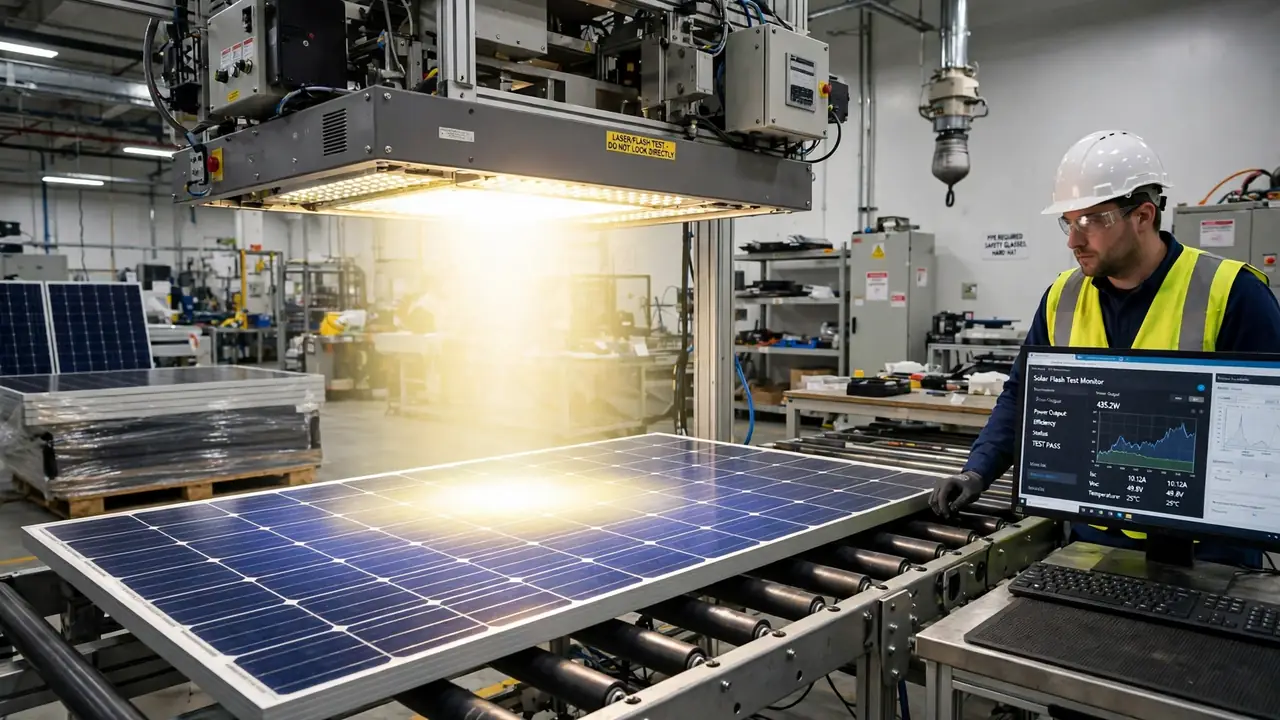
A flash test report is a factory document listing the measured electrical numbers of one specific solar panel. Every panel from a proper factory is tested one by one. The test is called a flash test — also a sun simulator test — because the panel is flashed with a short, bright pulse of light from a xenon lamp while a computer records how it reacts.
The flash copies sunlight, and the test runs under fixed laboratory conditions called Standard Test Conditions, or STC: light of 1,000 watts per square metre, a cell temperature of 25 degrees Celsius, and the same amount of air as real sunlight at midday. Every panel is tested the same way, so results can be compared fairly.
The report is usually a printed sheet the dealer keeps, listing the panel model, the serial number tested, the test date, and the measured numbers: maximum power, voltages, currents, and fill factor. What matters is simple: your panel’s serial number should be on that report, and its numbers should match the label on the back of your panel.
What Happens During a Flash Test?
The test takes only a few seconds. The finished panel is placed in the flash test machine, and a xenon lamp fires a bright flash lasting only a few thousandths of a second — between 1 and 30 milliseconds. The flash is short on purpose: long enough to measure the panel, but short enough that it does not heat up and change the result.
While the light flashes, the machine measures the panel’s current and voltage across a full range, from zero voltage to the point where no current flows. This curve is called the current-voltage curve, or I-V curve. From it, the computer works out the panel’s maximum power point — where it produces the most power — and records the numbers.
The machine also checks your panel against a reference module — a panel whose exact power was measured in advance by a qualified laboratory — so the result is real, not a machine error. The numbers are saved against the panel’s serial number, and panels are sorted by measured power into classes. That class is printed on the label — which is why the report matters: the wattage on the label comes from this very test.
The Numbers on a Flash Test Report
A flash test report can look confusing at first — but there are only a few numbers you need to understand.
| Number on the report | What it means | What to check |
|---|---|---|
| Pmax (W) | Maximum power produced in the test | Must match the label |
| Voc (V) | Voltage when no current flows | Close to datasheet value |
| Isc (A) | Current when voltage is zero | Close to datasheet value |
| Vmp (V) | Voltage at maximum power | Close to datasheet value |
| Imp (A) | Current at maximum power | Close to datasheet value |
| Fill factor (%) | How well the panel turns light into power | Higher is better |
Pmax — the Number That Matters Most
Pmax is the maximum power the panel produced in the flash test — the single most important number on the report. If you are buying a panel sold as 585 watts, its Pmax should read around 585 watts: good brands work to a simple rule that measured power should not fall below the label. A panel measuring clearly below its label is not the panel you are paying for.
Voc, Isc, Vmp and Imp — the Four Electrical Numbers
Voc is the open-circuit voltage — the voltage when nothing is connected and no current flows. Isc is the short-circuit current — the current when the terminals are connected and voltage drops to zero. Vmp and Imp are the voltage and current at the panel’s maximum power point — multiply them and you get Pmax, the real power your inverter works with. Check that Vmp times Imp roughly equals the Pmax printed next to them, and that all four numbers sit close to the datasheet values. If any is far off, something is wrong with the panel or the report.
Fill Factor — a Quick Quality Check
Fill factor is a percentage showing how good the panel is at turning light into usable power — Pmax divided by Voc times Isc. A high fill factor means well-made cells, clean connections, and little power lost inside the panel. A low one means weak cells, poor connections, or damage you cannot see. Just look at the number: if it is clearly lower than the datasheet value, treat it as a warning sign.
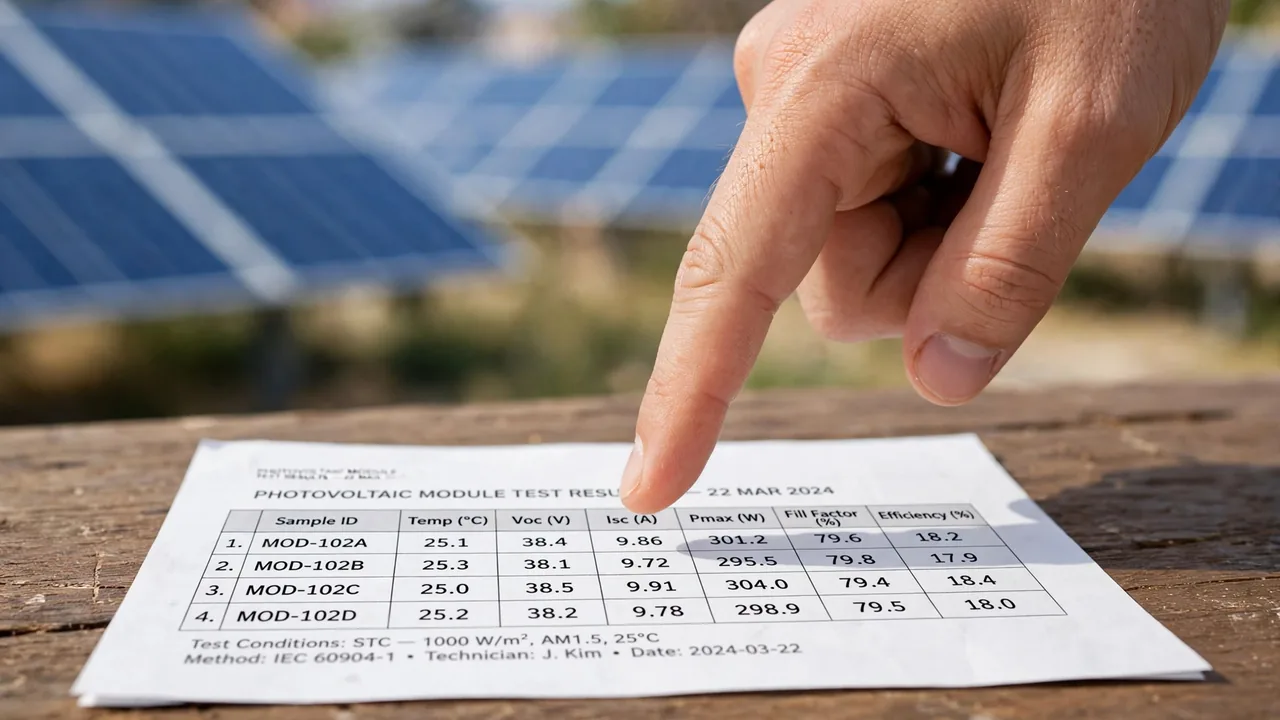
Flash Test Report vs Datasheet — Don’t Mix Them Up
Buyers often confuse the flash test report with the datasheet, because both list similar numbers. But a datasheet describes a whole model — the rated numbers for every panel of one type, one sheet covering thousands of panels. A flash test report describes one panel — yours — and lists the numbers your exact panel actually produced at the factory.
Think of it this way: the datasheet is the promise, and the flash test report is the proof. Compare the two when you buy — the report’s numbers should sit close to the datasheet’s numbers for that model. If they are far apart, either the panel is not what it claims to be, or the report belongs to a different panel. Our guide on how to read a solar panel datasheet explains every datasheet number in plain words.
How to Read a Flash Test Report in 5 Steps
Follow these five steps at the shop, before you pay.
Step 1: Match the Serial Number
Find the serial number on the report and compare it with the serial number on the back label of the panel you are buying, and with the number under the front glass and on the frame. All of them should agree — if the report shows a different number, it belongs to a different panel.
Step 2: Check Pmax Against the Label
Look at the Pmax on the report and compare it with the wattage on the panel’s back label. They should match, or sit very close together. A panel that measures clearly below its label is not delivering what you are paying for. This is the single most important check on the whole report.
Step 3: Compare the Other Numbers With the Datasheet
Take the datasheet for the exact model and compare Voc, Isc, Vmp, and Imp with the report. Small differences are normal — no two panels are identical — but large gaps are not. If the report’s numbers are far from the datasheet, ask the dealer why.
Step 4: Check the Fill Factor
Look at the fill factor on the report and compare it with the datasheet. A fill factor clearly below the model’s normal value points to weak cells or poor connections — a quiet warning sign many buyers miss, because they only look at Pmax.
Step 5: Check the Test Date and the Lab
Look for the test date and the factory or laboratory that ran it. A report with no date, no lab name, or a photocopied look is not a real report for your panel.
Red Flags in a Flash Test Report
Some reports are genuine; some are not worth the paper they are printed on. Watch for these warning signs:
- No report at all: the dealer says it is “not available” and never produces it.
- Serial number does not match: the number on the report differs from your panel’s number, so it proves nothing.
- Pmax below the label: the measured power is clearly lower than the wattage on the panel.
- Numbers that don’t add up: Vmp times Imp does not roughly equal Pmax — the report may have been typed by hand.
- One report for every panel: the same sheet is shown for all panels in the shop. A real report is per-panel.
If you see one of these signs, do not argue and do not pay — ask for the correct report for your panel’s serial number, or buy from a dealer who can show it. The same rule applies to used panels: our guide on buying used solar panels in Pakistan puts the flash test report at the top of its checks, because an old panel without a report is a gamble.
Why the Report Matters So Much in Pakistan
In Pakistan, most buyers cannot visit the factory. You buy from a dealer in a shop and trust what the dealer tells you. The flash test report is the one document that lets you check that claim with your own eyes — before the panel goes on your roof.
It matters for three reasons. First, it proves the wattage: a label can be reprinted, but a matching factory report with the right serial number is much harder to fake. Second, it proves the grade: a genuine A-grade panel comes with a proper report, while panels sold without one are often lower-grade panels sold as A-grade — our A-grade vs B-grade guide explains the difference. Third, it protects your warranty: if a panel underperforms later, the report is the factory’s record of what it measured on day one.
The report also protects you against fakes: a copied panel may look right from the outside, but it will not have a genuine factory report with a matching serial number. Check it with our solar panel verification guide for Pakistan and our fake vs original solar panel guide — and for Jinko panels, the guide on checking a Jinko serial number shows how the brand’s own portal works. Buying from an authorized solar panel distributor in Pakistan makes this easier.
One honest note: the flash test measures the panel under laboratory conditions, not on your roof. On a real rooftop, heat, dust, shade, and the sun’s angle all reduce output below the laboratory number — normal for every panel, not a fault. Use the report to compare panels fairly, not to predict your daily units. For the full routine, our checklist before buying solar panels covers every check.
What to Do If the Dealer Cannot Show a Report
Sometimes the dealer genuinely does not have the report in the shop — it may be with the distributor or in a digital file. That alone is not proof of a bad panel, but it is a reason to pause, not to pay. Ask the dealer to get the report for your panel’s serial number before you pay; a dealer selling genuine panels can usually produce it within a day. If the dealer refuses, buy elsewhere.
Never pay in full for panels you have not checked. Check the serial numbers, ask for the flash test report, read the datasheet, and keep copies of everything — the report, the invoice with the serial numbers on it, and the warranty card. Those papers protect you for years. For the technical background, Sinovoltaics explains flash testing and its importance in detail.
Check Current Prices
Now you know how to read a flash test report — the next step is seeing what genuine, properly tested panels go for today. Check the solar plate price in pakistan, the solar panel price in pakistan and the jinko solar panel price in pakistan listings on our homepage, updated daily.
Frequently Asked Questions (FAQs)
What is a flash test report for a solar panel?
A flash test report is a factory document that lists the measured electrical numbers of one specific solar panel — its maximum power, voltages, currents, and fill factor — along with the panel’s serial number and the test date. Every panel from a proper factory is flash-tested one by one before it is packed, and the report is the written proof of what that exact panel produced.
What does a flash test measure?
A flash test measures the panel’s electrical performance under Standard Test Conditions: light of 1,000 watts per square metre, a cell temperature of 25 degrees Celsius, and the same air as real sunlight at midday. The machine flashes the panel with a xenon lamp, records its current-voltage curve, and works out Pmax (maximum power), Voc, Isc, Vmp, Imp, and fill factor.
How do I read a flash test report?
Start with two checks: match the serial number on the report with the serial number on the back label of your panel, then compare Pmax on the report with the wattage printed on the label — they should match. Then compare Voc, Isc, Vmp, Imp, and fill factor with the datasheet for the exact model, and check the test date and the laboratory that ran the test.
What should the measured wattage be on the report?
The measured Pmax should match the wattage printed on the panel’s label, or sit very close to it. Good brands work to a simple rule that the measured power should not fall below the label. A panel that measures clearly below its label on its own factory report is not delivering what you are paying for.
Is a flash test report the same as a datasheet?
No. A datasheet describes a whole model — the rated numbers for every panel of one type, the same sheet covering thousands of panels. A flash test report describes one panel — yours — and lists the numbers your exact panel actually produced when it was tested at the factory. The datasheet is the promise; the flash test report is the proof.
Can a dealer fake a flash test report?
Yes, a report can be faked — usually by typing up a sheet by hand, photocopying one report for every panel, or showing a report with a different serial number. That is why you must check that the serial number matches your panel, that Vmp times Imp roughly equals Pmax, and that the report carries a test date and a laboratory name. A report that fails these checks proves nothing.
Do all solar panels come with a flash test report?
Every panel from a proper factory is flash-tested, and a report exists for each one. Whether the dealer can show it to you is another matter — the report may be with the distributor or in a digital file. A dealer selling genuine panels can usually produce the report for your serial number within a day. If the dealer refuses, buy elsewhere.
What if my dealer cannot show a flash test report?
Do not pay in full. Ask the dealer to get the report for your panel’s serial number before you pay, and to show you the serial numbers on the panels you will receive. If the dealer refuses, changes the subject, or offers a report for a different serial number, treat that as your answer and buy from a dealer who can show the report.