
Net Metering for 5kW vs 10kW Systems: Key Differences

Net metering for 5kW vs 10kW systems works on the same rule — your bi-directional meter records the units you import from the grid and the surplus solar units you export to it, and your bill is based on the difference. The real difference between the two sizes is scale: a 10kW system has roughly twice the panel capacity of a 5kW system, so it generates roughly twice the electricity, needs roughly twice the roof space, needs a larger sanctioned load from your DISCO, and suits a much bigger home. A 5kW system fits a moderate home with one air conditioner and normal appliances; a 10kW system fits a large home running two or three air conditioners and heavier daytime loads. This guide compares the two sizes across every factor that matters for net metering, so you can choose the size that matches your home instead of guessing.
Both sizes connect to the grid the same way, follow the same net metering policy, and use the same kind of bi-directional meter. What changes is how much you generate and export, how much roof and sanctioned load you need, and how your monthly bill behaves. This guide compares the net metering 5kw vs 10kw system decision across every factor that matters, so you can choose the size that matches your home.
5kW vs 10kW Net Metering at a Glance
The table below compares the factors that change with size — everything else about net metering stays the same.
| Factor | 5kW System | 10kW System |
|---|---|---|
| Panel capacity | 5 kilowatts | 10 kilowatts |
| Typical panel count | About 8 to 9 panels | About 17 to 18 panels |
| Roof space needed | Modest — one small roof section | Large — about double the area |
| Electricity generated | Enough for a moderate home | Roughly double a 5kW system |
| Sanctioned load needed | Lower — suits a standard home connection | Higher — may need a load increase |
| Best for | Small to medium homes, one air conditioner | Large homes, two or three air conditioners |
| Export to the grid | Moderate surplus on sunny days | Large surplus, especially at midday |
| Inverter size | 5kW inverter | 10kW inverter |
The panel counts above assume modern high-wattage panels of around 580 watts each. If you use smaller panels, the count rises; the total capacity is what matters, not the number of panels. Our 5kW solar system planning guide and 10kW solar system planning guide explain each size in more detail.
How Much Electricity Each Size Generates
A solar system’s output depends on its capacity and on sunshine. Under the same roof, the same tilt and the same weather, a 10kW system generates roughly twice as much electricity as a 5kW system, because it has twice the panel capacity. That simple relationship is the starting point for the whole comparison.
For a sense of scale, a 5kW system typically covers the daytime needs of a moderate home: fans, lights, a fridge, a television, a washing machine and one air conditioner. A 10kW system covers all of that plus more — two or three air conditioners, a water pump and other heavy appliances running during the day. If you want exact daily generation figures, see our guide on how many units a 10kW solar system produces per day and compare it with your own monthly bill. Generation varies by season — both sizes produce more in the long, clear days of summer and less in the short, hazy days of winter — but the ratio between them stays the same, so seasonal change does not change which size is right for you.
Roof Space: The First Practical Difference
Roof space is often the factor that decides the size before anything else. A 10kW system needs about double the clear, shade-free roof area of a 5kW system, because it carries about double the panels. On a small roof, a 10kW array may simply not fit, no matter how much electricity the home uses.
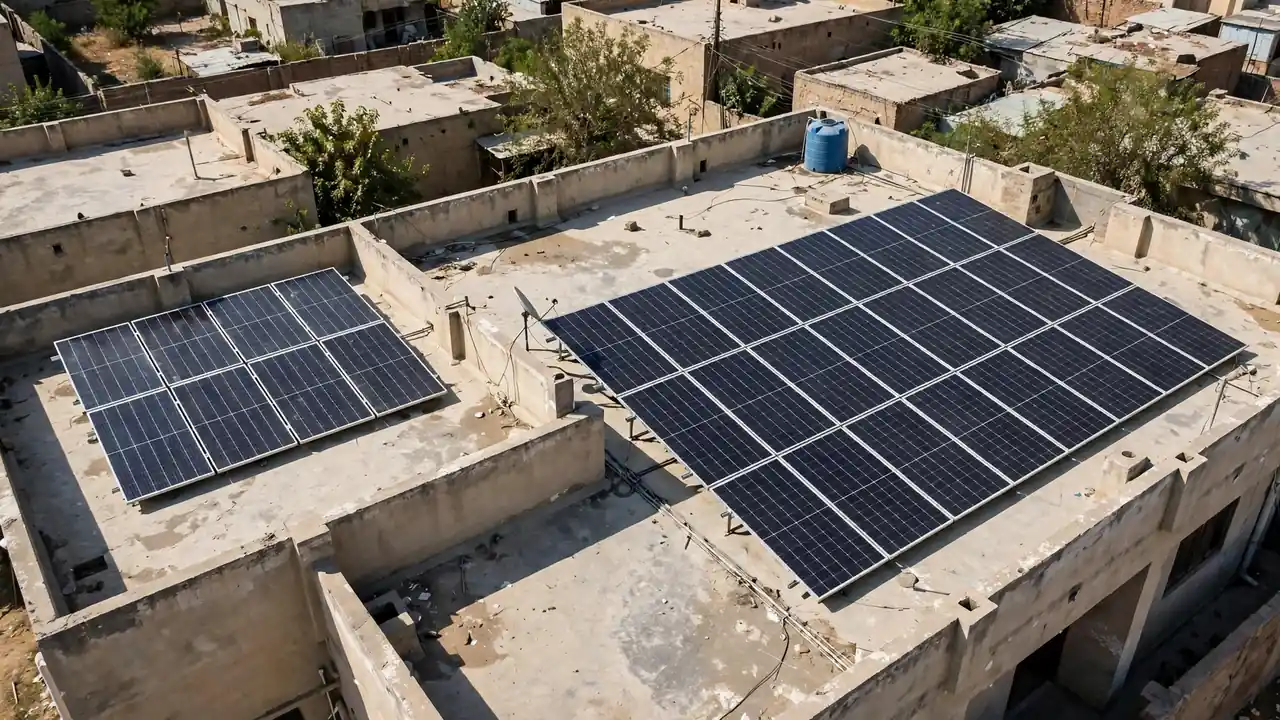
If your roof can only hold a 5kW array comfortably, that is a strong signal — oversizing onto a shaded or cramped roof wastes the extra capacity. On a large, open roof the decision shifts from space to your electricity consumption and your sanctioned load, covered below.
Sanctioned Load: The Rule That Decides Your Maximum Size
Sanctioned load is the maximum electricity load your DISCO has approved for your connection, and it sets a ceiling on the solar system you can install under net metering. Your system size cannot exceed the limit tied to your sanctioned load, so a home with a small sanctioned load may not be allowed a 10kW system at all until the load is increased.
This is where the two sizes often part ways in practice. A 5kW system usually fits within the sanctioned load of a standard home connection, so approval is straightforward. A 10kW system often needs a higher sanctioned load, which means applying for a load increase, possibly upgrading the service cable and meter, and waiting for the DISCO to approve it. The process is explained in our guide on what sanctioned load means in net metering.
Check your sanctioned load on your electricity bill before you plan the system size. If the load is too low for 10kW, you have two honest options: increase the sanctioned load first, or install the 5kW system your connection already supports. A system larger than your sanctioned load allows is a common reason net metering applications get delayed.
Import and Export: How the Two Sizes Behave Differently
Under net metering, your home uses solar electricity first and exports only the surplus. A 5kW system on a moderate home usually exports a modest surplus around midday, when generation peaks and daytime usage is low. A 10kW system on the same kind of home exports a much larger surplus, because its midday generation far exceeds what the home can use at that hour.
That difference shapes your bill. Exported units are credited against imported units, so a bigger export can offset more of your night-time consumption. But the credit is measured in units, not money, and exported units are not paid out in cash — surplus credit simply carries forward to the next billing cycle. A very large surplus therefore builds up as carried-forward credit rather than cash savings, which is why oversizing purely to export is rarely the best plan. The mechanics are covered in our guide on how net metering billing works in Pakistan.
The ideal is balance: a system sized so that most of what it generates is used in the home during the day, with a reasonable surplus for export. A 5kW system often achieves that balance naturally for a moderate home, while a 10kW system achieves it for a large home with heavy daytime usage.
Which Size Suits Which Home?
The honest answer depends on your monthly units, not on what your neighbour installed. Start from your electricity bills: add up the units your home used over the last six to twelve months, and look at the summer months separately, when air conditioners push consumption up.
A 5kW system suits you if:
- Your home is small to medium sized, with one air conditioner or none.
- Your monthly consumption is moderate and your heaviest loads run during the day.
- Your roof has limited clear space, or your sanctioned load is standard.
- You want a straightforward net metering application with minimal extra approvals.
A 10kW system suits you if:
- Your home is large, with two or three air conditioners and several heavy appliances.
- Your monthly consumption is high, especially in summer.
- Your roof has plenty of clear, shade-free space for around seventeen or eighteen panels.
- Your sanctioned load already supports it, or you are willing to apply for a load increase.
If you are unsure about your load, work it out first with our guide on how to calculate your home’s electricity load for solar. Guessing the size is the most expensive mistake in solar — a system that is too small leaves you buying grid units every month, and a system that is too big spends its life exporting surplus you cannot use.
Inverter and Meter Differences
Each system size pairs with a matching inverter: a 5kW inverter for a 5kW system, and a 10kW inverter for a 10kW system. The inverter converts the panels’ DC output into AC for your home and the grid, and it must be sized to the array. A larger inverter also needs a suitable connection point and, in many homes, a three-phase supply — another reason a 10kW system sometimes needs extra work on the electrical side. Our solar inverter buying guide for Pakistan explains inverter types and sizing in detail.
The net meter itself is the same idea for both sizes — a bi-directional meter that records import and export separately — but the DISCO installs a meter rated for the system size and connection type. A 10kW system on a three-phase connection uses a three-phase net meter; a 5kW system on a single-phase connection uses a single-phase one. The application documents are the same for both sizes; see our net metering documents checklist and our net metering inspection preparation guide before you apply.
Can You Start with 5kW and Expand to 10kW Later?
Yes, and for many homes this is the sensible path. You can install a 5kW system now and add panels later, provided three things are planned from the start: roof space left free for the extra panels, an inverter that can handle the larger array (or a second inverter), and a sanctioned load that can be increased when the time comes. Our guide on how to expand your solar system by adding panels later covers the practical steps.
Expansion is not free of paperwork — the net metering agreement is tied to the installed capacity, so adding panels usually means updating the agreement and having the system re-inspected. Still, starting with the size your bills justify today and growing later beats installing a 10kW system on day one for a home that does not yet need it.
Common Mistakes When Choosing Between 5kW and 10kW
Choosing by panel count alone. Panel counts change as panel wattages change. Compare systems by total capacity in kilowatts, not by how many panels a seller lists.
Ignoring the sanctioned load. A 10kW system that your connection cannot support will stall at the application stage. Check the sanctioned load first.
Sizing for summer only. Summer consumption with air conditioners is the peak, but the system must also make sense across the whole year. Size from twelve months of bills, not one.
Oversizing just to export. Exported units earn credit in units, not cash. A system far larger than your daytime usage builds up credit you may never fully use.
Forgetting roof shade. A 10kW array squeezed into a partly shaded roof performs like a smaller system. Shade-free space matters more than total roof size.
Skipping the policy. Net metering rules, including how export is credited, are set by the regulator and applied by your DISCO. Read the latest net metering policy guide before you commit, and confirm the current rules with your DISCO. For the regulator’s own net metering information, see the NEPRA net metering page.
Check Current Prices
System sizes and net metering rules stay fairly stable, but panel and inverter prices move with the market, so check the latest figures before you buy. Our homepage is updated daily with current prices — see the solar plate price in pakistan tables, the solar panel price in pakistan listings, and the solar inverter price in pakistan table to compare 5kW and 10kW options side by side before choosing your size.
Frequently Asked Questions (FAQs)
Which is better for net metering, a 5kW or a 10kW solar system?
A 5kW system suits a small to medium home with one air conditioner and moderate monthly consumption, while a 10kW system suits a large home with two or three air conditioners and high consumption. The 10kW system generates roughly twice the electricity, needs roughly twice the roof space, and usually needs a higher sanctioned load. Choose from your last twelve months of electricity bills, not from what a neighbour installed.
How much more electricity does a 10kW system generate than a 5kW system?
A 10kW system generates roughly twice as much electricity as a 5kW system under the same sunshine and roof conditions, because it has twice the panel capacity. Both systems export their surplus to the grid through the same bi-directional meter, but the 10kW system exports a much larger surplus around midday.
How much roof space does a 10kW system need compared with a 5kW system?
A 10kW system needs about double the clear, shade-free roof space of a 5kW system, because it carries about seventeen or eighteen panels compared with about eight or nine. Measure the usable roof area and check for shade from water tanks, trees and neighbouring buildings before choosing a size.
Can I install a 10kW system with net metering on a normal home connection?
Yes, if your sanctioned load allows it. A 5kW system usually fits within a standard home connection, but a 10kW system often needs a higher sanctioned load. Check the sanctioned load printed on your electricity bill first — if it is too low, apply for a load increase before installing the larger system.
What happens to the extra units a 10kW system exports?
Exported units are credited against the units you import from the grid, and any surplus credit carries forward to the next billing cycle. The credit is measured in units, not money, and it is not paid out in cash, so a very large surplus builds up as carried-forward credit rather than cash savings.
Can I start with a 5kW system and expand to 10kW later?
Yes. You can install a 5kW system now and add panels later, provided you leave free roof space, use an inverter that can handle the larger array or add a second inverter, and plan for a sanctioned load increase. Adding panels usually means updating your net metering agreement and a re-inspection.
Is a 10kW system worth it for net metering in Pakistan?
It depends on your daytime usage. A 10kW system is worth it for a large home with heavy daytime loads, because most of what it generates is used in the home. For a moderate home it can be oversized — the surplus is exported as unit credit, not cash — so size the system from your actual monthly consumption.