
Net Metering Documents Checklist for Pakistan

What documents are required for net metering in Pakistan? In short: your CNIC, your latest paid electricity bill, proof that you own or occupy the property, a single-line diagram of your solar system, datasheets for your panels and inverter, and proof that your installer is registered. Your installer prepares the technical papers; you provide the identity and property papers. Get the full set right the first time and your application moves smoothly — miss one paper and the file can sit for weeks while the DISCO asks for it.
This checklist covers every document a homeowner in Pakistan usually needs for a net metering application, explains who prepares each one, and flags the mistakes that delay most applications. Rules and forms differ slightly from one DISCO to another, so always confirm the current form with your own DISCO — but the core set below is the same almost everywhere.
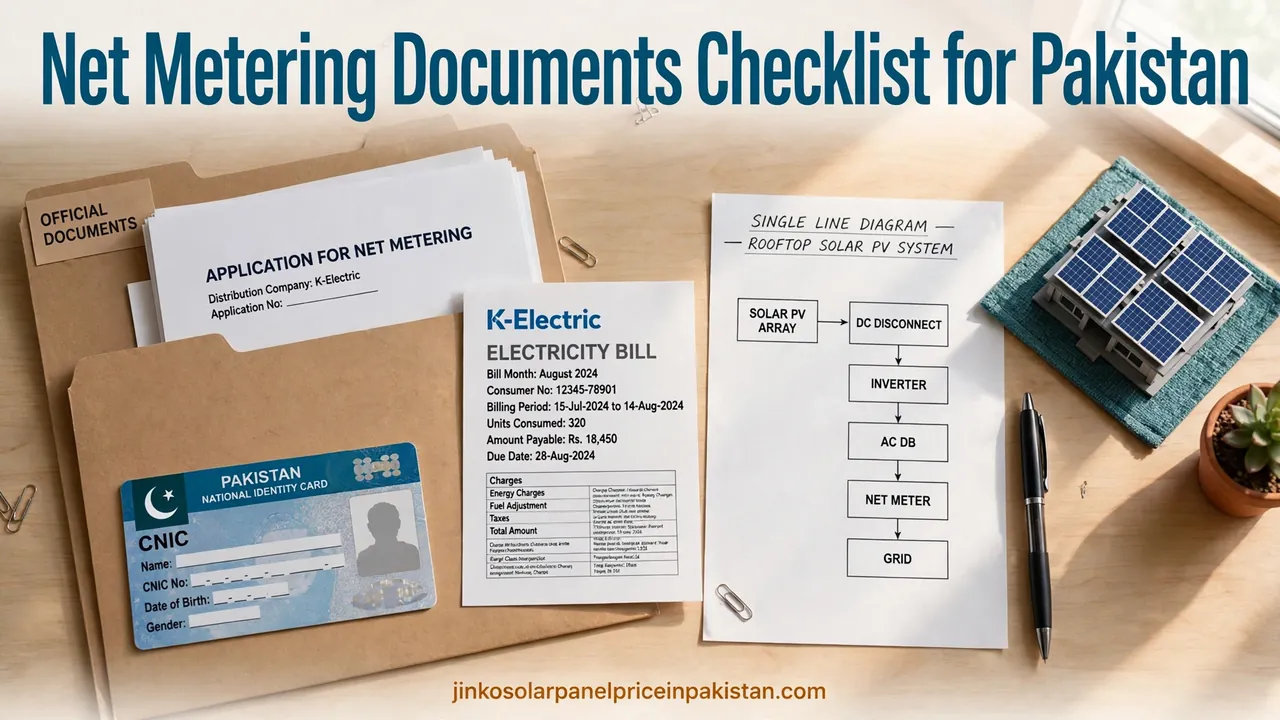
Who Needs These Documents?
Net metering connects your rooftop solar system to the grid so that extra units you generate can be exported and credited. The application goes to your DISCO — LESCO, IESCO, MEPCO, FESCO, GEPCO, PESCO, K-Electric or whichever company supplies your electricity. The DISCO needs to know three things before it agrees: who you are, that the property and the electricity connection are yours (or that you have permission), and that the solar system is safe and properly designed.
That is why the documents fall into three groups. Identity and account papers prove you are the connection holder. Property papers prove you have the right to install on that roof. Technical papers prove the system is designed, installed and equipped to NEPRA’s standards. Your installer handles the third group; you handle the first two. Understanding that split is the first step to a fast application.
The Complete Net Metering Documents Checklist
Use this table as your master checklist. Tick each item off as you collect it, and keep a photocopy of everything you submit.
| Document | Who prepares it | What it proves |
|---|---|---|
| CNIC copy of the applicant | You | Your identity |
| Latest paid electricity bill | You | Active connection, reference number, no arrears |
| Property ownership proof or tenancy agreement | You | Right to install on the property |
| Landlord NOC (if you are a tenant) | You and the landlord | Permission to install on rented property |
| DISCO net metering application form | You, with the installer | Formal request with consumer and system details |
| Single-line diagram (SLD) | Installer | How the system connects to your wiring and the grid |
| Solar panel datasheet | Installer | Panel make, model, wattage and certification |
| Inverter datasheet | Installer | Inverter make, model, capacity and certification |
| Installer registration certificate | Installer | Installer is registered and authorised |
| Load calculation report | Installer | System size matches your sanctioned load |
| Net metering agreement | DISCO (you sign it) | Terms of export, billing and metering |
1. Identity and Account Documents
Your CNIC copy is the first paper in the file. The name on the CNIC must match the name on the electricity bill — if the connection is in a parent’s or spouse’s name, the application is usually made in that person’s name, with you acting on their behalf if the DISCO allows it. A mismatch between the CNIC name and the bill name is one of the most common reasons a file is sent back at the counter.
Your latest electricity bill does more work than any other single document. It carries your consumer or reference number, your connection category, your sanctioned load and your payment history. The DISCO checks it for unpaid arrears, because an application with outstanding dues is usually rejected at intake. Submit the most recent bill you have, and make sure it is paid before you apply. Keeping the last few months of bills handy also helps, because the DISCO may look at your consumption pattern when it checks the system size you have applied for.
2. Property Documents
For a house you own, the DISCO usually accepts a registry, fard, allotment letter or similar ownership paper. For a rented house, you need the tenancy agreement plus a written no-objection certificate (NOC) from the landlord or property owner, giving permission to install solar panels and apply for net metering. If the electricity meter is in someone else’s name — a landlord, a parent, a previous owner — the DISCO will want the meter owner’s consent as well.
Check that the property address on your ownership papers matches the address on the electricity bill. Small differences in spelling or house number can cause a query, so sort them out with the DISCO’s customer service before you submit rather than after.
3. Technical Documents Your Installer Prepares
The single-line diagram, usually called the SLD, is the most important technical document. It is a simple electrical drawing that shows how your panels, inverter, protection devices and meter connect to your home wiring and to the grid. It must be prepared by a qualified installer or engineer — a hand-drawn sketch is not enough. A wrong or incomplete SLD is the single most common technical reason for a delay, so ask your installer to show you the finished diagram before it goes in the file.
The equipment datasheets prove that your panels and inverter are genuine, certified products with the specifications your application claims. The installer should supply the manufacturer’s datasheet for the exact panel model and inverter model installed, including capacity and certification details. Keep the serial numbers of the inverter and panels recorded as well — the DISCO may check them during inspection. If you are still choosing equipment, our solar inverter buying guide for Pakistan explains what to check before you buy.
The installer must also be registered with the relevant authority. Ask for a copy of the installer’s registration certificate and check that it is current. A file submitted by an unregistered installer can be rejected outright, and you would have to start again with a registered one. Our guide to choosing a solar installer in Pakistan explains how to check an installer’s credentials before you hire them.
Finally, the installer prepares a load calculation showing that the system size you are applying for fits within your sanctioned load — the maximum load your connection is approved for. A system larger than your sanctioned load needs a load enhancement first. Read our net metering policy guide for how sanctioned load fits into the wider rules.
4. Application Form and Agreement
Every DISCO has its own net metering application form, available from its office or website. Fill it in completely and carefully — an unsigned form, a blank field or a wrong reference number sends the file back. The form asks for your consumer details, your reference number, your sanctioned load and the specifications of your system, so have the bill and the datasheets in front of you while you fill it in.
After the DISCO accepts the application and inspects the system, you sign a net metering agreement. This is the DISCO’s standard agreement covering how exported units are credited, how the bi-directional meter works and what each side is responsible for. Read it before you sign, and keep your signed copy with the rest of your file.

Residential vs Commercial: Extra Documents
The checklist above covers a typical home application. A business or commercial applicant usually needs a few extra papers: business registration documents, the company’s NTN, and a letter or board resolution naming the person authorised to sign the application on the company’s behalf. The technical documents are the same, but the system is usually larger, and a larger system may need a NEPRA generation licence in addition to DISCO approval — your installer will confirm whether that applies to your size.
If the property is owned by more than one person, or the applicant is applying on someone else’s behalf, the DISCO may ask for an authority letter or power of attorney. Ask your DISCO’s net metering desk what it needs for your situation before you submit, rather than discovering it after.
Common Reasons Applications Get Delayed or Rejected
Most delays come from paperwork, not from the solar system itself. The most frequent problems are: an incomplete or unsigned application form; an SLD that is missing, hand-drawn or does not match the installed system; unpaid arrears on the latest bill; a name mismatch between the CNIC, the bill and the property papers; a system size that exceeds the sanctioned load; and missing installer registration papers. Each of these is easy to prevent with a careful check before submission.
A second group of delays comes from the system itself: equipment without proper datasheets or certification, an inverter that does not meet the DISCO’s requirements, or protection and earthing that fails inspection. This is why choosing a registered installer and genuine equipment matters — the paperwork and the hardware are checked together. Our solar panel verification guide explains how to confirm your panels are genuine before installation.
If your file is returned, the DISCO will tell you what is missing or wrong. Fix exactly what was asked for and resubmit — do not send a fresh application, which starts the queue again. Keep a note of every visit and every paper you hand over, with dates, so you can follow up clearly if the file stalls.
What Happens After You Submit
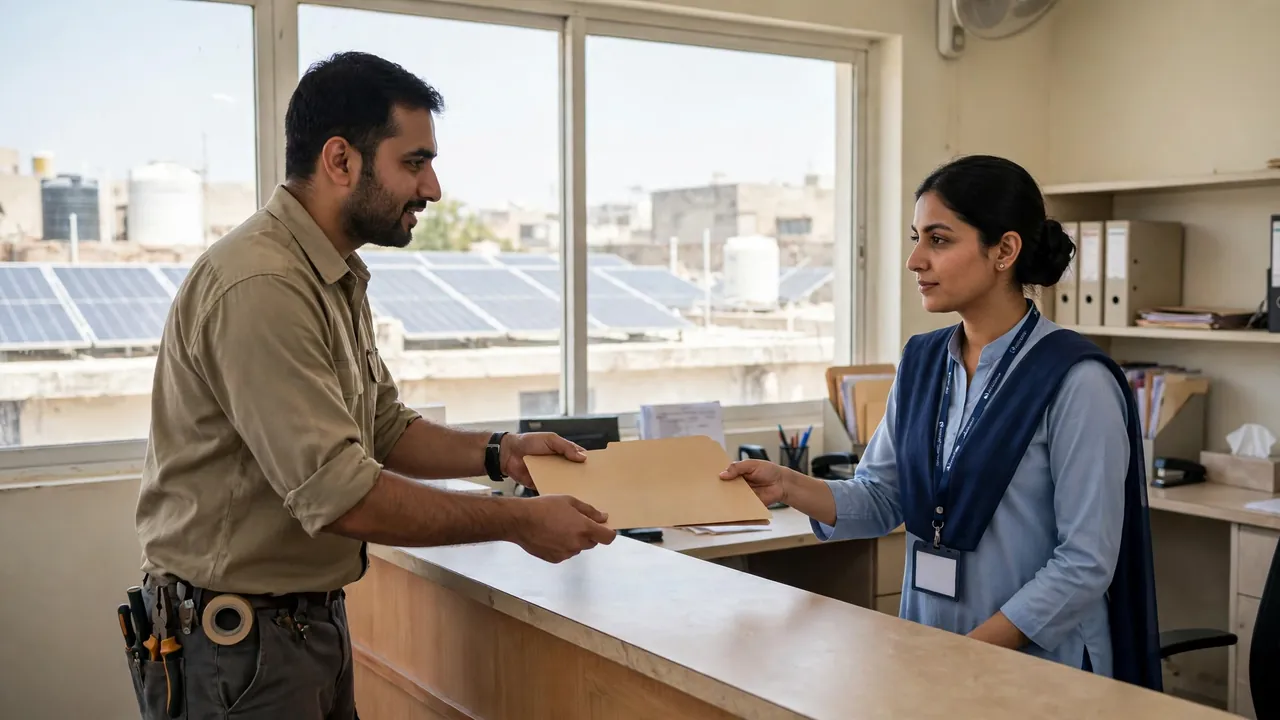
Once the complete file is accepted, the DISCO reviews the documents and the technical design, then inspects the installed system. The inspection checks that the system matches the SLD and the datasheets, that the wiring, protection and earthing are correct, and that the meter can be replaced with a bi-directional meter. If the inspection passes, the bi-directional meter is installed and the net metering agreement is signed, and your exported units start being credited on your bill.
How long each step takes varies by DISCO, by city and by how busy the net metering desk is, so do not rely on a fixed timeline from anyone except your own DISCO. If the DISCO asks for an extra document during review, provide it quickly — files that wait for a reply from the applicant are the ones that take longest. For the billing side of the story, including how exported units appear on your bill, see our latest electricity unit price guide.
How to Keep Your Documents Ready
Keep one folder — physical or digital — with everything in it: CNIC copy, latest paid bill, property papers, the filled application form, the SLD, both datasheets, the installer registration certificate and the signed agreement once you have it. Make sure the name, address and reference number are the same on every paper, and update the folder whenever a new bill arrives or a paper changes.
Before you submit, run a final check with your installer: is the form signed, is the bill paid and current, does the SLD match the system on your roof, and are the datasheets for the exact models installed? Five minutes of checking at home saves weeks of waiting at the DISCO.
Check Current Prices
Net metering makes the most sense when your system is sized and priced right, so check the daily updated tables on our homepage before you finalise your system. You can see the latest solar plate price in pakistan and solar panel price in pakistan, along with the current solar inverter price in pakistan. For the official rules behind this checklist, see the NEPRA net metering page.
Frequently Asked Questions (FAQs)
What documents are required for net metering in Pakistan?
Your CNIC, your latest paid electricity bill, proof of property ownership (or a tenancy agreement plus landlord NOC if you rent), the DISCO’s net metering application form, a single-line diagram, datasheets for your panels and inverter, your installer’s registration certificate, and a load calculation showing the system fits your sanctioned load.
Do I need to own the property to apply for net metering?
You usually need to own the property, or have the owner’s written permission. If you rent, you need a tenancy agreement and a no-objection certificate (NOC) from the landlord. If the electricity meter is in someone else’s name, the DISCO will also want that person’s consent.
What is a single-line diagram and who prepares it?
A single-line diagram (SLD) is an electrical drawing that shows how your panels, inverter, protection devices and meter connect to your home wiring and the grid. It must be prepared by a qualified installer or engineer — a hand-drawn sketch is not enough — and it must match the system actually installed on your roof.
Can I apply for net metering if my electricity bill has unpaid arrears?
Usually no. The DISCO checks your latest bill for unpaid arrears at intake, and an application with outstanding dues is normally rejected or sent back. Pay the bill in full first, then apply with the paid bill as proof.
Does my installer submit the documents, or do I apply myself?
In most cases your installer prepares the technical documents and submits the complete file to the DISCO on your behalf. You provide the identity and property papers — CNIC, paid bill and ownership proof — and sign the application form and the net metering agreement. Check the file yourself before it is submitted.
How do I know if my system size matches my sanctioned load?
Compare the system size on your application with the sanctioned load printed on your electricity bill. The system must fit within that load — a larger system needs a load enhancement first. Your installer prepares a load calculation report to confirm the match before the file is submitted.
What happens if a document is missing from my application?
The DISCO returns the file with a note explaining what is missing or wrong. Fix exactly what was asked for and resubmit the same file — do not start a fresh application, which puts you at the back of the queue. Keep a dated record of every paper you hand over.