
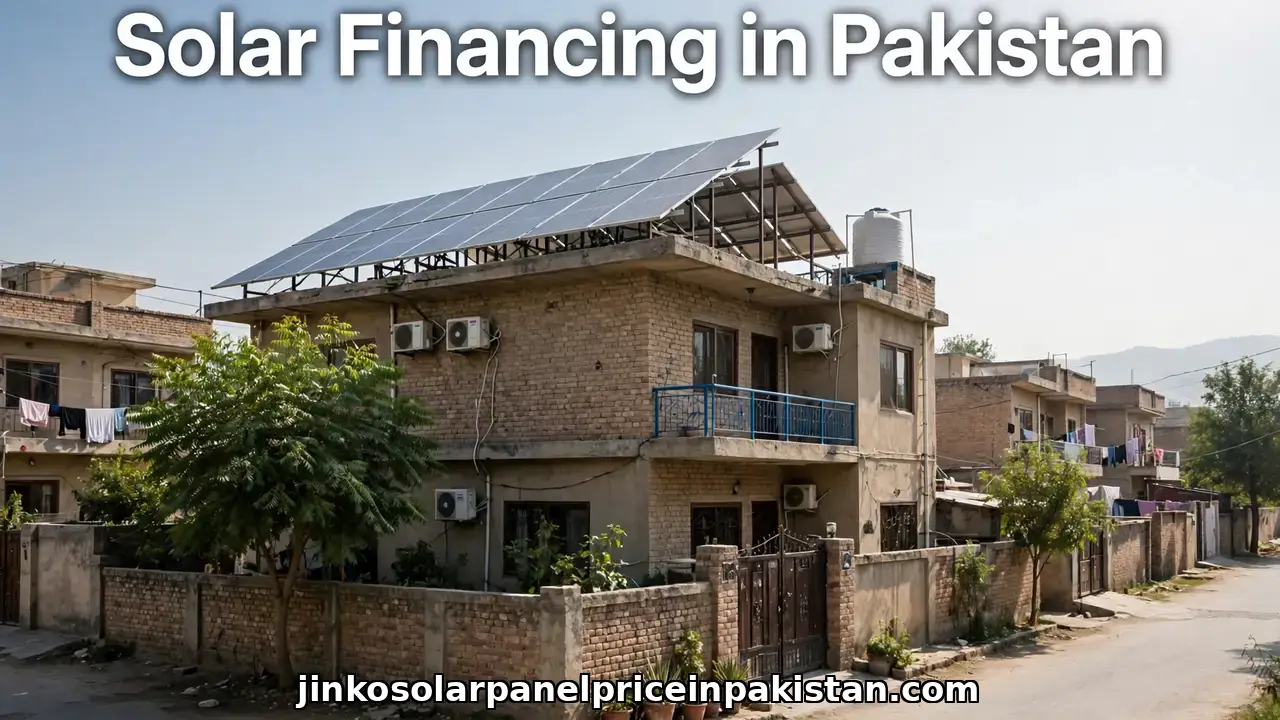
Solar Financing in Pakistan: Bank Loans and Installments for Home Solar Systems

The short answer: solar financing in pakistan lets you install a home solar system now and pay for it in monthly installments instead of paying the full cost upfront. Several Pakistani banks offer dedicated solar financing products, and some offer Islamic, interest-free structures as well. The bank usually pays your approved installer directly, and you repay the bank over an agreed period. Before you apply, compare the system you want against the solar panel price in pakistan tables on our homepage, so the loan you ask for matches a real quotation — not a guess.
A home solar system is one of the most expensive things most Pakistani families will ever put on their roof. Panels, an inverter, batteries and mounting structure together represent years of savings, and paying for all of it at once is not possible for many households. That is the problem solar financing exists to solve. This guide explains how bank solar loans and installments work in Pakistan, the difference between conventional and Islamic financing, which banks publish dedicated solar products, what documents you will need, and how to compare offers without signing something you have not read. It does not quote rates or installment amounts, because banks change those regularly — instead, it tells you where to find the current figures and what to ask for in writing.
How Solar Financing Works in Pakistan
Solar financing is a loan or installment facility taken specifically to buy and install a solar energy system. In most bank products, the process runs the same way: you get a quotation from an installer the bank has approved, the bank assesses your income and documents, and once approved, the bank pays the installer directly. You then repay the bank in monthly installments over an agreed period. The system is installed on your roof while you are still paying for it, so you start saving on electricity bills from the first month while the loan is running.
There are three broad ways to finance a home solar system in Pakistan. The first is a dedicated solar loan from a bank, where the product is written specifically for solar equipment. The second is a general personal loan used to pay for solar — some banks do not publish a dedicated solar product, so customers use a personal loan instead, which usually works differently and should be compared carefully. The third is a dealer or installer installment plan, where the seller spreads the payment over time. Dealer plans are not bank loans: the terms, the security and the consequences of missing a payment are whatever the dealer writes into the agreement, so read it the same way you would read a bank contract and get every promise in writing.
One thing financing is not: a discount. A loan spreads the cost over time, but the total amount you repay is always more than the cash price of the system, because the bank charges a markup or profit on the financing. Whether that extra cost is worth it depends on how much your electricity bill falls and how long you keep the system — our guide on whether solar panels are worth it walks through that calculation. Financing makes sense when the monthly installment is comfortably below the saving on your bill, not when it only just matches it.
Conventional vs Islamic Solar Financing
Pakistani banks offer solar financing in two forms, and the difference matters to many homeowners. Conventional financing is an interest-bearing loan: the bank lends money, and you repay it with a markup that is usually linked to KIBOR, the interbank rate banks price from. Because KIBOR moves with the State Bank’s monetary policy, a variable-rate loan is repriced periodically — your installment can change over the life of the loan. Some banks also offer a hybrid option that fixes the installment for an initial period and then switches to variable pricing, so you know exactly what you pay at the start but not for the whole term.
Islamic financing works differently. There is no interest. Instead, the bank uses a Shariah-compliant sale or partnership structure. In a Musawamah arrangement, the bank buys the solar system and sells it to you at a disclosed marked-up price that is fixed when you sign, and you pay that price in installments. In a Diminishing Musharakah arrangement, the bank and the customer jointly own the system, and you gradually buy out the bank’s share while paying rent for the share you do not yet own. The practical difference for the customer is that the total price is agreed upfront in a sale-based structure, while in a conventional variable-rate loan the total cost can move with KIBOR. Which structure suits you depends on your beliefs and on the actual written offer — ask the bank to explain, in plain language, how the total amount you will repay is calculated, and get it in the Key Fact Statement before you sign.
Which Banks Offer Solar Financing in Pakistan
Several banks publish dedicated solar financing products on their own websites. The products below are the ones verified on the banks’ own pages while preparing this guide. Other banks also advertise solar financing, and their terms change regularly — check each bank’s own product page and ask for the current written offer before you apply, rather than relying on a comparison article, including this one.
Meezan Bank — Meezan Solar
Meezan Bank offers Meezan Solar, a Shariah-compliant solar financing product structured as Musawamah: the bank buys the system and sells it to you at a disclosed price, paid in unequal monthly installments over a period of one to five years. The product covers complete home solar systems, from small home setups up to large installations, and it is available only in Karachi, Lahore and Rawalpindi/Islamabad. The system must be installed by an installer from Meezan’s approved Energy Partner list, and the property where the system is installed must be owned by the applicant — if it is owned by an immediate family member, that person becomes a co-applicant. Flats and apartments are not financed under this product.
Two limits are important to know before you apply. First, batteries are not financed under Meezan Solar, in on-grid or off-grid systems, and the cost of the net metering arrangement is also not financed — you pay for those separately. Second, you must be an active tax payer with an NTN, you must hold or open an account with Meezan Bank, and the bank takes security in the form of a hypothecation agreement on the solar panels plus post-dated cheques. After the Musawamah contract is executed, the risk of damage or loss passes to you, and after-sale service is a matter between you and the bank’s approved energy partner — so the solar inverter price in pakistan and the cost of the other components are worth protecting, and you should read the takaful and after-sale terms before signing.
Bank Alfalah — Home Solar Finance
Bank Alfalah offers Home Solar Finance, a conventional product for domestic customers, with systems from three kilowatts and repayment over three to ten years in equal monthly installments. The bank publishes its pricing formula on its product page: variable pricing linked to KIBOR, with a hybrid option that fixes the installment for an initial period and then switches to variable. Systems must come from a Bank Alfalah-approved vendor, and the property must be residential and owned by the borrower, a spouse or a blood relative — otherwise a no-objection undertaking from the owner is required. Up to two co-borrowers, who must be a spouse or blood relatives, can be added to strengthen eligibility, and the bank allows balloon or partial prepayments and early settlement.
Bank Alfalah’s application runs through a seven-step process on its product page: application, documents with the vendor quotation, pre-screening, processing and verifications, credit review and decision, pre-disbursement formalities and signing, then disbursement. Insurance is part of the package, with the first year’s premium paid upfront. The bank also publishes an Islamic variant, Alfalah Islamic Green Finance, for customers who want a Shariah-compliant structure — ask the bank for its current terms, because the conventional and Islamic products are not the same offer.
JS Bank — Smart Roshni
JS Bank publishes a solar financing page under the name JS Smart Roshni, and it also runs the Pakistan Distributed Solar Project, a programme backed by the Green Climate Fund. Its published eligibility material is written for businesses rather than individual homeowners, so if you are a salaried homeowner, confirm in the branch whether the product you are being offered is the household product or a business facility — the terms, the security and the documentation are different. The Green Climate Fund’s own reporting on the project confirms it moved to a market-linked lending model after the State Bank’s refinance scheme ended, which is a reminder that concessional terms attached to older programmes do not automatically carry over to a new application.
The State Bank Scheme: What It Is and What It Is Not
Many homeowners have heard that the State Bank of Pakistan once offered cheap solar loans, and they walk into a bank expecting that rate. The honest position is more complicated. The State Bank did publish a Financing Scheme for Renewable Energy, a refinance facility under which banks could lend for renewable energy at concessional terms, and the scheme’s documents are still published on the State Bank’s own website. But published guides disagree about whether new residential borrowers can still access concessional terms under it today: some describe a concessional rate as available subject to allocation, while others say the facility has wound down for new home consumers and that banks now lend at their own commercial rates. We could not settle that disagreement from a primary State Bank source, so this guide does not state a rate at all.
What is clear, and recent, is that the State Bank has made it easier for banks to lend for solar at all. Under a State Bank circular issued in October 2026, banks may now extend renewable-energy financing without any security, or against hypothecation of the installed equipment itself — the panels, inverters and batteries. That matters because it removes the old assumption that a solar loan always needs a property mortgage. It is a permission, not an order: a bank can still decline your application, or ask for the equipment as security, or ask for a property mortgage under its own credit policy. The practical advice is simple: when you apply, ask the bank in writing whether any concessional State Bank tranche is currently open for your application, and get the answer in the written offer — not as a verbal promise at the branch.
Government Schemes vs Bank Loans: Do Not Confuse Them
A bank loan and a government solar scheme are two different things, and confusing them is one of the most common mistakes in this market. A government scheme gives a free system to households that meet narrow eligibility rules — for example, the CM Punjab Free Solar Panel Scheme covers households with low monthly consumption, selected through balloting. A bank loan gives you money you must repay, with a markup or profit, and it is available to anyone who meets the bank’s credit rules. Our guide to government solar schemes in Pakistan explains the free schemes and their eligibility in full.
Check the schemes first. If you qualify for a free system, a loan is the wrong product for you. If you do not qualify — and most Pakistani households do not fall inside the low-consumption band — then a loan is the realistic route, and the comparison in this guide is the one to use. Never pay anyone who offers to register you for a government scheme for a fee: registration runs through the official portal or SMS service and costs nothing.
Documents You Will Need
Every bank asks for broadly the same document package, with small variations. Prepare it once, and you can use it to apply at more than one bank — which is exactly what you should do, because comparing written offers is the only way to know which bank is actually cheaper for you.
- CNIC copy, front and back, for the applicant and any co-applicant, plus passport-size photographs.
- Income proof: recent salary slips or an employment letter for salaried applicants, or bank statements, tax returns and audited financials for self-employed applicants.
- Bank statements, usually for the last several months, showing your income coming in and your existing commitments going out.
- Recent electricity bills, which the bank uses to check your consumption pattern and to sense-check the system size in the quotation.
- Property ownership documents for the house where the system will be installed, or a no-objection undertaking from the owner if the property belongs to a family member.
- A solar system quotation from the bank’s approved vendor, listing the panels and inverter specifications — the loan is sized from this quotation, not from a verbal estimate.
- Tax filer status: an NTN and evidence that you are an active tax filer. Some banks make this mandatory; others treat it as preferred. Check before you apply, because a non-filer application can stall at the first check.
- The bank’s own application form, signed, plus any bank-specific forms such as an Islamic finance undertaking where the product is Shariah-compliant.
Two documents cause most delays: the vendor quotation and the property papers. Get the quotation from a vendor on the bank’s approved list before you file the application, and check that the property documents match the name on your CNIC. If the property is owned by more than one person, every owner may need to become a co-applicant, which takes time to arrange — start that conversation early.
How to Compare Offers Without Getting Burned
Banks do not make comparison easy, because each one quotes its product differently. The way through it is to ask every bank for the same three things in writing, and then compare those — not the advertising.
First, ask for the Key Fact Statement. This is the document that sets out the total amount you will repay, the installment, the tenure, every charge, and the conditions. If a bank will not give you one before you sign, that is your answer about that bank. Second, compare the total repayment, not the monthly installment. A longer tenure always means a smaller installment and a larger total repayment — the cheapest loan is the one with the lowest total, not the lowest monthly figure. Third, check what is included and what is not: does the financing cover the panels, the inverter, the wiring and the installation, or only part of the system? Are batteries and the net metering arrangement included or excluded? Meezan, for example, excludes both, so a customer who assumed they were included would face a separate bill after approval.
Also check the early-settlement terms, the late-payment treatment, whether the installment is fixed or variable, whether the system must come from an approved vendor, and whether insurance or takaful is required and who pays for it. A variable-rate loan can become more expensive if KIBOR rises, so ask what happens to your installment in that case and whether a hybrid fixed-then-variable option exists. Finally, check the security: is the loan secured only against the equipment, or does the bank also want a property mortgage or a personal guarantee? Under the State Bank’s October 2026 circular, a bank may lend for renewable energy without security or against the equipment alone — but it is not obliged to, so the written offer is what counts.
Before You Borrow: Size the System First
The most expensive mistake in solar financing is borrowing for the wrong system size. A loan is sized from the vendor quotation, and a quotation is only as good as the calculation behind it. Before you apply, work out how many panels your home actually needs from your annual electricity use — our guide to how many solar panels you need walks through that calculation step by step, starting from twelve months of bills. A system sized from a single summer bill will be too large, and a loan for an oversized system means years of installments for capacity you never needed.
Also think about how the system will earn its keep. Under the latest net metering policy, exported units are bought back at a much lower rate than the rate you pay for night-time imports, so a system that exports most of its output during the day and imports at night saves less than a system sized for daytime self-consumption. Batteries change that calculation, but batteries are often not financed — and the lithium battery price in pakistan is often a large share of the whole system value, so budget for batteries separately if you want backup after sunset. The loan decision and the system design decision are the same decision: get the design right first, then borrow exactly that amount.
Is Solar Financing Worth It?
Financing is worth it when the numbers work in your favour and the terms are clear. The test is simple: add up the total amount you will repay, compare it with the electricity bills you expect to avoid over the same period, and ask whether the gap is wide enough to be worth the risk that the system underperforms or that your circumstances change. A loan also locks you into monthly payments for years, so check the debt burden honestly — the bank will check it too, through your debt burden ratio and your credit history, and a weak credit record or a history of late payments can mean rejection or a smaller facility.
There are situations where financing is the wrong choice. If you qualify for a free government scheme, take the scheme. If your roof is shaded, too small, or rented without the owner’s consent, fix that first — no loan fixes a bad roof. And if the only offer you can get is a general personal loan at a much higher cost than a dedicated solar product, compare it against waiting and saving, or against a smaller system you can afford in cash. A solar system is a long-lived asset, and a loan is a long-lived commitment: the two should be decided together, with the written offer in front of you, not on the strength of a sales call.
Start by checking whether you qualify for a free scheme, then size your system from your bills, then take the same quotation to two or three banks and compare their Key Fact Statements side by side. The bank that is cheapest on paper is not always the bank that is easiest to deal with — but the bank that will not put its offer in writing is never the right one.
Can I get a solar loan in Pakistan?
Yes. Several Pakistani banks publish dedicated solar financing products — Meezan Bank offers Meezan Solar, an Islamic Musawamah product, and Bank Alfalah offers Home Solar Finance for households. Other banks advertise solar financing too. Check each bank’s own product page and ask for the current written offer before you apply, because terms change regularly.
Is solar financing halal in Pakistan?
Yes, through Islamic banks. Meezan Solar is structured as Musawamah, a sale in which the bank buys the system and sells it to you at a disclosed price paid in installments — no interest. Other Islamic banks and Islamic windows offer similar structures such as Diminishing Musharakah. If Shariah compliance matters to you, confirm the structure with the bank and read the written offer before signing.
What documents do I need for a solar loan in Pakistan?
Broadly the same package at every bank: your CNIC, income proof (salary slips or business income documents), bank statements, recent electricity bills, property ownership documents, a solar system quotation from the bank’s approved vendor, evidence of active tax filer status, passport-size photographs, and the bank’s signed application form. Some banks ask for extra forms, such as an Islamic finance undertaking.
Do banks finance batteries and net metering costs?
Not always. Meezan Solar explicitly does not finance batteries, in on-grid or off-grid systems, and the cost of the net metering arrangement is also not financed — you pay for those separately. Other banks differ, so check the written offer: ask whether the financing covers the panels, inverter, wiring and installation only, or batteries and net metering too.
Is the State Bank concessional solar loan still available?
The State Bank published a concessional refinance facility for renewable energy in its circulars, but published guides disagree on whether new residential borrowers can still access concessional terms under it today. Ask the bank in writing whether any concessional State Bank tranche is currently open for your application — do not assume a concessional rate applies, and do not accept a verbal promise at the branch.
Can I get solar financing if I rent my house?
It depends on the bank. Meezan Solar requires the property to be owned by the applicant — if it is owned by an immediate family member, that person becomes a co-applicant — and flats are not financed. Bank Alfalah requires the property to be residential and owned by the borrower, a spouse or a blood relative, with a no-objection undertaking otherwise. Check the bank’s ownership rule before you apply.