
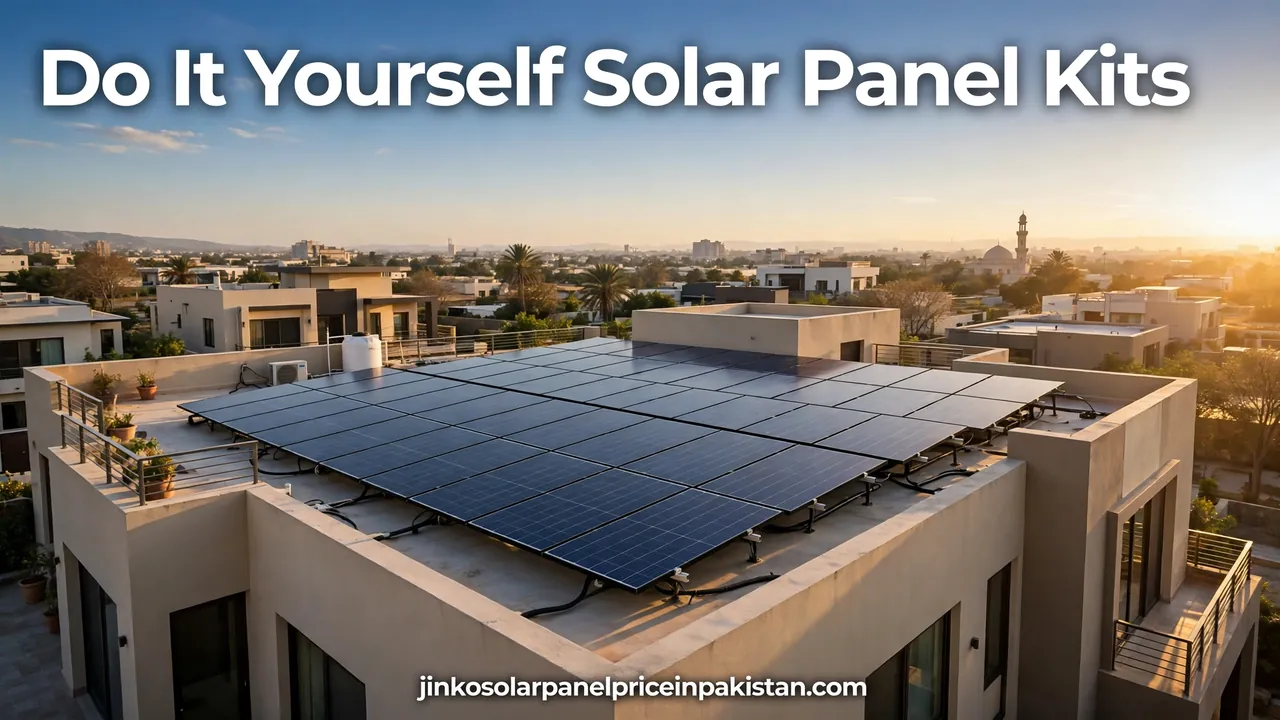
Do It Yourself Solar Panel Kits: Complete Guide for Pakistan

Do it yourself solar panel kits let you buy the panels, inverter, mounting and wiring as one matched bundle and install some or all of it yourself. For a small off-grid setup — a few fans, lights and phone charging during load shedding — a kit is a realistic DIY project. For a full-house system connected to the grid, the honest answer is different: you can do the panel mounting yourself, but the AC wiring, the distribution-board connection and the net-metering application belong to a licensed electrician or a certified installer. Before you compare kits, check the solar panel price in pakistan tables on our homepage, updated every morning, so you know what the same panels cost outside a bundle.
What Is in a Do It Yourself Solar Panel Kit?
A kit is a bundle, not a single product, and what is inside it decides whether it is genuinely DIY or only partly so. A complete kit should contain every solar panel in the set, matched to one inverter or charge controller, the mounting structure with clamps and bolts, DC cables with MC4 connectors, and a clear wiring diagram. Some kits add a battery and a battery cable set; others are panel-only bundles that expect you to buy the inverter and battery separately. Read the contents list before you buy — a kit missing its mounting rails or its DC breaker is not a complete kit, whatever the listing calls it.
The two parts that most often cause trouble are the inverter and the charge controller. A kit built around a recognised inverter brand — an inverex inverter, a crown inverter or an itel inverter, for example — is easier to get serviced and easier to match with a battery later. A kit with an unbranded inverter may work on day one and become a problem the first time it faults, because no service centre stocks its parts. Our solar inverter buying guide explains how to judge an inverter before you commit, and the solar inverter price in pakistan tables on our homepage show what inverters cost as separate items, so you can tell whether the bundle is actually saving you anything.
Panels deserve the same check. A kit should name the panel brand, the wattage of each panel and the warranty in writing — Tier-1, A-grade documented panels from a known brand, not unlabelled stock. Our Tier-1 solar panel guide explains what the tier label actually guarantees. If the seller cannot name the brand or show a datasheet, the kit is not a bargain; it is a risk. Check the canadian solar panel price in pakistan page and the jinko solar panel price in pakistan tables to see what documented panels from established brands cost on their own.
Types of DIY Solar Panel Kits
Not all kits aim at the same job. The right type depends on what you want the system to run and whether you need it to work when the grid is down.
| Kit type | What it runs | Who can install it |
|---|---|---|
| Small off-grid kit | Fans, lights, phone and laptop charging, a small DC load | Confident DIY — panels, controller, battery, basic DC wiring |
| Hybrid kit with battery | Daytime loads plus backup during load shedding | DIY mounting, professional for AC wiring and earthing |
| Grid-tied kit, no battery | Daytime loads, surplus exported where net metering exists | Professional — grid connection and net metering need approval |
| Portable / camping kit | Phones, lights, a small fridge on the move | Plug-and-play DIY, no fixed wiring at all |
For most Pakistani homes the hybrid kit is the natural fit, because load shedding is the problem people are actually solving — a grid-tied kit without a battery stops the moment the grid goes down, which is exactly when you need it most. Our on-grid vs off-grid vs hybrid inverter guide explains the three system types in full, and the how solar panels work guide explains what the panels themselves do in each setup.
What Size DIY Kit Do You Need?
Size the kit to the load, not to the roof and not to the listing’s headline wattage. Start by listing what the kit must run — count the fans, the lights, the fridge and anything else that matters during load shedding — and add up their wattage. A kit that covers fans and lights is a very different purchase from one that must also run a fridge and a water pump, and a kit that is too small will disappoint you every evening while a kit that is far too large wastes money on panels you cannot use. Our how many solar panels do you need guide walks through the same load-first sizing step by step.
Batteries decide the night-time answer. A kit without a battery gives you nothing after sunset, so if load shedding hits at night you need storage — and the battery is the part you will replace first, so check its type and warranty before anything else. Many buyers compare the lithium battery price in pakistan before choosing, because the battery is often the most expensive single item in a hybrid kit, and the same comparison applies to storage brands, as shoppers check the dyness lithium battery price in pakistan or the fronus lithium battery options when they price a battery-backed kit. Our lithium battery guide explains the types, and the phoenix battery price in pakistan guide covers the tubular-battery alternative many homes still use.
One more sizing trap: panel wattage on the box is measured in laboratory conditions, and real output on a Pakistani rooftop is lower — heat, dust and haze all take a share. Our solar panel efficiency guide explains the percentage on the datasheet, and our solar system derating guide explains why a system produces less than its headline figure. Size with a margin, and check the solar system price in pakistan tables to see what a comparable complete system costs before you decide the kit is the cheaper route.

Can You Install a Solar Kit Yourself in Pakistan?
Yes — up to a point, and the point matters. Mounting panels on a sound roof, running DC cables in conduit, and connecting a charge controller to a battery are jobs a careful homeowner with basic tools can learn. Connecting anything to the AC distribution board, altering the house wiring, or exporting power to the grid are not DIY jobs: they need a licensed electrician, proper earthing, and — for net metering — an approved bi-directional meter and a sanctioned application. The U.S. Department of Energy’s guide to planning a home solar electric system sets out the same sequence — assess, size, get bids, then work with a qualified installer and the utility — and that sequence applies in Pakistan too, with your local DISCO in the utility’s role.
The legal line is the net-metering application. A DIY kit wired into the grid without approval can be disconnected, can void the inverter warranty, and can create a safety risk for line workers during an outage. Our latest net metering policy update explains the current rules, which you should read before any grid connection. If your plan is a small off-grid kit that never touches the house wiring, none of this applies — that is the safest true-DIY setup, and the one most first-time buyers should start with.
Roof and structure come before wiring. A weak or leaking roof should be repaired before any panel goes on it, and the mounting structure must be anchored to hold through monsoon winds — our weak-roof installation guide explains what to check, and our solar panel shading analysis guide shows how to check for shade before you fix the layout. A kit installed on a shaded or damaged roof will underperform no matter how good its panels are.
Step-by-Step: Installing a Small DIY Solar Kit
This sequence covers a small off-grid kit — panels, charge controller and battery, with no grid connection. If your kit connects to the house AC wiring at any point, stop at the DC stage and hand the AC work to a licensed electrician.
Step 1 — Plan the layout. Choose the sunniest, least-shaded part of the roof, facing south, with the tilt your installer or the kit manual recommends for your city. Measure the space and confirm the panels fit with room to walk between rows for cleaning.
Step 2 — Fix the mounting structure. Anchor the rails firmly to the roof structure, not only to the surface, and check every bolt. A loose structure is the most common cause of storm damage to DIY systems.
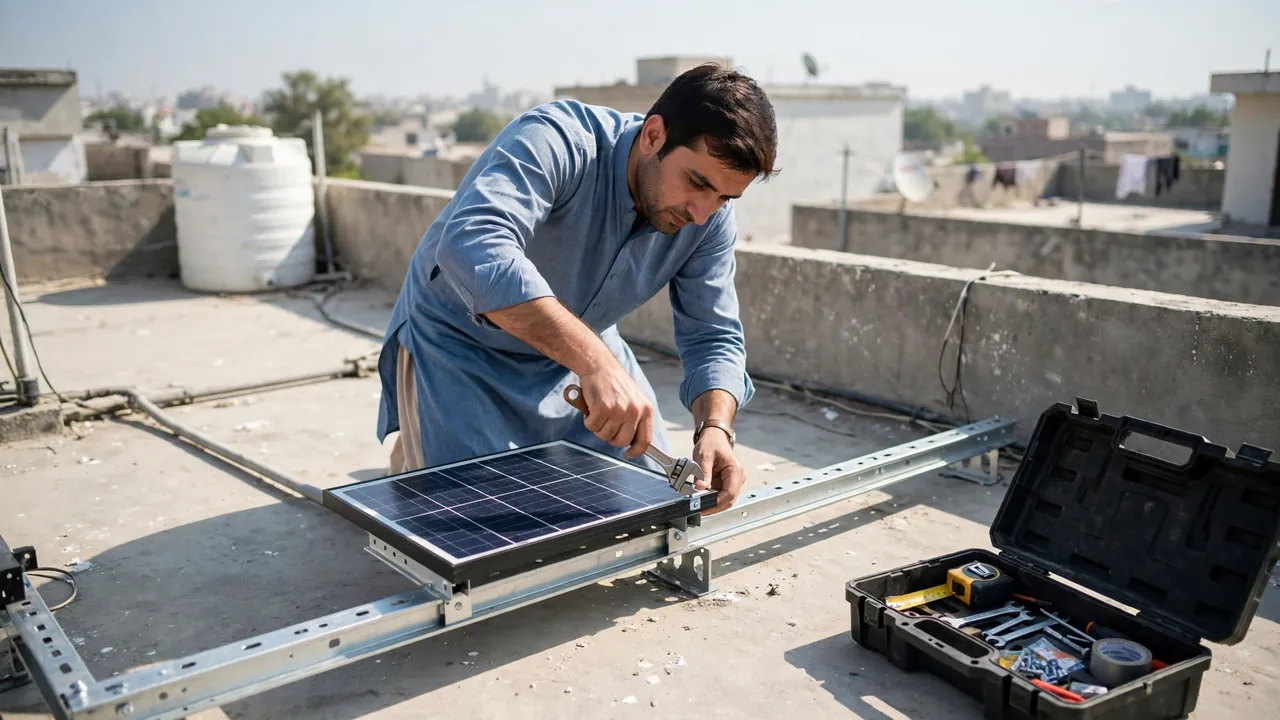
Step 3 — Mount the panels. Clamp each panel to the rails, leave a small gap between panels for airflow, and do not step on the glass. Connect the panels in the series or parallel arrangement the manual specifies — mixing the two by mistake is a common first-timer error.
Step 4 — Run the DC cables. Use proper solar DC cable in conduit from the array to the charge controller, keeping the run as short as practical. Fit MC4 connectors correctly — a loose MC4 connection arcs, heats up and can burn.
Step 5 — Connect the charge controller and battery. Connect the battery to the controller first, then the panels, following the manual’s exact order. Reversing the order can damage the controller. Set the controller to your battery type — lithium and lead-acid need different charge settings.
Step 6 — Test before you trust it. Check the controller display, confirm the battery is charging, and run your intended loads one at a time. Watch the system for a full day before you rely on it during load shedding. Our how to install solar panels guide covers the same steps for a full-size system, and our guide to common solar installation mistakes lists the faults installers notice first in DIY jobs.
DIY vs Professional Installation
The choice is not about pride — it is about which risks you can carry yourself and which ones need a professional’s insurance, warranty and licence.
| Factor | DIY kit | Professional installation |
|---|---|---|
| Best for | Small off-grid kits, portable kits, learning the system | Full-house systems, grid-tied and hybrid systems |
| Labour | Your own time, tools and weekends | Installer team, usually finished in a day or two |
| Safety | You carry the DC and roof-work risk | Trained crew, proper earthing, safety gear |
| Warranty | Some brands void warranty on self-installed systems | Installer warranty plus manufacturer warranty |
| Net metering | Not possible without a licensed installer and approval | Installer files the application with the DISCO |
| After-sales help | You troubleshoot, with forums and manuals | Installer support line and service visits |
A middle path works well for many buyers: buy the kit yourself, mount the panels yourself, and hire a licensed electrician for the AC connection, earthing and testing. You keep control of the component choice and still get a safe, warrantied connection. Our installer vetting checklist shows how to choose that electrician or installer, and the complete guide to installation costs explains the factors that decide what professional installation is worth.
Common Mistakes with DIY Solar Kits
Most DIY failures are not bad luck — they are the same few mistakes, repeated. First, buying the cheapest kit without checking the panel brand, the inverter brand or the warranty paperwork; unbranded panels with no datasheet are the fastest way to regret a purchase. Second, undersizing the battery, so the system dies halfway through a load-shedding night. Third, skipping earthing and surge protection — a rooftop array without earthing is a lightning and shock risk, not a saving. Fourth, ignoring shade: a single shaded panel can drag down a whole string, which is why the shading check comes before the purchase, not after. Fifth, using ordinary household wire for DC runs instead of proper solar cable — DC arcs do not stop the way AC arcs do, and thin wire overheats. And sixth, forgetting documentation: keep the invoices, warranty cards and the kit manual, because the next buyer, the next technician and any warranty claim will all ask for them.
One more mistake is specific to Pakistan’s market: trusting a listing’s headline wattage without checking the panel datasheet. A 585-watt panel is a real, standard size — the solar panel 585 watt price in pakistan today tables track it daily — but a kit that claims far more wattage than its panel count can physically deliver is mislabelled. Count the panels, read the datasheet wattage, and multiply; if the listing’s total does not match, walk away. The solar plates price in pakistan and solar panels price in pakistan tables help you compare like with like, and the solar plate price in pakistan 585 listings show what the standard 585-watt size goes for.
Where to Buy DIY Solar Panel Kits in Pakistan
Buy from a dealer or marketplace seller who names the brands, shows datasheets, and gives a written warranty — in Lahore’s Hall Road and Akbari Mandi, Karachi’s Saddar electronics market, Islamabad’s Blue Area, or a reputable online marketplace with buyer protection. Avoid sellers who will not name the panel brand, who bundle an unbranded inverter, or who refuse a written warranty; those are the kits that fail first and cannot be serviced. Compare the kit against the open market before you pay: the today solar panel price in pakistan tables and the solar plate rate listings show current panel rates, the aiko solar panel price in pakistan row covers a premium brand option, and the inverex solar panel 585 watt price in pakistan listings cover a common kit panel. If the kit’s implied panel cost is far above the open-market rate, you are paying for the bundle convenience — decide whether that convenience is worth it, rather than discovering it later.
Check three things at the shop, not at home: the panel brand and datasheet, the inverter brand and its service network, and the warranty card with the seller’s stamp. Ask whether the seller will help if a panel arrives cracked or the inverter faults in the first month — the answer tells you more than the listing does. And keep every document: the solar price in pakistan changes daily, so the invoice is also your proof of what you paid and when.
Is a DIY Solar Kit Worth It?
For a small off-grid need — fans, lights and charging through load shedding — yes, a well-chosen kit is worth it, because you get backup power without the labour cost of a full installation, and you learn how your system works. For a full-house system, the honest answer is usually to buy the components yourself and hire a professional for the installation: you keep the saving on the parts and avoid the risks that come with AC wiring, earthing and net metering. Our is solar panels worth it guide explains the same bill-saving logic from the owner’s side, and the complete guide to solar panel costs sets out the factors that decide what any system — kit or custom — is worth in the first place.
Whatever route you choose, start with the load, buy documented brands, and never let a kit’s headline wattage substitute for a datasheet. A kit is a shortcut to owning solar, not a shortcut around safety — and the systems that last are the ones installed carefully, documented fully, and sized to the home they serve.
Are DIY solar panel kits worth it?
For a small off-grid need — fans, lights and phone charging during load shedding — yes, a well-chosen kit is worth it, because you get backup power without the labour cost of a full installation. For a full-house system, buying the components yourself and hiring a professional for the installation is usually the better route.
Can I install solar panels myself in Pakistan?
Yes, up to a point. Mounting panels, running DC cables and connecting a charge controller to a battery are realistic DIY jobs. Connecting anything to the AC distribution board, altering house wiring or exporting power to the grid needs a licensed electrician, and net metering needs an approved application.
What is included in a DIY solar panel kit?
A complete kit should contain the solar panels, a matched inverter or charge controller, the mounting structure with clamps and bolts, DC cables with MC4 connectors, and a clear wiring diagram. Some kits add a battery and battery cables; panel-only bundles expect you to buy the inverter and battery separately.
What size solar kit do I need for my home?
Size the kit to the load, not to the roof or the listing’s headline wattage. List what it must run — fans, lights, fridge and anything else that matters during load shedding — add up their wattage, and check the sizing guide on this site. A kit that is too small will disappoint you every evening; one far too large wastes money on panels you cannot use.
Do DIY solar kits work during load shedding?
Only if the kit includes a battery. A grid-tied kit without a battery stops the moment the grid goes down, which is exactly when you need it most. For load-shedding backup you need a hybrid kit with storage — a battery that covers the night load.
Can a DIY solar kit connect to net metering?
Not on a DIY basis. Net metering needs a licensed installer, an approved bi-directional meter and a sanctioned application with your DISCO. A kit wired into the grid without approval can be disconnected and can void the inverter warranty.
What tools do I need to install a solar panel kit myself?
Basic hand tools, a drill, a spanner set, a multimeter and a cable cutter, plus safety gear for roof work — gloves, eye protection and secure footing. For the AC connection and earthing you need a licensed electrician, not more tools.
Where can I check current solar panel prices in Pakistan?
Right here: the solar panel price in pakistan tables on our homepage are updated every morning, so you can check today’s rates for panels, inverters and full systems before you finalise any quotation.