
Solar Changeover Switch: Complete Guide for Pakistan

A solar changeover switch is the small switch that lets your home move between WAPDA and solar power — safely, without ever connecting the two sources together. If your home has solar panels and also uses WAPDA supply, you need a changeover switch so that only one source feeds your home at a time. Without it, solar power can flow back into the WAPDA lines, which is dangerous for linemen working outside and can damage your inverter. This solar changeover switch guide pakistan explains what the switch does, the manual and automatic types, how to pick the right size, and how to use it safely.
What Is a Solar Changeover Switch?
A changeover switch has two inputs and one output. One input comes from WAPDA, the other from your solar inverter, and the output goes to your home’s load. The switch connects your home to one source at a time — never both at once. In the solar world it is also called a transfer switch, and the automatic version is called an ATS, short for automatic transfer switch. Most homes in Pakistan with solar still keep their WAPDA connection, because solar makes no power at night and may not cover the full load on cloudy days — so the home needs a clean, safe way to move between the two sources.
How a Changeover Switch Works
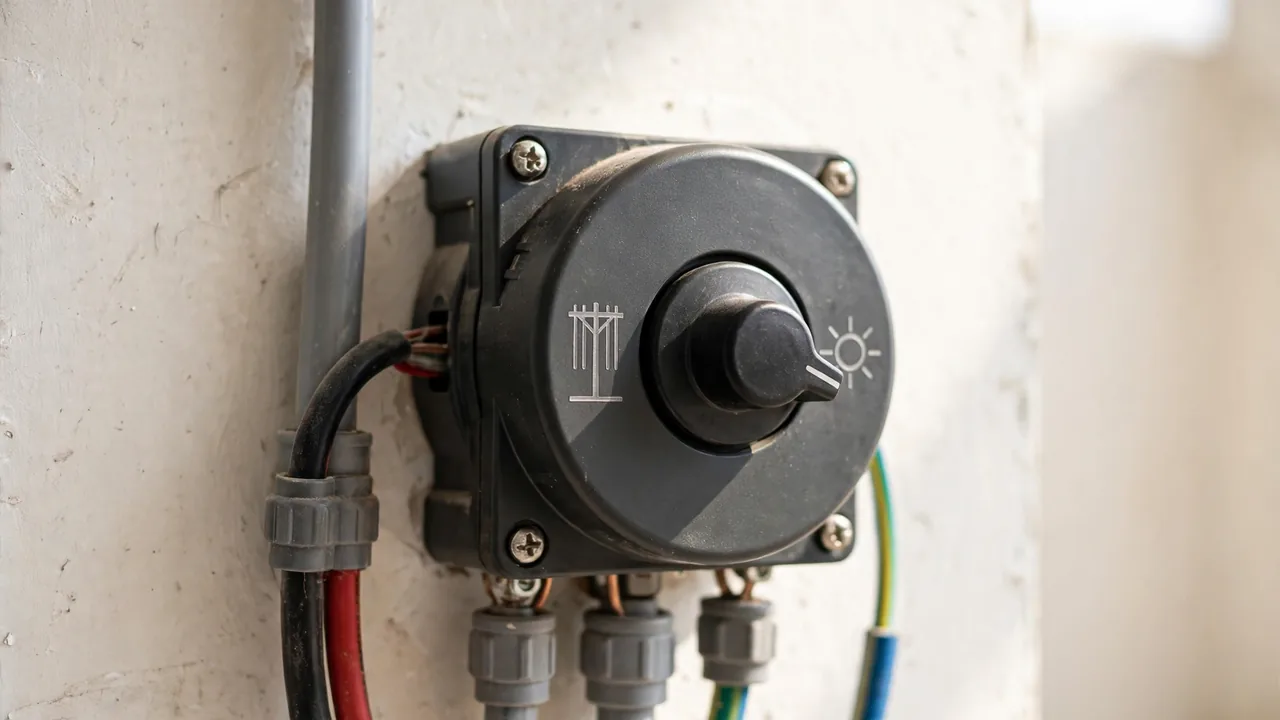
A manual changeover switch usually has three positions on a rotary knob: position I connects your home to WAPDA, position II to your solar inverter, and the middle position, marked 0 or OFF, disconnects both. You turn the knob by hand.
The middle OFF position is the safety feature: the switch must pass through OFF before it can connect the other source. This is called break-before-make: it breaks the first connection before it makes the second one, so the two sources can never touch each other, even for a split second. Wikipedia’s transfer switch explainer describes the same break-before-make principle and why it matters for safety.
An automatic changeover switch, or ATS, does the same job without your hand on the knob. It watches the main source all the time: when WAPDA power goes out, it moves the load to the inverter and batteries, and when WAPDA returns and stays stable, it moves the load back. A changeover switch does not produce power or store it — it only chooses the source. The panels make the power, the inverter converts it, and the batteries store it. Our solar inverter buying guide for Pakistan explains how the inverter side of the system works.
Manual vs Automatic Changeover Switch
The biggest choice is between a manual switch and an automatic one — both do the same core job, but they fit different homes and budgets. Here is how they compare.
| Feature | Manual changeover switch | Automatic changeover switch (ATS) |
| How it switches | You turn the knob by hand | Switches by itself when a source fails |
| Power cut during switch | Short break while you turn the knob | Very short break |
| Complexity | Very simple, few parts, rarely fails | Sensors, relays, control circuit |
| Best for | Small homes, tight budgets, simple setups | Homes with batteries, shops |
Manual Changeover Switch
A manual switch is a simple rotary switch in a small box on the wall, with no electronics inside — so there is almost nothing to go wrong, and any electrician can fit or replace it. The trade-off is that it needs you: if WAPDA fails at night while you are asleep, your home stays without power until you wake up and turn the knob.
Manual switches suit small homes where someone is usually around, and they are also common as a backup to an automatic system.
Automatic Changeover Switch (ATS)
An ATS watches the WAPDA supply continuously. The moment it drops, the ATS moves the load to the inverter and batteries, and moves it back when WAPDA returns and stays steady. The whole thing happens in seconds, and you do not have to be at home — that is why ATS units are the normal choice for homes with a hybrid inverter and batteries. The catch is complexity: an ATS has sensing circuits and relays, so it costs more and needs a skilled electrician to wire it correctly. Our hybrid solar inverter guide explains the kind of system an ATS usually works with, and our off-grid solar inverter guide covers setups where the switch plays a different role.
Why Your Solar System Needs a Changeover Switch
The first reason is safety. If your inverter feeds power into the house wiring while WAPDA is also connected, power can flow backwards out to the street lines. A lineman working on those lines expects them to be dead during an outage, so backfeeding puts his life at risk and can damage your inverter when WAPDA returns. A changeover switch makes backfeeding impossible, because the two sources are never connected together.
The second reason is control. Load shedding in Pakistan is a daily fact of life, and with a changeover switch you decide — or your ATS decides — when the home runs on solar and batteries and when it runs on WAPDA. The third reason is protection: switching through the OFF position gives the system a clean break, which sensitive things like a fridge compressor prefer over a sudden, messy change. The switch also lets you isolate the solar system completely when an electrician needs to work on it — turn it to OFF and both sources are disconnected.
Finally, a changeover switch is one part of a safe, complete installation. Our DC breaker selection guide covers the breakers on the panel side, and our solar surge protection device guide covers protection against voltage spikes. The changeover switch handles the source side — which supply feeds the house.
Types of Changeover Switches for Solar Homes
Rotary Changeover Switch
This is the classic manual switch — a round knob in a small box, with positions for source one, OFF, and source two. It is the most common type in Pakistani homes: one look at the knob tells you which source is feeding the house.
Automatic Transfer Switch (ATS)
The ATS is the automatic type described above, with its own control circuit that senses voltage and decides when to switch. It is used with hybrid inverters, generator backup, and larger homes, and some units include a manual override for when the automatic part fails.
What Size Changeover Switch Do You Need?
Size means two things: the current rating in amps, and the number of poles. Get either one wrong and the switch is unsafe or does not fit your wiring. The current rating must cover the maximum load your home will draw. Add up what you expect to run at one time — fans, lights, fridge, TV, pump — and pick a switch rated above that total. Common home ratings are 32 amps, 63 amps, and 100 amps. A switch rated below your real load will overheat, and its contacts can weld shut. When in doubt, ask your installer to pick the next size up.
A single-phase home needs a two-pole switch, which switches both the live and the neutral wires. A three-phase home needs a four-pole switch, which switches all three live wires plus the neutral. Fitting a two-pole switch on a three-phase supply leaves wires unswitched, which is unsafe. Fit the switch in a dry, accessible place, close to the distribution board. Our guide on where to install your solar inverter covers the same placement thinking for the inverter: easy to reach, out of rain, and away from children.
How to Use a Manual Changeover Switch Safely
- Check the load first. If heavy things like a water pump or an air conditioner are running, switch them off before you move the knob.
- Turn the knob to OFF. Wait a second or two. This is the break-before-make step — let the first source disconnect fully.
- Turn the knob to the other source. Move it firmly until it clicks — a half-turned knob can sit between contacts and overheat.
- Check that power is back. Look at a light or the inverter display to confirm the new source is feeding the house, then switch the heavy loads back on one by one.
Never force the knob — if it feels stuck, stop and call your electrician, as a stuck switch may have damaged contacts inside. Never open the switch box yourself while either source is live: the inside carries full mains voltage.
If your system has a hybrid inverter, check whether the inverter already handles the switchover — many switch to battery power automatically when WAPDA fails, and a manual changeover is only needed when you want to take the inverter out of service. Our solar inverter installation guide explains how the inverter, batteries, and switching fit together during installation.
Common Mistakes to Avoid
- Skipping the switch entirely. Some installers connect the inverter output straight into the house wiring without any changeover — the most dangerous shortcut in home solar. It invites backfeeding and leaves no clean way to isolate the system.
- Undersizing the switch. A 32-amp switch on a home that draws more will heat up and fail early. Size it to the real load.
- Switching under heavy load. Moving the knob while a pump or air conditioner is running causes arcing, which burns the contacts a little every time. Switch heavy loads off first.
- Mixing up the inputs. If the WAPDA and solar wires are swapped, the knob positions lie to you. Label both inputs clearly and test after installation.
- Fitting it in a bad place. A switch behind a cupboard, high on a wall, or out in the rain will not be used properly. Keep it at a comfortable height, indoors, and easy to reach in the dark.
- Ignoring the neutral wire. On a two-pole switch both live and neutral must switch together. A single-pole changeover leaves the neutral connected to both sources, which can cause strange faults.
Changeover Switch vs Other Protection Devices
A changeover switch is often confused with other devices in the setup, but each one has a different job. A DC breaker protects the wires between the panels and the inverter, tripping if the current gets too high. A surge protection device guards against sudden voltage spikes. An earth leakage breaker protects people from electric shock. None of these chooses the power source. Only the changeover switch does that, which is why a complete system has all of them. If you are planning the protection side of your setup, read our DC breaker selection guide and our surge protection device guide.
Check Current Prices
This guide stays evergreen, so it does not list prices — a figure printed here would be out of date within days. For today’s verified numbers, see the solar plate price in pakistan tables on our homepage, updated daily. You will also find the latest solar panel price in pakistan by brand and wattage, and the solar inverter price in pakistan. Check the tables there before you buy, and confirm the final quote with your dealer.
Conclusion
A solar changeover switch is a small, simple device that does a big safety job: it makes sure your home is fed by one source at a time, and never by both together. A manual switch is cheap and reliable, and fine for a small home where someone is around to turn the knob. An automatic switch costs more but runs itself, which suits homes with batteries and hybrid inverters. Either way, pick the right size for your load, match the poles to your supply, and never skip the switch to save money. This solar changeover switch guide pakistan covers the basics — your installer can confirm the exact size and type for your home.
Frequently Asked Questions (FAQs)
What is a solar changeover switch?
A solar changeover switch is a switch with two inputs and one output. One input comes from WAPDA, the other from your solar inverter, and the output goes to your home. It connects your home to one source at a time — never both at once — so the two supplies can never touch each other.
Do I need a changeover switch for my solar system?
Yes, if your home uses both WAPDA and solar power. Without a changeover switch, solar power can flow backwards into the WAPDA lines, which is dangerous for linemen and can damage your inverter. The switch is the device that makes using both sources safe.
What is the difference between a manual and an automatic changeover switch?
A manual changeover switch is a rotary knob you turn by hand to move the load between WAPDA and solar. An automatic changeover switch, or ATS, watches the supply and moves the load by itself when WAPDA fails, then moves it back when WAPDA returns. Manual is simpler and cheaper; automatic works even when nobody is home.
What size changeover switch do I need for my home?
The rating must cover the maximum load your home will draw through the switch. Common home ratings are 32 amps, 63 amps, and 100 amps. A single-phase home needs a two-pole switch and a three-phase home needs a four-pole switch. Ask your installer to work out your load and pick the next size up if you are unsure.
Can I switch between WAPDA and solar while appliances are running?
It is safer to switch heavy loads off first. Moving the knob while a water pump or air conditioner is running can cause arcing at the contacts, which burns them a little every time. Switch the heavy loads off, move the knob through OFF to the other source, then switch the loads back on one by one.
Can I use a changeover switch with a hybrid inverter?
Yes. Many hybrid inverters already switch to battery power automatically when WAPDA fails, so the changeover switch is mainly needed when you want to run the whole house from a different source or take the inverter out of service. Check your inverter manual or ask your installer how the two work together in your setup.
Where should a changeover switch be installed?
Indoors, in a dry place, close to the distribution board, at a comfortable height that is easy to reach in the dark. Keep it out of rain and away from children. It should never be hidden behind furniture or fitted so high that you cannot reach the knob safely.
What happens if I connect solar and WAPDA without a changeover switch?
That is the most dangerous shortcut in home solar. Without a changeover switch the two sources can connect together, solar power can backfeed into the street lines and endanger linemen, and your inverter can be damaged when WAPDA returns. Always fit a changeover switch between the two sources and the house load.