
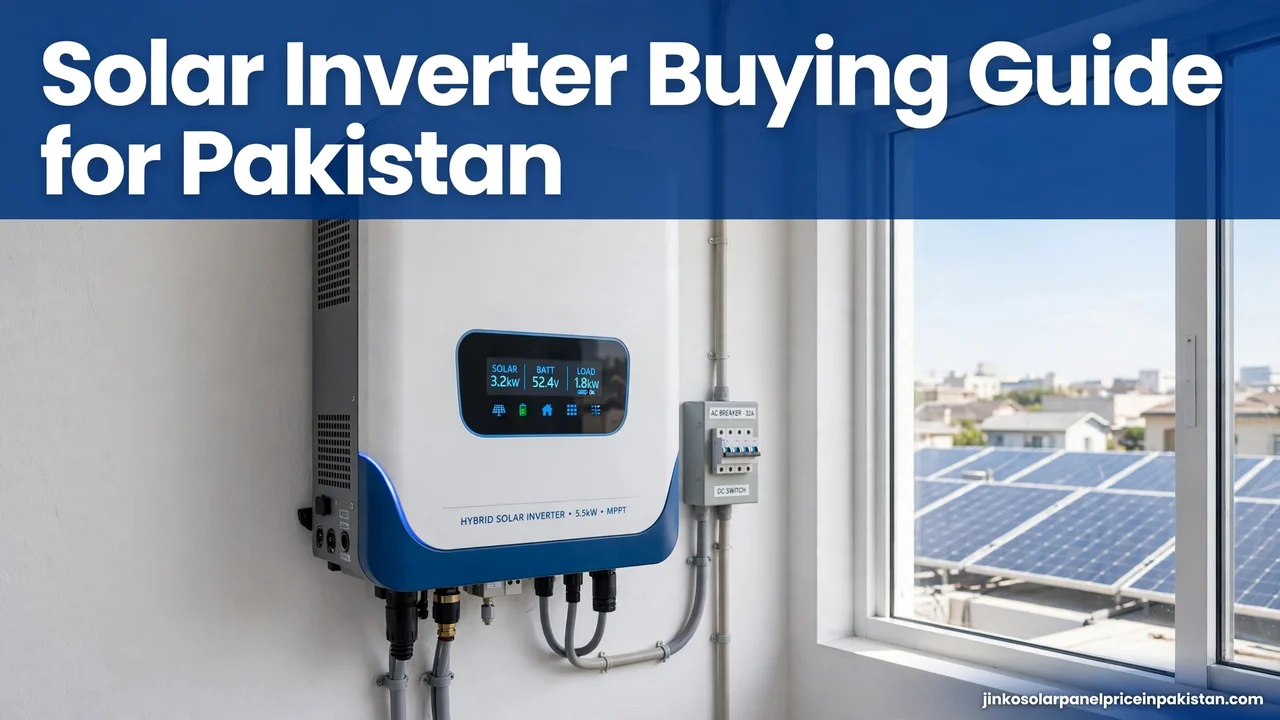
Solar Inverter Buying Guide for Pakistan: Types, Sizing and What to Check

Short answer: To buy the right solar inverter in Pakistan, first pick the type that matches your situation — on-grid for stable supply with net metering, off-grid for areas with no grid at all, or hybrid for backup during load-shedding. Then size it to your peak load with room to spare, check the MPPT design and PV voltage range, confirm battery compatibility and the warranty terms, and buy from a seller with real local after-sales support. This guide walks through each step so you do not pay for the wrong machine.
The inverter is the brain of your solar system: it converts the DC electricity your panels produce into the AC electricity your home runs on, and in hybrid systems it also manages batteries and the grid connection. Panels get most of the attention, but a badly chosen inverter caps your entire system’s output, reliability, and lifespan. The good news is that buying right is a checklist problem, not a guessing game.
1. Types of Solar Inverters in Pakistan
Every inverter on the Pakistani market falls into one of three functional families. Understanding them is the single most important step, because each type is designed for a different relationship with the grid and with batteries. Solar inverters are commonly classified this way — stand-alone/off-grid, grid-tie, and hybrid/battery-backup designs (Wikipedia’s solar inverter overview explains the standard classification).
On-Grid (Grid-Tie) Inverters
An on-grid inverter synchronizes with the utility grid and pushes your solar power into your home and, with net metering, back into the grid. It has no battery connection. The critical fact buyers miss: an on-grid inverter shuts down during a power outage — this is a safety requirement (anti-islanding) so it never energizes lines that repair crews are working on. On-grid suits homes and businesses in areas with stable supply where the goal is bill reduction and net metering, not backup. If you plan net metering, confirm the inverter model is on your distribution company’s accepted list — our net metering policy guide explains the approval side.
Off-Grid Inverters
An off-grid inverter builds its own AC supply independently of the utility grid, always paired with a battery bank. It is the right choice for sites with no grid connection — farms, remote homes, tube wells — or where the grid is so unreliable it barely exists. Off-grid systems need disciplined sizing: when the battery bank is empty and the sun is weak, there is no grid to fall back on, so the battery and inverter must be matched to your real consumption, not your optimistic estimate.
Hybrid Inverters
A hybrid inverter combines everything in one unit: solar input, battery charging and management, and grid interaction. During the day it runs your loads from solar and charges the battery; during an outage it switches to battery power; and with net metering it can export surplus. For most Pakistani households dealing with load-shedding, hybrid is the default recommendation — it gives bill savings on normal days and backup on bad days. Many hybrid models can be installed without batteries and have batteries added later, which is a useful upgrade path, but confirm this on the specific model’s datasheet rather than assuming it.

2. How to Size Your Inverter (kW)
Sizing is where most buying mistakes happen. An undersized inverter trips under load or clips your solar output; a wildly oversized one costs more than you needed. The method is straightforward:
- List your loads. Write down everything the inverter will run — fans, lights, fridge, TV, water pump, air conditioner — with each appliance’s wattage from its nameplate or manual.
- Find your peak, not your average. Size for the worst realistic moment: everything that could plausibly run at once. Motors (fridge compressors, pumps, ACs) draw a starting surge several times their running wattage — the inverter’s surge rating must cover this, or the compressor simply will not start.
- Leave headroom. Pick a rated capacity comfortably above your calculated peak. A system running at its absolute limit every evening fails sooner and leaves no room for the extra appliance you will inevitably add later.
- Match the inverter to the panel array. The panel array’s DC capacity and the inverter’s AC rating should be in the same ballpark. A large array on a tiny inverter wastes midday generation (clipping); a huge inverter on a small array runs inefficiently at low load.
- Think in stages. If you plan to add panels or batteries within a year or two, buying one step up in capacity now is cheaper than replacing the inverter later.
If sizing math feels uncertain, get two independent installers to size your system and compare their numbers — agreement between them is a strong signal. And remember that sizing rules are evergreen while prices are not: see our top hybrid inverters in Pakistan roundup for the models commonly sized for homes here.
3. MPPT: The Feature That Decides Your Real Output
MPPT — maximum power point tracking — is the circuit that continuously adjusts the electrical load on your panels to harvest the maximum available power as sunlight, temperature, and shading change through the day. Every modern solar inverter has it; what differs is the quality and count.
- Number of MPPT trackers. A single MPPT treats the whole array as one. If your roof has panels facing two different directions (for example, some east and some west), a dual-MPPT inverter lets each orientation operate at its own optimum instead of dragging both down to the weaker one’s level. Split-orientation roofs should treat dual MPPT as a requirement, not a luxury.
- PV voltage window. The datasheet lists a start-up voltage and an MPPT operating range. Your panel string’s voltage — which drops on hot Pakistani summer afternoons — must stay inside that range, or the tracker underperforms. This is an installer’s calculation, but ask to see it.
- Efficiency claims. Published conversion efficiencies on modern inverters are high; what matters more in practice is the MPPT design and thermal behavior in heat, since an inverter baking in a closed room in July performs worse than its datasheet suggests.
4. Key Checks Before You Buy
Type and size get you 80% of the way. These checks cover the rest:
Battery Compatibility
For hybrid and off-grid inverters, confirm the supported battery voltage (commonly 48V for home systems) and battery chemistry. If you plan lithium batteries, the inverter should support lithium profiles and ideally communicate with the battery’s management system; for tubular lead-acid, check the charge settings are adjustable. Our lithium vs dry battery comparison covers the trade-offs on the storage side.
Warranty and After-Sales in Pakistan
An inverter is a long-term appliance — treat the warranty as part of the product. Ask for the written warranty card and check four things: how long the warranty lasts, whether it covers parts and service or parts only, who honors it in your city (a local service center with stock, or a dealer who ships the unit away for weeks), and whether parallel/grey imports are excluded. A strong local service network matters more than a long warranty on paper that nobody nearby can execute.
Heat, Protection Rating, and Placement
Pakistan’s summers punish electronics. Check the inverter’s rated operating temperature range and its ingress protection (IP) rating if it will sit outdoors or in a dusty area. Install it in a shaded, ventilated spot — never in a sealed box on a sun-baked wall — because sustained heat is the fastest way to shorten an inverter’s life.
Monitoring and Display
A clear display or a WiFi/app-based monitoring option lets you verify the system is actually producing what it should. Many problems — a tripped string, a failing panel, chronic clipping — are invisible without monitoring and only show up as a mysteriously high electricity bill months later.

5. Common Mistakes to Avoid
- Buying an on-grid inverter and expecting backup. The most expensive misunderstanding in the market. If the grid fails, a grid-tie unit stops — full stop.
- Sizing to the brochure, not the home. Copying a neighbor’s system size ignores that your loads, roof, and backup needs are different.
- Ignoring surge ratings. An inverter that handles your running watts but not your fridge’s starting surge will trip every time the compressor kicks in.
- Skipping the originality check. The inverter market has counterfeit and refurbished units sold as new. Buy from authorized channels, verify serial numbers with the brand where possible, and keep the purchase invoice — you will need it for any warranty claim.
- No installer vetting. A good inverter installed badly — undersized DC cables, no proper earthing, no surge protection — underperforms and can be dangerous. Vet the installer, not just the box.
Check Current Prices
Inverter and panel prices in Pakistan move with the dollar rate, import duties, and market demand, so any fixed figure printed in a guide goes stale fast. Our homepage tracks the latest solar panel prices in Pakistan with tables updated daily from the live market — brand-wise rates for Jinko, Longi, Canadian Solar, Trina, and more.
Check today’s updated solar panel prices →
Frequently Asked Questions (FAQs)
Which type of solar inverter is best for Pakistan?
For most households, a hybrid inverter is the best fit: it reduces electricity bills on normal days and provides battery backup during load-shedding, and many models support net metering. Choose on-grid only if your supply is stable and you want maximum bill savings with no backup; choose off-grid for sites with no grid connection at all.
What size inverter do I need for my home?
Add up the wattage of everything the inverter will run at the same time, include the starting surge of motors like fridges and pumps, and choose a rated capacity comfortably above that peak. Matching the inverter to your panel array size and leaving room for future expansion avoids costly replacements later.
What is MPPT in a solar inverter?
MPPT (maximum power point tracking) continuously adjusts the electrical load on your solar panels to extract the maximum available power as sunlight and temperature change. Dual-MPPT inverters are better for roofs with panels facing different directions, since each orientation gets its own tracker.
Can a hybrid inverter work without batteries?
Many hybrid inverter models can run without batteries – operating like an on-grid unit during the day – with batteries added later. However, this is model-specific, so confirm battery-less operation on the datasheet of the exact unit you are buying before relying on it.
How long does a solar inverter last?
A quality inverter installed in a cool, ventilated location and sized with headroom typically serves for many years. Heat, dust, overloading, and poor installation shorten its life – which is why placement, sizing, and buying from sellers with real after-sales support matter as much as the brand.
Where can I see today’s solar panel prices in Pakistan?
Our homepage maintains daily updated price tables for all major brands – Jinko, Longi, Canadian Solar, Trina, and more. Check the current solar panel prices page for today’s rates.
