
Bidirectional Meters for Net Metering: Types Explained

A bidirectional net meter is the special meter that makes net metering work. It measures electricity flowing in two directions: the units your home takes from the grid, and the extra units your solar panels send back to the grid. Without this meter, your distribution company cannot count what you export, so you cannot get credit for it. This bidirectional net meter types pakistan guide explains what the meter does, the types you will see in Pakistani homes, how to read its screen, and which type your home needs.
What Is a Bidirectional Net Meter?
A normal electricity meter only measures in one direction: it counts the units coming into your home from the grid, and that total becomes your bill. A bidirectional meter does that job too, but it also measures the units going the other way — the extra solar power your panels produce that your home does not use right away.
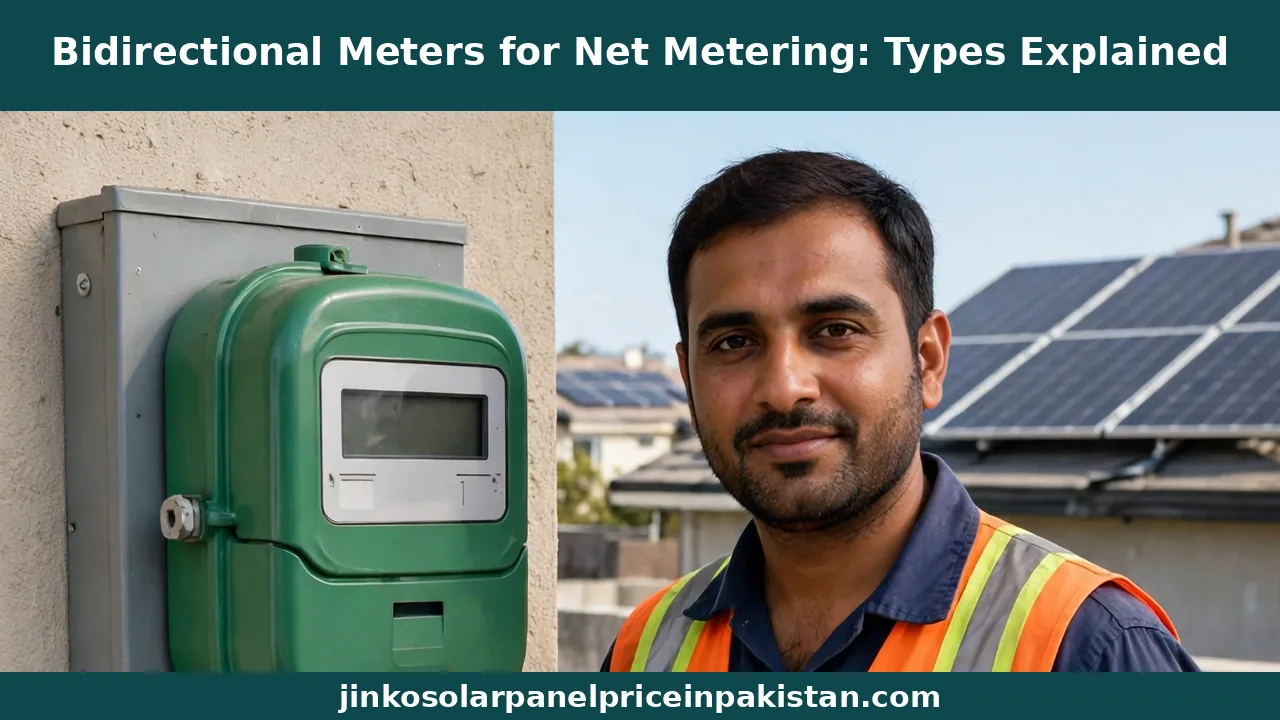
Think of it as a two-way counter. In the morning, when your panels make more power than your home needs, the extra units flow out to the grid and the meter records them as export. At night, when your panels make nothing, the meter records the units your home draws as import. The monthly bill is worked out from the difference between the two numbers. In Pakistan this meter is often called a green meter, because the box the distribution companies install is usually green.
Net metering itself is a billing system that lets solar homes use the grid like a battery: export during the day, import at night, and pay only for the net difference. Wikipedia’s net metering explainer describes the same idea — a single bi-directional meter that measures current flowing in both directions. Our latest net metering policy guide covers the rules of the scheme in Pakistan, while this article focuses on the meter itself.
How Does a Bidirectional Meter Work?
The meter has two separate registers inside it, one for import and one for export. A register is simply a counter that keeps a running total. The import register counts every unit your home pulls from the grid. The export register counts every unit your solar system pushes back into the grid. The two numbers never mix — each one only moves in its own direction.
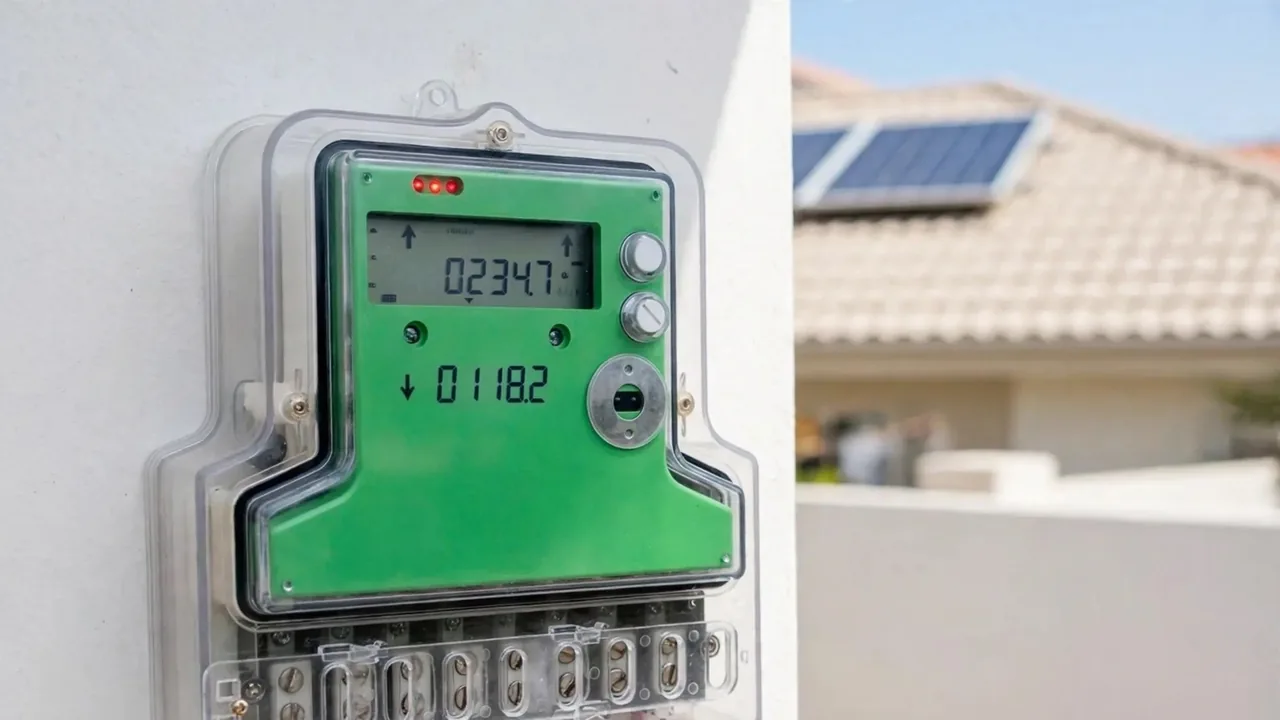
Most modern meters show these numbers on a digital screen, and the screen cycles through several readings one after another. You will usually see a code or a small arrow on the screen: an arrow pointing in means import, an arrow pointing out means export. Some screens show the total import first, then the total export, then the date and time. The exact order depends on the meter model, and the model name is printed on the meter’s front label.
One thing the meter does not do is decide the value of your exported units — it only counts them. How those units are treated on your bill is decided by the net metering rules, not by the meter. Our guide on how net metering billing works explains what happens to the numbers after the meter records them.
Bidirectional Net Meter Types Pakistan — Single-Phase, Three-Phase and Smart
Not every home gets the same meter. The type depends on your electricity connection, the size of your solar system, and what your distribution company stocks. Here are the types you will actually see in Pakistan.
Single-Phase Bidirectional Meter
This is the meter for most small homes. A single-phase connection has one live wire and one neutral wire, and it suits homes with a modest load — fans, lights, a fridge, a TV, and a small water pump. If your home already has a single-phase connection, the distribution company will normally replace your old meter with a single-phase bidirectional one when your net metering is approved. It measures import and export on that one phase, and it is the simplest and most common type.
Three-Phase Bidirectional Meter
Larger homes and small shops usually have a three-phase connection, with three live wires plus a neutral. A three-phase bidirectional meter measures import and export on all three phases, so it can handle bigger loads — air conditioners, larger pumps, and three-phase motors. If your solar system is large or your sanctioned load is high, your distribution company will install this type.
Smart Bidirectional Meter (AMI Meter)
A smart meter is a digital bidirectional meter with a communication module built in. Instead of a meter reader visiting every month, it sends its readings to the distribution company automatically, over the mobile network or a radio link. Some also record when you import and export, hour by hour, which matters if your area ever moves to time-based billing. Smart meters are still being rolled out in Pakistan, so not every area has them yet.
Whole-Current vs CT-Operated Meters
A whole-current meter carries the full current of your home through the meter itself, and it suits ordinary homes. A CT-operated meter uses current transformers — small rings fitted around the cables — to measure the current without passing it all through the meter, and distribution companies use it for larger connections. You do not choose between the two; your connection size decides it.
Bidirectional Meter vs Normal Meter
The difference between the two meters is simple, but it changes everything about your bill. Here is a side-by-side comparison.
| Feature | Normal meter | Bidirectional meter |
| Measures | Import only | Import and export |
| Registers | One counter | Two counters |
| Works with solar export | No — it cannot count exported units | Yes — that is its main job |
| Colour in Pakistan | Usually white or grey | Usually green (called a green meter) |
| Reading | Manual, by a meter reader | Manual or automatic (smart type) |
| Needed for net metering | No | Yes — net metering cannot start without it |
One warning: if your solar system is running and your old one-way meter is still in place, the exported units are not counted at all — and some old meters can even misread exported power as imported power, adding to your bill instead of reducing it. That is why the meter must be replaced before you switch the system on for export — see our net metering inspection preparation guide.
How to Read Your Bidirectional Meter
Reading your own meter tells you whether your system is exporting well and whether the bill matches the meter. Here is how to do it.
- Find the display button. Most digital meters have a small push button on the front. Each press moves the screen to the next reading.
- Note the import reading. Look for the reading with an arrow pointing in, or a code that your bill calls import. Write the number down with the date.
- Note the export reading. Keep pressing until you see the reading with an arrow pointing out. That is the total your panels have exported since the meter was installed.
- Compare month to month. Subtract last month’s import from this month’s import to get the units you used. Do the same for export. The difference between the two is what your bill is based on.
If the screen is blank, the meter may have lost power or its internal battery may be flat — report it to your distribution company rather than opening the meter yourself. Never break the seal on a meter: the seal proves the meter has not been tampered with, and a broken seal can lead to a fine or a disconnection.
Which Type Do You Need for Your Home?
In practice, you do not pick the meter type yourself — your distribution company does, based on your connection. But it helps to know what to expect, so here is the simple rule. If your home has a single-phase connection and a small or medium solar system, expect a single-phase bidirectional meter. If your home has a three-phase connection, or a large system with heavy loads, expect a three-phase bidirectional meter. If your area has smart metering, you may get a smart meter of either type.
If you are planning a large system but your home is still on a single-phase connection, talk to your installer and your distribution company before the panels go up — upgrading the connection takes time and paperwork. Our on-grid solar inverter guide explains the inverter side of the setup, which also depends on your connection type.
How the Bidirectional Meter Is Installed
The meter is installed by your distribution company, not by your solar installer and not by you. The usual sequence is this: first your net metering application is approved, then your solar system is installed and inspected, and then the distribution company replaces your old meter with the bidirectional one and signs the net metering agreement. Only after the new meter is in place should the system start exporting to the grid.
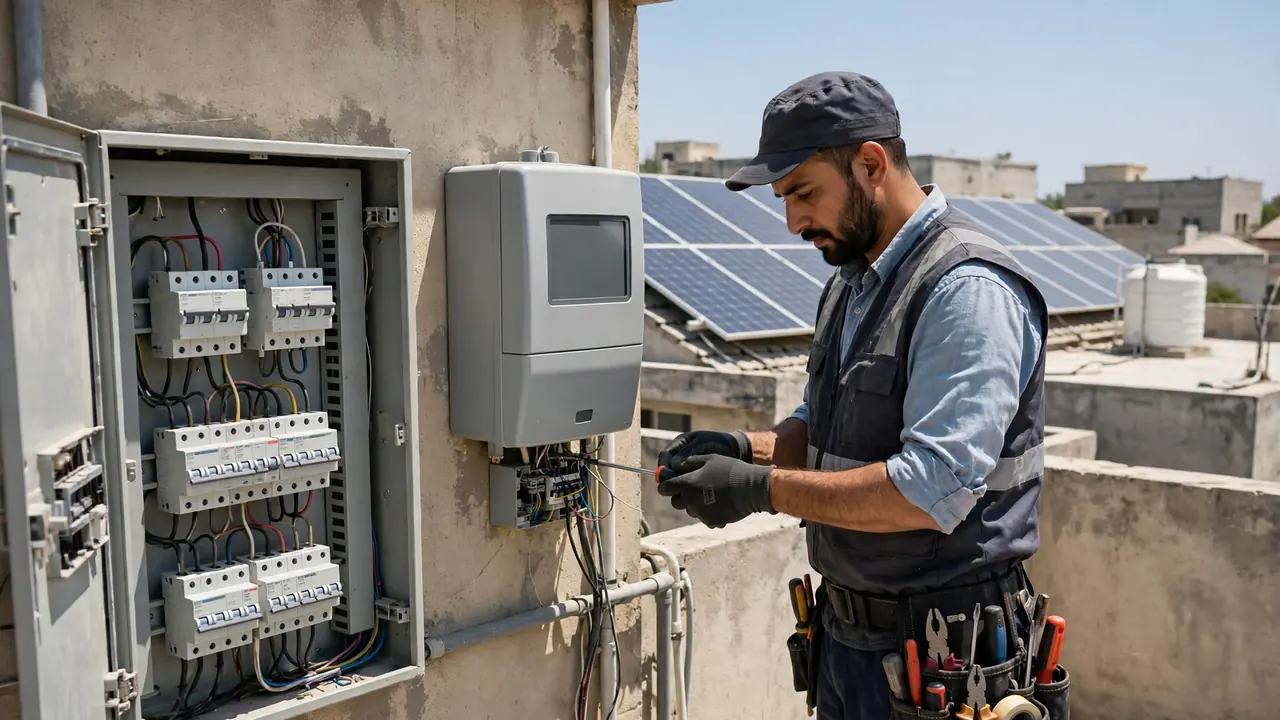
Before the installation day, make sure the meter board is accessible and dry, and the wiring from the inverter to the meter board is complete. If the inspector finds the wiring or earthing incomplete, the meter installation will be delayed until the faults are fixed.
Common Bidirectional Meter Problems and What to Do
- Export reading not moving. If your panels are producing power but the export register never changes, the system may not be exporting at all — the inverter may be set to zero export, or the wiring may be wrong. Ask your installer to check the inverter settings first. Our zero export device guide explains the setting that stops export on purpose.
- Blank or frozen display. A blank screen usually means the meter has lost supply or its display has failed. Report it to your distribution company and keep a note of the date — do not open the meter or press anything inside it.
- Bill does not match the meter. Compare the readings printed on your bill with the numbers on the meter screen. A small difference is normal, because the bill is read on a fixed date, but a large gap means the wrong reading was recorded. Take a photo of the screen and visit your distribution company office with the bill.
- Meter shows export at night. A small export reading at night is usually the inverter drawing a tiny amount of power, or a display quirk — but a large night-time export figure is a fault. Report it and ask for the meter to be tested.
- Burning smell or heat from the meter box. Switch the system off at the changeover switch, do not touch the meter, and call your distribution company and your installer immediately. A hot meter box is a loose connection, and loose connections are a fire risk.
Check Current Prices
This guide stays evergreen, so it does not list prices — a figure printed here would be out of date within days. For today’s verified numbers, see the solar plate price in pakistan tables on our homepage, updated daily. You will also find the latest solar panel price in pakistan by brand and wattage, and the solar inverter price in pakistan. Check the tables there before you buy, and confirm the final quote with your dealer.
Conclusion
A bidirectional net meter is a small box with a big job: it counts the units your home takes from the grid and the units your solar panels send back, and those two numbers are what your net metering bill is built on. Most Pakistani homes get a single-phase green meter, larger homes get a three-phase one, and smart meters are slowly joining both types. Check the import and export numbers against your bill each month, and never switch your system on for export before the new meter is in place. This bidirectional net meter types pakistan guide covers the basics — your distribution company can confirm the exact meter type for your connection.
Frequently Asked Questions (FAQs)
What is a bidirectional meter?
A bidirectional meter is a meter that measures electricity flowing in both directions. It counts the units your home takes from the grid as import, and the extra units your solar panels send back to the grid as export. Those two numbers are what a net metering bill is worked out from.
Is a bidirectional meter the same as a green meter?
Yes, in Pakistan they are the same thing. The bidirectional meter installed for net metering is usually in a green box, so people call it a green meter. Green meter is the everyday name; bidirectional meter is the technical name for what it does.
Can I use my old meter with net metering?
No. A normal one-way meter only counts import, so it cannot record the units your panels export. Worse, some old meters can misread exported power as imported power. Net metering cannot start until the distribution company replaces your old meter with a bidirectional one.
How do I read import and export units on my bidirectional meter?
Press the display button on the front to move through the readings. Look for the reading with an arrow pointing in — that is import. Keep pressing until you see the reading with an arrow pointing out — that is export. Compare each number with last month’s number to work out what you used and what you exported.
Which type of bidirectional meter do I need for my home?
Your distribution company decides, based on your connection. A single-phase connection gets a single-phase bidirectional meter, and a three-phase connection gets a three-phase one. If your area has smart metering, you may get a smart meter of either type.
Who installs the bidirectional meter in Pakistan?
Your distribution company installs it, not your solar installer and not you. It is fitted after your net metering application is approved and your system is inspected. Only after the new meter is in place should your system start exporting to the grid.
What happens if my bidirectional meter stops working?
Report it to your distribution company and do not open the meter yourself. A blank screen usually means the meter has lost supply or its display has failed. Keep a note of the date you reported it, and never break the seal on a meter — a broken seal can lead to a fine.
Do I need a bidirectional meter if I have batteries?
Yes, if you want net metering. Batteries store power for your own use at night, but the meter is still needed to count any extra units your panels send to the grid during the day. Without it, your exported units are not recorded and you get no credit for them.