
DC Breakers for Solar Systems: Complete Selection Guide

A DC breaker is a safety switch that cuts off the direct current between your solar panels and the rest of the system when something goes wrong. To choose the right one, match three things: a DC voltage rating above your string’s highest voltage, a current rating above its short-circuit current times 1.56, and a breaking capacity that can handle a fault. This dc breaker for solar selection guide walks you through each choice in plain language, so you can spot a wrong breaker early.
What Is a DC Breaker and What Does It Do in a Solar System?
A circuit breaker is an automatic switch: when the current rises above a safe level, it trips and opens the circuit. Unlike a fuse, which melts and must be replaced, a breaker can be switched back on after the fault is fixed.
In a solar system, the current from the panels to the inverter is direct current (DC). The DC breaker sits on that side and does three jobs: it protects the cables by tripping before a fault current overheats them, it shields the inverter and charge controller from fault current, and it lets you switch a string off by hand — for cleaning or maintenance — without pulling live cables apart. A small system has one breaker per string; a bigger system has breakers at several points, covered below.
Why You Must Never Use an AC Breaker on the DC Side
This is the most important rule in this guide: an AC breaker must never be used on the DC side, even if its numbers look right. The two look almost the same from the outside — and that is exactly why the mistake happens.
The reason is the arc. When a breaker opens under load, an arc of hot plasma forms between its contacts. In an AC circuit the current passes through zero 100 times a second, so the arc dies out on its own. In a DC circuit there is no zero crossing, so the arc keeps burning. A DC breaker kills it with magnets and splitter plates that stretch, split and cool it. An AC breaker has none of that, so on DC the arc can keep burning, weld the contacts, and start a fire.
Check the printing on every breaker: it must say DC, with a DC voltage rating such as 1000V DC or 1500V DC. A breaker marked only 230V or 400V AC has no place on the DC side — our solar DC wiring guide makes the same point for cables.
Types of DC Breakers You Will See in Pakistan
Home solar systems use three types of DC protection — each fits a different place in the system.
DC MCB (Miniature Circuit Breaker)
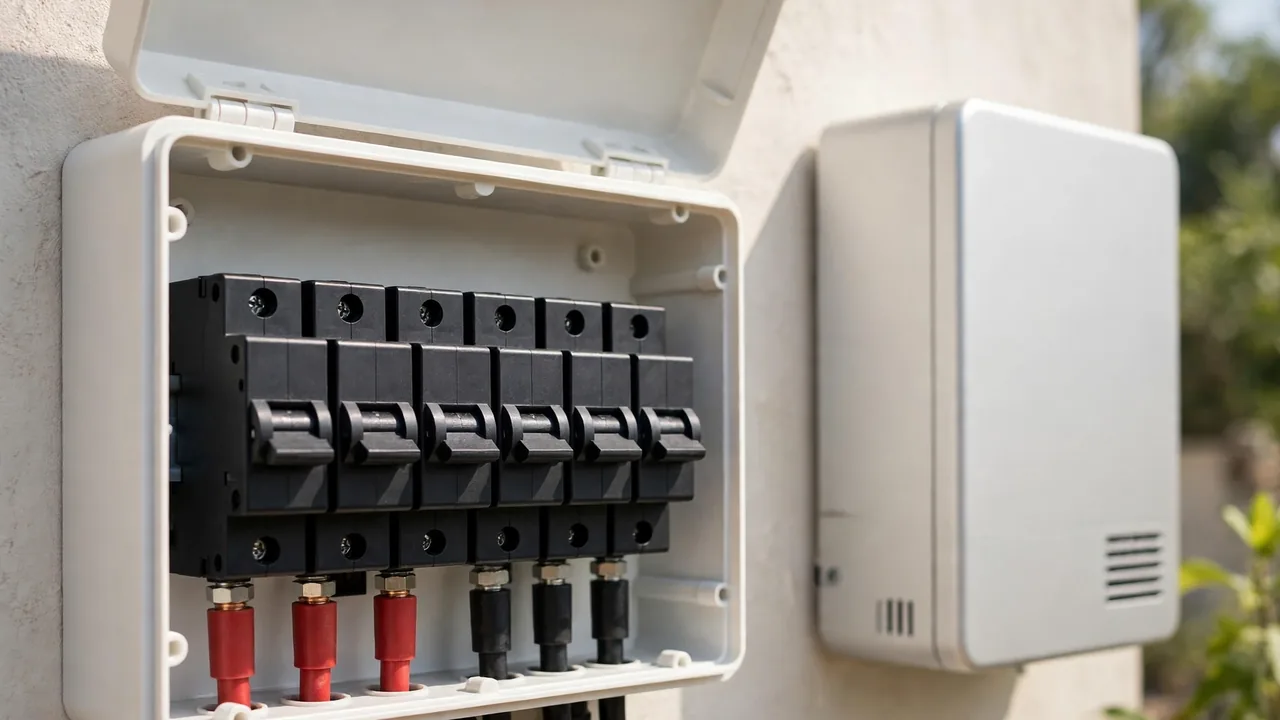
The DC MCB is the small breaker you see in rows inside a distribution box — the one in the photo below. It protects one string or one small circuit, and it is the standard choice for home rooftop systems, commonly rated 1000V DC, 10A to 63A. It trips on overload and short circuit, and doubles as a manual switch for that string.
DC MCCB (Moulded Case Circuit Breaker)
The DC MCCB is a bigger, heavier breaker for bigger currents — the main DC breaker of a large home or commercial system, or the battery breaker of a high-power hybrid setup. It handles higher fault currents than an MCB, and many models let the installer adjust the trip setting. For a single small string you will not need one, but you may see one where strings join, or on a large inverter’s battery side.
The Four Ratings Printed on Every DC Breaker
Every DC breaker carries four numbers. Get any one wrong and it cannot protect your system properly.
Rated Voltage — Must Be Higher Than Your String Voltage
The rated voltage is the highest DC voltage the breaker can safely interrupt, and it must sit above the highest voltage your string can reach. That peak comes on a cold morning, when a string produces its open-circuit voltage (Voc). Take the Voc of one panel from its datasheet and multiply by the panels in the string — cold mornings push it higher. For most home strings in Pakistan, that means a 1000V DC breaker. See our guide on how to read a solar panel datasheet to find Voc and Isc for your own panels.
Rated Current (In) — The Size of the Breaker
The rated current, marked In, is the current the breaker can carry all day without tripping. Standard sizes step up in a fixed series — 10A, 16A, 20A, 25A, 32A, 40A, 63A and so on — chosen from the string current with the 1.56 rule below. Too small, and it trips on every sunny afternoon; too big, and it may never trip on a fault, leaving the cable unprotected.
Breaking Capacity (kA) — Can It Stop a Real Fault?
Breaking capacity, marked in kA (kilo-amps), is the biggest fault current the breaker can interrupt without being destroyed. A panel string can only push a small fault current, so a 6kA breaker is the usual choice for home strings. But a battery bank can push a very large fault current, so battery breakers need a much higher breaking capacity — one that cannot stop the fault it faces can fail dangerously.
Trip Curve (B, C or D) — How Fast It Trips
The trip curve tells you how much current trips the magnetic part instantly: B-curve at 3 to 5 times the rated current, C-curve at 5 to 10 times, D-curve at 10 to 20 times. For solar DC circuits, C-curve is the standard choice — it ignores the small surges of normal operation but trips fast on a real short circuit. The Wattuneed circuit breaker guide explains the curves and the IEC standards behind them in full detail.
How to Size a DC Breaker in 4 Steps
Sizing a DC breaker is a calculation, not a guess — follow these four steps for every DC circuit.
Step 1: Find the Short-Circuit Current (Isc)
Read the short-circuit current (Isc) from the panel datasheet or the label on the back of the panel. If two strings join into one cable and one breaker, add their Isc values: two 13-amp strings make 26 amps in the shared breaker.
Step 2: Multiply by 1.56
Multiply Isc by 1.56. This number from the electrical code combines two safety margins of 1.25 each: one for bright-sun conditions that push the current above the test value (the edge-of-cloud effect), and one because solar current flows for hours at a time, so the breaker runs hot. For a string with Isc of 13 amps: 13 × 1.56 = 20.28 amps — the minimum breaker rating for that string.
Step 3: Round Up to the Next Standard Size
Breakers come in fixed sizes, so round the result up — never down. In the example above, 20.28 amps rounds up to a 25A breaker. If the breaker sits in a hot, sun-baked box, go one size up again, because heat lowers its real tripping point.
Step 4: Check the Voltage and the Cable
Now check the other two ratings: the breaker voltage must be above the string’s highest cold-morning voltage, and the cable must match the breaker — rated higher than the breaker, so the breaker trips before the cable overheats. A big breaker on a thin cable protects nothing. Our solar DC cable size selection guide shows how to size the cable for the same circuit.
Worked example: a home string of ten large panels, Isc 13 amps, Voc 49 volts per panel, needs a 25A, 1000V DC, C-curve breaker — 13 × 1.56 = 20.28 amps, rounded up to 25A, and 10 × 49 = 490 volts, higher on a cold morning, so 1000V DC with cable rated above 25 amps.
Where Each Breaker Goes in a Solar System
A home hybrid system has a breaker at each point where protection is needed.
- Each panel string. One DC breaker per string, close to the inverter or in the combiner box.
- Combiner box output. Where several strings join into one cable, a larger breaker protects the combined cable.
- Battery to inverter. A DC breaker (often an MCCB) between the battery bank and the inverter, sized for the battery’s high current. See our inverter and battery pairing guide.
- Inverter AC output. The inverter’s AC output also needs a breaker — an AC breaker, on the AC side, where it belongs.
Breakers work with the rest of the protection: the surge protection device handles lightning and switching surges, and earthing gives fault current a safe path to ground — see our lightning protection guide and our solar panel earthing and grounding guide.
Polarised vs Non-Polarised DC Breakers
Many DC breakers are polarised: they only work correctly when current flows in one direction, from positive to negative exactly as marked, because the magnetic arc-blowing inside is built for that direction. Wire one backwards and it may not clear a fault at all. For a simple panel string, current flows one way only, so a polarised breaker is fine if the wiring is correct. But in a battery circuit, current flows both ways — out when the battery discharges, in when it charges — so use a non-polarised (bidirectional) DC breaker there. A polarised breaker is marked with + and − terminals, and the wiring must match those marks exactly.
Common DC Breaker Mistakes to Avoid
- Using an AC breaker on the DC side. The arc cannot be cleared, and the breaker can fail instead of protecting you.
- Sizing by the panel’s normal current instead of Isc × 1.56. Too small and it trips on sunny afternoons; too big and it never protects the cable.
- Ignoring the voltage rating. A 600V DC breaker on a string that reaches 800V on a cold morning cannot interrupt a fault safely.
- One breaker for many strings. A shared breaker cannot isolate a faulty string.
- Big breaker, thin cable. If the cable is the weaker part, it burns first and the breaker never trips.
- Wrong polarity on a polarised breaker. Reversed + and − means the arc-blowing works backwards, so the breaker may not clear a fault.
- Mounting the breaker box in full sun with no shade or ventilation. Hot breakers trip at lower currents, so a sun-baked box causes nuisance tripping on the hottest days.
- Switching a tripped breaker back on without finding the cause. Resetting it again and again hides a fault that will come back worse.
How to Check Your Installer’s Breaker Work
You do not need to be an electrician to spot bad breaker work. On installation day, check six things: the printing on each breaker (it must say DC, with a DC voltage rating and a brand and model you can look up); the sizes (ask the installer what Isc he used and what the 1.56 calculation gave — a good installer explains it in one minute); the polarity (+ and − wired exactly as marked); one breaker per string; the cable match; and the box itself (shaded or ventilated, lids closed, cables clipped and labelled). If the installer cannot explain the sizing, or the breakers are unbranded with no markings, do not accept the work. Our checklist before buying solar panels and the solar inverter buying guide for Pakistan help you check the rest of the system the same way, and our solar inverter maintenance guide covers ongoing care.
Check Current Prices
A DC breaker is only one small part of a solar system. If you are comparing systems, check the solar plate price in pakistan and the solar panel price in pakistan on our homepage, where today’s prices are updated daily, along with the solar inverter price in pakistan for the inverter at the end of those DC cables.
Frequently Asked Questions (FAQs)
What size DC breaker do I need for solar panels?
Find the string’s short-circuit current (Isc) on the panel datasheet, multiply it by 1.56, and round up to the next standard breaker size. For a string with Isc of 13 amps, 13 × 1.56 = 20.28 amps, so a 25A breaker is the right size. Then check that the breaker voltage rating is above the string’s highest cold-morning voltage.
Can I use an AC breaker for solar DC?
No. An AC breaker cannot clear a DC arc, because DC current has no zero crossing for the arc to die out on its own. On a DC circuit the arc can keep burning, weld the contacts together, and start a fire. Always use a breaker that is marked DC, with a DC voltage rating.
What is the difference between a DC MCB and a DC MCCB?
A DC MCB is the small breaker that protects one string or one small circuit, commonly rated 1000V DC with currents from 10A to 63A. A DC MCCB is a bigger, heavier breaker for bigger currents — the main DC breaker of a large system or the battery breaker of a high-power hybrid setup — with a higher breaking capacity and often an adjustable trip setting.
Do I need a breaker for each solar string?
Yes. Each string needs its own DC breaker so a fault in one string can be isolated without shutting down the rest of the system. A single breaker shared by several strings cannot isolate a faulty string, and a fault in one string can feed back through the others.
What does 1000V DC mean on a breaker?
1000V DC is the highest DC voltage the breaker can safely interrupt. It must be above the highest voltage your string can reach, which is the open-circuit voltage (Voc) of all the panels in the string on a cold morning. For most home strings in Pakistan, a 1000V DC breaker is the right rating.
Can a DC isolator replace a DC breaker?
No. An isolator (disconnect switch) only switches a circuit off by hand — it will not trip on its own when a fault happens. A solar system needs both: breakers for automatic protection, and isolators so a technician can safely disconnect a string before working on it.
Why does my solar DC breaker keep tripping?
The usual causes are a breaker sized too small (the 1.56 rule was not applied), a breaker box baking in full sun, a real fault such as a short circuit or a loose connection, or the wrong trip curve. Do not just switch it back on again and again — test the circuit and find the cause first.
Do I need a breaker between the battery and the inverter?
Yes. A battery bank can push a very large fault current, so the battery-to-inverter circuit needs a DC breaker with a high breaking capacity — often an MCCB. Because battery current flows both ways (out when discharging, in when charging), use a non-polarised (bidirectional) DC breaker there.