
How Many Solar Panels Do You Need for Your Home?

The short answer is this: to work out how many solar panels you need for your home, take your annual electricity use in units (kilowatt-hours), divide it by the number of units one panel produces in a year in your location, and round the result up. A small home with modest use may need only a handful of panels, while a larger home running air conditioning for long hours may need several times as many. There is no single correct number for every house, because the answer depends on how much electricity your home actually uses, the wattage of the panels you choose, and how much sunlight your roof receives.
This guide walks through the calculation step by step, with worked examples you can adapt to your own home. It covers the whole home, not a single appliance: if you only want to size panels for one air conditioner, our separate guide on how many solar panels are required for a 1 ton AC covers that specific case. For the full home, start with your electricity bill, not with a guess.
Step 1: Find Your Annual Electricity Use in Units
Your electricity bill measures energy in units, where one unit equals one kilowatt-hour (kWh). The first number you need is how many units your home uses in a full year. The most reliable way to get it is to add up twelve months of bills. If you do not have all twelve, add up the months you do have and note whether they cover summer, winter, or both, because use in Pakistani homes usually rises sharply in summer when fans and air conditioning run for long hours.
If you only have one recent bill, multiply its units by twelve as a rough starting point, but treat that figure with care. A bill from a mild month will understate the year, and a bill from the hottest month will overstate it. Where possible, compare the result with a second bill from a different season, or build the same total from an appliance-by-appliance list as a cross-check when bills are missing or hard to read.
Write down two figures before moving on: your annual units, and your average daily units (annual units divided by 365). The annual figure drives the panel count; the daily figure helps you sense-check the result later.
Step 2: Work Out What One Panel Produces in a Day
A solar panel’s wattage tells you its peak output under standard test conditions, not what it produces in a real day. A 585-watt panel does not produce 585 watts all day long. It produces power in proportion to the sunlight falling on it, which is usually described in peak sun hours: the number of hours per day at which sunlight is strong enough to count as full sun. One panel’s daily output is roughly its wattage multiplied by the peak sun hours for your roof, divided by 1,000 to convert watts to kilowatts.
For example, a 585-watt panel on a roof receiving 5 peak sun hours would produce about 2.9 units in a day before losses (585 × 5 ÷ 1,000 = 2.925). In practice, real systems lose some energy to heat, dust, wiring, inverter conversion, and panels not facing the sun perfectly, so a sensible planning step is to reduce that ideal figure by a loss allowance. In the worked examples below, a 15 percent loss allowance is used as a planning assumption, not as a measured figure for any particular roof. That turns the 2.9 units into about 2.5 units per panel per day. Your installer’s site survey should replace these planning assumptions with figures for your actual roof, orientation, and shading.
Panel wattage matters here because a higher-wattage panel produces more units per day from the same roof area, so two homes with identical annual use can need different panel counts.
Step 3: Put the Two Numbers Together
The panel count formula is simple once the two inputs are ready:
Number of panels = annual units ÷ (daily units per panel × 365)

Using the example above, one 585-watt panel producing about 2.5 units a day after losses gives about 912 units a year (2.5 × 365). A home using 3,650 units a year would therefore need about 4 panels (3,650 ÷ 912 = 4.0). Always round up, not down: rounding down leaves a shortfall every single day, while rounding up covers the gap and leaves a small margin for cloudy days and future load growth. EnergySage explains the same method in its guide to how many solar panels you need for your home, using annual usage, local sunlight, and panel wattage as the three inputs.
The table below shows worked examples using the same planning assumptions throughout: 585-watt panels, 5 peak sun hours, and a 15 percent loss allowance, giving about 912 units per panel per year. These are illustrations of the method, not recommendations for any specific home. Change any input and the count changes with it.
| Home’s annual use | Average daily use | Panels needed (rounded up) |
|---|---|---|
| 1,825 units | 5 units | 3 panels |
| 3,650 units | 10 units | 5 panels |
| 5,475 units | 15 units | 7 panels |
| 7,300 units | 20 units | 9 panels |
| 10,950 units | 30 units | 13 panels |
| 14,600 units | 40 units | 17 panels |
Read the table as a sense-check, not a shopping list. If your own calculation lands far from the row matching your annual use, recheck the annual units first, then the peak sun hours and loss allowance.
How Panel Wattage Changes the Count
Panel wattage is the easiest lever for reducing the panel count. A higher-wattage panel produces more units per day, so fewer panels cover the same annual use. Using the same 5 peak sun hours and 15 percent loss allowance, a 550-watt panel produces about 2.3 units a day after losses, while a 650-watt panel produces about 2.8 units a day. Over a year, that difference adds up to roughly 180 units per panel, which can remove one or two panels from a medium-sized system.
Higher-wattage panels are usually physically larger, though, so the total roof area for the system may barely change even when the panel count falls. Compare systems by total capacity in kilowatts and by total roof area, not by panel count alone.
Check Your Roof Space Before You Finalise the Count
A panel count is only useful if the panels fit. A typical residential panel covers roughly two square metres, and installers also need gaps between rows, clearance from roof edges, and space around vents, water tanks, and other obstructions. As a rough planning rule, allow about two and a half square metres of roof per panel including spacing, then compare that total with the usable area of your roof, not its total area.
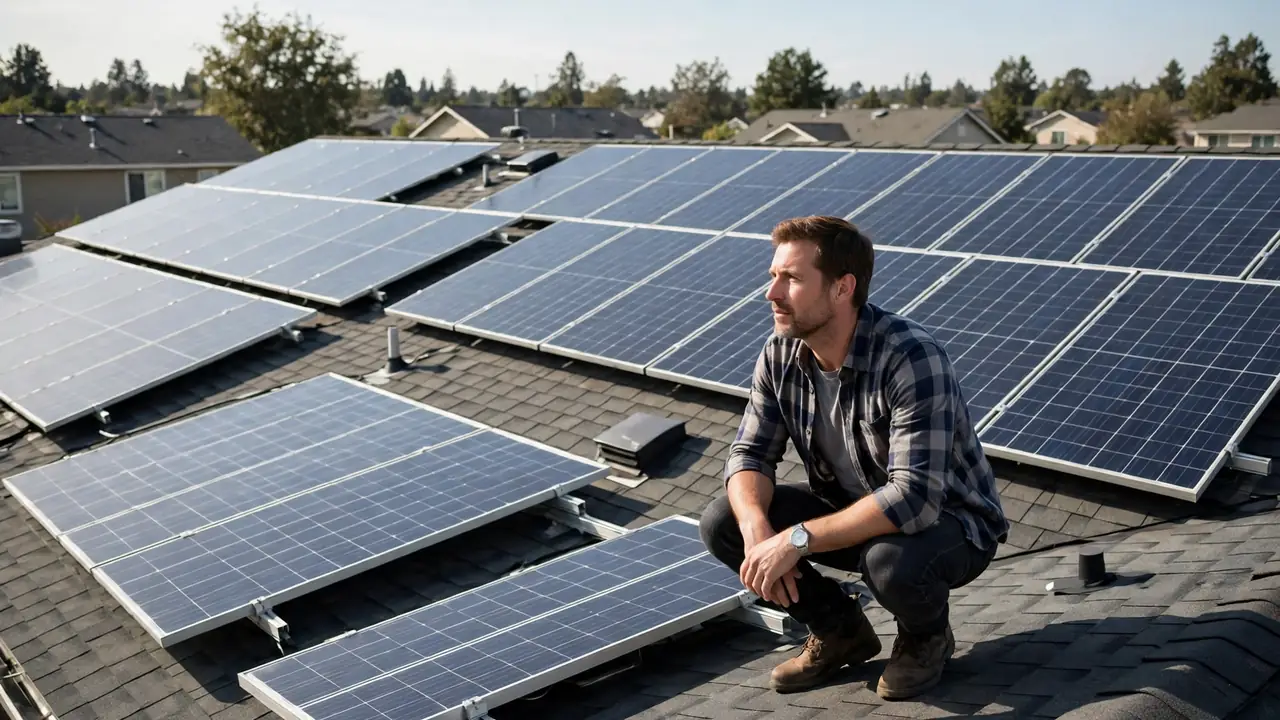
Roof direction and tilt matter as well. A south-facing roof in Pakistan generally receives the most direct sunlight over the day, while east- and west-facing roofs receive strong sun for part of the day only. Shading is the biggest risk of all: even partial shade from a neighbouring building, a water tank, or a tree can cut a panel’s output sharply. If part of your roof is shaded for much of the day, exclude that area from the usable roof calculation.
If the roof cannot fit the full panel count, you have three honest options: fit as many panels as the roof allows and accept partial coverage of your annual use, choose higher-wattage panels to get more units from the same area, or look at an elevated structure or additional roof area. Our guide to solar panel mounting structures in Pakistan explains how elevated structures can create usable panel area above an existing roof. What you should not do is squeeze panels into shaded or obstructed corners just to hit a target number on paper.
Five Things That Change Your Number
1. Whether you want full or partial coverage
Not every home needs to cover 100 percent of its annual use with solar. Some households size for daytime use only, some for full annual coverage including net metering exports, and some for a middle target such as covering summer cooling loads. Decide the target before calculating: a system sized for 50 percent coverage needs roughly half the panels of one sized for full coverage, all else being equal. Be explicit about the target when comparing quotations, or you will compare systems built for different goals.
2. Future loads you plan to add
A panel count based only on today’s use will fall short if you add a new air conditioner, an electric water heater, or an electric vehicle in the next year or two. List planned additions now and add their expected annual units to the calculation, or at least leave roof space and inverter capacity for extra panels later. It is far easier to plan that headroom at the start than to redesign the system afterwards. Our solar inverter buying guide for Pakistan explains why inverter capacity is part of the same decision.
3. Batteries and backup expectations
Panels decide how much energy the system generates; batteries decide how much of it you can use after sunset or during a power cut. Adding batteries does not change the panel count formula, but a home that wants long evening backup may add panels to make sure the batteries charge fully during the day. Our guide on how many batteries you need for a solar system covers the battery side separately.
4. Seasonal variation in use and sunlight
Annual totals hide seasonal swings. Summer brings both the highest use and the strongest sunlight, while winter brings lower use and weaker, shorter days. A system sized on annual averages will overproduce on some days and underproduce on others, which is normal and is exactly what net metering is designed to balance over the year. The problem case is a home whose use peaks in winter, for example with electric heating: annual-average sizing can leave it short in the months it needs power most. Check the seasonal pattern on your bills, not just the annual total.
5. System size benchmarks
Panel counts are often quoted as part of a system size in kilowatts: for example, a system of around 8 kilowatts built from 585-watt panels needs about 14 panels. Benchmarks like that are useful for comparing quotations, but they are no substitute for your own calculation. Use benchmarks to sense-check your result, and your own annual units to decide it. For a worked example of a larger home system, see our guide to the 8 kW solar panel system.
Common Mistakes to Avoid
The most common mistake is sizing from a single bill, usually a summer bill, and ending up with a system far larger than the home’s annual average needs. The second is confusing kilowatts with kilowatt-hours: a 5-kilowatt system is a capacity rating, not a daily production figure, and it does not produce 5 units an hour all day. The third is ignoring shading and roof direction, which quietly reduces real output below the planning figure. The fourth is forgetting future loads, which turns a correctly sized system into an undersized one within a year. And the fifth is rounding down: a panel count is a minimum, not a target to trim.
Finally, treat any panel count given without your annual units as a guess, however confident it sounds. A reputable installer will ask for twelve months of bills, check the roof, and show the working: annual units, peak sun hours, panel wattage, loss allowance, and the resulting count.
Check Current Prices
Panel counts and system sizes are only half the decision. For today’s updated panel tables, visit the homepage, where current prices are refreshed daily. Match the panel wattage and brand in the tables to the wattage you used in your calculation, so the system you size here is the system you compare there.
Frequently Asked Questions (FAQs)
How do I calculate how many solar panels I need for my home?
Add up twelve months of electricity bills to get your annual use in units, work out how many units one panel produces in a year on your roof, then divide the annual use by the per-panel annual output and round up. The three inputs are annual units, panel wattage, and peak sun hours, with a loss allowance for heat, dust, and inverter conversion.
How many solar panels does an average home need?
There is no single average that fits every home, because the count depends on annual electricity use. A home using about 3,650 units a year needs roughly 5 panels of 585 watts under typical planning assumptions, while a home using 10,950 units a year needs roughly 13. Your own bills decide your number, not a generic average.
Does a higher wattage panel mean I need fewer panels?
Yes. A higher-wattage panel produces more units per day from the same sunlight, so fewer panels cover the same annual use. Higher-wattage panels are usually larger, though, so the total roof area may stay similar even when the panel count falls.
How much roof space do I need for my solar panels?
Allow roughly two and a half square metres of roof per panel including spacing between rows and clearance from edges, vents, and water tanks. Compare that total with the usable roof area, not the total roof area, and exclude parts of the roof that are shaded for much of the day.
Does shading change how many solar panels I need?
Yes. Even partial shade from a neighbouring building, water tank, or tree can cut a panel’s output sharply, so shaded roof areas should be excluded from the usable area. A shaded roof may need more panels, or panels placed only on the unshaded sections, to reach the same annual output.
Should I size my system for full or partial coverage of my bills?
That is your choice, but decide it before calculating. A system sized for full annual coverage needs roughly twice as many panels as one sized for half coverage, all else being equal. Be explicit about the target when comparing quotations, or you will compare systems built for different goals.
Do I need extra panels if I plan to add an air conditioner later?
Yes, if the new appliance will add significant annual use. Add its expected annual units to your calculation now, or at least leave roof space and inverter capacity for extra panels later. Sizing only for today’s use can leave the system short within a year of a major addition.
Can I add more solar panels to my system later?
In many cases yes, provided there is usable roof space and the inverter and wiring can carry the extra capacity. Planning that headroom at the start is easier than redesigning the system afterwards, so discuss future expansion with your installer before the first installation.
