
How to Read a Solar Panel Datasheet

Can you tell whether a solar panel is right for your home just by reading its datasheet? Yes — once you know what the numbers mean. A solar panel datasheet is a one- or two-page document from the manufacturer that lists everything about a panel: how much power it makes, the voltage and current it produces, how it behaves in heat, its size and weight, and the certificates it carries. This guide explains how to read a solar panel datasheet line by line, in plain words, so you can check a dealer’s quotation, compare two panels fairly, and spot a datasheet that does not match the panel in front of you.

What Is a Solar Panel Datasheet?
A datasheet is the manufacturer’s own specification sheet for one panel model — a technical document, usually a PDF, published by the brand. Jinko, Longi, Canadian Solar, Trina and every other serious maker publish one for each model they sell.
You can usually get the datasheet in three ways. The dealer should give it to you with the quotation — ask for it by name if they do not. You can also download it from the manufacturer’s own website by searching for the exact model number. The short version of the same information is printed on the nameplate label on the back of every panel.
One warning before we start: a datasheet is only useful if it belongs to the exact panel you are buying. The model number on the datasheet must match the model number on the panel’s label and on your quotation. If the dealer shows you a datasheet for a different model, or cannot show you one at all, treat that as a red flag. Our solar panel verification guide for Pakistan explains the other document checks that go with it.
How to Read a Solar Panel Datasheet in 5 Minutes
If you only have five minutes, read these five things in this order: the model number at the top, the Pmax wattage, the Voc voltage, the temperature coefficient of Pmax, and the certifications at the bottom. Those five lines tell you what the panel is, how much power it is rated for, the highest voltage your inverter must handle, how much power it loses in Pakistani heat, and whether it passed independent testing.
STC and NOCT: The Two Test Conditions First
Almost every number on a datasheet is measured under Standard Test Conditions (STC): bright lab sunshine of 1,000 watts per square metre, a cell temperature of 25°C, and a standard sunlight spectrum called AM1.5. Those are perfect lab conditions that rarely happen on a real rooftop.
Datasheets also list a second set of numbers under NOCT (Nominal Operating Cell Temperature): weaker sunshine of 800 watts per square metre, air at 20°C and a light wind of 1 metre per second — much closer to a normal day on a roof. A panel’s NOCT wattage is always lower than its STC wattage, and it is the more honest guide to what you will actually get. So never compare one panel’s STC number with another panel’s NOCT number — compare STC with STC, or NOCT with NOCT. And never expect the STC wattage on a hot afternoon in June: the panel will be far hotter than 25°C, and heat cuts output, as the temperature coefficient section below explains.
The Electrical Numbers, Line by Line
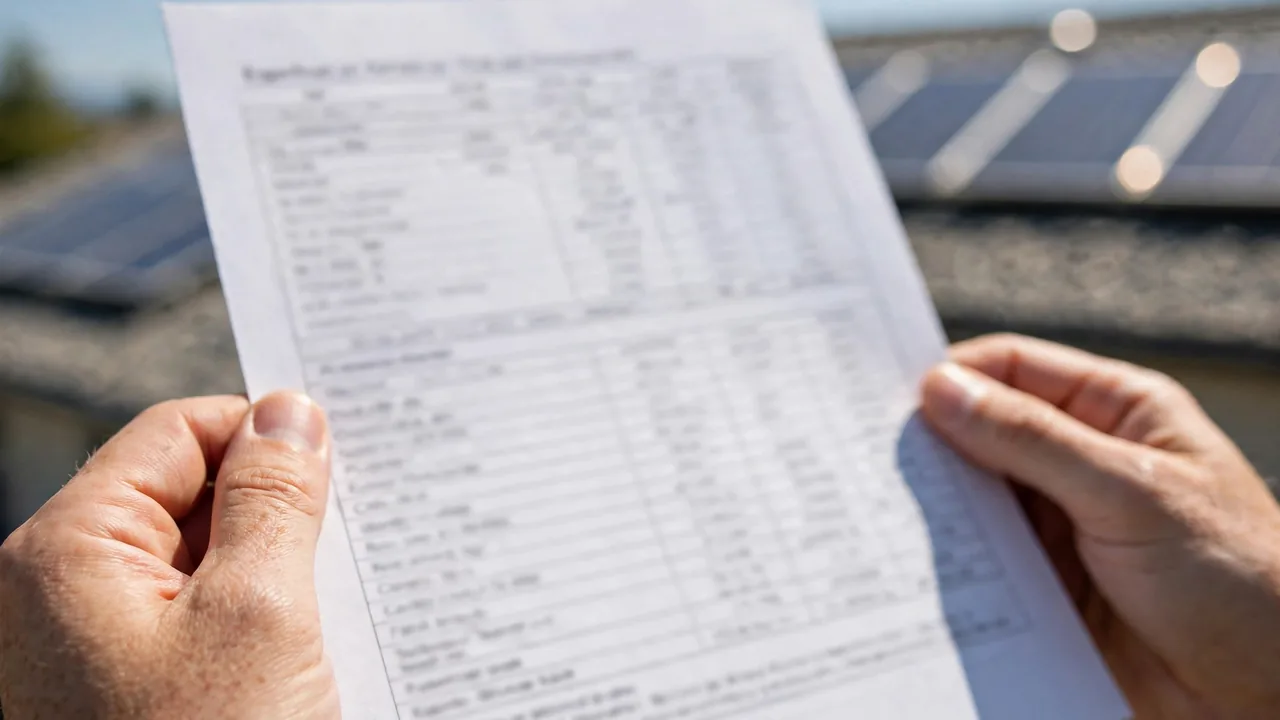
The electrical section is the heart of the datasheet. It looks crowded, but it is really just five numbers, all read from one curve that shows how the panel’s voltage and current behave together.
Pmax — Maximum Power
Pmax is the panel’s rated wattage — the headline number, like 585W. It is the maximum power the panel produces under STC, and it equals the voltage at maximum power (Vmp) multiplied by the current at maximum power (Imp). Pmax is the number you use to size your system and to compare panels, but remember it is a lab figure, not a promise for a hot rooftop.
Voc — Open Circuit Voltage
Voc is the highest voltage the panel produces when nothing is connected to it — no load, no current flowing. Your installer uses Voc to work out the total voltage of a string of panels in series, which must stay below your inverter’s maximum input voltage and the panel’s maximum system voltage. Voc matters most on cold mornings, because voltage rises as the panel gets colder.
Vmp — Voltage at Maximum Power
Vmp is the voltage at which the panel produces its maximum power — the voltage your inverter actually works at. It is always lower than Voc, usually around 70 to 80 percent of it. Your inverter has a working voltage range, and your installer picks the number of panels per string so the string voltage stays inside that range.
Isc — Short Circuit Current
Isc is the most current the panel can deliver when its positive and negative leads are connected together — a short circuit. It is a safety number: it sizes your cables, fuses and breakers, and it is checked against the maximum current your inverter or charge controller accepts. Never try to measure Isc yourself by shorting the panel leads — that is a job for test equipment.
Imp — Current at Maximum Power
Imp is the current the panel produces at its maximum power point, working together with Vmp. Your installer uses Imp to calculate voltage drop along the DC cables and to check the charge controller’s current limit. As a buyer, you mainly need to know that Pmax equals Vmp times Imp — if those three numbers do not roughly multiply out, something is wrong with the datasheet.
Efficiency and Power Tolerance
Module efficiency is the percentage of sunlight hitting the panel that turns into electricity. Aurora Solar’s guide to reading a spec sheet notes that most residential panels today sit between 20% and 23% efficiency, with premium models reaching higher. Higher efficiency means more power from the same roof area — it matters most when roof space is limited. But efficiency alone does not make a panel better for you; a slightly less efficient panel of the same wattage produces the same power, it just needs a little more space.
Power tolerance tells you how far the real panel’s output can sit from the printed wattage. A tolerance of 0 to +5W means the panel will never produce less than its rated wattage in the factory test, and may produce up to 5 watts more. Positive-only tolerance is a good sign. A wide tolerance that goes below zero means a panel sold as one wattage could test lower — ask the dealer for the flash test report, the factory sheet that records each panel’s measured output, and check that its wattage matches the panel in front of you.
Temperature Coefficient: The Number That Matters Most in Pakistan
As cells get hotter, they produce less power, and the temperature coefficient tells you exactly how much less. It is written as a percentage per degree Celsius, like −0.35%/°C, and it applies to Pmax.
Here is what that means on a Pakistani rooftop. Take a panel with a temperature coefficient of −0.35% per °C. On a hot afternoon the cells can easily reach 65°C — that is 40 degrees above the 25°C test temperature. Multiply 40 by 0.35%, and the panel produces about 14% less power than its lab rating. This is normal for every panel, not a defect — but it is why two panels with the same wattage can perform differently in our summers. The one with the smaller temperature coefficient (closer to zero) loses less power in the heat. Our temperature coefficient guide explains this in more detail.
Always compare temperature coefficients when you compare panels. In a country where rooftops cross 60°C in summer, this single line on the datasheet can matter more than a small difference in wattage.
Mechanical Details and Certifications
Below the electrical section, the datasheet lists the physical panel: length, width and thickness, weight, frame material, glass, junction box, and connector type. Check the dimensions and weight against your roof — an oversized or heavy panel needs a stronger structure and may not fit the space you have.
You will also find the maximum system voltage, usually 1,000V or 1,500V, which is the highest voltage the panel is certified to handle in a string, and the mechanical load ratings in Pascals, which tell you how much snow load the front can take and how much wind load the back can take. Higher numbers mean a stronger panel, which matters in storm-prone areas.
Finally, look for the certifications. At minimum, a genuine panel’s datasheet lists IEC 61215 for design and performance testing and IEC 61730 for safety. These are international standards, and they are the reason you can trust the numbers on the sheet. A datasheet with no certifications, or with certification names you cannot verify, is not a document to trust. The operating temperature range, usually −40°C to +85°C, is listed here too.
How to Match the Datasheet to the Panel in Front of You
Reading the datasheet is only half the job — you must also check that the panel in front of you is the panel on the sheet. Start with the model number: it must be identical on the datasheet, on the panel’s back label, and on your quotation.
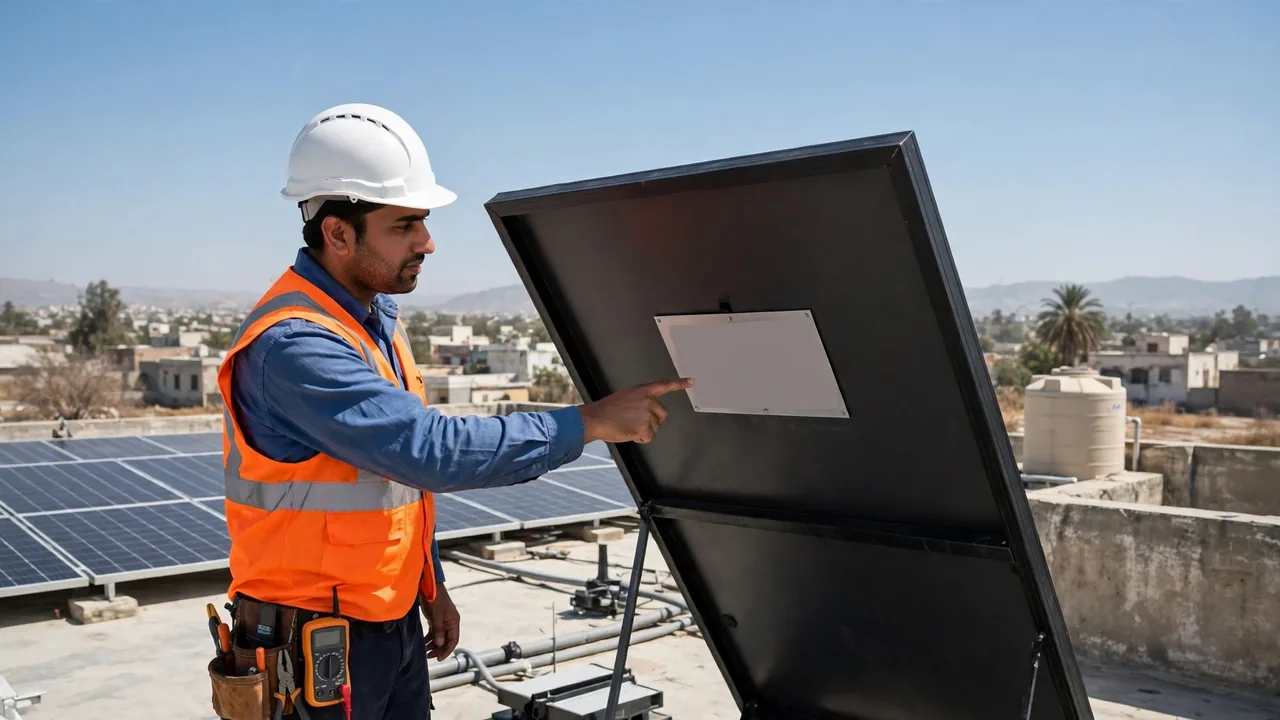
Next, check the serial number, printed on the back label near the junction box and often laser-etched under the front glass near the frame. The same number should appear on the flash test report and on the invoice. Also compare the wattage on the label with the Pmax on the datasheet — they must be the same. If the dealer cannot give you serial numbers before you pay, or the numbers on the label do not match the paperwork, do not accept the panels. Our fake vs original solar panel guide walks through the full check, and the brand verification guides for Jinko and Longi show how to confirm serial numbers on the manufacturer’s website.
Common Mistakes When Reading a Datasheet
Most datasheet mistakes come from reading one number and ignoring the rest. The most common is treating the STC wattage as what the panel will produce every day. It will not — real output sits between the STC and NOCT figures, and on hot days it sits closer to NOCT.
Another common mistake is ignoring Voc. Buyers focus on watts and forget voltage, but a string with too many panels can exceed the inverter’s voltage limit on a cold morning. That is your installer’s calculation to make — but knowing it exists means you can ask them about it, instead of discovering the problem after installation. And never compare panels by wattage alone: two panels with the same Pmax can differ in efficiency, temperature coefficient, power tolerance and warranty — and in Pakistani heat, the temperature coefficient alone can decide which one produces more over a year. Read the whole sheet, not just the headline.
Finally, never trust a datasheet that arrives as a blurry photo in a chat message, with no brand name or model number visible. Ask for the original PDF from the manufacturer and check the model number yourself on the brand’s own website.
Check Current Prices
Once you can read a datasheet, you can judge any quotation on its merits. Check the current solar plate price in pakistan, solar panel price in pakistan and jinko solar panel price in pakistan on our homepage, where the tables are updated daily. Compare the models first, then compare prices — a panel that loses more power in the heat is rarely the bargain it seems.
Frequently Asked Questions (FAQs)
What is the most important number on a solar panel datasheet?
Pmax, the panel’s rated wattage, is the first number most people look at — but it is not the whole story. Voc (open circuit voltage) decides whether your string of panels stays inside your inverter’s voltage limit, and the temperature coefficient of Pmax decides how much power the panel loses in Pakistani heat. Read all three together: a high wattage with a poor temperature coefficient can produce less over a year than a slightly lower wattage with a better one.
What is the difference between STC and NOCT ratings?
STC (Standard Test Conditions) is the lab test: 1,000 watts of sunshine per square metre, a cell temperature of 25°C and a standard sunlight spectrum. NOCT (Nominal Operating Cell Temperature) is closer to real life: 800 watts per square metre, air at 20°C and a light wind. A panel’s NOCT wattage is always lower than its STC wattage. Real output on your roof sits between the two — closer to NOCT on hot days. Always compare STC with STC, or NOCT with NOCT, never one against the other.
What does Voc mean, and why does it matter?
Voc is the highest voltage a panel produces when nothing is connected to it. Your installer adds up the Voc of all the panels in a string, and that total must stay below your inverter’s maximum input voltage and the panel’s maximum system voltage. It matters most on cold mornings, because voltage rises as panels get colder — a string that is safe on a hot day can go over the limit on a cold winter morning.
What is a good temperature coefficient for a solar panel?
The temperature coefficient of Pmax tells you how much power a panel loses for each degree above 25°C, written like −0.35%/°C. A smaller number (closer to zero) is better in Pakistan’s heat — it means the panel loses less power on hot rooftops. When comparing two panels, the one with the better temperature coefficient often produces more over a year, even if its headline wattage is the same.
How do I know if a datasheet matches my panel?
Check three things. First, the model number must be identical on the datasheet, on the panel’s back label and on your quotation. Second, the wattage on the label must equal the Pmax on the datasheet. Third, the serial number on the back label should match the flash test report and the invoice. If any of these do not match, or the dealer cannot show you the datasheet at all, do not pay until it is explained.
Where can I download a solar panel datasheet?
The dealer should give you the datasheet with the quotation — ask for it by name. You can also download it from the manufacturer’s own website by searching for the exact model number, for example on Jinko, Longi, Canadian Solar or Trina’s site. Always download it from the brand’s own website, never from a random link in a chat message, and check that the model number matches your panel exactly.
What is power tolerance on a datasheet?
Power tolerance is how far a real panel’s factory-tested output can sit from the printed wattage. A tolerance of 0 to +5W means the panel will never test below its rated wattage and may test up to 5 watts higher — that is a good sign. A tolerance that goes below zero means a panel could test lower than the wattage you paid for, so ask for the flash test report and check the measured wattage for your exact panels.
Do I need to understand the whole datasheet before buying solar panels?
No — you only need the five lines this guide starts with: the model number, Pmax, Voc, the temperature coefficient of Pmax, and the certifications. Those five tell you what the panel is, how much power it is rated for, the highest voltage your system must handle, how it behaves in heat, and whether it passed independent testing. Read the rest of the sheet when you want to compare two panels closely or check a detail your installer mentions.