
Temperature Coefficient of Solar Panels Explained

The temperature coefficient of solar panels tells you how much power a panel loses for every degree its cells rise above the 25°C lab rating. A typical modern panel is rated around -0.30% to -0.35% per °C, so on a hot Pakistani rooftop where cells can run 20–25°C hotter than the air, a panel can momentarily produce 10–14% less than its nameplate wattage. A number closer to zero is always better — premium cell technologies reach about -0.24% per °C — and the spec matters most in hot climates because heat is the single biggest everyday thief of solar output.
What the Temperature Coefficient Actually Measures
Solar panels are rated under Standard Test Conditions (STC): 1,000 W/m² of sunlight and a cell temperature of exactly 25°C. Those are lab conditions. On a real roof in May or June, the cells inside the panel run far hotter than 25°C, so the panel almost never delivers its full rated wattage while the sun is strong.
The temperature coefficient quantifies that gap. Expressed as a negative percentage per degree Celsius, it answers one question: for every 1°C the cells rise above 25°C, what share of rated power do I lose? Because the number is always negative, you want it as close to zero as possible. A panel rated -0.35%/°C loses 0.35% of its nameplate power for each degree above 25°C; a panel rated -0.28%/°C loses only 0.28% per degree. In a country where summer rooftops routinely bake, that difference compounds every single afternoon for the life of the system.
Why Solar Panels Lose Power in Heat
It feels backwards — the sun is strongest when panels make the least — but the physics is straightforward. As a silicon cell heats up, its internal electrical resistance rises and more electrons recombine before they can reach the circuit. The result is a steady drop in voltage, and therefore in power. This is a temporary effect: when the cells cool back toward 25°C, the panel returns to its full rated output.
This is also why panels quietly overperform on cold, bright winter days — cells below 25°C can push slightly above nameplate power — and sag on a scorching afternoon even though the sun feels stronger. It has nothing to do with panel quality being “bad in summer”; it is a property of silicon itself. What separates good panels from mediocre ones is simply how little they lose per degree.
Do not confuse this with degradation. Degradation is the slow, permanent decline of a panel over the years (quality panels lose well under 1% per year), while the temperature coefficient describes an instant, reversible dip that tracks the thermometer.
The Three Coefficients on Your Datasheet
Every proper panel datasheet has a box labelled Temperature Characteristics (sometimes “Thermal Characteristics”) listing three separate coefficients. Most buyers only need to care about one, but here is what all three mean:
- Pmax (maximum power) — the one that matters to you. This is the percentage of rated power lost per degree above 25°C, typically -0.24% to -0.45%/°C depending on cell technology. Use this number when comparing how much energy two panels will actually make in the heat.
- Voc (open-circuit voltage) — the one your installer cares about. Voltage drops as temperature rises (typically around -0.25% to -0.30%/°C), and it rises when panels are cold. Installers use the Voc coefficient for string sizing, because on a frosty winter morning the string voltage must not exceed the inverter’s maximum input.
- Isc (short-circuit current) — slightly positive. Current actually rises a tiny amount with temperature (often around +0.04% to +0.05%/°C). The gain is too small to offset the voltage drop, so it is mainly a technical footnote.
When you see the temperature coefficient quoted in a buying guide, it is almost always the Pmax figure. If a datasheet is missing these numbers entirely, treat that as a red flag about the panel’s grade — genuine Tier-1 datasheets always publish them.
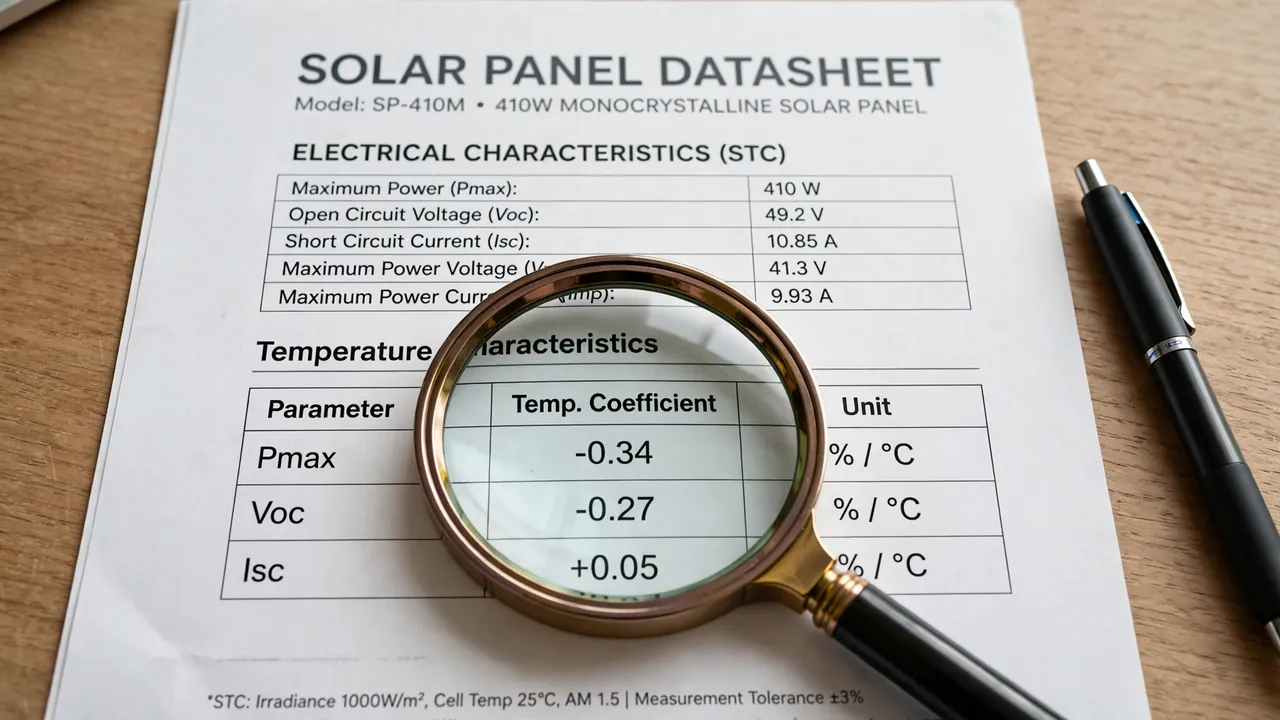
Reading this table is a useful authenticity check: a panel whose claimed temperature coefficient you cannot find on any official datasheet deserves the same scepticism as one with a solar panel warranty that no manufacturer document backs up.
Worked Example: What Heat Really Costs
The maths is simple, and worth doing once so you never guess again:
Power loss = (cell temperature − 25°C) × temperature coefficient
Take a mainstream panel rated at -0.35%/°C. On a hot afternoon the dark cells on a sun-baked roof easily reach 65°C. That is 40°C above the 25°C rating: 40 × (-0.35%) = -14%. So at that moment, the panel produces roughly 86% of its nameplate wattage.
Now take a premium panel rated at -0.26%/°C under the same heat: 40 × (-0.26%) = -10.4%. The better coefficient buys back three to four percentage points of output at exactly the time you need it most — the hottest afternoons, when your air conditioner is working hardest.
Two important caveats. First, cell temperature is not air temperature: cells typically run 20–25°C hotter than the surrounding air on a sunny roof, which is why the losses are larger than newcomers expect. Second, this describes the worst part of the afternoon, not the yearly average — your panels are only this hot for a few hours a day, and professional production models such as NREL’s PVWatts already fold these losses into their annual estimates.
What Is a Good Temperature Coefficient?
Closer to zero is better, full stop. Based on current manufacturer datasheets, here is how the common cell technologies stack up:
- HJT (heterojunction) panels: -0.24% to -0.27%/°C. The best heat tolerance on the market; loses the least on hot roofs.
- TOPCon (modern n-type) panels: -0.29% to -0.32%/°C. Excellent, and now common on quality residential installations.
- Mono PERC (mainstream p-type): -0.34% to -0.38%/°C. Solid, and by far the most widely installed technology today.
- Older mono / polycrystalline: -0.40% to -0.45%/°C. Larger hot-weather losses; these are mostly being phased out.
A practical rule of thumb: anything at or below -0.30%/°C is very good, around -0.35% is normal and perfectly fine for most homes, and worse than -0.40% deserves a second look if you live somewhere hot. This pattern also lines up with how N-type and P-type panels compare: n-type cells do not just convert sunlight more efficiently, they also hold that efficiency better as temperatures climb.
The temperature coefficient also gets confused with two other specs. Efficiency (often 20–23% on modern panels) measures how much sunlight becomes electricity at STC — it says nothing about heat behaviour. The degradation rate is the slow permanent decline over years, covered by the performance warranty. Heat stress and ageing are related over a panel’s lifetime, but the coefficient and the degradation rate are different numbers on different pages of the datasheet.
Temperature Coefficient and Pakistan’s Summers
In Pakistan this spec is not academic — it is a first-order buying consideration. Summer air temperatures in much of Punjab, Sindh and Balochistan sit in the mid-40s for weeks, and a dark panel on a sun-baked roof can push cell temperatures toward 70°C. At those temperatures, the gap between a -0.35%/°C panel and a -0.27%/°C panel is the difference between losing roughly a seventh of your rated power and losing closer to a tenth, right when household demand peaks.
This is why the coefficient works best as a tie-breaker. When two panels have similar wattage and similar build quality, the one with the better (less negative) temperature coefficient will out-produce the other on every hot afternoon for the next 25 years. In a mild climate the difference is a footnote; in Multan or Sukkur it is money.
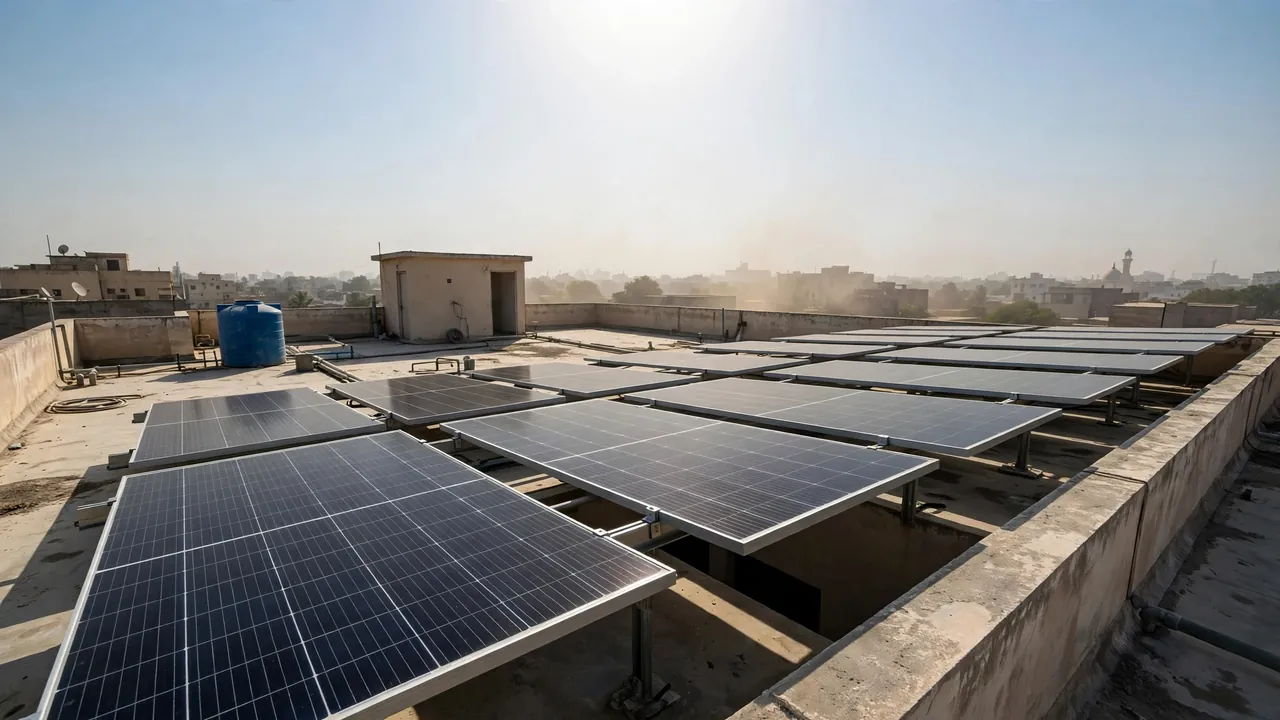
There is also an installation angle buyers often miss. The datasheet’s NOCT (Nominal Operating Cell Temperature, usually 40–48°C) assumes open-backside mounting with decent airflow. Panels laid nearly flat on a roof with no ventilation gap run hotter than their NOCT suggests and pay a bigger temperature penalty. A proper mounting structure that leaves airflow beneath the array — exactly the kind of detail covered in a good rooftop solar setup guide — is the cheapest way to fight heat losses: every degree cooler is free output.
How Buyers and Installers Should Use This Spec
If you are comparing quotes, ask each dealer for the panel’s datasheet and check the Pmax temperature coefficient in the Temperature Characteristics box. Two panels with identical wattage ratings are not identical in summer output if one is -0.29%/°C and the other is -0.38%/°C.
Pair that check with the basics that also keep panels cool: keep the array glass clean (dust traps heat as well as blocking light — see whether you need to clean your solar panels regularly), ensure the mounting leaves an airflow gap, and favour lighter-coloured roof surfaces where you have a choice. None of these change the coefficient itself, but they all lower the cell temperatures the coefficient acts on.
Finally, keep expectations realistic. The temperature coefficient describes midday behaviour, not annual yield. A hot, sunny location still produces far more solar energy per year than a cool, cloudy one — the coefficient only decides how much of that abundant sunshine each panel converts instead of losing to heat.
Common Myths About Heat and Solar Panels
- “Panels stop working in extreme heat.” No — they work, they just produce a few percent less. Even at 70°C cell temperature, a quality panel still delivers most of its rated power.
- “Higher wattage panels handle heat better.” Wattage says nothing about heat behaviour. A 400W panel at -0.26%/°C can out-produce a 430W panel at -0.40%/°C on a scorching afternoon. Compare the coefficient, not just the watts.
- “The temperature coefficient is the same as degradation.” No. The coefficient is an instant, reversible response to temperature; degradation is permanent ageing over years. Different causes, different numbers.
- “More expensive panels always have better coefficients.” Usually, but the correlation runs through cell technology, not price. A fairly priced TOPCon panel often has a better coefficient than a pricier PERC panel — check the datasheet rather than the price tag.
A better temperature coefficient is worth paying a little more for — check the solar plate rate per watt and the solar panel price in pakistan on our daily-updated homepage tables.
Frequently Asked Questions (FAQs)
What is a good temperature coefficient for solar panels?
Closer to zero is always better. Anything at or below -0.30% per °C is very good, around -0.35% is normal and fine for most homes, and worse than -0.40% deserves a second look if you live in a hot climate. Premium HJT panels reach about -0.24% to -0.27% per °C, while older or budget panels run near -0.45%.
What does a temperature coefficient of -0.35%/°C mean in practice?
It means the panel loses 0.35% of its rated power for every 1°C its cells rise above the 25°C test rating. If the cells reach 65°C on a hot roof — 40°C above rating — the panel is producing about 14% less than its nameplate at that moment. When the cells cool back toward 25°C, the panel returns to full rated output.
Why do solar panels lose power when they get hot?
In a silicon cell, higher temperature raises internal electrical resistance and lets more electrons recombine before they reach the circuit, which lowers voltage and power. This is a temporary, reversible loss tied to temperature — it is completely separate from the small permanent degradation a panel experiences as it ages.
Which panel technology has the best temperature coefficient?
HJT (heterojunction) panels currently have the best published temperature coefficients, around -0.24% to -0.27% per °C. Modern N-type TOPCon panels are excellent too, typically -0.29% to -0.32% per °C, noticeably better than mainstream mono PERC panels at -0.34% to -0.38% per °C.
Does the temperature coefficient affect my panel warranty?
No — the temperature coefficient and the warranty are separate things. The coefficient describes how much output dips on a hot afternoon (instant and reversible); the performance warranty covers slow permanent degradation over 25–30 years. A good coefficient helps summer output but does not extend the warranty.
Can I reduce heat loss on my rooftop installation?
You cannot change the coefficient itself, but you can lower the cell temperatures it acts on: leave an airflow gap under the array when mounting, keep the glass clean (dust traps heat as well as blocking light), and prefer lighter-coloured roof surfaces where you have a choice. Every degree cooler is free output.
Do solar panels work better in winter?
Yes, on a per-degree basis. A cold, bright winter day can push a panel slightly above its nameplate rating because the cells are below 25°C. You usually make less total energy in winter because the days are shorter and the sun is lower, but each panel converts more efficiently when it is cold — the flip side of the temperature coefficient.