
On-Grid Solar Inverter: Complete Guide for Pakistan

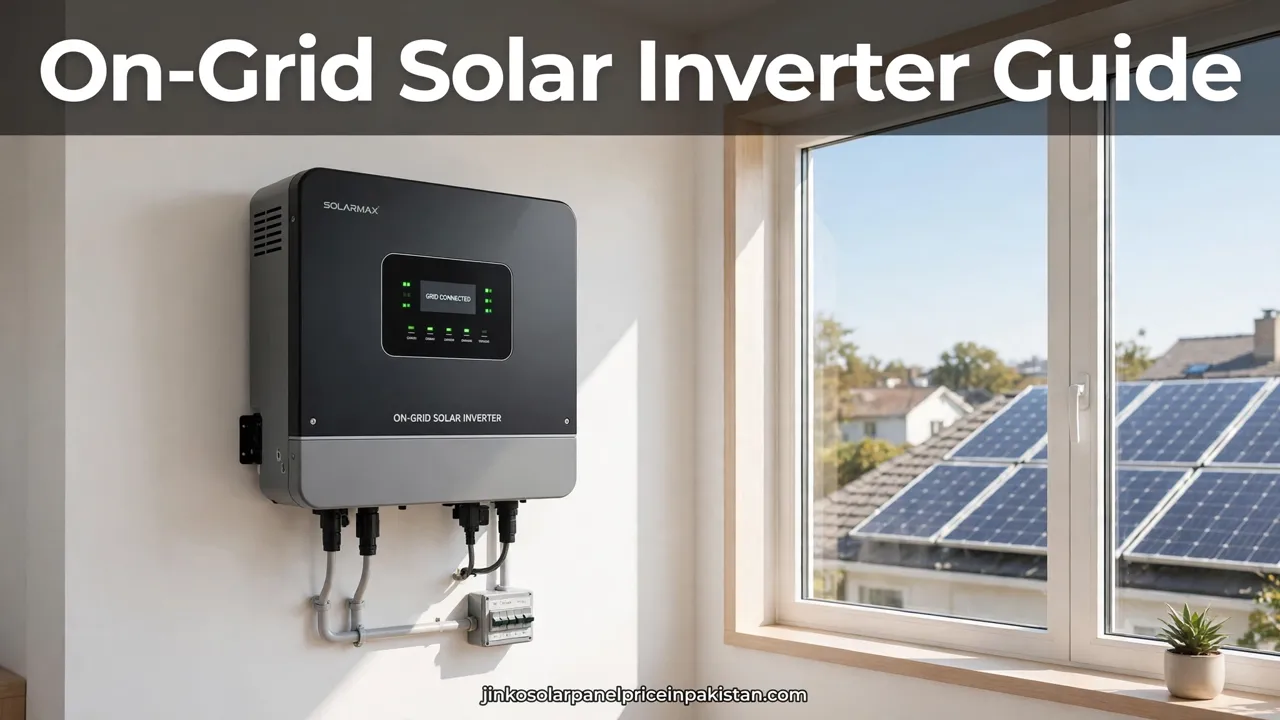
An on grid solar inverter in Pakistan is the inverter that connects a rooftop solar system directly to the utility grid, without batteries. It converts the direct current (DC) produced by your solar panels into alternating current (AC) for your home, sends any surplus electricity to the grid through a bidirectional meter, and draws from the grid whenever your panels are not producing enough. In short: panels make DC, the on-grid inverter turns it into usable AC, your home uses what it needs first, and the grid handles the rest.
This guide explains what an on-grid inverter is, how it works, how it relates to net metering, what happens during a power cut, and what to check before you choose one.
What Is an On-Grid Solar Inverter?
An on-grid inverter, also called a grid-tied inverter, is designed to work in step with the utility grid. It constantly matches its output to the grid’s voltage and frequency, so the AC it produces can flow into your home’s wiring and, when there is a surplus, out to the grid. Unlike a hybrid inverter, a standard on-grid inverter has no battery connection and no backup output. It is a simpler system with fewer components, which is one reason it is a common choice for homes and businesses with a reliable grid connection.
The grid acts as the system’s balancing partner: by day the inverter supplies your home first, and at night or on overcast days the grid supplies it. You store nothing yourself; the grid connection, with net metering where it applies, smooths out the gap between generation and consumption.
How an On-Grid Inverter Works, Step by Step
The process runs automatically from sunrise to sunset. Here is what happens at each stage:

- Your solar panels absorb sunlight and produce DC electricity. The amount varies through the day with sunshine, cloud cover, shading and panel temperature.
- The DC electricity flows to the inverter. Its maximum power point tracking (MPPT) function continuously adjusts to find the operating point at which the panels deliver their best output under current conditions. See our guide on what MPPT is in a solar inverter.
- The inverter converts DC into AC and synchronises that AC with the grid’s voltage and frequency. Only once it is synchronised does it supply power to your home.
- Your home uses the solar AC first. Lights, fans, refrigerators and other appliances draw from the inverter’s output before anything is drawn from the grid.
- When panel output is higher than your home’s consumption at that moment, the surplus flows through your bidirectional meter to the grid. When output is lower, the grid tops up the shortfall automatically.
- The inverter monitors the grid continuously. If the grid supply fails, it stops exporting immediately. This anti-islanding shutdown protects utility workers repairing the network.
The Main Jobs of an On-Grid Inverter
Beyond DC-to-AC conversion, an on-grid inverter performs several jobs that keep the system safe and useful.
DC-to-AC conversion
Home appliances and the grid run on AC, while panels produce DC, so conversion is what makes panel electricity usable. The inverter’s rated AC output capacity, in kilowatts (kW), is the figure that matters for matching it to your home’s load and grid connection.
Maximum power point tracking (MPPT)
MPPT is the inverter’s way of getting the best available output from the panels as sunlight, temperature and shading change. Some inverters have one MPPT input and some have two or more. Multiple inputs help when panels face different directions or one string is shaded while another is not, because each string can then be tracked separately.
Grid synchronisation
Before supplying power, the inverter matches the grid’s voltage and frequency and keeps matching them while it runs. If grid voltage or frequency moves outside its permitted range, the inverter disconnects. This is normal protective behaviour, although repeated disconnections are worth reporting to your installer.
Anti-islanding protection
Anti-islanding is the safety rule that stops an on-grid inverter from energising the grid during an outage. If the grid goes down, the inverter must shut down its output within a short time, even if the sun is shining and the panels are producing. This protects line workers who may be repairing the network and expecting it to be dead.
Monitoring and fault reporting
Most modern on-grid inverters include monitoring, usually through a mobile app or web portal connected by Wi-Fi. Monitoring shows generation and any fault or warning codes, so you can spot a problem early. If your inverter shows a fault code you do not recognise, our solar inverter error codes troubleshooting guide explains how to approach common warnings before calling a technician.
On-Grid Inverters and Net Metering in Pakistan
Net metering is the arrangement under which surplus solar electricity exported to the grid is recorded by a bidirectional meter and credited against the electricity you import. The on-grid inverter is what makes export possible: it is the device that pushes surplus AC through the meter to the grid in the first place. Without a grid-tied inverter, there is nothing to export.
Three things about net metering are worth getting clear before you install. First, the credited value of exported units is set by the applicable tariff and your distribution company (DISCO), not by the inverter. Second, your system size normally has to fit within your sanctioned load. Third, the application, inspection and meter installation steps take time and involve your DISCO. Our latest net metering policy guide walks through the policy side in detail.

What Happens During a Power Cut?
This is the most common misunderstanding about on-grid systems, so it deserves a plain answer: a standard on-grid inverter will not power your home during a power cut, even in bright sunshine. When the grid fails, anti-islanding protection shuts the inverter down, and your home loses solar power along with grid power until the grid returns.
If backup during outages matters to you, an on-grid inverter alone is the wrong choice. The alternatives are a hybrid inverter with batteries, which can keep selected circuits running during an outage, or a separate backup arrangement. Our on-grid vs off-grid vs hybrid inverter comparison and our hybrid solar inverter guide explain the difference in full. Do not let anyone sell you an on-grid system on the promise that it will run your home through load shedding; that is not how a standard grid-tied inverter works.
Types of On-Grid Inverters
Most homes in Pakistan use one of two on-grid layouts. A string inverter is a single unit that takes DC from one or more strings of panels connected in series. It is the most common residential choice and suits roofs where panels share a similar orientation and shading pattern. A microinverter layout instead places a small inverter behind each panel or each pair of panels, so each panel is converted and tracked individually. That layout can help on roofs with mixed orientations or partial shading, but it involves more units.
For larger commercial roofs, central inverters are also used: bigger single units serving a large array. The choice between layouts is a design decision for your installer, based on your roof, shading and panel layout.
Single-Phase vs Three-Phase On-Grid Inverters
Your electricity connection decides this question. A single-phase home uses a single-phase inverter, while a three-phase connection uses a three-phase inverter. The two are not interchangeable. If you are unsure which connection you have, your electricity bill or your DISCO record will show it, and your installer should confirm it before ordering equipment.
How to Size an On-Grid Inverter
Inverter sizing starts from your panel array and your load, not from a rule of thumb. Your installer should work from your panel layout, average daily consumption, sanctioned load and export limit. In many systems the inverter’s AC rating is slightly smaller than the panels’ total DC rating, because panels rarely produce at full rated capacity all at once; this is normal when done within the manufacturer’s specifications.
Two limits deserve attention in Pakistan: your sanctioned load, which caps the system size your DISCO will approve, and any export limit on your connection, which caps how much surplus you can send to the grid at any moment. Ask your installer to explain both limits for your connection before you agree to a system size. For the general sizing method, read our solar inverter buying guide for Pakistan and our guide on how to choose the right size inverter.
What to Check Before Buying an On-Grid Inverter
- Phase and connection type: confirm single-phase or three-phase from your bill and DISCO record, and make sure the inverter matches it.
- Sanctioned load and export limit: ask your installer to confirm both in writing for your connection, so the system size is approvable and not curtailed more than you expect.
- MPPT inputs and string design: if your roof has two orientations or partial shading, ask how the string layout and MPPT inputs handle it.
- Monitoring: check that the inverter’s app or portal works on your phone and that you, not only the installer, can see generation and fault data.
- Installation location: the inverter needs ventilation, shade from direct harsh sun where possible, and protection from rain and dust; our solar inverter installation guide covers placement and wiring in detail.
- Warranty and local support: read what the warranty actually covers, how long it runs, and who handles a claim in Pakistan. A warranty you cannot claim locally is worth much less than it looks on paper.
- Certification and grid compliance: confirm the model is certified for grid connection and accepted by your DISCO, and keep the datasheet and warranty documents with your system records.
- Installer credentials: use an installer who can show previous grid-tied installations and will handle the DISCO inspection and net metering paperwork.
Common Mistakes With On-Grid Inverters
The most costly mistake is expecting backup power from a standard on-grid inverter and discovering the truth during the first outage. The next is sizing from a neighbour’s system instead of your own load, sanctioned load and roof. Another is ignoring shading: a shaded string can drag down a whole string inverter’s output if the layout was not designed for it. Finally, many owners never check their monitoring after installation, so a tripped inverter can go unnoticed for weeks.
Maintenance and Everyday Care
An on-grid inverter has no moving parts and needs little routine maintenance, but it is not maintenance-free. Keep ventilation openings clear, keep the area around it clean and dry, and check the display or app for warnings. If it stops producing, first check grid supply, the AC and DC isolators, and any tripped breaker. Never open the casing yourself; the DC side remains live in sunlight even when the AC side is switched off, so internal work belongs to a qualified technician.
Is an On-Grid Inverter Right for You?
An on-grid inverter is a good fit if your grid connection is reliable, you want a simpler system without battery maintenance, and net metering is available so surplus generation is credited. It is a poor fit if you need power during outages or want to store solar energy for night use. In those cases, a hybrid inverter with batteries is the system to compare it against, not a bigger on-grid inverter.
Check Current Prices
Panel and inverter figures change with the market, so this guide deliberately carries no figures of its own. For the latest tables, see the daily updated price tables on our homepage. Compare any quotation against those tables and the inverter checks above before you commit.
For independent background on grid-connected system size and export limits, see the Australian Government’s guide to sizing a solar system. Its network rules are Australian, so always confirm the Pakistan-specific limits with your own DISCO and installer.
Frequently Asked Questions (FAQs)
What is an on grid solar inverter in Pakistan?
An on-grid inverter converts the DC electricity from your solar panels into AC electricity for your home and connects directly to the utility grid, without batteries. Your home uses the solar power first, surplus electricity is exported to the grid through a bidirectional meter, and the grid supplies your home when panels are not producing enough.
Does an on-grid inverter work during a power cut?
No. A standard on-grid inverter shuts down during a power cut because of anti-islanding protection, which stops it from energising the grid while workers may be repairing it. Even in bright sunshine it will not power your home during an outage. If backup power matters to you, compare a hybrid inverter with batteries instead.
Can an on-grid inverter be used with net metering?
Yes, an on-grid inverter is the device that makes net metering possible. It pushes surplus AC through your bidirectional meter to the grid, and the meter records both imported and exported units. The credited value of exported units and the rules for carrying them forward are set by your tariff and distribution company, not by the inverter.
Do I need a single-phase or three-phase on-grid inverter?
Your electricity connection decides it. A single-phase home needs a single-phase inverter and a three-phase connection needs a three-phase inverter. The two are not interchangeable, so confirm your connection type from your electricity bill or distribution company record before ordering equipment.
How do I choose the right size on-grid inverter?
Start from your panel layout, average daily consumption, sanctioned load and your connection’s export limit, and let your installer size from those figures. In many systems the inverter’s AC rating is slightly smaller than the panels’ total DC rating, because panels rarely produce at full rated capacity all at once.
What is the difference between a string inverter and a microinverter?
A string inverter is a single unit serving one or more strings of panels, and it suits roofs where panels share a similar orientation and shading pattern. A microinverter layout places a small inverter behind each panel or pair of panels, so each panel is tracked individually, which can help on roofs with mixed orientations or partial shading.
What should I check before buying an on-grid inverter?
Check that the phase type matches your connection, that the system size fits your sanctioned load and export limit, that monitoring works on your own phone, and that warranty and local support are clear. Also confirm the model is certified for grid connection and accepted by your distribution company, and keep the datasheet and warranty documents with your system records.
