
What Is a Zero Export Device? Complete Solar Guide

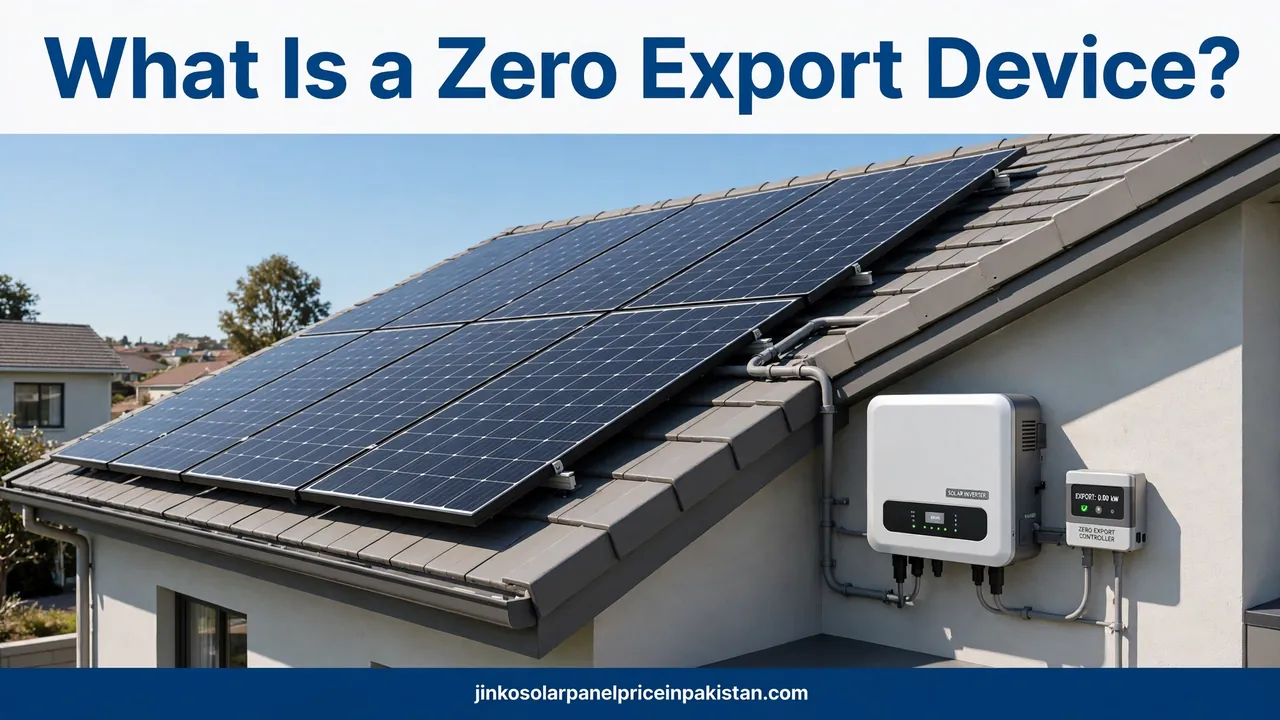
A zero export device is a control unit that stops a grid-connected solar system from sending surplus electricity back to the public grid. It continuously measures how much power your home or business is using and tells the inverter to produce only that much, so every unit your panels generate is consumed on site.
In this guide, you will learn how a zero export device works, what parts it needs, when it makes sense, how it differs from net metering and export limits, and what to check before buying one — including its limits, because it is not the right choice for every solar owner.
What Is a Zero Export Device?
A zero export device, also called an export limiter or a self-consumption controller, is hardware that works together with your solar inverter. Its only job is to prevent reverse power flow at your electricity meter. In other words, it makes sure that power flows in one direction only: from the grid into your premises when you need it, never from your solar system back out to the grid.
It does not generate or store electricity. It is a controller: it watches power flow at the point where your premises connect to the grid and adjusts the inverter’s output moment by moment to match real-time consumption. Some inverters have export limitation built in, so the “device” is the inverter’s own software plus an external meter or sensor; in other setups it is a separate controller box wired between the meter and the inverter. Either way, the function is the same: no surplus power leaves your premises.
How Does a Zero Export Device Work?
A zero export setup works as a closed control loop with three steps that repeat continuously while the sun shines.
Step 1: Measure the Power Flow
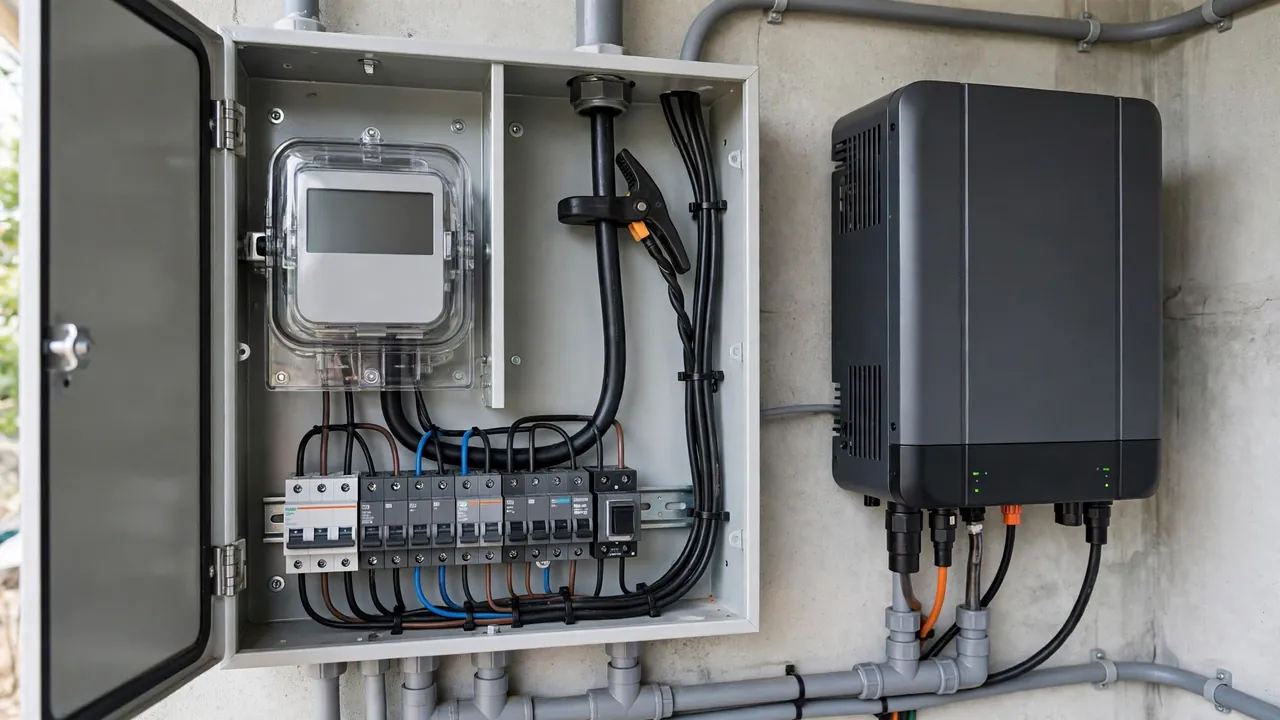
A current transformer (CT) sensor, or a smart energy meter, is fitted on the main incoming supply cable at your meter. It measures, in real time, whether electricity is flowing into your premises from the grid or trying to flow out, and reports this to the controller several times per second.
Step 2: Compare Generation With Consumption
The controller compares two values: how much power your panels are producing, and how much power your premises are using. If production is lower than consumption, the inverter runs at full output and the grid tops up the difference. If production is higher, there is a surplus that would otherwise be exported.
Step 3: Curtail the Inverter Output
When a surplus is detected, the controller signals the inverter to reduce output until it matches on-site consumption. This is called curtailment: the inverter deliberately produces less than the panels could deliver. As consumption rises again, for example when a large appliance switches on, the controller releases the limit and the inverter ramps back up.
The result is a system that follows your load curve all day. At midday, when panels produce the most and daytime consumption is often lowest, curtailment is heaviest. In the morning and evening, the system usually runs without any limiting.
Main Components of a Zero Export System
A typical installation has four parts:
1. The Inverter
The inverter must accept an external power-limit signal and change its output quickly. Most modern grid-tied and hybrid inverters support export limitation, but the feature is model-specific, so confirm compatibility for your exact inverter model before buying a separate controller.
2. The CT Sensor or Smart Meter
This is the measuring eye of the system. A CT clamp fits around the main cable without cutting it, while a smart meter is wired into the supply. Accuracy matters: a poorly placed or incorrectly sized sensor gives wrong readings, and the controller then limits the inverter at the wrong times.
3. The Controller
The controller is the brain: it receives sensor readings, decides the allowed inverter output, and sends the command. In some systems this logic lives inside the inverter; in others it is a separate box. Either arrangement is fine as long as the components are compatible and configured together.
4. The Communication Link
The sensor, controller, and inverter must talk to each other, usually over a wired connection or a local protocol. Good controllers include a fail-safe: if communication fails, the inverter falls back to a conservative output level rather than exporting freely.
Zero Export vs Net Metering vs Export Limit
Net metering means surplus electricity is exported to the grid and credited against electricity you later import. Your meter effectively runs in both directions under your distribution company’s net metering rules. If you have net metering, you generally do not need a zero export device, because exporting is the whole point.
An export limit means you may export, but only up to a capped amount. The same kind of controller is used, but the setpoint is a fixed export cap rather than zero. Some grids impose export limits where the local network cannot absorb full reverse flow.
Zero export means no export at all. Every unit must be consumed on site, stored in a battery, or curtailed. This is the strictest of the three, used where the grid operator does not allow feed-in, where net metering is unavailable, or where the owner prefers full self-consumption.
The key difference is the goal: net metering earns value from surplus, an export limit caps surplus, and zero export eliminates surplus. Confirm which arrangement your distribution company allows for your premises before committing to any of them. Our guide to net metering policy explains the process side of the net metering route.
When Do You Need a Zero Export Device?
- Your grid operator does not allow export. Some feeders and connections are approved on a no-export basis, often because of local network capacity. A zero export device is then a condition of connecting at all.
- You do not have net metering. If your net metering application is pending, rejected, or not worthwhile for you, a zero export setup lets you use solar for daytime self-consumption without exporting.
- You want maximum self-consumption. Some owners prefer to size their system to daytime load and avoid grid interaction altogether, for simplicity or independence.
- You are waiting on approvals. A zero export configuration can let a system run for self-consumption while a net metering application is processed, subject to your distribution company’s rules. Confirm this in writing first.
- Your premises cannot export for technical reasons. Shared buildings, certain commercial connections, and weak rural feeders sometimes cannot accept reverse flow.
Conversely, it is usually unnecessary if you already hold a net metering connection and are happy exporting surplus, since limiting output would throw away generation you could otherwise be credited for.
Zero Export With and Without a Battery
A battery changes the economics considerably, because it gives surplus power somewhere useful to go instead of being curtailed.
Without a Battery
In a batteryless zero export system, any generation above instantaneous consumption is simply curtailed and lost. This works well if daytime consumption is high and steady, for example a home with daytime appliance use, a shop, or a small office. It works poorly if the house is empty all day, because most midday generation is wasted.

With a Battery
With a battery, surplus charges the battery first, and only once the battery is full does the inverter start curtailing. This raises self-consumption and gives you stored power for the evening. The pairing must be sized correctly, though: an undersized battery fills up early and leaves the same curtailment problem for the rest of the day. Our inverter and battery pairing guide explains how to match the two components.
A hybrid inverter is the natural partner for a battery-based zero export system, because it manages panels, battery, and grid in one unit. If you are still choosing an inverter, read our solar inverter buying guide and our hybrid inverter guide first.
Limitations You Should Know Before Buying
Curtailment wastes potential generation. On a batteryless system, every curtailed unit is generation you paid for in panels but never use. This is the main reason zero export systems should be sized to daytime load rather than to roof space.
Brief export spikes can still occur. No control loop is instantaneous. When a large load switches off suddenly, or a cloud passes, there is a short delay before the inverter responds, so very short, small export events can appear in monitoring data even on a correctly configured system. “Zero” therefore means effectively zero over time, not the physical impossibility of any brief reverse flow.
It does not give you backup power. During a grid outage, a standard grid-tied inverter shuts down for safety, with or without a zero export controller. Backup needs a hybrid inverter with battery backup, which is a different feature. See our on-grid inverter guide and our comparison of on-grid vs hybrid inverters for the distinction.
It adds a point of failure. The sensor, controller, and communication link are extra components. If any of them fails or is misconfigured, the system may curtail unnecessarily, silently reducing your savings, or fail to limit at all. Monitoring output after installation is therefore important, not optional.
What to Check Before You Buy
- Confirm the rule first. Ask your distribution company or installer, in writing, whether your connection allows export, an export limit, or zero export only. Do not buy before you know the rule.
- Confirm inverter compatibility. The controller must support your exact inverter make and model. A generic claim is not enough; ask for the model list or written confirmation.
- Check the sensor arrangement. Ask where the CT sensor or smart meter will be installed and how many phases it covers. A single-phase sensor on a three-phase supply will not measure correctly.
- Ask about fail-safe behaviour. What happens if the sensor cable is damaged or communication drops? The answer should be a conservative fallback, not unlimited output.
- Size the system to daytime load. On a batteryless system, size the array to what you actually use during sunshine hours, not to the maximum your roof can hold. Our three-way inverter comparison puts this decision in the wider inverter choice.
- Decide on a battery honestly. If your daytime load is low, budget for a battery or accept that a large share of generation will be curtailed.
- Ask about monitoring. You should be able to see, in the inverter app or portal, how much generation was curtailed. Without that visibility, you cannot tell whether the device is working.
- Keep the paperwork. Keep the controller settings, commissioning report, and any grid-operator approval together for any later net metering application.
Can You Switch From Zero Export to Net Metering Later?
Often, yes, but it is not automatic. Switching means a new arrangement with your distribution company: a fresh application, possibly a meter change, and reconfiguration of the inverter from zero export to export mode. The controller hardware is usually reusable, since the same equipment can often enforce a different setpoint, but the permission is separate.
For background on how manufacturers document these arrangements, see SMA’s official zero feed-in system guide, which describes how zero-export configurations are built and which components they require.
Check Current Prices
This guide is intentionally evergreen, so it contains no panel or device prices. For today’s updated solar panel prices, visit our homepage at jinkosolarpanelpriceinpakistan.com, where prices are refreshed daily.
Final Thoughts
A zero export device is a simple idea executed by precise control: measure the grid connection, compare generation with consumption, and curtail the inverter so nothing flows back. It unlocks solar for premises that cannot export and pairs well with batteries and hybrid inverters. Its main cost is curtailment, so what matters most is the system around it: the right inverter, a correctly placed sensor, a fail-safe configuration, and an array sized to daytime load.
Frequently Asked Questions (FAQs)
What is a zero export device?
A zero export device is a controller that stops a grid-connected solar system from sending surplus electricity back to the public grid. It measures your real-time power consumption and tells the inverter to produce only that much, so all solar generation is consumed on site.
How does a zero export device work?
A current transformer sensor or smart meter on the main supply cable measures power flow at the grid connection. The controller compares solar generation with on-site consumption and signals the inverter to curtail output whenever generation exceeds consumption.
Do I need a zero export device if I have net metering?
Generally no. Net metering is designed for exporting surplus electricity and earning credit for it, so limiting output would waste generation you could otherwise be credited for. A zero export device is for connections where export is not allowed or not wanted.
What is the difference between zero export and an export limit?
Zero export allows no electricity to flow back to the grid at all, while an export limit allows export up to a fixed capped amount. Both use the same kind of controller, but with a different setpoint: zero for zero export, or a fixed cap for an export limit.
Does a zero export device work without a battery?
Yes, but any generation above your instantaneous consumption is curtailed and lost. A batteryless zero export system works best when daytime consumption is high and steady. With a battery, surplus charges the battery first and curtailment only starts once the battery is full.
Does a zero export device give backup power during outages?
No. A zero export device only controls grid export; it is not a backup solution. During a grid outage, a standard grid-tied inverter shuts down for safety. Backup power during outages needs a hybrid inverter with battery backup, which is a different feature.
Can I switch from zero export to net metering later?
Often yes, but it requires a new arrangement with your distribution company, such as a fresh application, possibly a meter change, and reconfiguration of the inverter from zero export to export mode. The controller hardware is usually reusable, but the permission is separate.
What should I check before buying a zero export device?
Confirm in writing which arrangement your connection allows, confirm the controller supports your exact inverter model, check the sensor covers all supply phases, ask about fail-safe behaviour if communication fails, size the array to daytime load, and make sure you can monitor curtailed generation.
