

How to Calculate Your Home’s Electricity Load for Solar

The short answer is this: to calculate your home’s electricity load for solar, list every appliance with its wattage, multiply each wattage by the hours it runs per day, add the results up in kilowatt-hours (units), and then check that total against your electricity bill. That total — your daily energy use — is the number a solar system must be sized around. The peak load, meaning the most watts running at the same moment, matters too, because it decides the inverter size. This guide walks through both numbers step by step, with no guesswork and no skipped appliances.
Getting this calculation right before you talk to an installer matters. Oversize the system and you pay for capacity you never use; undersize it and it will fall short when you need it most, especially in summer when fans and air conditioning run for long hours. A careful load calculation also lets you judge any quotation on its merits, instead of accepting a system size with no explanation of how it was reached.
Load vs Energy: Two Numbers You Must Not Confuse
Most sizing mistakes start with mixing up two different quantities. Load, measured in watts (W) or kilowatts (kW), is how fast electricity is being drawn at a given moment — like the speed of a car. Energy, measured in watt-hours (Wh) or kilowatt-hours (kWh), is how much electricity is used over time — like the distance travelled. In Pakistan, one kilowatt-hour is the same thing as one “unit” on your electricity bill, so your daily energy use in kWh is your daily unit consumption.
Here is why both matter for solar. Your energy use (daily units) decides how much electricity the solar system must generate over a day. Your peak load (the highest kW drawn at one moment) decides how large the inverter must be, because the inverter has to carry everything running at the same time. A home can have a modest daily energy total but a high peak load — for example, if a water pump, washing machine and air conditioner all start together.
Keep this distinction in mind through every step below. Whenever you see watts, you are looking at load. Whenever you see watt-hours or units, you are looking at energy over time. This article explains how to calculate home electricity load solar sizing depends on, starting from your own appliances rather than a rule of thumb.
Step 1: List Every Appliance, Room by Room
Walk through your home room by room and write down every electrical appliance: fans, lights, refrigerator, television, air conditioners, washing machine, water pump, microwave, iron, computer, router and chargers. Check the kitchen and laundry area, and remember seasonal appliances such as room heaters or extra fans that only appear in summer.
For each appliance, find its wattage, usually printed on a label on the back or underside, or on its nameplate. If only the current draw is given, in amperes, multiply it by the voltage to get watts: watts = amperes × volts. In Pakistan, household supply is nominally 230 volts, so an appliance drawing 2 amperes is roughly a 460-watt appliance. The standard method for estimating appliance energy use from wattage and hours is published by university extension services — for example, Virginia Tech Extension’s guide to estimating appliance energy use sets it out as wattage × hours used per day ÷ 1000 = daily kilowatt-hour consumption.
Two cautions apply here. First, the wattage on the label is usually the maximum power the appliance draws, not necessarily what it draws all the time — a refrigerator, for instance, cycles on and off. Second, for appliances with several settings, such as a fan on low versus high speed, note the setting you actually use most. A load calculation built on best-case settings will understate your real consumption.

Step 2: Work Out Daily Energy Use, Appliance by Appliance
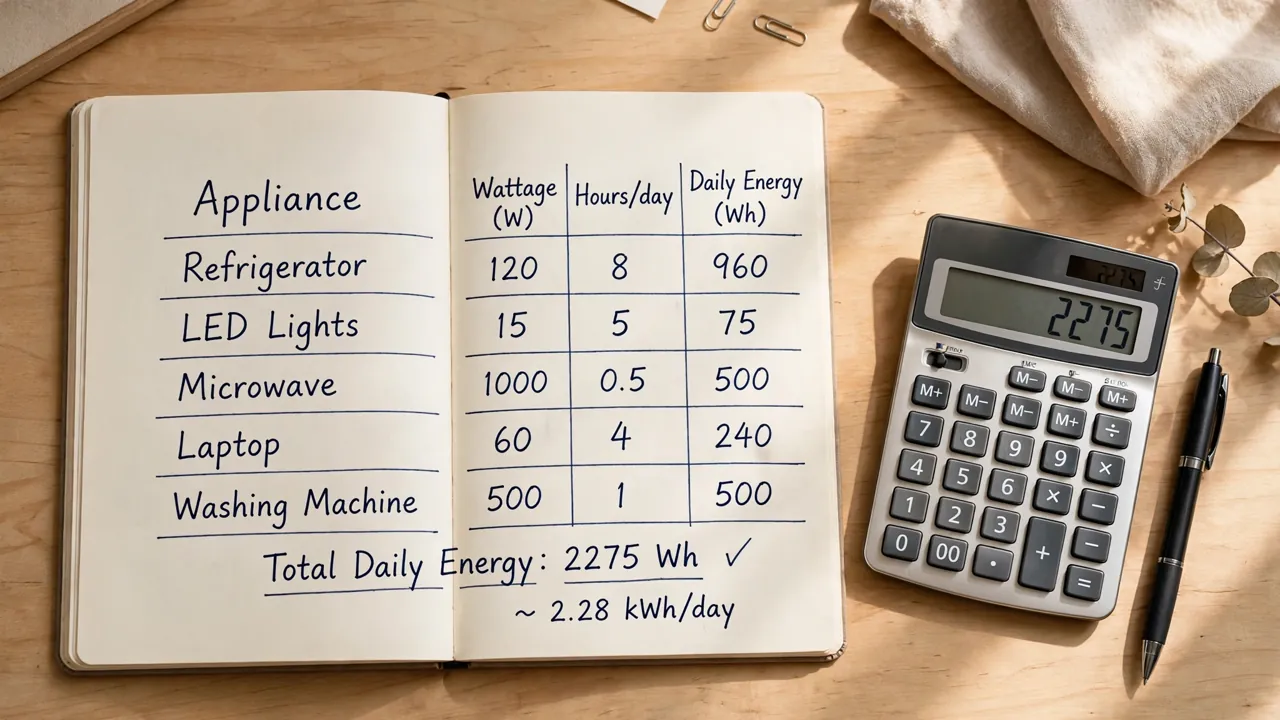
For each appliance, apply one simple formula:
Daily energy (kWh) = wattage ÷ 1000 × hours used per day
Take an illustrative example. A ceiling fan rated at 75 watts running 12 hours a day uses 75 ÷ 1000 × 12 = 0.9 kWh, or 0.9 units. A television rated at 120 watts running 5 hours a day uses 120 ÷ 1000 × 5 = 0.6 units. Add up every appliance the same way, and the grand total is your home’s daily energy consumption in units.
Hours of use are where most people go wrong, so be realistic rather than optimistic. Count the hours an appliance actually runs, not the hours it is switched on at the wall. A washing machine loaded twice a week does not run all day; a water pump that fills the tank twice daily runs only for those filling periods. If an appliance’s use changes with the season, calculate two totals: a summer total and a winter total. In most Pakistani homes the summer total is the one to size for, because cooling loads are highest then.
Once you have the daily total, multiply by 30 for an approximate monthly total — your cross-check for Step 4.
Step 3: Find Your Connected Load and Your Peak Load
Your connected load is simply the sum of the wattages of everything in the house — every appliance added together, as if all of them ran at once. In practice, that never happens, so the connected load is an upper bound, not a sizing target. Still, write it down: it gives you the full picture.
Your peak load is the more useful number. It is the highest total wattage that actually runs at the same moment. To find it, think about your busiest hour — typically a summer evening — and add up only the appliances running together then: lights, fans, television, refrigerator and the air conditioner, for example. Leave out appliances that never overlap.
Two adjustments matter for peak load. First, motor starting surge: motors in refrigerators, air conditioners and water pumps draw a brief surge when they start, several times their running wattage for a fraction of a second. An inverter must ride through that surge, so tell your installer which motor appliances you have and which of them can start at the same time. Second, diversity: not every appliance runs at full power simultaneously. If a quotation sizes the inverter for the full connected load with no explanation, ask why — it may be oversized. Our solar inverter buying guide for Pakistan explains inverter types and sizing in more detail.
Step 4: Cross-Check Against Your Electricity Bill
Your electricity bill is the reality check for your appliance list. Look at the last twelve months of bills and note the units each month. Add them up and divide by 365 for average daily units, and divide the highest month — usually a summer month — by 30 for a peak-season daily figure.
Now compare. If your appliance calculation says 12 units a day but your bills average 18, something is missing from your list: an appliance you forgot, hours you underestimated, or a seasonal load you left out. If your calculation says far more than the bills show, you have probably counted an appliance’s maximum wattage for hours it does not actually run at that level — the refrigerator cycling issue from Step 1 is the usual culprit. Adjust the list until the two figures are in the same range. A calculation that disagrees with a year of bills has an error in it, and it is far better to find that error now than after installation.
The bill also shows patterns your appliance list cannot: how consumption rises in summer, whether one month spiked, and whether usage is growing year on year. If you plan to add an appliance soon — another air conditioner, for example — add its expected load now, and note it separately so the installer can see what is current load and what is planned load.
Step 5: Turn Your Load Into a Solar Starting Point
With a trusted daily unit figure and a peak load figure, you have the two inputs a solar sizing conversation needs. The daily units tell you how much energy the system must generate on an average day; the peak load tells you the minimum inverter capacity that can carry your home at its busiest moment. Hand both numbers to any installer, and ask them to show how their proposed system size follows from your numbers — not from a rule of thumb about house size or bedroom count. For a sense of how system size relates to household scale, see our post on the 8 kW solar panel system as an example of a larger home system.
Remember that a solar system generates during daylight hours, while much of a home’s load — lights, television, fans at night — falls outside those hours. That mismatch is exactly why the next sizing decisions matter: whether the system is on-grid, hybrid or off-grid, and whether batteries are involved. If you are considering backup, work out the backup load separately — only the appliances you truly need during a power cut — rather than backing up the whole house by default. Our guide on how to calculate solar battery backup time covers that calculation, and our guide on how many batteries a solar system needs covers battery count.
Finally, treat the load calculation as a living document. Keep the list, update it when you buy or retire an appliance, and bring the updated version to any future conversation about expanding the system.
Common Mistakes in Home Load Calculation
- Confusing kW with kWh. A 5 kW system and 5 units a day are completely different things. One is a rate, the other is an amount over time.
- Counting the refrigerator at full wattage for 24 hours. Refrigerators cycle on and off. Counting full draw around the clock inflates the total substantially.
- Using one season’s figures for the whole year. Summer cooling loads can double a home’s daily units. Calculate summer and winter separately.
- Adding every appliance together as the peak load. The iron, the microwave, the washing machine and the water pump rarely all run at once. Peak load is about simultaneity, not the sum of everything you own.
- Forgetting motor starting surge. Pumps and compressors draw a brief surge on startup. The inverter must handle it, even though it barely affects daily units.
- Leaving out small, always-on loads. Routers, chargers and standby devices draw little each, but they run around the clock and add up over a month.
- Sizing from a single month’s bill. One month can be an outlier. Use twelve months, and size from the average and the peak-season figure together.
Quick Checklist Before You Talk to an Installer
- Room-by-room appliance list with wattage for each item, from nameplates where possible.
- Realistic hours of use per appliance, with separate summer and winter totals.
- Daily energy total in units (kWh), plus the monthly total for cross-checking.
- Connected load (everything added together) and peak load (what actually runs together).
- Twelve months of bills, with average daily units and peak-season daily units noted.
- Motor appliances listed separately, with notes on which can start at the same time.
- Planned future appliances listed separately from current load.
- Backup-only appliance list, if you are considering batteries or a hybrid system.
Walk in with this checklist complete, and the sizing conversation changes: instead of accepting a quoted system size on trust, you can check it against your own numbers and ask informed questions about anything that does not line up.
Check Current Prices
Once you know your home’s load, the next question is what a system of the right size involves today. For current, daily-updated solar panel tables, visit the homepage, where today’s panel prices are updated every morning. Use your load figures alongside those tables to compare options on an equal footing — and confirm the final system size with a qualified installer who has seen your load calculation.
Frequently Asked Questions (FAQs)
What is home electricity load for solar?
Home electricity load for solar means two numbers: your daily energy use in kilowatt-hours (units) and your peak load in kilowatts, the highest wattage running at the same moment. Daily units decide how much energy a system must generate, while peak load decides the inverter size.
How do I calculate my home’s daily electricity units?
List every appliance with its wattage, multiply each wattage by the hours it runs per day, divide by 1000 to get kilowatt-hours, and add all the results together. The total is your daily energy use in units. Multiply by 30 for an approximate monthly total.
What is the difference between kW and kWh?
Kilowatts (kW) measure power, the rate at which electricity is drawn at a moment. Kilowatt-hours (kWh), or units, measure energy used over time. A 1 kW appliance running for one hour uses 1 kWh. Solar sizing needs both: kWh for generation and kW for inverter capacity.
How do I find an appliance’s wattage if it is not on the label?
Check the label or nameplate on the back or underside of the appliance. If only the current draw in amperes is given, multiply amperes by volts to get watts. Household supply in Pakistan is nominally 230 volts, so a 2-ampere appliance is roughly 460 watts.
Should I size my solar system for summer or winter load?
Size from the summer total in most Pakistani homes, because cooling loads make summer the peak season. Calculate a winter total as well for comparison, but the system must cope with the higher summer figure, not the lower winter one.
What is peak load and why does the inverter need it?
Peak load is the highest total wattage running at the same time in your home, typically on a summer evening. The inverter must carry that load, including brief motor starting surges from refrigerators, air conditioners and water pumps, so it cannot be sized on daily units alone.
Why does my load calculation differ from my electricity bill?
Usually because an appliance was missed, hours of use were underestimated, or a maximum nameplate wattage was counted for hours the appliance does not actually run at that level. Refrigerators cycle on and off, so counting full wattage for 24 hours inflates the total. Adjust the list until it roughly matches twelve months of bills.
Do I need to count standby and always-on loads?
Yes. Routers, chargers, standby devices and security equipment draw little each, but they run around the clock, so they add up over a month. Include them in the appliance list, even if each one contributes only a small daily amount.
