
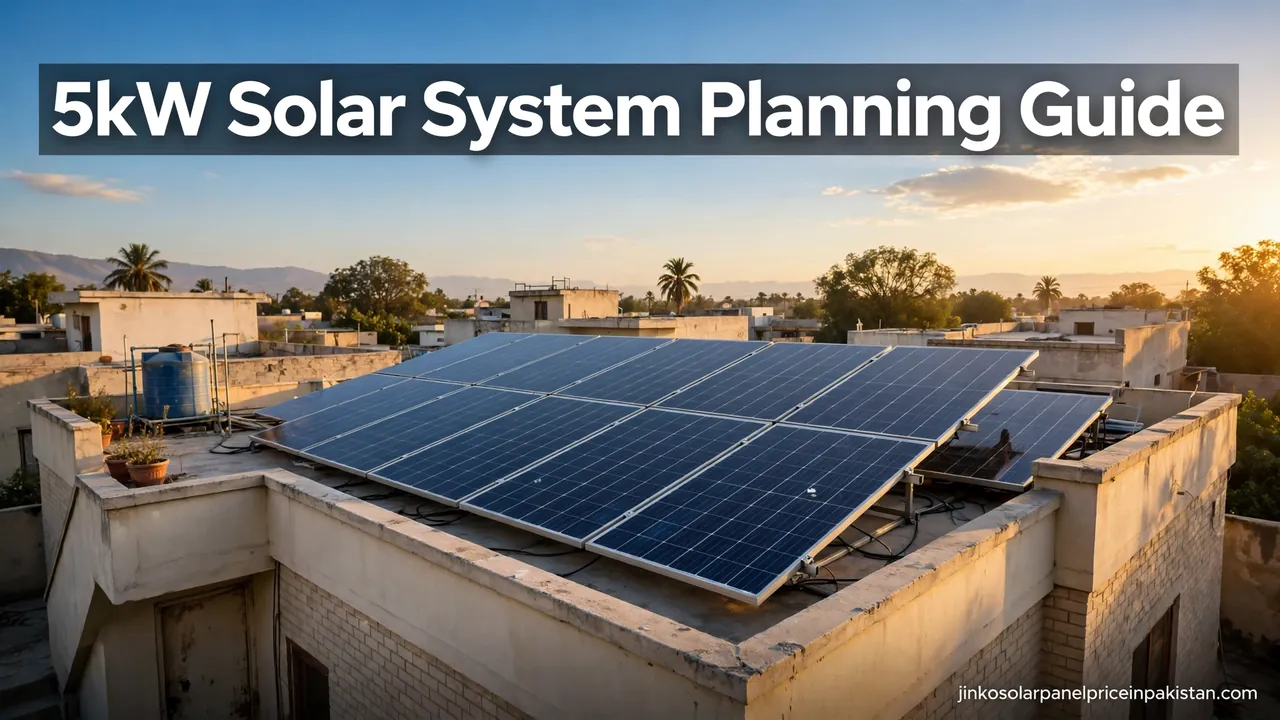
5kW Solar System Planning Guide for Pakistan

Planning a 5kW solar system in Pakistan? A 5kW system is the most popular residential size in the country — large enough to run a home’s essential appliances including an air conditioner, yet compact enough to fit on a typical rooftop. A well-planned 5kW system can generate roughly 20 to 25 units of electricity per day in most parts of Pakistan, covering the monthly consumption of an average household. This guide walks you through every planning step: calculating your electricity load, working out the panel count, choosing the right inverter, planning battery backup, checking roof space, deciding between on-grid and hybrid, and understanding the 2026 net billing rules — so the system you buy actually fits your needs.
Step 1 — Calculate Your Electricity Load
Every good solar plan starts with your electricity bill, not with the panels. Pull out your last few monthly bills and note your consumption in units (kWh). A 5kW system producing around 20–25 units a day covers roughly 600–750 units a month, so if your average bill sits in that range, 5kW is the right size for you.
Next, list the appliances you want to run and their wattage: fans, LED lights, refrigerator, TV, water pump, iron, microwave and air conditioner. Add up the wattage of everything you expect to run at the same time, then add 20–25% headroom for motor starting surges and future additions. This load list becomes the foundation for every other decision — panel count, inverter size and battery bank all follow from it. If you need help with the math, our guide on how to calculate your home electricity load for solar walks through the full method.
Step 2 — Work Out How Many Panels You Need
The panel count for a 5kW system is simple division: 5,000 watts divided by the wattage of each panel. With today’s high-wattage panels, the math works out like this:
- 585W panels: 5,000 ÷ 585 = 8.55, so you need 9 panels
- 550W panels: 5,000 ÷ 550 = 9.09, so you need 10 panels
- 615W panels: 5,000 ÷ 615 = 8.13, so you need 9 panels
You always round up, because panels come in whole units and a small buffer covers wiring losses and dust. Choosing higher-wattage panels reduces the total panel count, which means less roof space, fewer mounting rails and simpler wiring. Stick to Tier-1 panels from established brands so the wattage printed on the datasheet is what the panel actually delivers. For a deeper look at panel math for any home size, see how many solar panels you need for your home.
Step 3 — Choose the Right Inverter Size
For a 5kW array, a 5kW inverter is the standard match. The inverter converts the DC electricity from your panels into the AC electricity your home uses, and it is the hardest-working component in the system, so sizing it correctly matters.
Two points to get right. First, decide the inverter type: a standard on-grid inverter if your grid supply is stable, or a hybrid inverter if you want battery backup during load shedding. Second, make sure the inverter’s maximum DC input comfortably handles your 9–10 panels wired in series — your installer will confirm the string voltage stays within the inverter’s MPPT range. Many homeowners slightly oversize the inverter to handle motor starting surges from refrigerators, pumps and air conditioners. Our detailed breakdown of what size inverter you need for a 5kW solar system covers the exact sizing logic.
Step 4 — Plan Battery Backup (For Hybrid Systems)
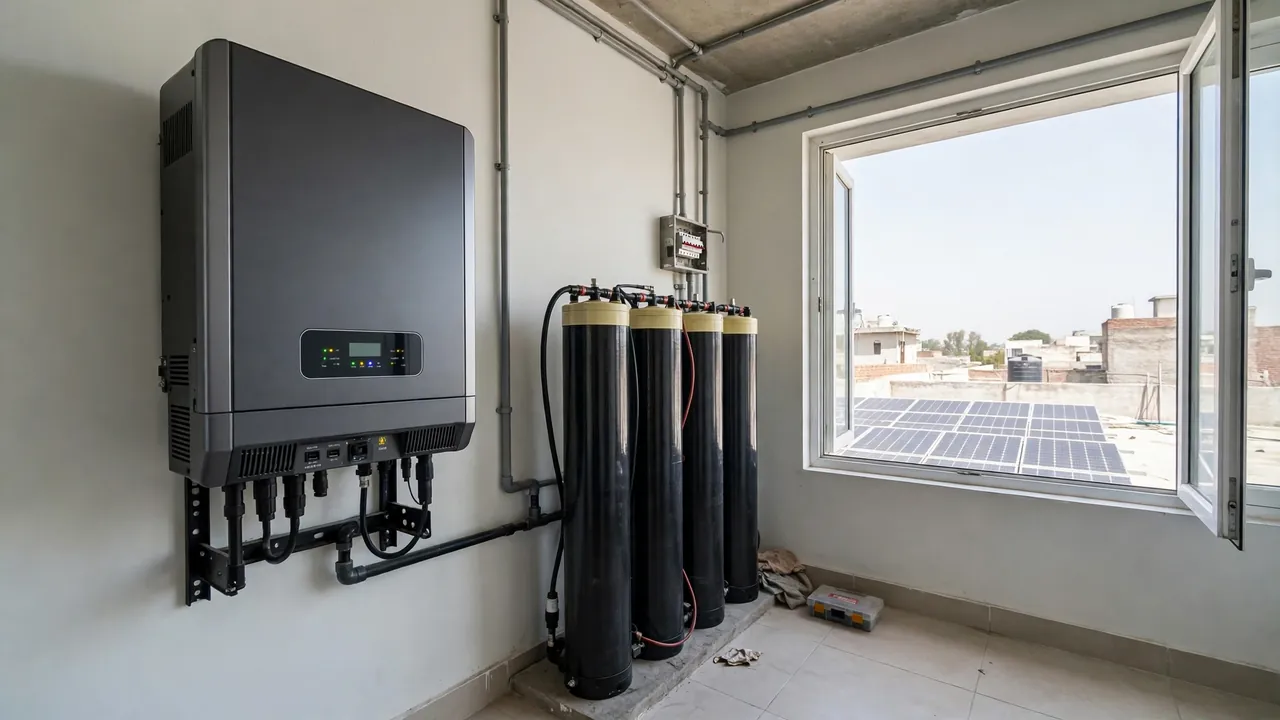
An on-grid 5kW system needs no batteries at all — when the grid fails, the system simply shuts down for safety. If you want power during load shedding, you need a hybrid inverter plus a battery bank, and this is the part of the plan most people get wrong.
Size your battery bank from your night-time load, not your total load. Add up what runs after sunset — fans, lights, TV, fridge, Wi-Fi router — multiply by the backup hours you want, and you get the storage capacity in kWh. For example, a 1,000W night load backed up for 4 hours needs roughly 4 kWh of usable storage. Tall tubular batteries are the traditional choice in Pakistan and handle deep daily cycling well; lithium (LiFePO4) batteries cost more upfront but last longer and need no maintenance. Whatever type you choose, never drain the bank completely — keeping some reserve charge extends battery life significantly. See how many batteries a 5kW solar system needs for the full sizing method.
Step 5 — Check Roof Space and Structure
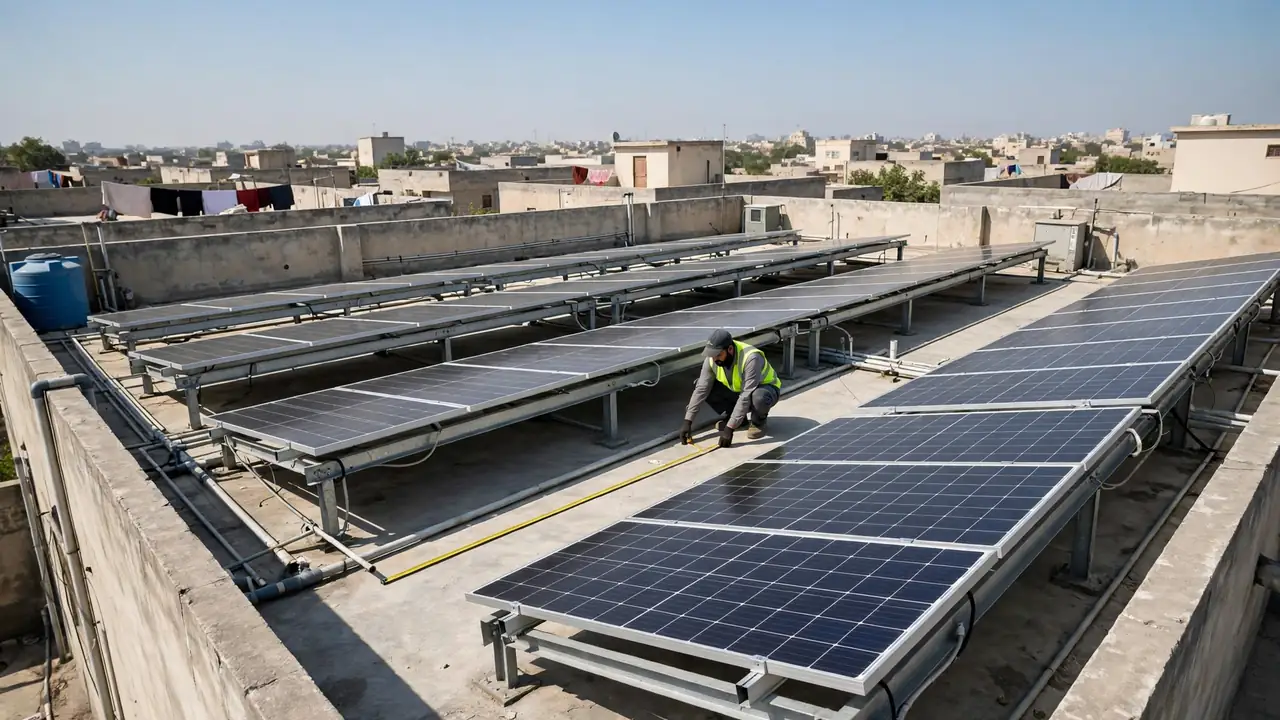
A 5kW system needs a clear, shade-free patch of roof. Each high-wattage panel covers roughly 2.3 square metres, so 9 panels occupy about 21 square metres — but you also need gaps between rows for maintenance access and to prevent one row shading the next. Plan for roughly 25–35 square metres of usable, unshaded roof facing south or south-west.
Check these four things before you commit:
- Shading: Walk the roof at 9 AM, noon and 3 PM. Even partial shade from a water tank, parapet wall or neighbouring building can drag down the whole string’s output.
- Direction and tilt: South-facing panels tilted around 15–25 degrees catch the most sun across the year in Pakistan. Flat roofs are fine — the mounting structure creates the tilt.
- Roof strength: Panels plus an elevated structure add significant weight. Older or weak roofs may need reinforcement or a ground-mounted option.
- Structure type: A simple low-height frame suits most homes; an elevated structure doubles as a shaded sitting area but needs stronger foundations and more steel.
Our guide to solar panel mounting structures in Pakistan explains the types, materials and installation points in detail.
Step 6 — Decide: On-Grid or Hybrid?
This is the single biggest planning decision, and the right answer depends on your area’s grid reliability:
- On-grid: No batteries, lower upfront cost, simpler maintenance. The system feeds surplus daytime power to the grid and you draw from the grid at night. Best for areas with stable supply. Downside: no power during load shedding.
- Hybrid: Batteries plus a hybrid inverter give you backup during outages and let you store daytime surplus for the evening. Best for areas with frequent or long load shedding. Downside: higher cost and batteries need replacement after their lifespan.
Many Pakistani households start with a hybrid inverter and a modest battery bank, then add more batteries later as the budget allows — a hybrid inverter makes that upgrade path possible, while a pure on-grid inverter does not. Read the full hybrid solar inverter guide for Pakistan before you decide.
Step 7 — Plan for Net Billing Under the 2026 NEPRA Rules
If you are installing a 5kW system now, there is one regulatory change you must plan around: since 9 February 2026, NEPRA’s Prosumer Regulations 2026 replaced traditional net metering with net billing for all new solar connections. Under net billing, the electricity you export is credited separately at the national average energy purchase price instead of being swapped unit-for-unit against your imports, and new agreements run for five years. Systems up to 25kW are approved by your local DISCO, and your system size cannot exceed your sanctioned load — so check your sanctioned load on your bill before finalising a 5kW plan.
What this means for your planning: size the system to consume as much of your own solar power as possible during the day — shift heavy loads like the water pump, washing machine and iron to sunlight hours. If you already hold an older net-metering agreement, it keeps its original terms until it expires, so don’t make changes that alter your system’s maximum output. For the complete picture, see our net metering policy update and this independent explainer of Pakistan’s 2026 net metering vs net billing rules, which tracks the official NEPRA notifications.
Common 5kW Planning Mistakes to Avoid
- Skipping the load calculation and buying a round number — a 5kW system that doesn’t match your actual consumption either wastes capacity or leaves you short.
- Undersizing the inverter to save money — an inverter running at its limit on hot afternoons ages faster and can trip on surge loads.
- Ignoring partial shade — one shaded panel in a series string pulls down every panel in that string. Plan the layout around the shade, not through it.
- Mixing panel brands or wattages in one string — mismatched panels force the whole string down to the weakest panel’s level.
- Forgetting the paperwork — net billing applications, sanctioned-load checks and the bi-directional meter take time; start them while installation is underway, not after.
- Skipping earthing and surge protection — proper earthing, DC breakers and a surge protection device are cheap insurance for an expensive system.
- Planning only for today — if you might add an air conditioner or an EV charger later, leave roof space and inverter headroom for it now.
Frequently Asked Questions (FAQs)
How many solar panels are needed for a 5kW system?
Divide 5,000 watts by the wattage of each panel and round up. With 585W panels you need 9 panels, with 550W panels you need 10, and with 615W panels you need 9. Higher-wattage panels reduce the total count, roof space and wiring complexity.
What size inverter do I need for a 5kW solar system?
A 5kW inverter is the standard match for a 5kW panel array. Choose an on-grid inverter if your grid supply is stable, or a hybrid inverter if you want battery backup during load shedding. Make sure the inverter’s MPPT range suits your panel string voltage.
Can a 5kW solar system run an air conditioner?
Yes. A 5kW system can typically run a 1 to 1.5 ton inverter air conditioner along with fans, lights, a refrigerator and a TV during sunlight hours, provided your load is planned so simultaneous demand stays within the system’s capacity.
How much roof space does a 5kW system need?
Plan for roughly 25 to 35 square metres of shade-free roof. Nine high-wattage panels cover about 21 square metres, and you need extra space between rows for maintenance access and to prevent row-to-row shading.
On-grid or hybrid: which is better for a 5kW system in Pakistan?
On-grid suits areas with stable grid supply — it costs less and needs no batteries, but gives no power during load shedding. Hybrid suits areas with frequent outages — batteries provide backup but add cost and need replacement after their lifespan.
Is net metering still available for new 5kW systems in Pakistan?
Since 9 February 2026, new solar connections fall under net billing per NEPRA’s Prosumer Regulations 2026, not net metering. Exported units are credited separately at the national average energy purchase price. Older net-metering agreements keep their original terms until they expire.
How many batteries does a 5kW hybrid system need?
It depends on your night-time load and desired backup hours. Add up what runs after sunset, multiply by the backup hours you want, and size the battery bank from that figure. Tall tubular batteries are the traditional choice in Pakistan; lithium batteries last longer and need no maintenance.