
MPPT vs PWM Charge Controller: Which Should You Buy?

If your solar system has batteries, the charge controller is the small box that sits between your solar panels and your batteries and decides how the panels’ power reaches the battery. There are two types: PWM and MPPT. The short answer: MPPT is the better choice for most home systems in Pakistan, because it squeezes more power out of the same panels when the panel voltage is higher than the battery voltage. PWM is the cheaper, simpler option, and it still makes sense for very small systems where the panel voltage already matches the battery. This mppt vs pwm charge controller guide explains how each type works and how to pick the right one.
What Is a Solar Charge Controller?
A solar panel does not produce a steady voltage — it rises and falls with the sun, the clouds, and the temperature. A battery, on the other hand, needs a controlled voltage to charge safely. Connect panels straight to a battery and it overcharges on a sunny day, loses water, and dies years early. The charge controller sits in the middle and manages this job.
A charge controller has three main jobs. First, it charges the battery in stages — fast bulk, then slower absorption, then a gentle float that keeps the battery full without overcharging. Our solar battery charging stages guide explains the three stages in plain words. It also stops the battery from overcharging once full, and stops current flowing backwards into the panels at night. It guards against deep discharge too — see how long solar batteries last to understand why that matters.
To be clear: this guide is about standalone charge controllers — the separate boxes used in off-grid systems, where the panels charge the batteries directly. Many modern hybrid inverters already have one built in, so you may not need a separate controller. Our guide to MPPT in solar inverters explains the built-in version, and our off-grid solar inverter guide covers the systems where standalone controllers are most common.
How a PWM Charge Controller Works
PWM stands for Pulse Width Modulation. Think of a PWM controller as a smart switch between your panels and your battery: when the battery needs charging, it connects the panels straight to the battery. When the battery is nearly full, the switch pulses on and off fast, giving just enough charge to top up. The name comes from those pulses: their width is adjusted to control the power flow.
The key thing about PWM: it pulls the panel voltage down to the battery voltage. A typical small 12-volt panel produces around 17 to 18 volts at its best point, but a 12-volt battery charges at around 13 to 14 volts. When a PWM controller connects them, the panel is forced to work at the battery’s voltage, and that extra power is lost.
So PWM works best when the panel voltage already matches the battery: a 12-volt panel with a 12-volt battery loses very little. The moment the panel voltage is much higher than the battery voltage, the loss grows. PWM controllers are simple inside, with few parts, so they rarely fail. That simplicity is their biggest strength — and their biggest limit.
How an MPPT Charge Controller Works
MPPT stands for Maximum Power Point Tracking. An MPPT controller is a DC-to-DC converter: it lets the panel run at its best voltage, then turns the extra voltage into extra charging current. If the panel produces 18 volts and the battery needs 13, the controller turns the extra voltage into more amps. Almost nothing is wasted.
The tracking part is what makes it smart: a panel’s best working point moves all day with the sun, the clouds, and the temperature, and the controller adjusts many times a second to stay at the point of most power. Victron Energy’s white paper on PWM or MPPT explains that the advantage is biggest when the cells are cold or very hot, or when the light is very weak — then it can harvest much more than a PWM controller. In normal conditions, makers commonly describe the gain as roughly a fifth to a third more energy from the same panels.
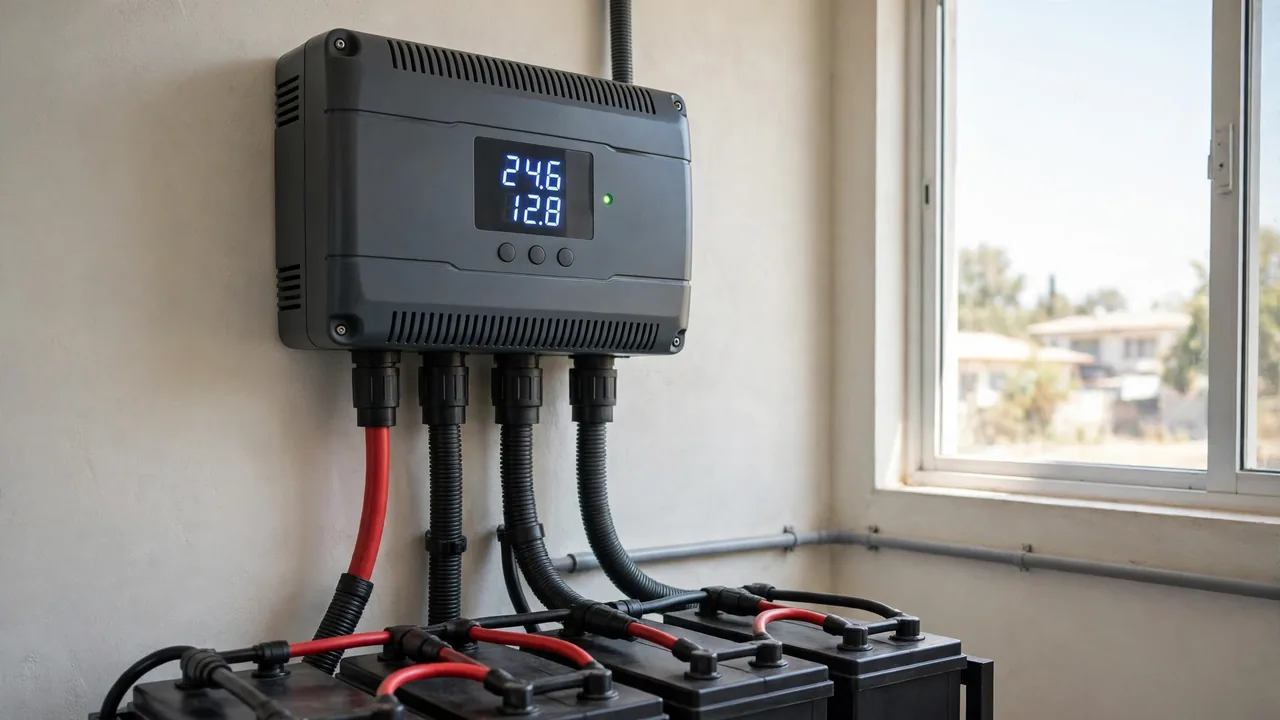
MPPT also opens up wiring options that PWM cannot handle. Because it converts voltage, you can wire several panels in series into a high-voltage string, and the controller still charges a 12, 24, or 48-volt battery correctly. High voltage means low current on the cables, so thinner wires and less energy lost as heat on a long run from the roof. That helps in Pakistani homes, where panels are often far from the battery room. Our inverter and battery pairing guide explains how the battery side should match the rest.
MPPT vs PWM Charge Controller: The Key Differences
Both types charge a battery from solar panels, but they do it in very different ways. This mppt vs pwm charge controller comparison looks at standalone controllers only, not the MPPT built into inverters.
| Feature | PWM charge controller | MPPT charge controller |
| How it works | Switches panels onto the battery, pulsing to control charging | Converts the panels’ higher voltage into extra charging current |
| Panel vs battery voltage | Must be close — panel voltage is pulled down to battery voltage | Can be much higher — panels can run in series at high voltage |
| Energy harvested | Good when voltages match; loses the extra voltage otherwise | Harvests more, especially in cold or cloudy weather |
| Panel wiring | Panels in parallel, matched to battery voltage | Series or parallel, high-voltage strings allowed |
| Battery types | Lead-acid batteries; limited lithium support on basic models | Charging profiles for lead-acid and lithium batteries |
| Complexity | Very simple, few parts, reliable | More complex, needs correct sizing |
| Best for | Tiny systems with small, voltage-matched panels | Most home systems, larger arrays, lithium batteries |
The right question is not “which one is better” in general — it is “which one fits my system”. A PWM controller on a small, well-matched system can be the smart buy. An MPPT controller on a larger system, or wherever panel voltage is higher than battery voltage, pays for itself in extra energy.
When a PWM Charge Controller Makes Sense
PWM is the right choice when the system is small and the voltages already match. Think of one small panel charging one battery — a few lights and a fan, a gate motor, a street light, or a small cabin. Here the panel and the battery are both 12-volt, so the PWM controller loses almost nothing. The controller is simple, and there is very little to go wrong.
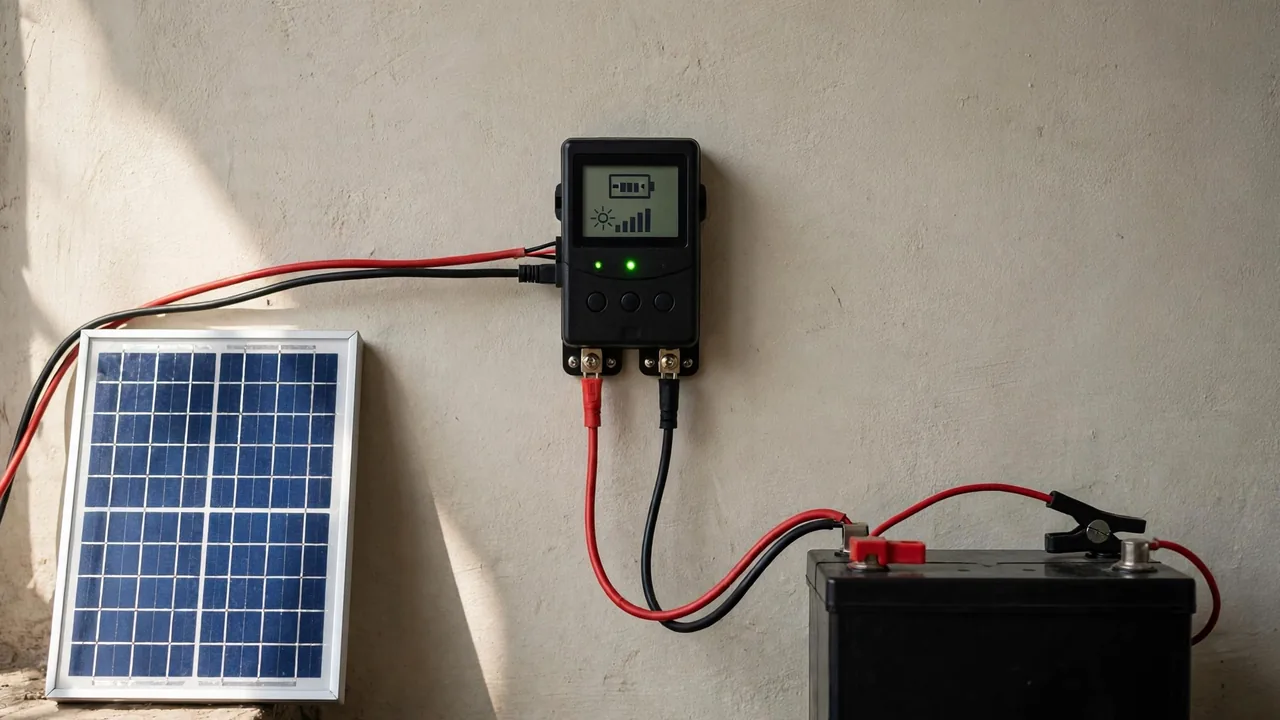
PWM also fits a very tight budget or a temporary setup you plan to replace later. But be honest about the size: if you plan to add more panels later, a PWM controller will hold you back, because it cannot handle high-voltage panel strings.
The one mistake to avoid is pairing a PWM controller with a modern high-voltage panel. Today’s large rooftop panels produce far more voltage than a 12-volt battery needs. Put one of those on a PWM controller and most of the panel’s power is wasted. If your panels are large, PWM is the wrong tool.
When an MPPT Charge Controller Is the Better Choice
In the mppt vs pwm charge controller choice, MPPT is the better option for almost every home system in Pakistan. More than one or two panels, a 24 or 48-volt battery bank, lithium batteries, or panels wired in series — in all of these, MPPT is the answer. It also helps when panels sit far from the batteries, since high-voltage strings keep cable losses low. On cold winter mornings, when panel voltage rises, MPPT turns the extra into charging current instead of wasting it.
Lithium batteries are a strong reason to choose MPPT. Lithium needs a precise charging profile — the right voltages at each stage, and no equalisation charging. Most MPPT controllers let you select a lithium profile. Many basic PWM controllers do not. Our lithium battery BMS guide explains the protection system inside a lithium battery and why correct charging matters.
MPPT also future-proofs the system: start with two panels, add two more next year, and a controller sized with headroom takes the extra panels. Work out your nightly backup need first — our guide to calculating solar battery backup time shows the simple maths — because the battery size decides the charging current your controller must deliver.
How to Size a Charge Controller
Sizing works the same way on both sides of the mppt vs pwm charge controller choice. Every controller has two numbers on its label: maximum PV input voltage and maximum charge current in amps. Get both right and it will serve you for years; get either wrong and you risk damage or wasted panels.
First, the voltage: add up the open-circuit voltage — Voc on the panel’s label — of all the panels wired in series. That total must stay below the controller’s maximum PV input voltage. Leave a margin, because panel voltage rises on cold mornings.
Second, the current. Divide your total panel watts by the battery voltage to get the charging current in amps. For example, 400 watts of panels on a 12-volt battery gives about 33 amps, so a 30-amp controller is too small — you need a 40-amp one. Always pick a controller rated above the current you calculated, so it is not running flat out on every sunny day.
Third, check the battery settings. Make sure the controller has a charging profile for your battery type — flooded lead-acid, AGM, gel, or lithium. A real MPPT controller lists a maximum PV voltage well above the battery voltage on its datasheet. If a controller labelled “MPPT” has a maximum PV voltage barely above the battery voltage, or no datasheet at all, treat it with suspicion — some cheap units are PWM controllers with an MPPT sticker.
Common Mistakes When Buying a Charge Controller
Most mppt vs pwm charge controller buying mistakes come down to sizing or panel matching. Watch out for these seven.
- Buying PWM for high-voltage panels. Modern large panels and PWM controllers do not mix — most of the panel’s power is wasted.
- Undersizing the current. A controller rated below your array’s current will overheat or cut out on sunny days. Do the maths first, then buy above the result.
- Ignoring cold-morning voltage. Panel voltage rises when it is cold, so a string that fits on a warm day can exceed the limit on a cold morning. Leave a margin.
- Buying a lithium battery without a lithium profile. Lithium batteries need their own charging voltages; a controller without a lithium setting can damage an expensive battery. Check before you buy.
- Trusting an “MPPT” label with no datasheet. A genuine MPPT controller comes with a datasheet showing maximum PV voltage and charge current. No datasheet means no proof.
- Skipping protection on the controller wires. The cables between the panels, the controller, and the battery carry serious current and need proper fuses or breakers — our DC breaker selection guide explains what goes where.
- Connecting the panels before the battery. Most controllers must be connected to the battery first, so they can detect the battery voltage. Follow the manual’s order — connecting the panels first can damage the controller.
Still deciding on the rest of the system? Our solar inverter buying guide for Pakistan covers how the inverter, panels, and batteries fit together.
Check Current Prices
A charge controller is a small part of a solar system’s overall cost. Before you buy anything, check the latest solar plate price in pakistan and the latest solar panel price in pakistan on our homepage, where the daily updated tables list panels, inverters, and batteries — including the current solar inverter price in pakistan.
Frequently Asked Questions (FAQs)
What is the difference between MPPT and PWM charge controllers?
A PWM controller connects the panels straight to the battery and pulls the panel voltage down to battery voltage, so any extra voltage is wasted. An MPPT controller lets the panel run at its best voltage and converts the extra voltage into extra charging current, so almost nothing is wasted. MPPT harvests more energy from the same panels, especially when panel voltage is much higher than battery voltage.
Which charge controller is best for a home solar system in Pakistan?
For most home systems in Pakistan, MPPT is the better choice — more than one or two panels, a 24 or 48-volt battery bank, lithium batteries, or panels wired in series all point to MPPT. PWM only wins on very small systems where one small panel already matches the battery voltage.
Can I use a PWM controller with a large solar panel?
You can connect it, but it is a bad match. Modern large panels produce far more voltage than a 12-volt battery needs, and a PWM controller throws most of that extra power away. Use an MPPT controller for any large, high-voltage panel.
Can I use an MPPT controller with a lithium battery?
Yes, as long as the controller has a lithium charging profile. Lithium batteries need precise voltages at each charging stage and no equalisation charging. Most MPPT controllers let you select a lithium profile; check for it before you buy, because many basic PWM controllers do not have one.
What size charge controller do I need?
Check two numbers on the label: the maximum PV input voltage and the maximum charge current in amps. Add up the open-circuit voltage (Voc) of the panels in series — it must stay below the controller’s maximum, with a margin for cold mornings. Then divide your total panel watts by the battery voltage to get the charging current, and pick a controller rated above that number.
Do hybrid inverters need a separate charge controller?
No. Most hybrid inverters already have a charge controller built in, so a separate controller is not needed. Standalone charge controllers are for off-grid systems and for systems where the panels charge the batteries directly, without a hybrid inverter in between.
Is MPPT worth it for a small solar system?
Usually not. On a very small system — one small 12-volt panel and one 12-volt battery — the panel voltage already matches the battery, so PWM loses almost nothing and costs less. MPPT starts to pay off as soon as the system grows or the panel voltage rises above the battery voltage.
What happens if I connect solar panels without a charge controller?
The battery will overcharge on sunny days, lose water, and fail years early. A charge controller is not optional for any panel-and-battery system — it controls the charging voltage, stops overcharging, and stops current flowing backwards into the panels at night.