
Solar Battery Charging Stages: Bulk, Absorption and Float Explained

Solar battery charging stages explained in one line: a good solar charge controller charges a battery in three main stages — bulk, absorption and float — first pushing in as much charge as the battery can safely accept, then holding the voltage steady while the current tapers off, and finally dropping to a low maintenance voltage that keeps the battery full without overcharging it. If you understand these three stages, you can read your charge controller display with confidence, spot a charging problem early, and understand why a battery that looks “full” in the morning may still need hours to finish charging properly.
This guide explains each stage in plain language, how the stages differ between lead-acid and lithium batteries, what extra stage some flooded batteries need, and the common mistakes that shorten battery life. It is a charging-process guide, not a buying guide: for help choosing a battery, see the site’s battery guides linked below.
How Solar Battery Charging Works
Your solar panels do not charge a battery directly. The charge controller sits between the panels and the battery bank, and its job is to deliver the right amount of current and voltage at the right time. Without it, a battery could be overcharged on a sunny day or damaged by an uncontrolled flow of current.
There are two common controller types. A PWM (pulse width modulation) controller connects the panels to the battery in rapid pulses, while an MPPT (maximum power point tracking) controller converts the panel output to get the most usable power from it. Both types can run a three-stage charging profile, but the controller must be set to the correct battery type: a profile meant for one chemistry can overcharge or undercharge another. That single setting matters more than most owners realise, and it is the first thing to check whenever charging behaviour looks wrong.
Charging is not a single steady process. A battery accepts charge easily when it is empty and resists it as it fills up, much like a sponge soaks up water quickly at first and then only slowly. The three stages match the charging method to what the battery can accept at each point, which is why a controller switches stages automatically rather than pushing the same current all the way to full.
Stage 1: Bulk Charging
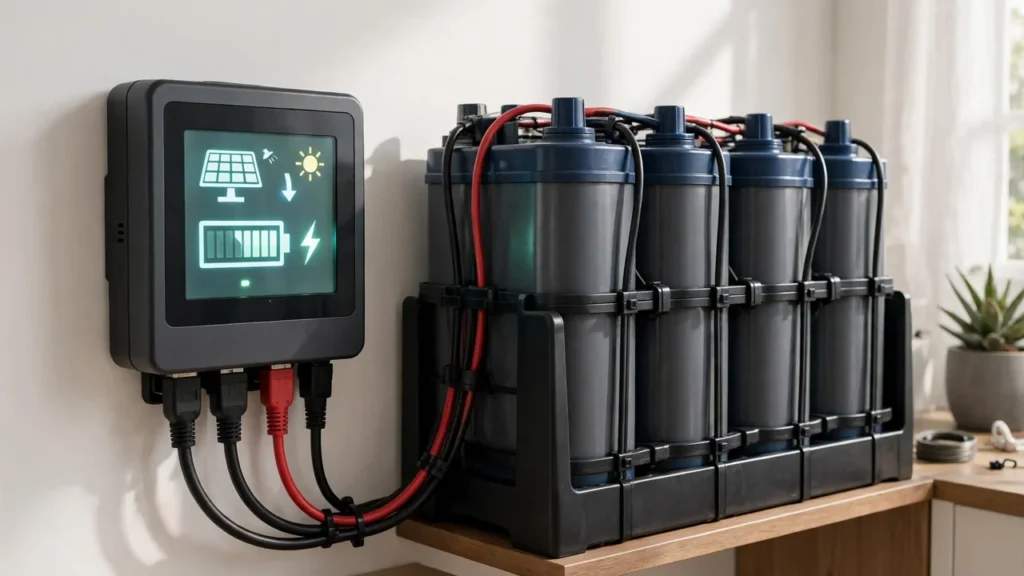
Bulk charging is the first and fastest stage. When the battery is discharged, the controller delivers the maximum safe current available from the panels, and the battery voltage rises steadily as charge goes in. During this stage the battery is doing most of the work of accepting charge, and the controller is mainly making sure the current stays within safe limits.
Bulk charging typically restores most of the battery’s charge — roughly the first four-fifths or so for a lead-acid battery — before the voltage reaches its set charging level. That is why a battery can look like it is charging quickly in the morning and then appear to slow down: the fast part is over, and the careful finishing stages have begun. A battery that never seems to leave bulk charging, even after a full sunny day, may have a problem worth investigating, such as a shaded panel, a loose connection, or a battery that can no longer hold charge.
What to expect during bulk charging
- Current is high and voltage climbs steadily from the discharged level.
- Charging feels fast, because the battery is accepting energy readily.
- The stage ends when the battery voltage reaches the controller’s absorption voltage setting, not when the battery is completely full.
Stage 2: Absorption Charging
Absorption is the finishing stage, and it is the one most often misunderstood. Once the battery reaches its target charging voltage, the controller holds that voltage constant and lets the current fall gradually as the battery fills. The battery is still charging, but more gently, so the remaining charge can be absorbed evenly without pushing the voltage higher.
This stage takes time. Depending on the battery type, its size and how deeply it was discharged, absorption can last from well under an hour to several hours. Cutting it short — for example, by switching the system off as soon as the display shows a high voltage — leaves the battery only partly charged, even though the voltage looked “full”. Repeated partial charging, especially in lead-acid batteries, allows sulphation to build up on the plates and gradually reduces usable capacity.
Absorption also protects the battery. By holding voltage steady instead of continuing to push current, the controller avoids the gassing and water loss that come with overcharging. If your controller regularly skips absorption or ends it very quickly, check that the battery-type setting is correct and that the battery bank is not oversized for the solar array feeding it.
Signs absorption is working normally
- Voltage stays roughly steady while the charging current falls step by step.
- The stage lasts noticeably longer after a deep discharge than after a shallow one.
- The controller moves to float only after the current has tapered to a low level or a set absorption time has passed.
Stage 3: Float Charging

Float is the maintenance stage. Once the battery is fully charged, the controller drops the voltage to a lower float level and supplies only a small trickle of current — just enough to replace what the battery loses through self-discharge. The battery is kept ready for use without being stressed by a continuously high voltage.
A battery held at float is not being charged in the usual sense; it is being maintained. That distinction matters for backup systems that sit unused for days. A healthy system should spend its idle sunny hours at float, not cycling between bulk and absorption, and a controller that keeps restarting bulk charging on a full battery may have its voltage settings too close together or a load that keeps waking the system.
What float looks like on your display
- Voltage is lower than during absorption, and current is very small.
- The battery stays near full charge while the system idles.
- When a load runs or the sun goes down, the system leaves float and the cycle begins again the next time solar power is available.
Do All Batteries Use the Same Three Stages?
The three stages describe the classic charging profile, but the details change with battery chemistry. Lead-acid batteries — including tubular, AGM and gel types — follow the bulk, absorption and float pattern closely, though each type has its own voltage settings, which is why the battery-type setting on the controller must match the battery actually installed.
Lithium iron phosphate (LiFePO4) batteries behave differently. They accept charge efficiently across a wider range and are managed by an internal battery management system (BMS) that protects individual cells. Many lithium charging profiles hold the battery at the absorption voltage for longer and use little or no separate float stage, because the BMS and the charger handle the final part of charging differently. The practical point is the same: use the lithium profile for a lithium battery and the lead-acid profile for a lead-acid battery, and never assume one profile fits both.
For a deeper look at lithium batteries, see the lithium battery guide for solar in Pakistan, and for lead-acid care, the solar battery maintenance guide explains routine checks that support healthy charging.
What About Equalization?
Some flooded lead-acid batteries need an occasional extra stage called equalization. This is a controlled, slightly higher-voltage charge applied for a limited time to balance the cells and reduce sulphation and acid stratification. It is only for flooded batteries that are designed for it: applying equalization to sealed AGM, gel or lithium batteries can damage them, so it should only be used when the battery maker’s instructions allow it and the controller supports it.
Equalization is not part of the daily cycle. It is an occasional maintenance step, usually handled automatically by the controller on a schedule or started manually by an installer. If you are unsure whether your batteries need it, check the battery documentation or ask your installer rather than switching it on to see what happens.
How the Stages Fit Together Over a Solar Day
On a normal sunny day, a discharged battery starts in bulk in the morning, moves into absorption as it nears full, and settles at float by the afternoon if there is enough sun. On a cloudy day, the battery may never leave bulk, and that is normal — the controller simply delivers what the panels can produce. The stages describe what the controller does with the power available, not a timetable it must follow regardless of weather.
Night-time use changes the picture. Loads discharge the battery overnight, so the next morning the cycle starts again from wherever the battery ended up. That daily rhythm is why battery charging and battery sizing are linked: a bank that is regularly discharged very deeply takes longer to finish absorption, and a bank that is too small for the night-time load may never reach float at all. The guide to how many batteries a solar system needs and the series vs parallel battery wiring guide explain how bank size and wiring affect that daily cycle.
Common Charging Mistakes to Avoid
Using the wrong battery-type profile
The most common and most avoidable mistake is leaving the controller on its default profile when the battery type is different. Each chemistry and construction needs its own voltages, and a mismatch can mean chronic undercharging or steady overcharging. Check the profile whenever a battery is replaced or a new bank is added.
Judging charge by voltage alone
Voltage rises quickly during bulk charging and can look full long before the battery is actually full. A battery under charge always reads higher than the same battery at rest, so voltage alone is a poor guide to state of charge. Watch the stage and the current as well: absorption with falling current, followed by float, is the reliable sign of a completed charge.
Ignoring a battery that never reaches float
A system that never reaches float on sunny days is telling you something. It may be undersized for the load, have a failing battery, or suffer from shading, dirty panels or a loose connection. The solar inverter installation guide covers the wiring and placement checks that often sit behind charging problems, and the MPPT explainer explains how the controller type affects what reaches the battery.
Mixing old and new batteries
Adding a new battery to an old bank means the controller charges the whole bank as one unit, so the weaker battery limits the result. Mixed banks often finish absorption unevenly and age faster as a group. Where possible, keep a bank matched in type, age and capacity.
Check Current Prices
This guide covers how solar batteries charge, not what batteries cost today. For the latest solar panel prices, updated daily, visit the homepage of jinkosolarpanelpriceinpakistan.com, where the current tables are maintained. If you are planning a new battery bank, compare the charging profile your controller supports with the battery type you intend to buy before you commit.
For further reading on the charging stages themselves, the Deep Cycle Battery FAQ published by NAZ Solar Electric describes bulk, absorption and float charging in detail and is a useful independent reference for the stages covered here: Deep Cycle Battery FAQ — Battery Charging.
Frequently Asked Questions (FAQs)
What are the three solar battery charging stages?
The three main stages are bulk, absorption and float. In bulk charging the controller delivers the maximum safe current and the battery fills quickly. In absorption it holds the voltage steady while the current tapers off to finish the charge gently. In float it drops to a lower maintenance voltage that keeps the battery full without overcharging it.
How long does absorption charging take?
Absorption can last from well under an hour to several hours, depending on the battery type, its size and how deeply it was discharged. A battery that has been deeply discharged needs a longer absorption stage than one that was only lightly used, and cutting this stage short can leave the battery only partly charged.
What is float charging and is it the same as trickle charging?
Float charging is a maintenance stage in which the controller supplies only a small current to replace self-discharge and keep a full battery ready for use. It is often called a trickle charge because the current is very small, but its purpose is maintenance, not filling an empty battery.
Why does my battery charge quickly at first and then slow down?
This is normal. A discharged battery accepts charge easily, so bulk charging is fast. As the battery fills, its internal resistance rises and it accepts charge more slowly, so the controller switches to absorption and the current tapers off. The slow finish is what completes the charge safely.
Do lithium solar batteries use bulk, absorption and float stages?
Lithium iron phosphate batteries are charged differently from lead-acid batteries. They accept charge efficiently over a wider range and are managed by an internal battery management system, so many lithium profiles hold the absorption voltage for longer and use little or no separate float stage. Always use the lithium profile for a lithium battery.
What is battery equalization and does my battery need it?
Equalization is an occasional, slightly higher-voltage charge used to balance the cells and reduce sulphation in some flooded lead-acid batteries. It is only for flooded batteries designed for it and should never be applied to sealed AGM, gel or lithium batteries unless the battery maker specifically allows it.
What should I check if my battery never reaches float?
First check that the charge controller is set to the correct battery type. Then look for a load that is too large for the bank, shading or dirty panels, loose connections, or a failing battery. A system that never reaches float on sunny days is usually undersized for its load or has a fault that needs attention.
Can I judge my battery’s charge level from voltage alone?
No. A battery being charged always reads higher than the same battery at rest, so voltage alone can look full long before charging is complete. Check the charging stage and the current as well: absorption with falling current, followed by float, is the reliable sign that a charge has finished.
