
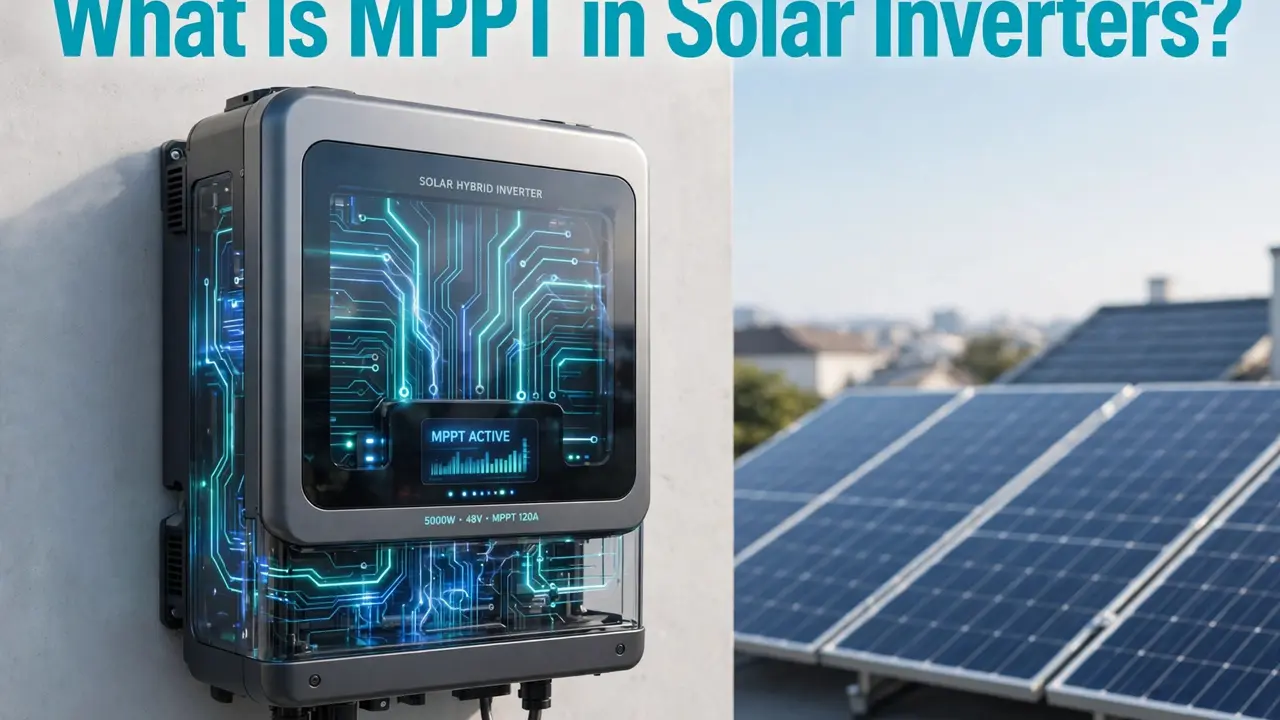
What Is MPPT in Solar Inverters? Complete Guide

MPPT — short for Maximum Power Point Tracking — is the technology inside modern solar inverters that makes sure your solar panels produce the maximum power they are capable of at every moment of the day. A solar panel’s output changes constantly with sunlight and temperature, and there is always one specific voltage at which the panel produces its peak power. MPPT continuously finds that voltage and keeps the panel operating there, so none of the energy your panels are producing goes to waste.
If you are comparing inverters in Pakistan, you will see “MPPT” on almost every datasheet — on hybrid inverters, on-grid string inverters, and standalone charge controllers. This guide explains what it is, how it works, why single vs dual MPPT matters, and what to check on the spec sheet before you buy.
What Is MPPT? (Maximum Power Point Tracking)
A solar panel does not produce a fixed amount of power. Its output depends on the voltage at which it is forced to operate. Run it at too low a voltage and you get plenty of current but very little voltage; let it run too high and the current collapses toward zero. Somewhere between those extremes sits one sweet spot — the single voltage where volts multiplied by amps is at its absolute peak. That sweet spot is called the maximum power point (MPP), and on a datasheet you will see it listed as Vmp (peak power voltage) with its matching current Imp.
MPPT is simply the act of hunting for that sweet spot — continuously, all day — as conditions change. And conditions change constantly. The maximum power point moves with sunlight intensity, and even more dramatically with cell temperature: a panel’s Vmp sags on a hot afternoon and climbs on a cold morning. An inverter without MPPT can only be at the right voltage by accident; an inverter with MPPT is at the right voltage all day.
Two things MPPT is not:
- It is not a brand, and it is not automatically a separate component you must buy. On most modern equipment it is built in.
- It is not a way to pull more power out of a panel than the panel can physically make. What it does is stop you from wasting the power the panel is already producing.
Why MPPT Matters More in Pakistan’s Climate
In Pakistan, rooftop panels face big daily temperature swings. Panels heat up significantly on a summer afternoon, and that heat pushes the panel’s Vmp down; on cold winter mornings, Vmp climbs. Without MPPT, an inverter sits at a fixed operating point while the real maximum power point drifts away — and the gap between the two is harvested energy lost.
MPPT solves this by treating the panel’s operating voltage as a moving target and tracking it in real time. The practical result: more energy harvested across the whole day, in every season, and better performance during cloudy or low-light hours when the power curve is harder to read.
How MPPT Works: Sample, Hunt, Convert
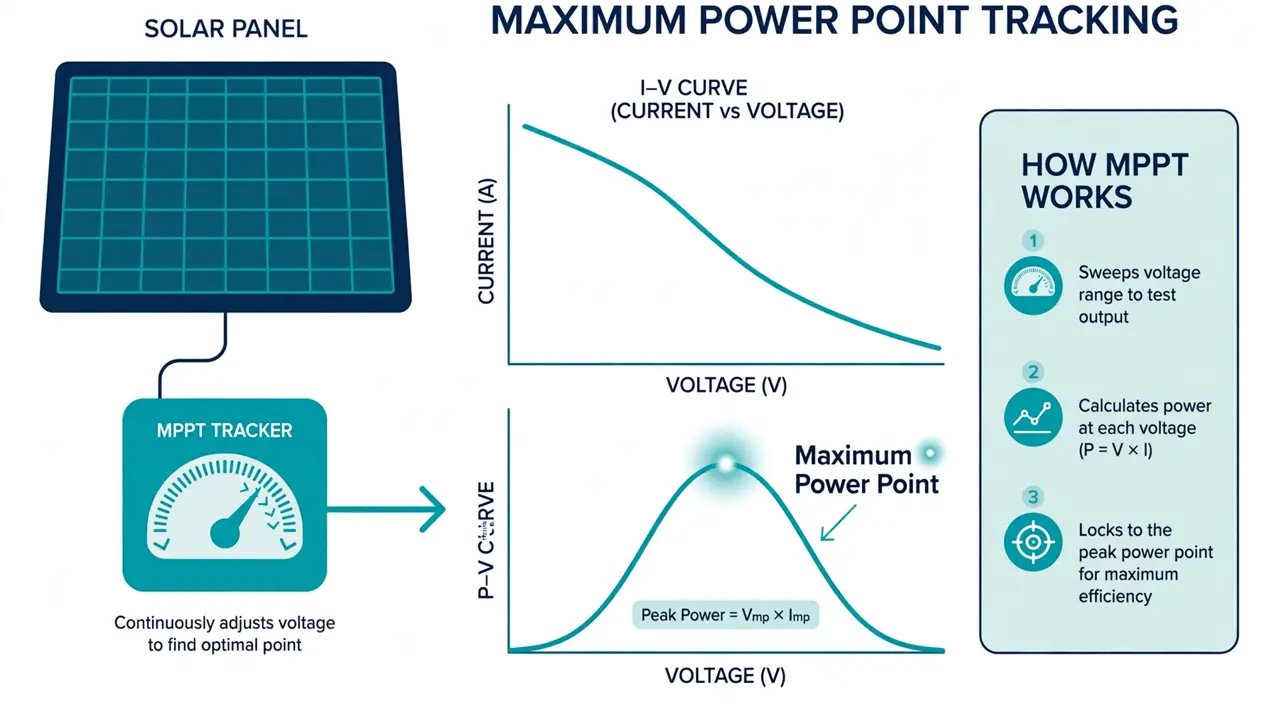
Inside the inverter, the MPPT function is essentially a DC-DC converter guided by a microprocessor. It repeats a three-step cycle many times per second:
- Sample. It measures the solar array’s voltage and current.
- Hunt. A tracking algorithm searches for the peak of the power curve. The two algorithms you will see named on spec sheets are Perturb and Observe (nudge the voltage slightly, see whether power rose, keep moving in that direction) and Incremental Conductance (compare the rate of change of current against the rate of change of voltage; when they balance, you are at the peak — faster and steadier under rapidly changing light, but more complex to implement).
- Convert. The converter steps the array’s higher voltage down to whatever the battery or the AC stage needs, and the power that would have been lost comes out the other side as extra current. Power in roughly equals power out: volts down, amps up.
This voltage-to-current conversion is why MPPT harvests more than older PWM technology. Where a PWM controller simply throws away any voltage above what the battery needs, an MPPT converter turns that surplus voltage into usable charging current. For a deeper technical walkthrough of the tracking process, see this comprehensive MPPT explainer.
MPPT vs PWM: The Key Differences
PWM (Pulse Width Modulation) is the older, simpler charge-control technology. Here is how the two compare for a homeowner:
| Factor | MPPT | PWM |
|---|---|---|
| Harvest efficiency | Tracks the peak power point continuously, harvesting more energy in all conditions | Pulls the panel down to battery voltage, discarding surplus voltage as heat |
| Low-light and cloudy performance | Adapts the operating point and performs noticeably better | Fixed operating behavior, weaker yield on dull days |
| Supported panel voltage | Supports high-voltage strings, so panels can be wired in series | Panel voltage must stay close to battery voltage |
| Best suited for | Medium to large home and commercial systems | Small DC systems with low panel voltage |
| Complexity and build | DC-DC converter plus tracking algorithm | Simple switching circuit |
For a typical Pakistani home running a few kilowatts of rooftop solar, MPPT is the right choice — it is the standard technology in every serious residential inverter on the market today.
Single MPPT vs Dual (Multiple) MPPTs
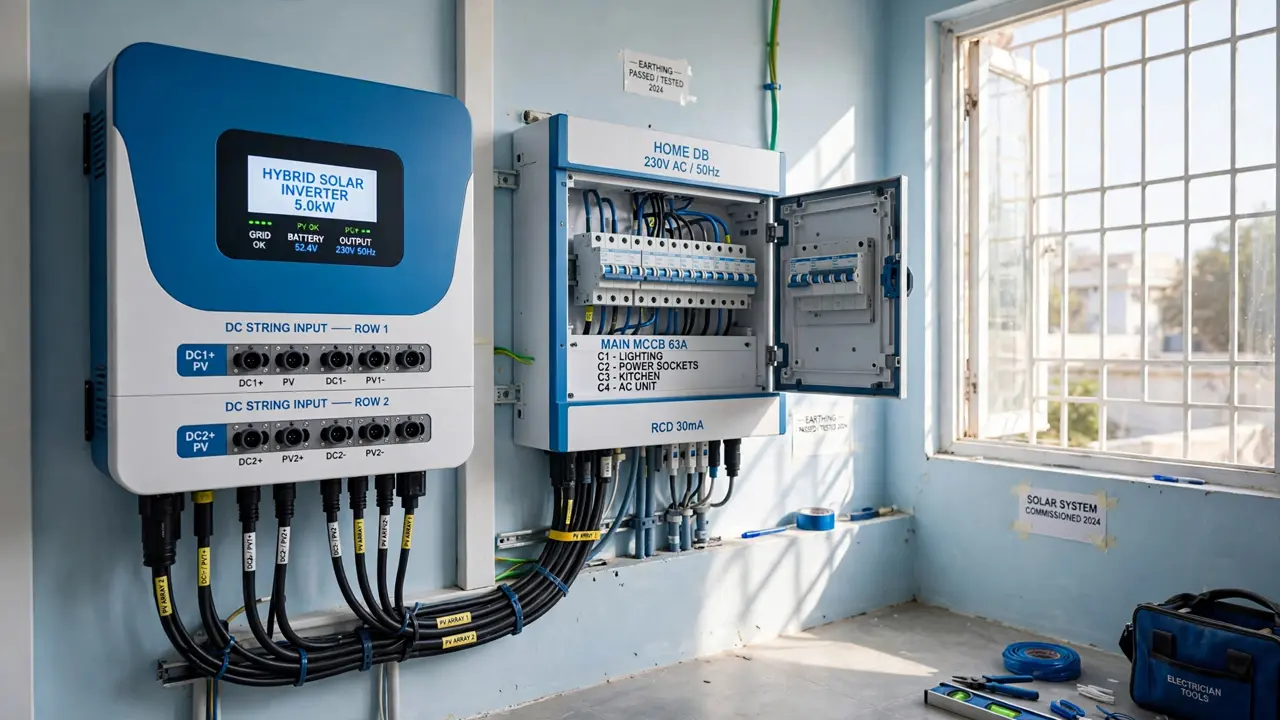
One of the most practical spec-sheet details is the number of independent MPPTs in the inverter. Here is why it matters:
In a string system, panels are wired in series, so every panel in a string carries the same current, and the whole string is tracked to a single operating voltage. That is fine when all panels see the same sun. But if half your panels face east and half face west — or one section gets shaded by a water tank while another stays in full sun — the two groups peak at completely different times and voltages. A single MPPT has to compromise between them, and both groups lose energy.
A dual-MPPT inverter solves this by running two separate strings at two separate optimal voltages simultaneously. The east string peaks in the morning, the west string peaks in the afternoon, and neither drags the other off its maximum power point. You need separate trackers whenever groups of panels will produce differently from each other:
- Different roof orientations (east/west splits are common on Pakistani homes)
- Different tilt angles on the same roof
- Different shade patterns through the day (tanks, parapets, neighboring buildings)
- Different panel models or wattages mixed in one system
- A rooftop array plus a ground-mount or pergola array
When comparing hybrid inverters, look for the independent tracker count rather than just the number of string inputs — two strings sharing one MPPT are still governed by a single tracker, so shade on one string pulls both off their best operating point.
Does Your Inverter Already Have MPPT?
For most buyers, this is the practical question. Here is how MPPT maps to common equipment:
- All-in-one hybrid inverters: Yes, built in — typically two or three independent MPPTs. The MPPT harvests the solar DC, and the rest of the unit (battery charger, inverter, grid interaction, backup switching) handles where that power goes. These are two different jobs that happen to live in the same box.
- Grid-tie string inverters: Yes, built in — usually one to three MPPTs, since there is no battery and panels run straight into the inverter.
- Standalone MPPT charge controllers: Yes — the unit is an MPPT, sitting between the array and the battery in modular DC systems.
- Inverter/chargers with no PV input: No. These invert and charge from AC only, so solar must come through a separate MPPT charge controller or an AC-coupled PV inverter.
- Microinverters and DC optimizers: Yes — effectively one MPPT per panel, which gives panel-level tracking.
The quickest physical check: does the unit have PV input terminals (DC wires coming in from the panels)? If yes, it has MPPT. If it only has battery, grid, and load connections, something else is harvesting your solar. If you are deciding between inverter types first, read our on-grid vs off-grid vs hybrid inverter comparison, then use our solar inverter buying guide to shortlist models.
MPPT Voltage Range: What to Check on the Datasheet
Every inverter with MPPT lists an MPPT voltage range (for example, 120–450 V on a typical hybrid). This is the window inside which the tracker can do its job. Your panel strings must be designed so their combined Vmp sits comfortably inside this range — both on the hottest day of the year (when string voltage is lowest) and the coldest morning (when it is highest).
Other figures worth checking alongside it:
- Maximum PV input voltage: the absolute ceiling your string’s open-circuit voltage must never exceed, including cold-weather voltage rise.
- Maximum input current per MPPT: relevant when you parallel two strings into one tracker.
- Maximum PV array power: the total panel wattage the inverter will accept — hybrid inverters often accept more panel power than their rated AC output (oversizing is normal and allowed up to the stated limit).
Getting the string voltage right is a core part of system design, and it directly affects how well MPPT performs. Our inverter sizing guide walks through matching panel strings to inverter input limits step by step.
Shading and MPPT: What Tracking Can and Cannot Fix
MPPT improves yield under partial shading, but it cannot eliminate shading losses. Here is what to realistically expect:
- Whole-string shading (clouds, haze): a single MPPT adapts well, finding the new peak quickly.
- Uneven shading across strings (one section shaded, one not): only multiple independent MPPTs handle this properly, since each tracker optimizes its own string.
- Hard, persistent shade (a chimney shadow crossing the same panels every afternoon): no tracker recovers this energy — the fix is string layout, panel placement, or per-panel electronics, not a better MPPT algorithm.
This is why the number of independent MPPTs is worth more attention than most buyers give it, especially on L-shaped roofs or homes with water tanks and mumty structures casting shadows.
Common MPPT Myths
Myth 1: MPPT creates extra power
It does not create anything — it recovers power that would otherwise be lost between the panel and the load. A 580 W panel cannot become a 620 W panel because of MPPT; it simply gets closer to delivering its real 580 W.
Myth 2: A bigger MPPT current rating means more energy
The amp rating (e.g., 120 A) describes how much current the tracker can handle, not how much it produces. Oversized ratings add headroom and safety margin; they do not generate energy by themselves.
Myth 3: Dual MPPT is always better
Dual MPPT only pays off when your array actually splits into groups with different conditions. On a single clean, unshaded, single-orientation roof, a well-matched single MPPT harvests just as effectively.
Myth 4: MPPT eliminates the need for good system design
Tracking is a compensation mechanism, not a substitute for correct string sizing, orientation, and shading avoidance.
Key Takeaways
- MPPT (Maximum Power Point Tracking) continuously adjusts the operating voltage of your solar array so panels always work at their peak power point.
- It matters most where temperatures and light change a lot through the day — exactly the conditions Pakistani rooftops see.
- MPPT outperforms PWM by converting surplus panel voltage into usable current instead of discarding it.
- The number of independent MPPTs is a key spec: two or more trackers let differently-oriented or partially shaded strings each run at their own optimum.
- Check the MPPT voltage range, maximum PV voltage, and per-tracker current limits on the datasheet before finalizing your panel strings.
- Hybrid inverters, on-grid string inverters, and standalone charge controllers all include MPPT; inverter/chargers without PV inputs do not.
Check Current Prices
MPPT specifications vary across inverter brands and models, and prices move with the market. For today’s updated solar panel and inverter price tables in Pakistan, visit our homepage — the tables there are refreshed daily. If you are comparing specific inverter brands, our guides to hybrid solar inverters in Pakistan and the top 5 best hybrid inverters will help you shortlist.
Frequently Asked Questions (FAQs)
What is MPPT in a solar inverter?
MPPT (Maximum Power Point Tracking) is the technology inside a solar inverter that continuously adjusts the operating voltage of the solar array so the panels always work at the voltage where they produce their peak power. It recovers energy that would otherwise be lost when conditions change.
What is the full form of MPPT?
MPPT stands for Maximum Power Point Tracking. It refers to the tracking algorithm — and the DC-DC converter hardware that runs it — which keeps a solar array at its maximum power point (Vmp x Imp) throughout the day.
Is MPPT better than PWM?
Yes, for most residential systems. MPPT converts surplus panel voltage into usable charging current instead of discarding it, performs better in low light and cloudy weather, and supports high-voltage panel strings. PWM is simpler but only suits small, low-voltage DC systems.
How many MPPTs do I need in my inverter?
One MPPT is enough for a single clean, unshaded, single-orientation array. Choose an inverter with two or more independent MPPTs when your panels split into groups with different orientations, tilt angles, shade patterns, or panel models, so each group can be tracked at its own optimum.
Do all solar inverters have MPPT?
Almost all modern ones do. Hybrid inverters and grid-tie string inverters have built-in MPPT; standalone MPPT charge controllers exist for modular DC systems. Inverter/chargers with no PV input have no MPPT — solar must be harvested through a separate controller or PV inverter.
What MPPT voltage range should I look for?
Check the inverter’s stated MPPT voltage range on the datasheet and design your panel strings so their combined Vmp sits comfortably inside it — both on the hottest day (lowest string voltage) and the coldest morning (highest string voltage). Also respect the maximum PV input voltage and per-tracker current limits.
Can MPPT fix shading problems?
Partially. MPPT adapts well to uniform shading like clouds, and multiple independent MPPTs handle strings that shade unevenly. But hard, persistent shade from a chimney or water tank cannot be recovered by any tracker — the fix is string layout, panel placement, or per-panel electronics.
