

How Many Units Does a 10kW Solar System Produce Per Day?

A 10kW solar system in Pakistan typically produces around 40 to 45 units (kWh) per day on average — roughly 1,200 to 1,400 units per month over the year. On long, clear summer days, a well-installed system can approach 50 units in a day, while short, cloudy winter days may drop output closer to 30 units. The exact number for your roof depends on your city’s sunlight, your panels’ tilt and direction, shading, and system losses — this guide shows you how to work it out for your own setup.
In this guide, you will learn the simple formula behind daily solar output, what a 10kW system produces month by month in Pakistan, the factors that push output up or down, and how to check whether your own system is performing as it should.
The Simple Formula for Daily Solar Output
Daily output is not a mystery number. It comes from a straightforward calculation:
Daily units = System size (kW) × Peak sun hours × Performance ratio
Here is what each part means:
- System size (kW): For this guide, 10 kW — the total rated DC capacity of your panels.
- Peak sun hours: The number of hours per day when sunlight is strong enough to count as full sunshine. In most parts of Pakistan, this averages around 5 hours, higher in the south and lower in the north and in winter.
- Performance ratio (usually 0.75 to 0.80): This accounts for real-world losses — inverter conversion, heat, dust, wiring, and panel mismatch. No system delivers 100% of its rated capacity all day.
Using typical Pakistani conditions — 5 peak sun hours and a performance ratio of 0.78 — the calculation looks like this: 10 × 5 × 0.78 = 39 units per day. With 5.5 peak sun hours, the same system gives about 43 units. That is why the realistic average for a 10kW system in Pakistan sits in the 40 to 45 units per day range, rather than the theoretical 50 units you would get by multiplying 10 kW by 5 hours with zero losses.
How Many Units Does a 10kW System Produce at Different Sun Levels?
The table below shows how daily output changes with the amount of usable sunshine, assuming a performance ratio of 0.78. Use it to estimate output for your own city and season.
| Peak sun hours per day | Estimated daily units | Estimated monthly units |
|---|---|---|
| 4.0 hours (cloudy winter day) | ~31 units | ~930 units |
| 4.5 hours | ~35 units | ~1,050 units |
| 5.0 hours (typical average) | ~39 units | ~1,170 units |
| 5.5 hours | ~43 units | ~1,290 units |
| 6.0 hours (clear summer day) | ~47 units | ~1,410 units |
These are planning estimates, not guarantees. Your installer’s production estimate for your exact roof, tilt, and location is the figure to compare your real output against. If you are still deciding on system size, our guide on how to calculate your home’s electricity load for solar helps you match a system to your actual consumption first.
Month-by-Month Output in Pakistan: What to Expect
Because days are longer and sunnier in summer, a 10kW system produces noticeably more units from April to September than from November to February. A typical seasonal pattern looks like this:
- Summer (May to August): The strongest months — often 45 to 50 units per day on clear days, though extreme heat slightly reduces panel efficiency.
- Spring and autumn (March–April, September–October): Comfortable, steady months — typically 40 to 45 units per day, often the best balance of long days and moderate temperatures.
- Winter (November to February): Shorter days and lower sun angles — commonly 30 to 38 units per day, with fog and smog in Punjab sometimes pushing output lower for days at a time.
- Monsoon spells: Heavy cloud cover can cut daily output sharply for a few days, but production does not stop — panels still generate electricity from diffused light.
Over a full year, these seasons average out to roughly 14,000 to 16,000 units per year for a typical 10kW system in Pakistan. If you want the same calculation for a smaller setup, see how many units a 3kW solar system produces per day.
7 Factors That Affect Your 10kW System’s Daily Units
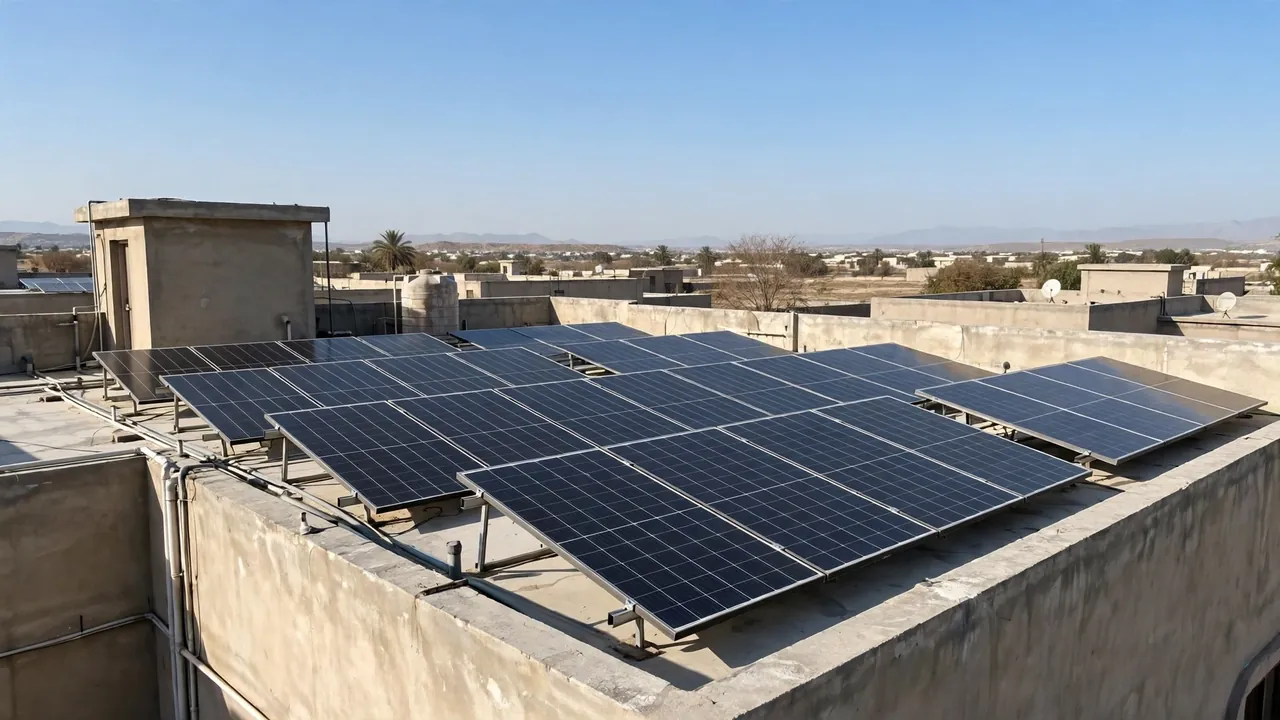
1. Peak sun hours in your city
Southern cities such as Karachi, Hyderabad, and much of Sindh and southern Punjab receive more usable sunshine than northern cities such as Islamabad and Murree. Even within one city, output varies between a clear June day and a foggy January day.
2. Panel tilt and direction
Panels facing true south at a tilt suited to your latitude capture the most sunlight over the year. Flat or wrongly angled panels can lose a meaningful share of daily output. See our solar panel mounting structures guide for how tilt and structure choices affect production.
3. Shading
Even partial shade — a water tank, a neighbouring building, a tree branch — can cut a string of panels’ output far more than the shaded area suggests. This is one of the most common reasons a system underperforms its estimate.
4. Temperature
Solar panels actually perform better in moderate temperatures. On very hot days, panel efficiency drops slightly, which is why a mild, sunny March day can sometimes outproduce a scorching June afternoon.
5. Dust and smog
Dust buildup and seasonal smog block sunlight before it reaches the cells. In dusty or smog-prone areas, regular cleaning makes a visible difference to daily units.
6. Inverter efficiency and system losses
Your inverter converts DC power from the panels into AC power for your home, and a small percentage is lost in conversion, wiring, and connections. Quality components and correct sizing keep these losses at the low end.
7. Panel degradation over time
Panels lose a small fraction of their output capacity each year. A system that produces 43 units per day when new will typically produce slightly less a decade later — this gradual decline is normal and is already factored into long-term production estimates.
Is a 10kW System Enough for Your Home?
It depends on your monthly consumption. A home using around 1,000 to 1,200 units per month will, on average, roughly match a 10kW system’s monthly output of 1,200 to 1,400 units. But matching the monthly total is not the whole story: solar produces during the day, while much of a household’s usage happens in the evening. That is why many 10kW owners pair their system with net metering, so surplus daytime units are exported to the grid and credited against nighttime usage.
To size correctly, start from your actual bills rather than from a rule of thumb. Our guide on how many solar panels you need for your home walks through the load-based approach step by step.
How to Check Your Own System’s Daily Units

Once your system is running, checking output is simple:
- Inverter app or display: Most modern inverters show today’s production in kWh (units) on their screen or companion app, along with monthly and total figures.
- Net meter or bidirectional meter: Your import/export meter shows how many units you sent to the grid, which you can compare with your inverter’s total production.
- Daily log: Note the inverter’s daily figure for a week and compare it with the table above for your season. A system consistently far below the expected range deserves a check for shading, dust, or a settings issue.
For a broader explanation of how panel output is calculated and what influences it, EnergySage’s guide on how much energy a solar panel produces is a useful independent reference — it notes, for example, that a 10 kW system in a sunny climate can produce around 15,000 kWh in a year, which lines up with the annual range given above.
Tips to Get Closer to Maximum Daily Output
- Keep panels clean, especially after dust storms or during smog season.
- Trim or work around anything that shades the array during peak sun hours (roughly 10 am to 3 pm).
- Check that the inverter is not showing fault warnings and that its firmware is up to date.
- Review your monthly production against the seasonal pattern above — a sudden drop is worth investigating early.
- Have the system inspected if output falls well below expectations for more than a few weeks without an obvious weather cause.
Once you know your expected output, work out the budget: compare the solar system price in pakistan for a 10kW setup with the solar panel price in pakistan per watt on our daily-updated homepage tables.
Frequently Asked Questions (FAQs)
How many units does a 10kW solar system produce per day in Pakistan?
A 10kW solar system in Pakistan typically produces around 40 to 45 units (kWh) per day on average. On clear summer days it can approach 50 units, while short, cloudy winter days may drop output closer to 30 units.
How many units does a 10kW solar system produce per month?
On average, a 10kW system produces roughly 1,200 to 1,400 units per month in Pakistan, adding up to around 14,000 to 16,000 units over a full year. Summer months are higher and winter months lower.
What is the formula to calculate a 10kW system’s daily units?
Multiply system size by peak sun hours and then by the performance ratio: 10 kW × peak sun hours × 0.75 to 0.80. With 5 peak sun hours and a 0.78 performance ratio, the result is about 39 units per day.
How many solar panels are needed for a 10kW system?
It depends on panel wattage. With 585-watt panels, a 10kW system needs around 17 to 18 panels; with lower-wattage panels the count is higher. Your installer confirms the exact count based on the panels chosen and available roof space.
Does a 10kW system produce the same units in winter and summer?
No. Summer days are longer and sunnier, so daily output is highest from April to September. Winter output is lower because of shorter days, lower sun angles, and fog or smog in many areas of Punjab and northern Pakistan.
Why is my 10kW system producing fewer units than expected?
The most common causes are shading from tanks, buildings or trees, dust or smog on the panels, a wrong tilt or direction, inverter faults, and seasonal weather. Compare your inverter’s daily reading with the expected range for your season before assuming a fault.
Is a 10kW system enough for a home using 1,000 units per month?
On average, yes — a 10kW system’s typical monthly output of 1,200 to 1,400 units covers a 1,000-unit monthly consumption. Because solar produces during the day and homes use most power in the evening, net metering helps balance daytime surplus against nighttime usage.
Do solar panels stop producing units on cloudy days?
No. Panels still generate electricity from diffused light on cloudy days, but output drops noticeably compared with a clear day. Heavy monsoon cloud cover can cut daily production sharply for a few days, then output recovers when skies clear.