
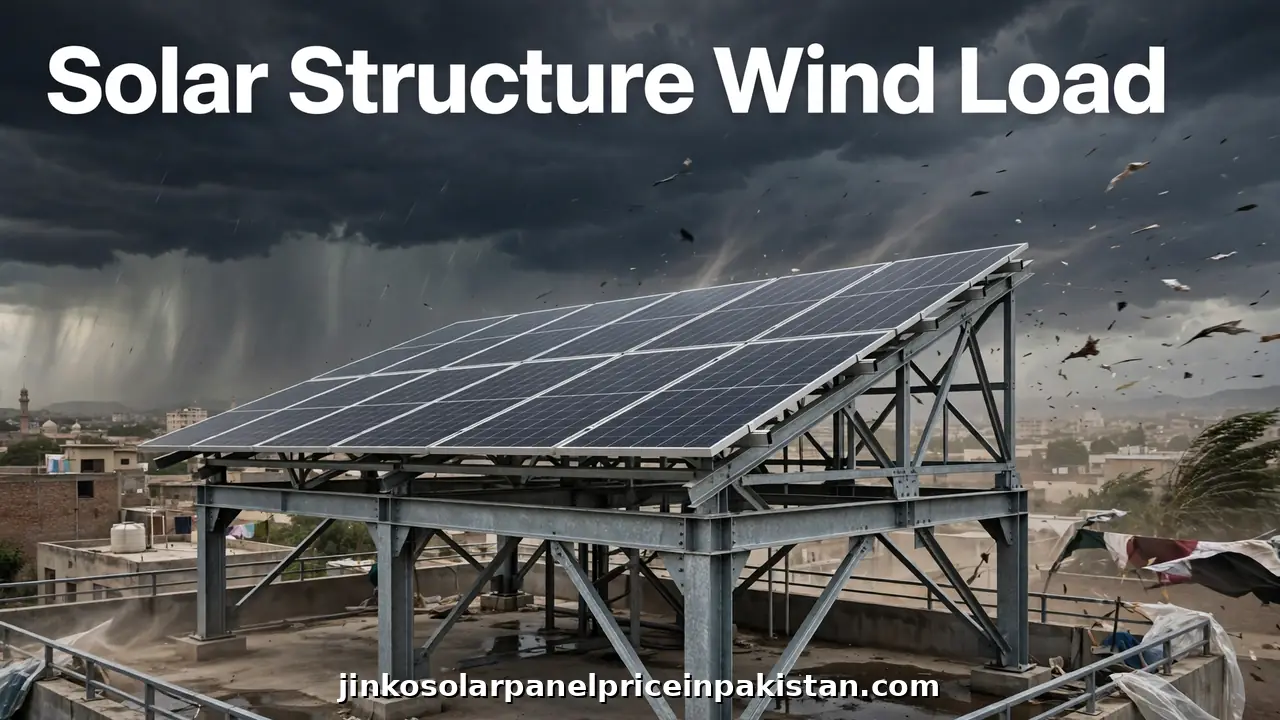
Solar Structure Wind Load: How Installers Should Design for Storms

Solar structure wind load design is the engineering behind keeping a solar array fixed to its roof or ground mount when a storm hits. It means sizing the rails, clamps, anchors, and foundations so the structure can resist the wind forces at your specific site — not just the average breeze, but the strongest gusts the location is likely to see. In Pakistan, where monsoon storms, coastal winds, and dust storms are a regular part of the year, wind load is not a detail to leave to guesswork.
What Is Wind Load on a Solar Structure?
Wind load is the force that moving air applies to a solar array and its mounting structure. A solar panel is a large, flat surface, and in wind it behaves much like a sail. It is not a single push in one direction. Wind creates pressure on the windward face, suction (uplift) on the leeward side, and a sideways drag that tries to slide the whole array.
For an installer, wind load design answers three practical questions: how much force will the wind apply at this site, which parts of the structure carry that force, and are those parts strong enough to hold?
Why Wind Load Design Matters in Pakistan
Pakistan’s weather gives solar structures a harder test than many installers expect: a structure that survives a calm winter can fail in the first monsoon storm if it was never designed for gusts.
Monsoon Storms and Sudden Gusts
The monsoon season brings intense, short-lived storms with strong gusts that arrive with little warning. A gust applies a sudden peak force that tests every bolt, clamp, and anchor at once, so good wind load design always plans for the gust, not the average.
Coastal Winds and Dust Storms
Coastal areas face stronger and more persistent winds than inland cities: open terrain near the sea offers nothing to slow the wind down, so arrays in Karachi and other coastal towns experience higher wind pressures than the same array inland. Dust storms across Punjab and Sindh carry the same gust problem inland, often with the hot, dry winds of early summer.
Elevated Structures Face Higher Loads
The risk grows further on elevated structures — the raised frames commonly built over rooftops in Pakistan to create shade and usable space below — which lift the panels higher into the wind and expose their undersides, increasing uplift.
How Wind Acts on a Solar Array
Wind attacks an array in three ways.
Uplift: The Main Threat
Uplift is the upward suction that tries to peel panels off their rails. As wind flows over a tilted panel, it speeds up and creates low pressure above the panel, while pressure builds underneath. The result is a lifting force — usually the largest wind force a rooftop array experiences. Uplift is what pulls clamps loose, bends rails, and, in the worst cases, lifts whole rows of panels off a roof.
Downforce and Sliding
Wind can also push down on an array, especially when it strikes the front face of a steeply tilted panel. Downforce is generally less dangerous than uplift because the structure and the roof can carry compression more easily than tension. The horizontal component of wind also tries to slide the array sideways. On a mechanically attached system, the anchors resist this; on a ballasted flat-roof system, sliding resistance comes from friction — and if the sliding force exceeds the friction, the whole array can shift and damage the roof membrane.
Edge and Corner Zones
Wind forces are not uniform across an array. The panels at the edges and corners of a roof experience much higher suction than the panels in the sheltered middle, because wind separates and accelerates as it flows over the roof edge. These edge and corner zones need closer anchor spacing, shorter rail spans, or extra clamps. An installer who spaces anchors evenly across the whole roof is under-designing the edges — exactly where failures start.
The Factors That Set Wind Load
Wind load is not a single number you can look up for all of Pakistan. It is calculated from several site-specific factors. The governing standard engineers use is ASCE 7, the American Society of Civil Engineers’ standard for minimum design loads, which sets out how to determine wind pressures from local wind speed, terrain, and building geometry. A clear explanation of how ASCE 7 applies to rooftop solar is available in this wind and snow load design guide.
Design Wind Speed and Exposure
Every location has a design wind speed — the strongest gust the structure is expected to face over its life. Wind pressure rises with the square of wind speed, so a modest increase in speed produces a large increase in force. The terrain around the building matters too: open, flat ground lets wind keep its full speed, while dense urban areas slow it down. A house facing open fields faces higher wind loads than an identical house in a crowded neighbourhood.
Panel Tilt Angle and Height
Steeper panels catch more wind. A panel tilted at a steep angle presents a larger face to the wind and generates more uplift and drag than the same panel mounted nearly flat — so the tilt that gives the best energy yield is not always the tilt that gives the lowest wind load. Height matters too: wind speed increases with height, so panels on tall elevated frames face stronger winds than panels mounted close to the roof surface. Low-profile mounting is naturally more wind-resistant than a tall, open frame.
Roof Zones, Parapets, and Row Spacing
Roof edges and corners see the highest pressures, and a parapet — the low wall around a flat roof’s edge — changes the airflow and can shift where the peak pressures occur. Installers should keep panels back from the roof edge and add extra attachments in the edge and corner zones. On ground mounts and flat roofs, the gap between rows also affects wind flow: tight rows shelter each other, while wide spacing lets the wind hit each row at full strength. Row spacing is usually set for shading, but it affects wind load too — one more reason to plan the layout with a proper solar panel row spacing plan rather than spacing rows by eye.
Rooftop vs Ground-Mount Wind Design
Rooftop and ground-mount arrays face the same wind, but the design answers are different, because what holds each one down is different.
Rooftop Systems: Attached or Ballasted
On a pitched roof, the array is usually mechanically attached: rails are bolted through the roof into the rafters or trusses, creating a continuous load path from the panel clamp down to the building frame. This is the most wind-resistant option, because the building itself carries the uplift — but the roof penetrations must be properly flashed and waterproofed. On a flat roof, installers often use ballasted systems, where concrete blocks hold the array down by weight. These are simpler to install, but the ballast must be calculated for the site’s wind load; in high-wind locations, a hybrid approach with some mechanical attachments is often safer.
Ground-Mount Systems: Foundations Carry the Load
A ground-mount array has no building to anchor to, so the foundation does all the work. Wind uplift tries to pull the posts out of the ground, and the foundation must resist that pull-out force. Concrete piers, helical piles, driven steel piles, and ballast blocks each resist uplift differently, and the right choice depends on the soil and the wind exposure. Our ground-mount solar foundation guide explains how to choose between them. A foundation designed only to hold the array’s weight will fail in uplift first.
What Installers Should Check in a Wind-Resistant Design
A wind-resistant solar structure is a system, not a single strong part. Every link in the chain matters, from the panel clamp to the foundation.
- Continuous load path: Every connection — clamp to rail, rail to post, post to anchor, anchor to roof or foundation — must carry the design wind force. One weak connection breaks the whole chain.
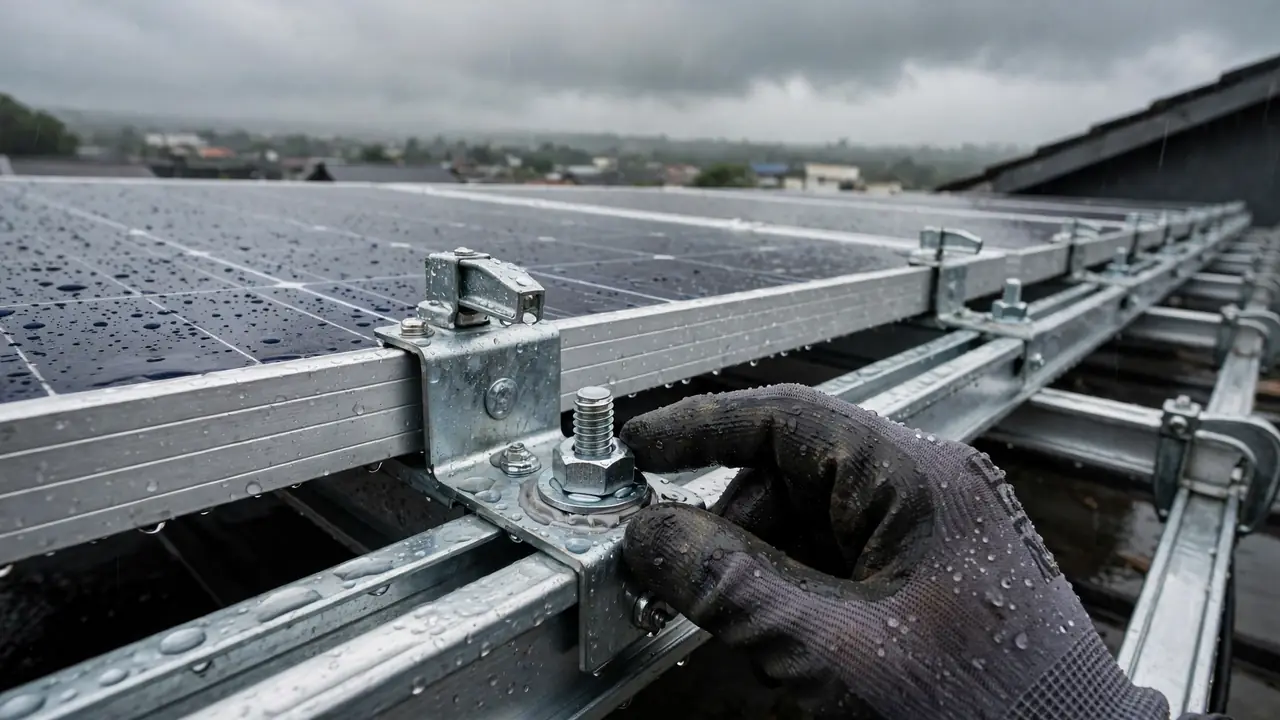
- Rail spans and clamp spacing: Shorter spans and closer clamps in the edge and corner zones, where suction is highest. Manufacturer load tables state the maximum span for a given wind load — follow them, do not guess.
- Anchor pull-out strength: On rooftops, anchors must be fixed into structural members (rafters or trusses), not just into the roof deck. On weak or old roofs, check the roof’s condition first — see our guide to installing solar panels on a weak roof.
- Foundation sizing: For ground mounts and elevated structures, the foundation must resist uplift, not just weight. Soil type, pier depth, and pile length all affect pull-out resistance.
- Corrosion protection: Hot-dip galvanized steel and anodized aluminium resist the corrosion that slowly weakens a structure in Pakistan’s humid summers and coastal air. A structure that was safe when new can become unsafe as it rusts.
- Manufacturer load tables and engineer review: Reputable racking manufacturers publish wind load ratings for their rails, clamps, and anchors — the installer should show the chosen hardware is rated for the site’s design wind load. For large arrays, tall elevated structures, and coastal sites, a structural engineer should review the design; the cost of a review is small compared with the cost of a failed structure.
Common Wind-Design Mistakes to Avoid
Most wind failures are not caused by freak weather. They are caused by ordinary design mistakes that a storm exposes.
- Designing for average wind instead of gusts: Peak gust forces are what break structures. Designing for the average is designing to fail.
- Ignoring the edge and corner zones: Even anchor spacing across the whole array leaves the edges under-designed, and failures start at the edges.
- Too steep a tilt on an elevated structure: A steep tilt on a tall frame multiplies uplift. Keep the tilt as low as the energy design allows, or strengthen the structure to match.
- Guessing ballast weight: Ballast that is not calculated for the site’s wind load is a guess, and a wrong guess lets the array slide or lift in a storm.
- Anchoring into the roof deck: Screws into thin decking pull out easily. Anchors belong in rafters or trusses.
- Skipping corrosion protection: A structure is only as strong as its weakest, rustiest bolt. Galvanized or stainless fixings are not optional in coastal or humid areas.
How to Check Your Existing Structure Before Storm Season
If your solar system is already installed, a short inspection before the monsoon season can catch wind-related problems while they are still cheap to fix. Walk the array and check the following, and ask your installer to fix anything you find.

- Every bolt, clamp, and nut is tight — none loose, missing, or backed out.
- No rails are bent or cracked, and no panels have lifted at the corners or edges.
- Ballast blocks (on flat-roof systems) are all in place, none cracked or shifted.
- Steel posts and fixings show no serious rust, especially at the base and at bolt holes.
- Ground-mount foundations are level and plumb, with no tilting posts, cracked concrete, or soil erosion around the footings.
- Roof penetrations are sealed, with no water stains below the array, and the structure is earthed properly — confirm the earthing with our solar panel earthing and grounding guide.
Loose clamps, rusted bolts, or a tilting post are the exact failure points that monsoon gusts exploit — a single afternoon of repairs can save the whole array.
Frequently Asked Questions (FAQs)
What is wind load on a solar structure?
Wind load is the force that moving air applies to a solar array and its mounting structure: pressure on the windward face, suction (uplift) on the leeward side, and a sideways drag that tries to slide the array. It is the main structural force a mounting system must be designed to resist.
Why is wind load design important for solar panels in Pakistan?
Pakistan’s monsoon storms bring sudden gusts, coastal areas face persistent strong winds, and dust storms hit inland cities. A structure designed only for average wind can fail in the first big storm, so wind load design protects the panels, the roof, and the whole investment.
What is wind uplift, and why is it the biggest risk?
Uplift is the upward suction created as wind flows over a tilted panel — low pressure above the panel and higher pressure below it. It is usually the largest wind force on a rooftop array, and it is what pulls clamps loose, bends rails, and can lift whole rows of panels off a roof. Every anchor, clamp, and rail connection exists mainly to resist it.
Do solar panels need to be designed for monsoon storms?
Yes. Monsoon gusts apply sudden peak forces that test every bolt, clamp, and anchor at once, so the design should plan for the gust, not the average wind speed. A short inspection of bolts, clamps, ballast, and foundations before the monsoon season catches wind-related problems while they are still cheap to fix.
What is the difference between ballasted and mechanically attached solar mounting?
A mechanically attached system is bolted through the roof into the rafters or trusses, creating a continuous load path to the building frame — the most wind-resistant option, but it needs roof penetrations that must be waterproofed. A ballasted system uses concrete blocks to hold the array down by weight, with no roof penetrations, but the ballast must be calculated for the site’s wind load or the array can slide or lift in a storm.
How does panel tilt angle affect wind load?
Steeper panels catch more wind. A panel tilted at a steep angle presents a larger face to the wind and generates more uplift and drag than the same panel mounted nearly flat. The tilt that gives the best energy yield is not always the tilt that gives the lowest wind load, and steep tilts on tall elevated structures need a stronger design.
How can I check my solar structure before storm season?
Check that every bolt, clamp, and nut is tight, no rails are bent or cracked, no panels have lifted at the corners, ballast blocks are in place, steel posts show no serious rust, and ground-mount foundations are level with no tilting posts or cracked concrete. Also confirm roof penetrations are sealed and the structure is earthed properly. Fix anything you find before the storm season.