
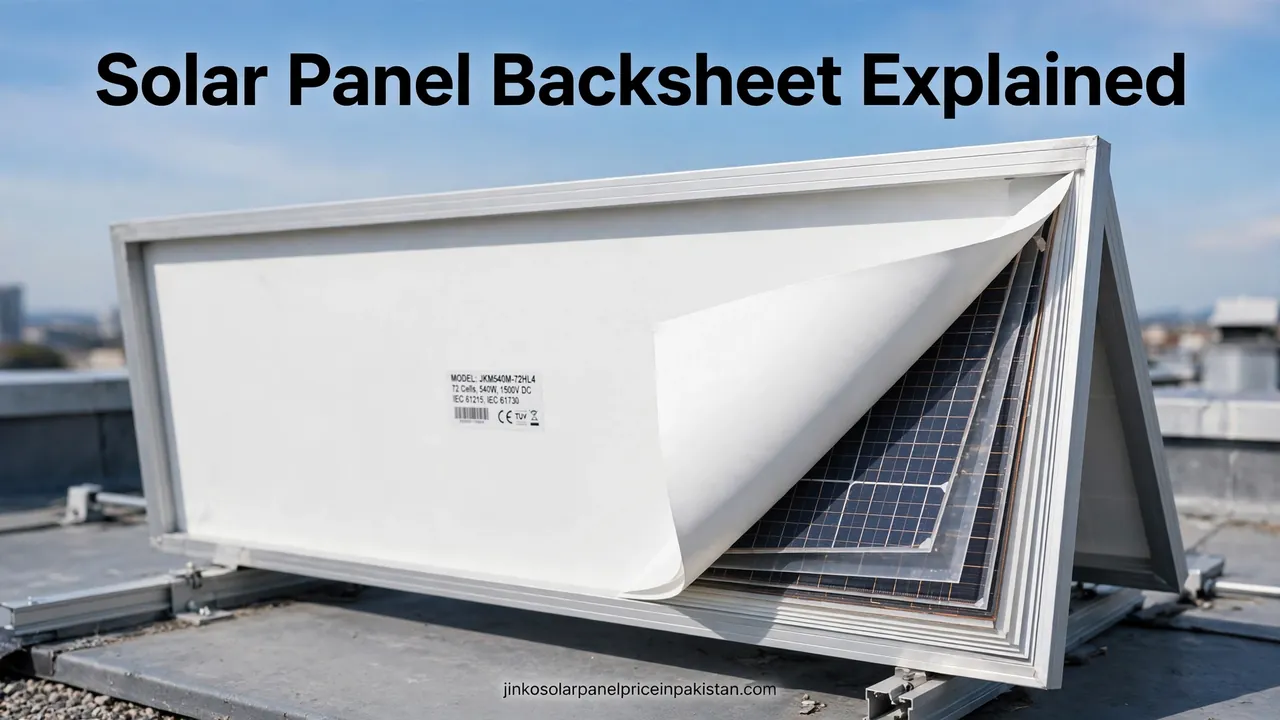
Solar Panel Backsheet Explained: Types and Importance

Solar panel backsheet explained in one line: the backsheet is the tough, multi-layer polymer film that forms the rear skin of a solar panel. It is the white (sometimes black or transparent) layer you see when you look at the back of a panel, and it protects the solar cells inside from moisture, ultraviolet radiation and physical damage while providing electrical insulation. Although buyers rarely ask about it, backsheet quality has a direct say in how long a panel keeps producing power on a Pakistani rooftop.
In this guide, you will learn what a backsheet does, how its three-layer structure works, the differences between white, black, transparent and glass backsheets, the failures to watch out for, and how to check backsheet quality before you buy a panel.
What Does a Solar Panel Backsheet Do?
A solar panel is a sealed sandwich: glass on the front, encapsulant and silicon cells in the middle, and the backsheet at the rear. The U.S. Department of Energy describes this module assembly as a laminated stack in which a tough polymer backsheet — or a second sheet of glass — closes the rear of the module and makes it waterproof. That rear layer carries four jobs that matter for the life of your system:
- Moisture barrier. Rain, humidity and morning dew constantly attack the back of a roof-mounted panel. The backsheet blocks water vapour from reaching the cells and electrical ribbons, where corrosion starts.
- Electrical insulation. The cells and copper ribbons operate at hundreds of volts. The backsheet’s dielectric layer keeps that voltage safely away from the frame, the mounting structure and anyone touching the array.
- UV protection. Reflected and scattered ultraviolet light hits the rear of the panel all day. The backsheet’s outer layer absorbs this punishment so the encapsulant and cells do not.
- Mechanical protection. Handling during transport, installation knocks, wind-borne dust and thermal expansion all stress the panel. The backsheet adds a flexible, abrasion-resistant skin that holds the laminate together.
If the backsheet fails, the cells are exposed — and that is when degradation accelerates and warranty claims begin.
How a Backsheet Is Built: The Three-Layer Structure
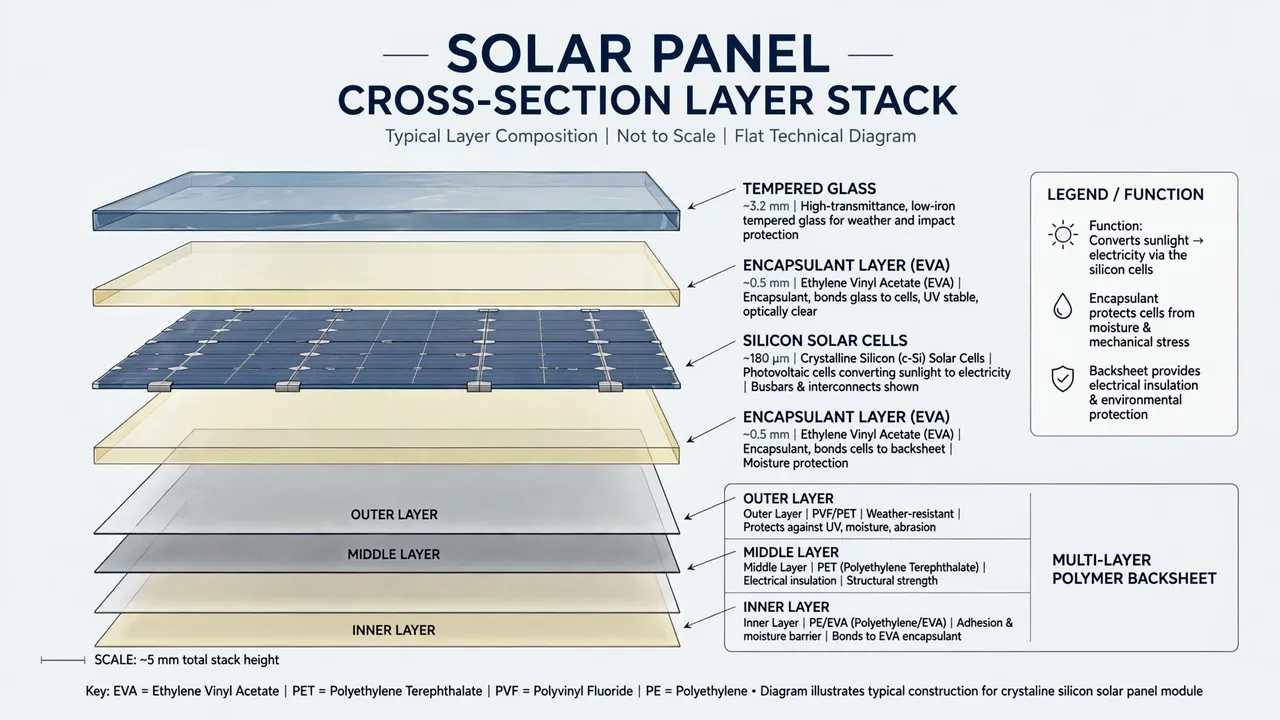
Most backsheets are not a single film but three bonded layers, each with a job:
- Outer layer (weather side). Faces the sky on the rear of the panel. It carries the UV and weather-resistance load — this is where fluoropolymer films like Tedlar (PVF) or Kynar (PVDF), or a UV-resistant coating, sit.
- Middle layer (core). Usually a PET (polyester) film. It provides mechanical strength and the main electrical insulation of the laminate.
- Inner layer (bonding side). Bonds to the encapsulant (typically EVA) that holds the cells. It is surface-treated so the laminate sticks together permanently during the lamination oven process.
Industry shorthand names these constructions by their layer chemistry: TPT (Tedlar–PET–Tedlar), KPK (Kynar–PET–Kynar) and TPE variants. The total thickness is typically around three-tenths of a millimetre — thin, but it must hold dielectric strength and weather resistance for the panel’s full warranted life.
Types of Solar Panel Backsheets
Backsheet types are usually grouped by construction and by the colour or finish you see on the rear of the panel.
White Backsheets
White is the traditional and still most common backsheet colour. The white finish reflects a portion of the sunlight that passes through the gaps between cells back toward the cells, giving the panel a small extra efficiency gain — light gets a second chance to be converted. White also radiates heat well, which helps keep cell temperature down on hot summer days. For standard rooftop systems in Pakistan, white remains the safe default choice.
Black Backsheets
Black backsheets exist mainly for looks: paired with a black frame and dark cells they create the “all-black” panel that many homeowners prefer for curb appeal. Black absorbs more heat than white, which can slightly raise cell temperature and trim output, though modern high-reflectivity black formulations have narrowed the gap. Choose black for aesthetics on visible roofs; choose white when maximum energy yield is the priority.
Transparent Backsheets
Transparent backsheets let light pass through the rear of the module. They are used on bifacial panels, whose cells generate electricity from both faces — the front from direct sunlight, the rear from light reflected off the ground or roof. A transparent backsheet is far lighter than a second sheet of glass, which makes bifacial panels practical on ordinary roof structures. They pair best with bright, reflective surfaces underneath (light-coloured roofs, concrete, or ground with high albedo); on a dark roof, the rear-side gain shrinks and a standard white-backsheet panel is usually the better value.
Glass Backsheets (Glass-Glass Modules)
Some panels replace the polymer backsheet entirely with a second sheet of tempered glass. These glass-glass (dual-glass) modules eliminate the polymer rear layer, which removes a whole class of backsheet failure modes — no delamination, no cracking, no chalking. They are heavier and typically costlier to transport and mount, and you will most often find them in utility-scale and commercial projects rather than on residential roofs.
White vs Transparent Backsheet: Which Is Better?
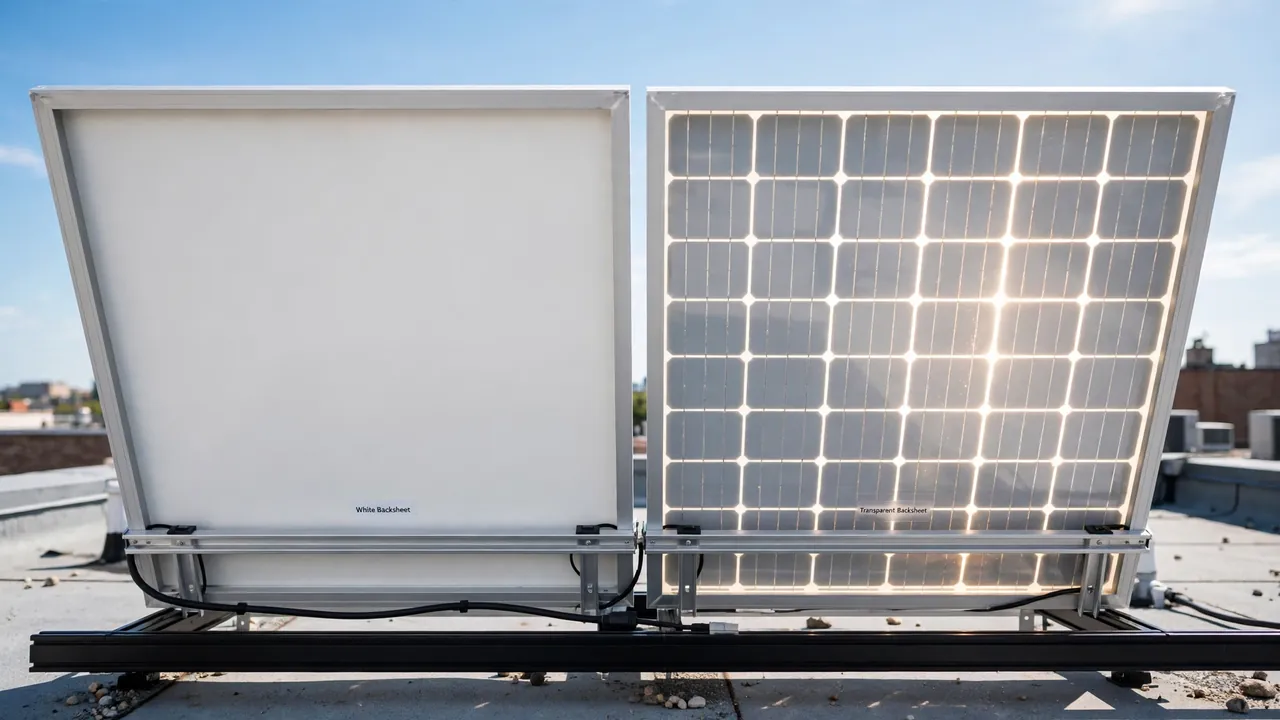
Neither is universally better — the right choice depends on the installation:
- White backsheet suits standard monofacial panels on typical roofs. It is the proven, lowest-risk option: decades of field history, a small reflectivity bonus, and good thermal behaviour.
- Transparent backsheet suits bifacial panels mounted above reflective surfaces. Where the rear side can actually see light — elevated structures, light roofs, open ground — the extra rear-side generation can be meaningful. Where it cannot, the transparent backsheet adds cost without adding energy.
A common mistake is buying a bifacial panel with a transparent backsheet and then mounting it flat on a dark roof a few centimetres above the surface. In that position the rear face sees almost no light, so the buyer pays the bifacial premium and gets monofacial performance. Match the backsheet to the mounting reality, not the brochure.
Common Backsheet Problems and Failures
Backsheet failures are among the most documented long-term reliability issues in photovoltaics. The common modes:
- Delamination. The backsheet layers separate from each other or from the encapsulant, usually after years of heat and UV cycling. Air and moisture enter the laminate and corrosion follows.
- Cracking. Fine cracks appear in the outer layer, especially in formulations with weak UV resistance. Cracks are entry points for moisture.
- Yellowing and chalking. The white surface discolours or powders with age. Cosmetic at first, it signals polymer degradation and usually comes with falling mechanical strength.
- Bubbling. Trapped gases or moisture form blisters between the layers, often where adhesion was poor or the panel ran very hot.
Pakistan’s combination of intense UV, high summer temperatures and seasonal humidity is a genuine stress test for backsheet materials, which is why the outer-layer chemistry — fluoropolymer versus plain coated PET — matters more here than in mild climates. This is also why the panel type decision should go hand in hand with a check of what is protecting the rear.
How Backsheet Quality Affects Panel Lifespan and Performance
A healthy backsheet is invisible to the system owner: the panel simply produces what its degradation rate promises, year after year. A failing backsheet breaks that contract. Moisture ingress corrodes cell ribbons and solder joints, raising series resistance and cutting output; in severe cases it creates safety issues as insulation resistance falls. Many warranty disputes over “underperforming panels” trace back not to the cells but to the rear skin that was supposed to protect them.
The practical takeaway: two panels with identical wattage and cell technology can age very differently if their backsheets are built to different standards. Backsheet quality is a hidden differentiator between tiers of panels — and one reason established brands publish detailed material specifications while no-name panels often say nothing at all.
How to Check Backsheet Quality Before Buying a Panel
You cannot X-ray a backsheet in the shop, but you can run practical checks:
- Read the datasheet. Reputable brands state the backsheet construction (TPT, KPK, coated, or glass) and the certifications the module passed. A datasheet that says nothing about the backsheet is a warning sign.
- Check certifications. Panels certified to IEC 61215 / 61730 have passed damp-heat, UV and thermal-cycling sequences that stress the backsheet. Ask the dealer for the actual certificate, not just the claim.
- Inspect the rear surface. The backsheet should be smooth, evenly coloured and firmly bonded with no bubbles, wrinkles or lifted edges around the junction box. Press gently — a well-laminated backsheet does not flex away from the cells.
- Ask about the warranty’s fine print. A long performance warranty means little if the product warranty on materials — the part that covers backsheet failure — is short or handled by an importer who may disappear. Confirm who honours claims in Pakistan: the brand, the distributor, or the dealer.
- Match the backsheet to the site. Coastal humidity, desert heat and dusty rooftops each punish different weaknesses. In hot, high-UV regions, fluoropolymer outer layers have the strongest track record.
Frequently Asked Questions (FAQs)
What is the backsheet of a solar panel?
The backsheet is the multi-layer polymer film that forms the rear skin of a solar panel. It blocks moisture, provides electrical insulation, resists UV radiation and protects the solar cells from physical damage.
What are the different types of solar panel backsheets?
The main types are white backsheets (the standard choice), black backsheets (for all-black panels), transparent backsheets (for bifacial panels), and glass backsheets used in glass-glass modules. By construction they are named TPT, KPK or TPE after their layer materials.
Which is better: a white or a transparent backsheet?
White is best for standard rooftop systems: it reflects some light back to the cells and has decades of proven field history. Transparent is better only for bifacial panels mounted above reflective surfaces, where the rear face can actually receive light. On a dark or flat-mounted roof, white wins.
Can a damaged solar panel backsheet be repaired?
A damaged polymer backsheet generally cannot be repaired reliably in the field — patching films and sealants are temporary at best because the backsheet must stay waterproof and electrically insulating for decades. If a panel’s backsheet is cracked or delaminating, a warranty claim is the correct route.
What causes a solar panel backsheet to fail?
Most failures come from long exposure to UV and heat, which breaks down weaker polymer formulations, plus moisture getting through poor seals, and manufacturing defects such as weak lamination adhesion. Intense sun and high temperatures — like Pakistan’s summers — accelerate the process.
How long does a solar panel backsheet last?
A quality backsheet is built to last the panel’s full warranted life, typically 25 years or more. Cheaper coated films in harsh climates can start yellowing, chalking or cracking earlier, which is why the outer-layer material matters more in hot, high-UV regions.
Do all solar panels have a backsheet?
Almost all conventional panels do, but glass-glass (dual-glass) modules replace the polymer backsheet with a second sheet of tempered glass, removing an entire class of backsheet failure modes. Bifacial panels may use either a transparent polymer backsheet or rear glass.