
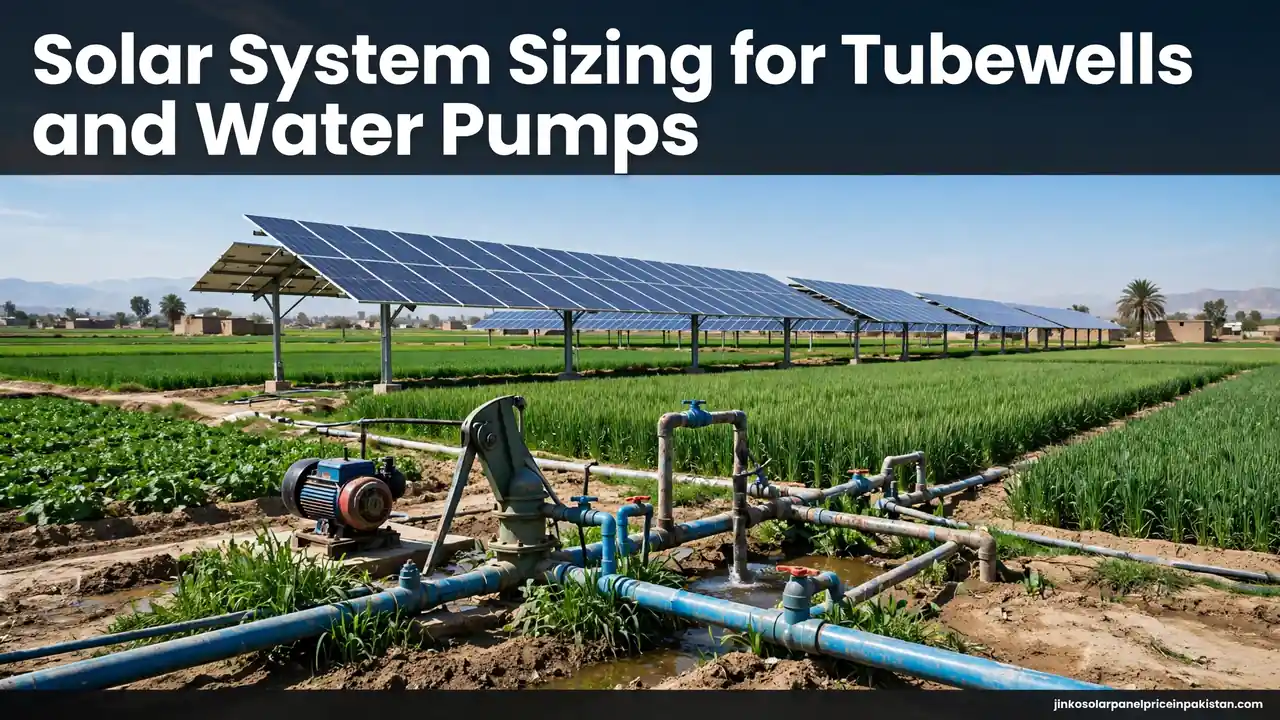
Solar System Sizing for Tubewells and Water Pumps

Sizing a solar system for a tubewell or water pump means matching four things: the pump’s wattage and starting surge, the daily water requirement, the total pumping head (bore depth plus lift and pipe friction), and the peak sun hours at your site. The standard method: convert the pump’s power draw and daily run hours into daily energy (kWh), divide by your peak sun hours for the panel array size with a safety margin, and choose an inverter that can handle the pump motor’s brief starting surge, not just its running watts.
This guide walks through the complete sizing process for solar-powered tubewells and water pumps in Pakistan, step by step, using only measurements you can take or read off your pump’s nameplate.
Why Tubewell Sizing Is Different From Home Sizing
Sizing solar for a house and sizing solar for a tubewell follow the same physics, but the priorities are almost reversed. A tubewell has one or two large motor loads running for a planned number of daylight hours, with the pump only needing power while the sun shines. That changes every design decision:
- One big motor, not many small loads: A tubewell has one dominant load — the pump motor — which decides the entire system size. Get the pump wrong and everything downstream is wrong.
- Daytime operation: Irrigation pumps run during the day, when panels produce directly. This is why most solar tubewells work without batteries at all — the sun is the power source and the water tank is the storage.
- Water storage replaces battery storage: Instead of storing electricity in batteries, the system stores water in a tank or reservoir. Pumping into a tank on sunny days and irrigating from it later is far cheaper and more reliable than cycling a battery bank daily.
- Motor starting surge dominates: A pump motor briefly draws several times its running current when it starts. An inverter that comfortably handles the running watts can still trip if it cannot ride through that surge — the single most common cause of under-sized solar tubewell systems.
If you are new to sizing math, our home electricity load calculation guide covers the wattage-to-units method this guide builds on.
The Four Numbers You Need Before Any Calculation
Before touching any formula, collect these four facts. Every one of them comes from your site and your pump, not from guesswork:
1. Pump power (HP or watts)
The pump’s nameplate lists its rated power, usually in horsepower (HP) for tubewells in Pakistan or in watts for small DC pumps. One horsepower equals 746 watts, so a 5 HP pump draws roughly 3,730 watts (3.73 kW) while running. Write down both the running power and — from the motor’s datasheet or your installer — the starting method and surge behavior, because that number decides the inverter, not the panel count.
2. Daily water requirement (litres)

How much water must the system move each day? For irrigation this depends on crop type, soil, season and field area; for livestock or household supply it is a fixed daily figure. Express it in litres (or cubic metres) per day. This number, together with the head, decides how many hours the pump must run — and the run hours decide the daily energy demand.
3. Total pumping head (metres)
Total dynamic head is the full resistance the pump must push against: the static water level in the bore, the drawdown while pumping, the vertical lift from the wellhead to the tank or field, the friction losses in pipes and fittings, and any pressure the irrigation method needs at the outlet. Drip irrigation needs modest pressure; sprinklers need more. Underestimating head is a classic reason pumps underdeliver, because a pump that cannot reach its rated head simply moves less water than its label promises.
4. Peak sun hours at your site
Peak sun hours are the equivalent hours of full-strength sunlight your location receives in a day — the figure panel output math is built on. Most of Pakistan receives strong sun for roughly five peak sun hours on a typical day, with winter lower and summer higher. Use a conservative average for your area rather than the best summer day, because the system must still pump enough water in the months you need it most.
How Much Power a Tubewell Pump Actually Uses
A pump consumes power in two ways, and both must be sized for:
- Running watts: The steady power draw while the pump is moving water. For a 5 HP pump this is about 3.7 kW. Multiply by daily run hours to get daily energy — a 5 HP pump running 6 hours consumes roughly 22 kWh of energy per day.
- Starting surge: In the first seconds of startup, an induction motor draws a multiple of its running current. Direct-on-line starting can demand several times the running watts; soft starters and variable frequency drives (VFDs) tame that surge dramatically. Never size the inverter from running watts alone.
This surge behavior is also why pump type matters. A surface pump draws from shallow sources (under about 8 metres of suction) and is easy to service, while a submersible pump sits inside the bore and is the standard choice for deeper wells. Electrically, the bigger divide is between DC and AC pumps, covered below.
Step-by-Step: Sizing the Solar System for Your Tubewell
With the four numbers in hand, work through these five steps in order:
Step 1 — Convert water need into pump run hours
Find your pump’s flow rate at your head — litres per minute from the pump curve at your total dynamic head, not the headline figure on the box (pumps deliver less at higher head). Divide the daily water requirement by the flow rate to get the hours the pump must run. Size the run hours with a margin for cloudy days rather than for the perfect clear day.
Step 2 — Calculate daily energy demand
Multiply the pump’s running watts by the daily run hours and divide by 1,000 to get kilowatt-hours (units) per day. This single figure — daily kWh — is what everything else is sized against, the same way a home load assessment anchors a rooftop system.
Step 3 — Size the panel array
Divide the daily energy demand by your peak sun hours to get the required array output in kilowatts, then add a 20–30 percent margin for dust, heat, wiring losses and cloudy spells. Panels rarely produce their rated output for the full solar day, so this margin is not optional — it is what keeps the pump running at useful speed on ordinary days rather than only on perfect ones. Our guide on how many solar panels you need explains the array math in more detail if you want to double-check the method.
Step 4 — Size the inverter or pump controller
For AC pumps, the inverter or solar pump drive must carry the continuous running watts and the motor’s starting surge. Choose equipment rated for the surge, and confirm on the datasheet that it can start your specific motor type — a VFD or soft starter lets a smaller drive start a larger motor safely. Our solar inverter buying guide for Pakistan explains inverter datasheets; for pumps, the surge rating is the line that matters most. Most agricultural pumps in Pakistan run on three-phase power, so confirm phase compatibility — see our single-phase vs three-phase inverter guide if you are unsure.
Step 5 — Match the array to the controller
The panel array’s voltage and current must sit inside the controller’s or inverter’s acceptable MPPT window, including on hot afternoons when panel voltage sags and on cold mornings when it peaks. Arrange panels in series and parallel strings to land comfortably in the middle of that window — our explainer on what MPPT means in a solar inverter covers this in plain language.
AC vs DC Pumps for Solar Tubewells
There are two electrical architectures for solar pumping, and the choice shapes the whole system:
- DC solar pumps run directly off the panels through an MPPT controller, with no inverter in the middle. They are simpler and slightly more efficient, and they suit smaller systems — household boreholes, livestock watering, and small plots. The tradeoff is scale: above a few horsepower, DC options thin out and prices climb.
- AC pumps with a solar drive pair a standard AC motor (often three-phase) with a solar pump inverter or VFD that converts panel DC to variable-frequency AC. This is the standard architecture for agricultural tubewells in Pakistan because it handles the 5 HP, 7.5 HP and larger motors farmers actually use, and the VFD’s soft-start protects both the motor and the inverter from starting surge.
Rule of thumb: below about 2–3 HP, a DC pump with an MPPT controller is worth considering; at agricultural sizes, AC with a proper solar pump drive is the proven path. If the site also needs grid or generator backup, the AC route integrates more easily — our off-grid inverter guide covers backup configurations in depth.
The Role of Pump Controllers and VFDs
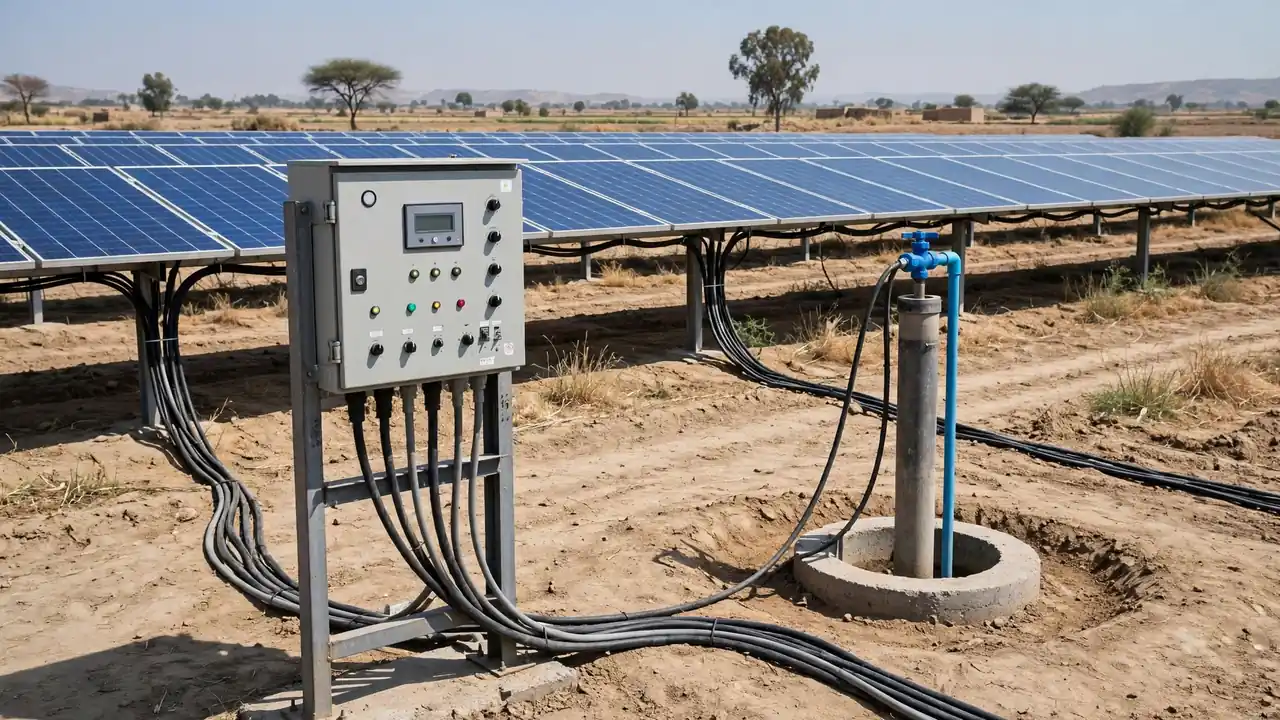
A dedicated solar pump controller or VFD does three jobs a plain inverter cannot do as well. First, it tracks the array’s maximum power point continuously, so pump speed follows the sun — full flow at midday, gentler flow at the edges of the day, rather than stalling every time a cloud passes. Second, it ramps the motor up gradually, removing the violent starting surge that trips ordinary inverters. Third, it protects the pump against dry running, over-voltage and under-voltage — the real killers of borehole pumps in the field.
For any tubewell-sized system, budget the controller as core equipment, not an accessory.
Water Storage vs Battery Backup
Most solar tubewells need no batteries at all, and adding them is usually the wrong answer. Batteries are expensive, wear out, and need maintenance — and a pump that runs only in daylight simply does not need nighttime electricity. Instead, size a water tank or reservoir to hold one to three days of the daily requirement. The panels pump water into the tank whenever the sun shines; irrigation draws from the tank whenever the crop needs it. This is the standard design taught in solar irrigation training worldwide, including the International Water Management Institute’s Training Manual on Solar Irrigation Pumps, which covers system sizing for South Asian agriculture.
Batteries only enter the picture for special cases: pumping needed strictly at night, or a hybrid site where the same system must also power the farmhouse after dark. For pure irrigation, the water tank is the battery — cheaper, simpler, and longer-lived.
Common Sizing Mistakes to Avoid
- Sizing the inverter from running watts only: The number one failure. The inverter must survive the motor’s starting surge, or use a VFD/soft starter to remove it.
- Ignoring pipe friction and drawdown in the head: Static depth is only part of the head. Add drawdown, pipe friction, elevation to the tank, and outlet pressure — or the pump will move far less water than expected.
- Using the headline flow rate: A pump rated at a shallow head delivers much less at a deep one. Read the flow at your actual total dynamic head on the pump curve.
- Sizing the array for the best summer day: The system must pump enough in the season you irrigate most. Use conservative peak sun hours and keep the 20–30 percent margin.
- Adding batteries “for safety”: For daytime irrigation, batteries add cost and failure points without helping. Put the money into the array margin and the water tank instead.
With the right size worked out, compare the solar system price in pakistan for tubewell setups and the solar panel price in pakistan on our daily-updated homepage tables to budget accurately.
Frequently Asked Questions (FAQs)
How do you size a solar system for a tubewell?
u003cpu003eWork in this order: note the pump’s running watts and starting surge, find the total pumping head (bore depth, drawdown, lift, pipe friction and outlet pressure), calculate daily water need in litres, convert that to pump run hours using the flow rate at your head, multiply watts by run hours for daily energy in kWh, divide by your peak sun hours for the array size with a 20-30 percent margin, and choose an inverter or solar pump drive rated for the starting surge.u003c/pu003e
What size inverter do I need for a tubewell pump?
u003cpu003eThe inverter must handle both the pump’s continuous running watts and its brief starting surge, which can be several times the running draw. Check the surge rating on the inverter’s datasheet against your motor type. A variable frequency drive (VFD) or soft starter ramps the motor up gently and removes most of the surge problem, which is why most solar pump drives for agricultural pumps include one.u003c/pu003e
Can a solar system run a 5 HP tubewell pump?
u003cpu003eA properly sized solar system can run a 5 HP tubewell pump, which draws roughly 3.7 kW while running. What matters is not just the horsepower but the total pumping head, the daily water requirement and the inverter’s ability to start the motor. Three-phase pumps need a three-phase solar pump drive.u003c/pu003e
Do solar tubewells need batteries?
u003cpu003eUsually not. Irrigation pumps run during the day when panels produce directly, so most solar tubewells store water in a tank or reservoir instead of storing electricity in batteries. A tank holding one to three days of water is cheaper, simpler and longer-lived than a battery bank. Batteries only make sense for night pumping or sites that also need household power after dark.u003c/pu003e
AC or DC pump — which is better for a solar tubewell?
u003cpu003eIt depends on pump size. DC solar pumps run directly from panels through an MPPT controller and suit smaller setups such as household boreholes, livestock watering and small plots. AC pumps paired with a solar pump drive or VFD are the standard choice for agricultural tubewells in Pakistan, because they handle the larger motors farmers actually use and their soft-starting protects the motor and inverter.u003c/pu003e
How many solar panels does a water pump need?
u003cpu003eThere is no fixed number: divide the pump’s running watts multiplied by daily run hours (your daily kWh) by your peak sun hours, then add a 20-30 percent margin. For example, a roughly 3.7 kW pump running 5 hours uses about 18.5 kWh per day, which at 5 peak sun hours points to an array in the 5 kW class before margin and losses are factored in.u003c/pu003e
What happens to a solar pump on cloudy days?
u003cpu003eA solar pump controller tracks the array’s maximum power point and slows the pump to match available sunlight, so on cloudy days the pump runs slower rather than stopping. A properly sized water tank covers these slower days, which is why storage tanks matter more than oversized arrays for keeping irrigation reliable.u003c/pu003e