
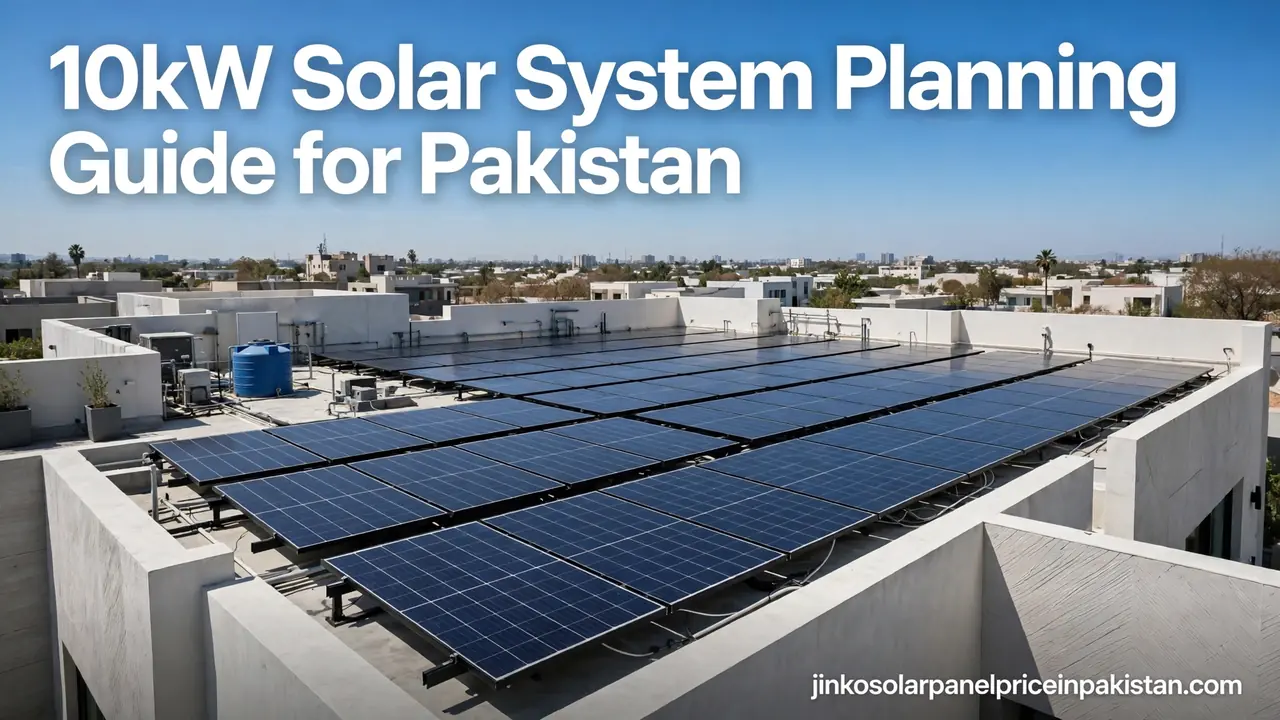
10kW Solar System Planning Guide for Pakistan

A 10kW solar system is one of the most popular choices for medium-to-large homes in Pakistan: it typically covers a household using roughly 35 to 50 units of electricity per day, needs about 17 to 19 solar panels and 40 to 55 square metres of shade-free roof, and pairs with a 10kW inverter (on-grid or hybrid depending on whether you want backup). Planning it well means getting five things right before you buy anything: your daily load, your panel count and layout, the right inverter type, your battery decision, and your net metering paperwork. This guide walks through each step so you can plan a 10kW system that actually fits your home.
Is a 10kW System the Right Size for Your Home?
System size should follow your electricity use, not the other way round. A 10kW array makes sense when your home consistently uses around 1,000 to 1,500 units a month. Typical fits include a double-storey house running two to three inverter air conditioners, a refrigerator, a water motor, and the usual fans and lights, or a home plus a small shop or office on the same connection.
If your bills are well below that range, a 10kW system will export most of its output, and a smaller system planned properly may serve you better. If you are above it, the 10kW plant will still help but will only cover part of your load. Before locking in the size, calculate your home’s electricity load from twelve months of bills, and add any appliances you plan to buy in the next two to three years. A system that lasts 20-plus years should be planned for your future load, not just today’s.
How Many Panels Make Up a 10kW System?
A 10kW system means 10,000 watts of panel capacity. The panel count is simple division: 10,000 divided by the wattage of the panel you choose. With common high-wattage panels this works out as follows:
- 585W panels: 10,000 / 585 = about 17.1, so 18 panels (rounding up keeps you at or above 10kW).
- 550W panels: 10,000 / 550 = about 18.2, so 19 panels.
- 610W panels: 10,000 / 610 = about 16.4, so 17 panels.
Higher-wattage panels mean fewer panels and less mounting hardware, but each panel is physically larger, so the total roof area stays roughly similar. Mixing different wattages in one array is bad practice: keep every panel in the system identical so the strings stay balanced. For a deeper walkthrough of the counting method, see our guide on how many solar panels your home needs.
Roof Space, Layout and Shading Plan

Allow roughly two and a half square metres of roof per panel, including spacing between rows and clearance from edges, vents and water tanks. For 17 to 19 panels that means about 40 to 55 square metres of genuinely usable roof, not just total roof area. A shaded square metre is not usable, so the shading survey comes before the layout, not after.
Three layout rules matter at 10kW scale:
- Orientation and tilt: face panels toward true south with a tilt close to your city’s latitude (roughly 24 to 32 degrees across Pakistan) for the best year-round output.
- Row spacing: leave enough gap between rows that the front row never shades the row behind it in winter, when the sun sits lower. Tight rows are the most common layout mistake on flat roofs.
- Obstruction mapping: water tanks, stair heads, parapet walls and neighbouring buildings all cast shadows that move through the day. Map them at morning, noon and evening before fixing the layout.
If your usable roof falls short, an elevated structure can free up space above tanks and clutter, but it adds wind-load and cost considerations that your installer should engineer properly.
Choosing the Inverter: On-Grid vs Hybrid at 10kW
The inverter is the brain of the system, and at 10kW the choice matters more than at smaller sizes because the equipment is a bigger share of the project. Two decisions come first:
On-grid or hybrid? An on-grid inverter is simpler and pairs with net metering: it feeds daytime surplus to the grid and you draw at night. A hybrid inverter does that plus charges batteries, giving you backup during load shedding. If outages are frequent in your area, or you plan to add batteries later, choosing a hybrid inverter now is far cheaper than replacing an on-grid unit later. Our on-grid vs hybrid comparison breaks down the trade-offs in detail.
Inverter capacity: pair the 10kW array with a 10kW inverter for a straightforward match. Some installers slightly undersize the inverter relative to the panels because panels rarely hit their rated output; whatever the approach, the inverter must be rated to handle the array’s maximum DC input and your home’s peak AC load. Check the inverter’s specification sheet rather than trusting a verbal promise. For the full selection method, read our solar inverter buying guide for Pakistan.
Also confirm the phase of your electricity connection early. Larger systems may need a three-phase connection and your distribution company’s approval for the inverter size you plan to connect; sorting this after purchase causes expensive delays.
Battery and Backup Planning for a 10kW System

Batteries are optional with net metering but essential if you want power during outages. Size the battery bank from your night-time and outage-window load, not from the 10kW figure: list what must keep running (fans, lights, fridge, Wi-Fi, one AC) and for how many hours, then size the storage to that. A common mistake is buying a battery bank the array cannot recharge on a winter day, so check that your planned panels produce enough surplus beyond daytime use to refill the batteries daily.
Lithium (LiFePO4) batteries suit daily cycling with deeper usable capacity and longer life, while tall tubular batteries cost less upfront but need water maintenance and shallower cycling. Our battery buying guide for solar systems compares the types and the sizing math in full. If batteries are a “maybe later” item, still buy the hybrid inverter now so the upgrade only needs batteries, not a new inverter.
Wiring, Protection and Mounting Checklist
The components between the panels and your switchboard decide how safe and durable the system is. Confirm each of these in your quotation:
- Structure: hot-dip galvanised or aluminium mounting structure, designed for your roof type and local wind conditions, with proper anchoring, not just dead weight.
- DC wiring: UV-rated solar DC cable of adequate cross-section for the string currents, run in conduit or trunking, with genuine MC4 connectors.
- Protection: DC and AC breakers or isolators, a surge protection device (SPD) on both sides, and proper earthing of the structure, inverter and panels.
- Monitoring: Wi-Fi or app-based monitoring so you can see daily production and catch a dead string early. A 10kW system with one failed string can lose a sixth of its output silently.
Ask the installer to walk you through the single-line diagram before work starts; if they cannot explain the protection scheme clearly, that is a red flag regardless of the brand names on the quote.
Plan Net Metering Before You Buy
Net metering turns your daytime surplus into bill credit, which is what makes a 10kW system financially sensible for many homes. But the paperwork has lead time, so start it alongside the purchase, not after installation. You will typically need your latest bills, CNIC copy, property documents and the installer’s technical details, and your distribution company will inspect the installation before the bidirectional meter goes in. Confirm the sanctioned load on your connection covers a 10kW inverter; if not, a load extension may be needed first. Getting the meter process moving early means the system starts earning credit from day one instead of sitting idle waiting for approval.
Common 10kW Planning Mistakes to Avoid
- Sizing from a guess: “10kW sounds right” is not a plan. Twelve months of bills decide the size.
- Ignoring shade: one shaded string drags down the whole array’s output; the shading survey is non-negotiable.
- Wrong inverter type: buying on-grid to save money, then paying again for a hybrid when outages bite.
- No expansion headroom: leaving no roof space or inverter capacity for the extra panels you will want in two years.
- Skipping the paperwork: a 10kW system without net metering approval wastes much of its daytime output.
- Chasing the cheapest quote: at 10kW, undersized cables, weak structures and missing protection cost far more than they save.
Frequently Asked Questions (FAQs)
Is a 10kW solar system enough for a full house in Pakistan?
A 10kW system suits a home using roughly 1,000 to 1,500 units a month, such as a double-storey house with two to three inverter air conditioners, a refrigerator, a water motor and normal lighting and fans. If your bills are well below that, a smaller system may fit better; the decision should come from twelve months of bills, not a guess.
How many solar panels are in a 10kW system?
Divide 10,000 watts by the panel wattage and round up. With 585W panels you need 18 panels, with 550W panels you need 19, and with 610W panels you need 17. Keep every panel identical so the strings stay balanced.
How much roof space does a 10kW system need?
Allow roughly two and a half square metres per panel including row spacing and clearances, which works out to about 40 to 55 square metres of shade-free, usable roof for 17 to 19 panels. Shaded areas, water tanks and vents do not count as usable roof.
What size inverter do I need for a 10kW solar system?
Pair the 10kW array with a 10kW inverter rated for the array’s maximum DC input and your home’s peak AC load. Choose on-grid if you only want net metering savings, or hybrid if you want backup during outages or plan to add batteries later, since upgrading from on-grid to hybrid later costs far more.
Can a 10kW system run air conditioners?
Yes, a 10kW system can run air conditioners during sunshine hours, provided the inverter and wiring are sized for their starting and running load. Inverter-type ACs are easier on the system than fixed-speed ones. Night-time AC use needs either batteries or grid supply.
Does a 10kW system need batteries?
Not necessarily. With net metering, daytime surplus becomes bill credit and batteries are optional. Add batteries only if you need power during outages, and size the bank from your night-time load rather than from the 10kW figure.
Can I expand a 10kW system later?
Yes, if you plan for it: leave free roof space, choose an inverter with spare capacity, and use a hybrid inverter so batteries can be added without replacing equipment. Retrofitting expansion into a system planned without headroom is much harder.