
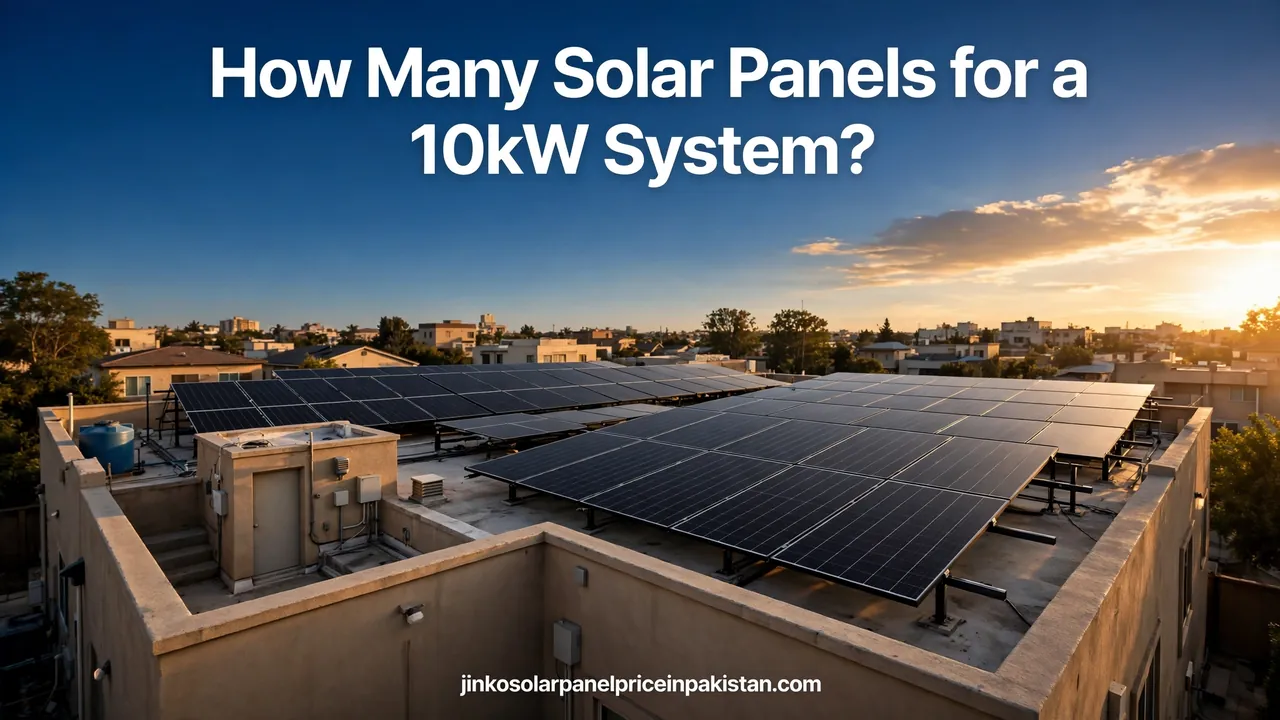
How Many Solar Panels Are Needed for a 10kW System?

The 10-Second Formula for a 10kW System
Every panel-count calculation for a 10kW system uses the same formula:Number of panels = 10,000 ÷ panel wattage, rounded UPFor example, with 585W panels: 10,000 ÷ 585 = 17.09, which rounds up to 18 panels. The rounding rule matters — panels only come in whole units, and the extra fraction covers real-world wiring losses, dust accumulation and the small gap between a panel’s lab-tested datasheet rating and what it delivers on your roof. Rounding down is never acceptable: 17 panels at 585W would give you 9,945W of nameplate capacity, leaving you short of a true 10kW array. If you are still working out which system size fits your home, our general guide on how many solar panels you need for your home walks through the full sizing method.Panel Count Table: 10kW System by Panel Wattage
Panel wattages keep climbing — a decade ago 300W was standard, today most Tier-1 panels sold in Pakistan sit between 545W and 650W. Here is the exact count for each common wattage:- 545W panels: 10,000 ÷ 545 = 18.35 → 19 panels
- 550W panels: 10,000 ÷ 550 = 18.18 → 19 panels
- 580W panels: 10,000 ÷ 580 = 17.24 → 18 panels
- 585W panels: 10,000 ÷ 585 = 17.09 → 18 panels
- 600W panels: 10,000 ÷ 600 = 16.67 → 17 panels
- 615W panels: 10,000 ÷ 615 = 16.26 → 17 panels
- 620W panels: 10,000 ÷ 620 = 16.13 → 17 panels
- 640W panels: 10,000 ÷ 640 = 15.63 → 16 panels
- 645W panels: 10,000 ÷ 645 = 15.50 → 16 panels
- 650W panels: 10,000 ÷ 650 = 15.38 → 16 panels
Why Two 10kW Quotes Can List Different Panel Counts
If one installer quotes 19 panels and another quotes 16 for the same 10kW system, neither is wrong — they are pricing different panel wattages. But there are other reasons panel counts differ, and you should understand them before comparing quotes.The panel wattage is the main variable
As the table above shows, the entire difference comes down to the wattage on each panel’s datasheet. A quote with 19 × 550W panels and a quote with 16 × 650W panels are both legitimate 10kW systems. Ask every installer to state the exact panel model and wattage in writing — a quote that says “10kW, 18 panels” without naming the wattage is incomplete.Nameplate tolerance and real-world output
A panel’s wattage is measured under standard test conditions in a lab. On your roof, heat, dust, wiring resistance and inverter conversion each shave a little off that figure. Reputable Tier-1 panels carry a positive nameplate tolerance (they deliver at least the rated wattage), which is one reason the always-round-up rule exists — that extra panel is your buffer. Verify any panel’s authenticity before purchase; our solar panel verification guide for Pakistan shows how to check serial numbers and authorised distributors.Never mix wattages in one string
Panels wired in series perform at the level of the weakest panel in the string. If your array mixes 550W and 585W panels, the 585W panels are dragged down to 550W behaviour — and your careful count math falls apart. A proper 10kW design uses one panel model throughout, or at minimum one wattage per string. This is the single most common corner-cutting trick in cheap quotes: mixing leftover stock from different batches.What Else Can Change Your 10kW Panel Count
The formula gives you the theoretical count, but four practical factors can push the real number up or down.1. Usable roof space and shading
You may only have room for 16 panels even though the math says 18 — in that case you need higher-wattage panels, not fewer watts. Walk your roof at 9 AM, noon and 3 PM: shade from a water tank, parapet wall or neighbouring building can eliminate whole rows. Even partial shade on one panel drags down its entire series string. Plan the layout around the shade, not through it.2. Inverter string sizing
Your installer splits the 16–19 panels into series strings that must fit the inverter’s MPPT voltage window — too few panels per string and the voltage drops below the MPPT range on hot days; too many and it exceeds the inverter’s maximum input on cold mornings. This is why the final layout is the installer’s engineering decision, not just your division. Read our solar inverter buying guide for Pakistan to understand what to check before the inverter is finalised.3. Orientation and tilt
South-facing panels tilted 15–25 degrees catch the most sun across the year in Pakistan. East-west splits are sometimes used on wide flat roofs to spread generation across the day, but they need more total panels for the same daily output. Flat roofs are fine — the mounting structure creates the tilt. Our guide to solar panel mounting structures in Pakistan explains the types and installation points.4. Sanctioned load and net billing rules
Under NEPRA’s Prosumer Regulations 2026, your system size cannot exceed your sanctioned load, and new connections fall under net billing rather than classic net metering — exported units are credited separately instead of swapped one-for-one. Check your sanctioned load on your electricity bill before finalising the panel count, and size the system to consume as much of your own solar power as possible during daylight hours. See our net metering policy update for the complete 2026 picture.How Much Roof Space Do 16–19 Panels Need?

- Row gaps: space between rows so one row never shades the next, and so a technician can walk the array for cleaning and inspection.
- Edge clearance: a margin around parapet walls for wind loading and safe access.
- Structure footprint: an elevated structure’s legs and foundations extend beyond the panel edges.
Matching the Inverter to Your 10kW Panel Count
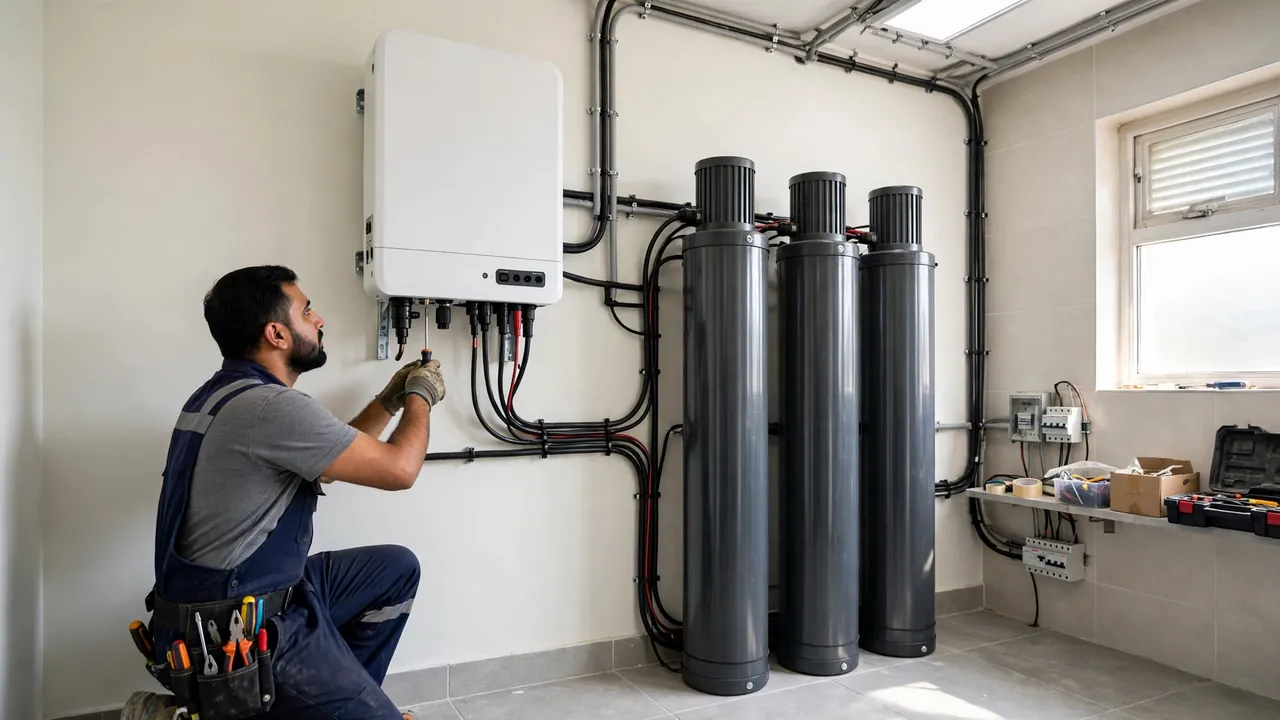
- On-grid inverter: no batteries, simpler and lower maintenance. The system shuts down during load shedding for safety. Best for areas with stable grid supply.
- Hybrid inverter: pairs with a battery bank for backup during outages. Best for areas with frequent or long load shedding. Many homeowners start with the hybrid inverter and add batteries later.
How Many Units Will a 10kW System Produce?
Panel count tells you the system’s size; sunshine tells you its output. A 10kW system in Pakistan typically generates around 40–50 units of electricity per day, varying with season, tilt, dust and shading. If you want to sanity-check that number for your exact location and roof orientation, NREL’s free PVWatts calculator lets you model a 10kW system’s expected monthly and annual output using historical weather data. For the day-by-day breakdown in local terms, see our guide to how many units a 10kW system produces per day.Common 10kW Panel-Count Mistakes to Avoid
- Rounding down the panel count to shave the quote — 17.09 panels means 18 panels, full stop.
- Mixing panel brands or wattages in one string — the whole string drops to the weakest panel’s level.
- Ordering panels before checking your sanctioned load — if the DISCO won’t approve 10kW on your connection, the count is academic.
- Counting panels but ignoring shade — one shaded panel in a series string pulls down every panel wired with it.
- Skipping the string-voltage check — panel count means nothing if the strings don’t fit the inverter’s MPPT window.
- Buying the count before the layout — roof space, row gaps and structure type can all change the practical number.
- Starting from your electricity bill’s unit count alone — work from appliance wattages and daytime load first; our home electricity load calculator guide shows the method.
Frequently Asked Questions (FAQs)
How many solar panels are needed for a 10kW system?
Between 16 and 19 panels, depending on panel wattage. With 585W panels you need 18, with 550W panels you need 19, with 615W panels you need 17, and with 650W panels you need 16. Always divide 10,000 by the panel wattage and round up.
Can I use fewer panels with higher-wattage modules?
Yes. Higher-wattage panels reduce the total count: 16 panels at 645–650W do the same job as 19 panels at 545–550W. Fewer panels also mean less roof space, fewer mounting rails and simpler wiring.
Does the panel count change for on-grid vs hybrid systems?
No. A 10kW array needs the same number of panels whether the inverter is on-grid or hybrid. Only the inverter type and battery bank change — the panel count follows the same formula.
How much roof space does a 10kW system need?
Plan for 45–60 square metres of shade-free, south-facing roof. The 16–19 panels themselves cover about 37–44 square metres, and you need extra space between rows for maintenance access and to prevent row-to-row shading.
Can I mix different wattage panels in a 10kW system?
Avoid it. Panels wired in series perform at the level of the weakest panel in the string, so mixing wattages wastes the higher-rated panels’ capacity. Use one panel model — or at minimum one wattage per string.
What size inverter do I need for a 10kW panel array?
A 10kW inverter is the standard match. Choose an on-grid inverter for areas with stable grid supply, or a hybrid inverter if you want battery backup during load shedding. Your installer must confirm the panel strings fit the inverter’s MPPT voltage range.
Should I check my sanctioned load before buying panels?
Yes. Under NEPRA’s 2026 rules your system size cannot exceed your sanctioned load, so check the figure on your electricity bill before finalising the panel count. New connections fall under net billing, not classic net metering.