
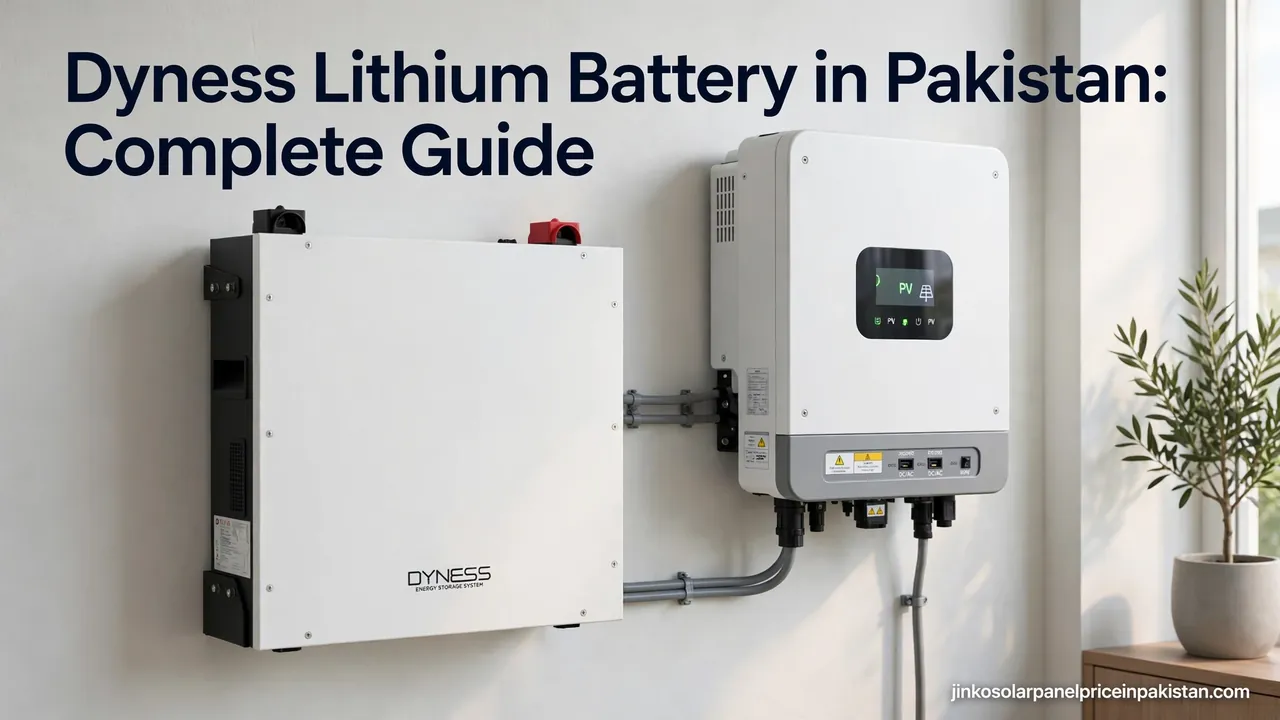
Dyness Lithium Battery in Pakistan: Complete Guide

If you are researching a dyness lithium battery for your solar system, here is the short answer: Dyness (Dyness Digital Energy Technology Co., Ltd.) is a Chinese energy-storage manufacturer whose lithium iron phosphate (LiFePO4) battery modules — including the B4850, B3 and DL5.0C lines — are widely stocked by solar dealers across Pakistan for home hybrid systems. They are sealed, maintenance-free deep-cycle batteries with a built-in Battery Management System, and they communicate with more than 30 inverter brands, which makes them one of the more flexible lithium options on the local market. The catch is the same as with any imported battery brand: buy a genuine unit from an authorized dealer, confirm your inverter model is on the compatibility list, and get the warranty terms in writing. This guide covers who Dyness is, the models you will actually find in Pakistan, their key features, how they compare with tubular batteries, and the checks that matter before you pay.
Who Makes Dyness Batteries?
Dyness is the brand name of Dyness Digital Energy Technology Co., Ltd., a Chinese company specialized in the research, production and sales of renewable energy storage systems and lithium-ion power batteries. According to the company’s own materials, it runs production facilities in the cities of Yangzhou and Taizhou in China’s Jiangsu province, and sells residential, commercial and off-grid storage products in dozens of countries. Its stated design philosophy is straightforward: make clean energy accessible with storage solutions that work in both on-grid and off-grid scenarios.
The brand’s residential portfolio is built around LiFePO4 chemistry and modular, expandable designs. As Dyness explains in its official home energy storage overview, its household products are designed for everything from small homes to larger villas, support on-grid and off-grid switching for backup power, and are compatible with over 30 inverter brands including KOSTAL, SMA, Victron, KACO and Solis. That breadth of inverter compatibility is one of the brand’s genuine differentiators — many lithium battery brands in Pakistan only guarantee communication with a handful of inverter models.
Dyness Battery Models Available in Pakistan
Pakistani solar dealers most commonly list the low-voltage (48V-class) Dyness modules, which are the ones that pair with standard hybrid inverters. Here is the lineup you are likely to encounter:
B4850 — the 2.4 kWh module
The B4850 is Dyness’s long-running 48V-class wall-mount module. According to its official user manual, the module is rated at 50Ah / 48V with 2.4 kWh of total stored energy, a charge voltage range of 52.5–54V, and a maximum discharge power of 2.4 kW. Its nameplate carries CE and TÜV Rheinland certifications, and the cells are managed by a built-in BMS. In practice, the B4850 is often used as the building block of a bank: multiple modules are paralleled to reach the capacity a household needs, and several Pakistani installers list it as their default lithium option for 5 kW hybrid systems.
B3 — the 3.6 kWh ESS unit
The Dyness B3 is a 48V-class energy storage unit with 3.6 kWh of capacity. It is a single-module design aimed at homes that want a compact wall-mounted unit with more capacity per box than the B4850. Like the rest of the range, it uses lithium iron phosphate cells and Dyness requires product registration on its official website after installation for the warranty to take effect — a detail worth knowing before you buy, because an unregistered unit can complicate a warranty claim later.
DL5.0C / DL5.0C Pro — the 5.12 kWh wall-mount modules
The DL5.0C line is Dyness’s 51.2V, 100Ah module delivering 5.12 kWh per unit. Dyness notes that the DL5.0C has a 1C charge and discharge ratio, meaning the battery can handle its full rated power continuously — useful for shock loads and for riding through blackout scenarios without strain. The Pro variant adds refinements and an optional self-heating function for low-temperature environments, letting the battery operate normally between −20°C and 55°C. In Pakistan’s market, the 5.12 kWh module is the most popular single-unit choice for homes that want a meaningful night-time backup from one box.
Powerbox and Tower Series — larger and high-voltage systems
Beyond the 48V modules, Dyness sells the Powerbox line (including the Powerbox Pro and the newer Powerbox G2, which the company describes as a compact flagship residential system) and the stackable high-voltage Tower Series, which pairs with high-voltage hybrid inverters for larger homes. The Powerbox Pro and Tower Series carry an IP65 protection rating for harsh weather, and Dyness has equipped newer models such as the PowerBrick with an optional aerosol fire extinguisher for an extra layer of safety. These are less common in Pakistani homes than the 48V modules, but worth knowing about if your installer proposes a high-voltage design.
Key Features of Dyness Lithium Batteries
Across the lineup, the engineering story is consistent:
- LiFePO4 chemistry: lithium iron phosphate is the safest common lithium chemistry for stationary home storage — thermally stable, tolerant of full-charge conditions, and rated for long cycle life under daily charging and discharging.
- Built-in Battery Management System: every module includes a BMS that monitors each cell and protects against over-charge, over-discharge, over-current, short circuits and temperature extremes.
- Wide inverter compatibility: Dyness claims compatibility with more than 30 inverter brands — including Victron, SMA, GoodWe, Solis, Growatt, Luxpower, Voltronic and Deye — over CAN or RS485 communication. This matters in Pakistan, where installers mix and match equipment.
- Expandable, stackable design: modules can be paralleled to grow capacity as needs increase, and Dyness supports mixing modules at different states of charge (0% and 100%) in a way that still utilizes the battery’s full power.
- Weather resistance on select models: IP65-rated enclosures on the Powerbox Pro and Tower Series protect against dust and water jets — relevant if your battery must live in a garage or utility area rather than a clean indoor room.
- Smart monitoring: Dyness’s self-developed Smart Cloud Platform and smartphone app provide real-time monitoring of system operation and battery health, plus firmware updates through the app.
- Low self-discharge: official manuals note that storage recharging intervals can stretch to around 10 months, which helps dealers and homeowners who keep a spare module.

Dyness vs Tubular Batteries: What Changes for You
Most Pakistani homes upgrading to lithium are coming from tall tubular lead-acid batteries, so the practical differences are worth spelling out. A Dyness module is sealed — no distilled water top-ups, no equalization charges, no specific-gravity checks — where a tubular bank needs regular attention. Lithium also delivers far more usable energy from the same headline rating: a tubular battery is typically only discharged to about half its capacity to protect its life, while a Dyness LiFePO4 module can routinely use most of its rated capacity every day.
The trade-offs are real too. A Dyness unit costs substantially more upfront than a tubular bank of similar headline capacity, it needs an inverter with a proper lithium charging profile (older UPS-style inverters usually do not qualify), and a faulty module is a warranty swap rather than something a local technician repairs. If you want the full cross-type picture before deciding, read our tubular vs lithium battery comparison for solar and the best battery for solar system in Pakistan guide. For the chemistry background behind all of this, our lithium battery for solar in Pakistan guide explains LiFePO4, sizing and installation in depth.
Inverter Compatibility: The Check That Matters Most
A Dyness battery is only as good as the inverter it talks to. The 48V-class modules (B4850, B3, DL5.0C) are designed for 48V hybrid inverters with a lithium charging profile, and the best results come when the BMS communicates with the inverter over CAN or RS485 so charging voltages and state of charge are managed automatically. Dyness’s published compatibility list covers 30+ brands, and Pakistani installers commonly pair Dyness modules with Inverex hybrid inverters and other lithium-aware hybrids.
Before you buy, get your installer to confirm two things in writing: that your exact inverter model supports lithium mode, and that the Dyness module’s communication protocol is on the tested list for that inverter. Our inverter and battery pairing guide walks through this matching process step by step, and the solar inverter buying guide for Pakistan explains what lithium support actually looks like on an inverter datasheet. If you are buying the inverter and battery together, choose the pair as a system rather than shopping for each in isolation.
How to Buy a Genuine Dyness Battery in Pakistan
Dyness modules are imported, so the Pakistani market has the usual risks: refurbished or counterfeit units, grey imports without local warranty backing, and dealers who overstate capacity. Protect yourself with these checks:
- Buy from an established solar dealer or installer who can name the importer and show you their distribution paperwork. A battery this expensive should never come from a seller with no physical address.
- Verify the serial number and full model number against the manufacturer’s documentation, and inspect the nameplate for the certification marks (CE, TÜV) and the rated capacity in Ah and kWh.
- Register the product on Dyness’s official website after installation — the B3 and DL5.0C manuals explicitly require online registration for the warranty to take effect. Keep the confirmation.
- Get the warranty in writing: who honors it locally, what it covers (cells vs. electronics), and the service contact for your city. The dealer’s name, the importer’s name and the warranty card should all be on paper before you pay.
- Ask for the installation manual and have the installer follow it — torque specs, cable sizing and communication wiring matter for warranty validity.
Installation and Care Basics
Dyness modules are designed for wall mounting or rack mounting in a dry, ventilated spot away from direct sun. Keep the area around the unit clear for airflow, mount it where temperatures stay moderate (Pakistan’s summer heat is the main enemy of battery lifespan), and make sure the installer torques the DC terminals to spec and routes the CAN/RS485 communication cable to the inverter. After installation, check the monitoring app periodically: it shows state of charge, cell health and any fault codes long before they become problems.

Day-to-day care is minimal — that is the point of lithium. No watering, no equalization, no corrosion cleanup beyond keeping terminals clean and tight. If the battery sits unused for months, the low self-discharge rate means it holds its charge far longer than lead-acid, though a periodic top-up charge per the manual’s guidance is good practice. For the full routine, see our solar battery maintenance guide. And when you size your bank, our solar battery backup time calculator guide shows how to convert a module’s kWh rating into real hours of backup for your load.
Frequently Asked Questions (FAQs)
Who makes Dyness batteries?
Dyness is the brand of Dyness Digital Energy Technology Co., Ltd., a Chinese company specialized in the research, production and sales of renewable energy storage systems and lithium-ion power batteries, with production facilities in Yangzhou and Taizhou in China’s Jiangsu province. It sells residential, commercial and off-grid storage products in dozens of countries.
Are Dyness batteries LiFePO4?
Yes. Dyness residential batteries use lithium iron phosphate (LiFePO4) cells — the safest common lithium chemistry for home storage — and every module includes a built-in Battery Management System that protects against over-charge, over-discharge, over-current, short circuits and temperature extremes.
Which inverters are compatible with Dyness batteries?
Dyness claims compatibility with more than 30 inverter brands, including KOSTAL, SMA, Victron, KACO, Solis, GoodWe, Growatt, Luxpower, Voltronic and Deye, over CAN or RS485 communication. Still, have your installer confirm your exact inverter model is on the tested compatibility list before you buy.
What Dyness battery models are available in Pakistan?
Dealers in Pakistan most commonly list the B4850 (48V, 50Ah, 2.4 kWh), the B3 (48V-class, 3.6 kWh) and the DL5.0C / DL5.0C Pro (51.2V, 100Ah, 5.12 kWh), plus the Powerbox and stackable high-voltage Tower Series for larger systems. Availability varies by dealer, so confirm the exact model and its warranty terms before paying.
Is Dyness a good battery brand for solar in Pakistan?
Dyness is a well-established lithium storage brand with international certifications (CE, TÜV Rheinland) on its modules and a wide inverter compatibility list, which makes it a solid option for home solar in Pakistan. The decisive factors are the same as for any imported battery: buy a genuine unit from an authorized dealer, confirm your inverter model is compatible, and get the warranty terms in writing.
How do I check a Dyness battery is genuine?
Buy from an established solar dealer or installer who can name the importer, verify the serial number and full model number, and check the nameplate’s certification marks. After installation, register the product on Dyness’s official website — the manuals require online registration for the warranty to take effect — and keep the warranty card and dealer paperwork.
Do Dyness batteries need maintenance?
Essentially none. Dyness modules are sealed LiFePO4 batteries with no distilled-water top-ups, no equalization charges and no specific-gravity checks. Check the monitoring app periodically, keep terminals clean and tight, mount the unit in a cool ventilated spot, and follow the installer’s guidance on periodic top-up charges if it sits unused.