
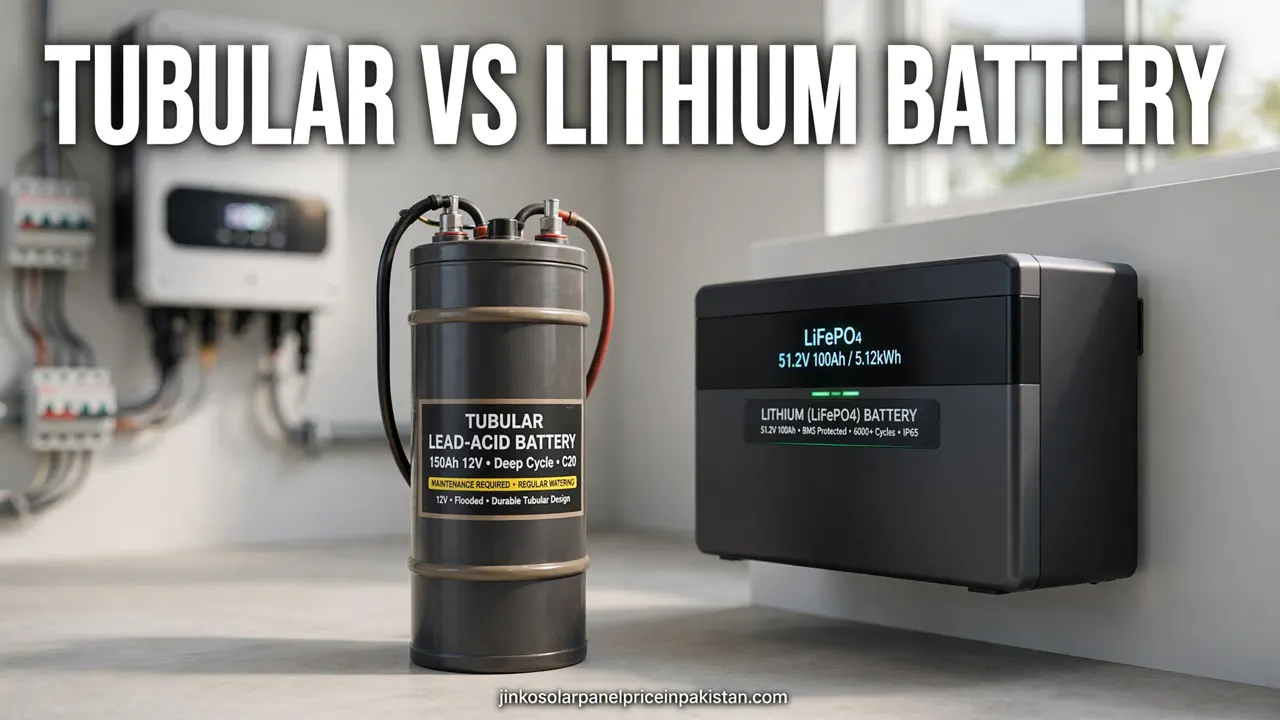
Tubular vs Lithium Battery for Solar: Which Is Better?

If you are choosing a tubular vs lithium battery for solar, here is the short answer: tall tubular batteries are the affordable, widely serviceable lead-acid workhorse of Pakistani solar — proven, easy to repair locally, but demanding regular maintenance and careful use of only about half their rated capacity. Lithium (LiFePO4) batteries are the modern alternative: they deliver far more usable energy from the same rating, last many more charge-discharge cycles, need zero maintenance, and pair best with lithium-compatible hybrid inverters — at a higher upfront cost and with fewer local repair options. Neither is “better” for everyone: choose tubular when budget and easy servicing matter most, and lithium when long life, zero maintenance and maximum usable backup matter most. This guide compares both side by side so you can decide for your own system.
What Is a Tall Tubular Battery?
A tall tubular battery is a deep-cycle flooded lead-acid battery. Its name comes from its construction: the positive plates are built as a series of spines wrapped in woven, porous fabric tubes, and those tubes are packed with lead-dioxide active material. The whole assembly sits in liquid electrolyte (dilute sulfuric acid) inside a tall polypropylene case. The tubular design is what sets it apart from ordinary flat-plate lead-acid batteries — the tubes hold the active material firmly in place, which resists shedding during repeated deep discharges and gives the battery a longer cycle life than a standard flat-plate battery.
Tubular batteries became the default storage choice for home solar and UPS systems across Pakistan for good reasons: they tolerate the daily charge-discharge duty of solar systems, they are stocked and serviced by dealers in nearly every city, and any experienced battery technician can top them up, test them and replace them. For a full walkthrough of their construction, charging and care, see our tall tubular battery guide.
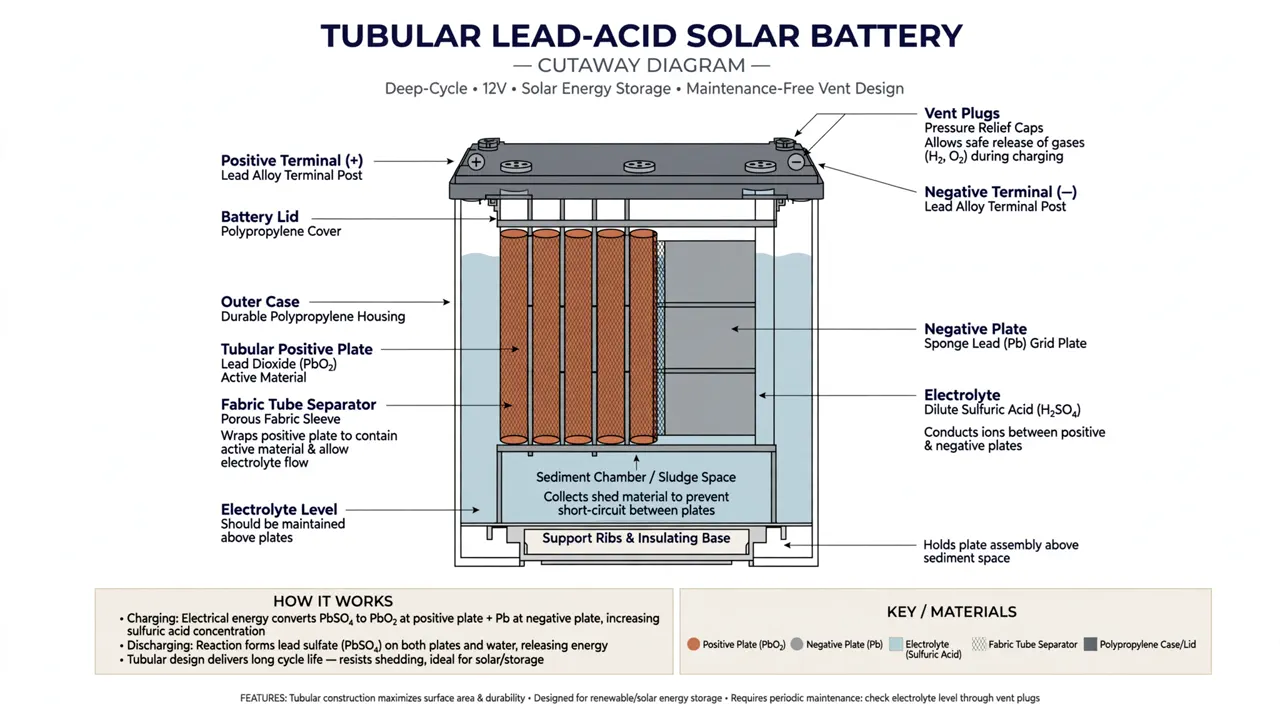
Two characteristics of tubular batteries shape every comparison below. First, they are flooded: the electrolyte level falls as water evaporates during charging, so the battery needs periodic distilled-water top-ups and good ventilation (charging releases small amounts of hydrogen gas). Second, they are lead-acid: to get a long service life, you should only draw about half of the rated capacity in each cycle. Draining a tubular battery deeply day after day shortens its life significantly.
What Is a Lithium (LiFePO4) Battery?
A lithium battery for solar storage almost always means one specific chemistry: lithium iron phosphate, written LiFePO4 or LFP. Its cathode is made of iron phosphate rather than cobalt or nickel blends, which gives it high thermal stability and tolerance of full-charge conditions — the reason it, rather than phone-style lithium chemistries, dominates stationary home storage. As Battery University explains in its guide to lithium-ion types, Li-phosphate stands out for thermal stability and long cycle life under daily cycling.
Nearly every LiFePO4 unit sold for solar includes a built-in Battery Management System (BMS) — electronics that watch every cell and guard against over-charging, over-discharging, over-current, short circuits and temperature extremes. The battery is sealed, needs no water, and lets you safely use most of its rated capacity every day. Our lithium battery for solar guide covers how LiFePO4 works, sizing and maintenance in depth, and our lithium vs dry battery comparison covers the other common pairing.
Tubular vs Lithium Battery for Solar: Head-to-Head Comparison
The table below compares the two technologies across the factors that actually decide a purchase. Read the detailed explanations that follow it for the “why” behind each row.
| Factor | Tall Tubular Battery | Lithium (LiFePO4) Battery |
|---|---|---|
| Chemistry | Flooded lead-acid, tubular positive plates | Lithium iron phosphate with built-in BMS |
| Usable capacity per cycle | About half of rated capacity for long life | Most of rated capacity, commonly four-fifths or more |
| Cycle life | Hundreds of deep cycles; moderate | Several thousand cycles; very long |
| Maintenance | Regular: distilled-water top-ups, terminal cleaning, ventilation | Essentially none: sealed, BMS-managed |
| Charging speed | Slower; needs absorption/float stages | Faster; high charge acceptance |
| Weight and space | Heavy, bulky; floor-mounted banks | Light and compact; many models wall-mounted |
| Inverter compatibility | Works with virtually any solar/UPS inverter | Needs lithium mode or compatible charging profile |
| Ventilation | Needs ventilated room (hydrogen gas) | Sealed; no hydrogen in normal use |
| Local serviceability | Excellent — serviced everywhere in Pakistan | Limited — few local repair options |
| Upfront cost | Lower | Higher |
Key Differences Explained
Usable capacity and depth of discharge
This is the single biggest practical difference. A tubular battery should only be discharged to about 50% depth of discharge (DoD) in daily use — going deeper regularly shortens its life. A LiFePO4 battery can routinely be discharged to 80–90% DoD without the same penalty. The result: a lithium battery of a given headline rating delivers roughly twice the usable backup of a tubular battery of the same rating. When people say “lithium feels bigger than its rating,” this is what they mean.
Cycle life and lifespan
A cycle is one full charge-and-discharge. Tubular batteries are rated for several hundred deep cycles — respectable for lead-acid, but a battery that cycles daily will reach that count in a few years. LiFePO4 batteries are commonly rated for several thousand cycles, which is why they suit a job that cycles the battery nearly every day of the year. In practice, a lithium bank installed today is expected to keep serving long after a tubular bank would have needed replacement — provided it is sized correctly and charged with a lithium-compatible profile.
Maintenance requirements
Tubular batteries demand an owner, not just a buyer. The flooded electrolyte loses water during charging, so levels must be checked and topped up with distilled water on a schedule; terminals corrode and need cleaning; and the battery room needs ventilation because charging releases hydrogen. Skip the maintenance and a tubular battery’s life collapses. Lithium batteries ask for almost nothing: no water, no equalization, no ventilation room — the sealed construction and BMS handle it. This difference matters enormously for homes where nobody wants a battery-care routine.
Charging speed and efficiency
LiFePO4 accepts high charge currents and charges at high efficiency, so more of your panels’ daytime energy reaches storage — an advantage that shows most on short winter days. Tubular lead-acid batteries charge more slowly: they need a full absorption stage to reach 100% and lose more energy as heat during charging. If your panels only get limited sun hours, lithium captures the day’s energy better.
Weight, size and installation
Lead is heavy. A tubular bank that delivers a given amount of usable backup weighs substantially more than an equivalent lithium setup and occupies more floor space. Many lithium modules mount on the wall and free the floor entirely. For apartments, small homes or anyone short on space, this is a genuine decision factor — not just a convenience.
Inverter compatibility
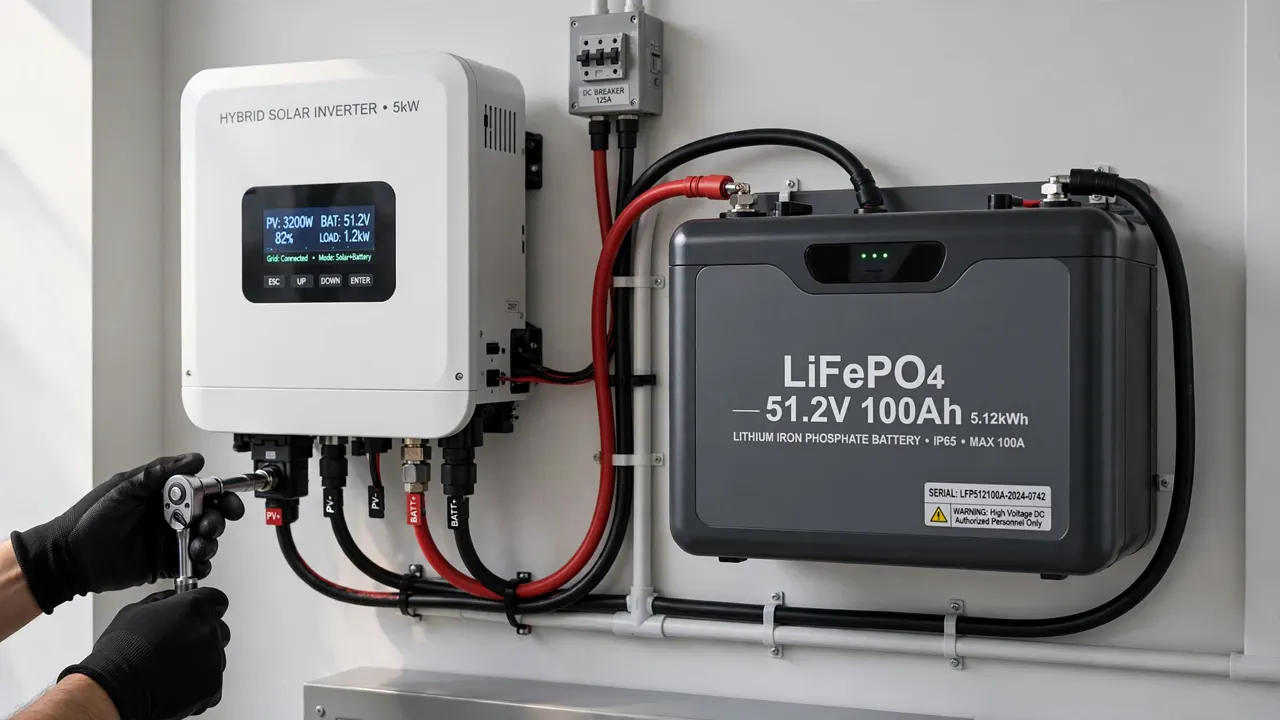
This is lithium’s one hard requirement — and tubular’s quiet strength. A tubular battery works with virtually any solar or UPS inverter: lead-acid charging profiles are universal. A lithium battery needs an inverter that offers a lithium mode or a compatible charging profile, ideally with BMS communication (CAN or RS485) so the inverter reads the battery’s state of charge directly. Connecting lithium to an inverter without lithium support can under- or over-charge the battery and void its advantages. Before buying lithium, confirm compatibility with your inverter’s maker or dealer. Our solar inverter buying guide explains what to check, including lithium support, MPPT and sizing.
Safety and ventilation
LiFePO4 is the safest common lithium chemistry for home storage: its iron-phosphate cathode is thermally stable, and the built-in BMS disconnects the battery before over-charge, over-discharge, over-current, short circuits or temperature extremes can cause damage. Buy from an authorized dealer and verify the unit’s authenticity markings. Tubular batteries are safe when handled correctly, but they carry lead-acid realities: hydrogen gas during charging (hence the ventilation requirement), corrosive acid, and heavy weight that needs careful handling. Neither technology is dangerous in normal, correctly installed use — the difference is that lithium removes most of the owner’s safety chores.
Which Battery Is Better for Your Home in Pakistan?
There is no universal winner — only the right fit for your situation. Use these profiles honestly:
Choose a tall tubular battery if…
- Budget is the deciding factor — tubular is the lowest-cost way to add storage to a solar system.
- You want easy local servicing — dealers and technicians for tubular batteries exist in virtually every Pakistani city.
- Your inverter is an older lead-acid unit — tubular works with everything, no compatibility checks needed.
- Someone at home can handle maintenance — water top-ups, terminal checks and ventilation are manageable if you accept the routine.
- Your night-time load is modest — the 50% usable-capacity rule hurts less when the load is small.
Choose a lithium (LiFePO4) battery if…
- You want maximum usable backup — roughly twice the usable energy per unit of rating.
- Zero maintenance matters — no water, no ventilation room, no routine at all.
- You are buying a new hybrid inverter anyway — choosing a lithium-compatible inverter from the start removes lithium’s main hurdle.
- Space is tight — wall-mounted lithium frees the floor a tubular bank would occupy.
- You think in long-term value — the higher upfront cost is offset over time by a much longer service life and no maintenance burden.
If you are still mapping the whole storage landscape, our types of solar batteries guide and best battery for solar system buying guide put this comparison in the full context.
Common Mistakes to Avoid When Choosing a Solar Battery
- Mixing tubular and lithium in one bank: never wire the two chemistries together — they need different charging voltages and profiles, and one of them will be damaged.
- Buying lithium for an incompatible inverter: confirm lithium mode or a lithium charging profile before you buy, not after installation.
- Sizing only by headline rating: compare usable capacity, not the number on the label — a lithium unit’s usable energy is roughly double a tubular unit’s at the same rating.
- Ignoring maintenance reality: tubular is a great battery only if the maintenance actually happens. If nobody will top up water, lithium’s zero-maintenance design is worth more than its rating suggests.
- Buying used batteries without testing: a used battery of either type may have lost much of its capacity. Our buying guide covers what to check before buying second-hand.
Check Current Solar Battery Prices in Pakistan
Battery prices move with the market, so this evergreen guide intentionally carries no price figures. Our homepage is updated every morning with the latest solar panel and battery prices in Pakistan — check there for today’s rates before you buy, then return to this comparison to pick the right technology for your system.
Frequently Asked Questions (FAQs)
Which is better for solar: a tubular battery or a lithium battery?
Neither is better for everyone. Tall tubular batteries cost less upfront, work with any inverter and are serviced everywhere in Pakistan, but need regular maintenance and only deliver about half their rated capacity per cycle. Lithium (LiFePO4) batteries deliver far more usable energy, last many more cycles, need zero maintenance and need a lithium-compatible inverter. Choose based on budget, maintenance willingness and your inverter.
How long do tubular batteries last compared to lithium batteries?
Qualitatively very different. Tubular lead-acid batteries are rated for several hundred deep cycles and typically serve a few years of daily solar cycling. LiFePO4 batteries are commonly rated for several thousand cycles, so a correctly sized and properly charged lithium bank is expected to serve much longer. Actual lifespan for both depends on depth of discharge, temperature, sizing and charging quality.
Do tubular batteries need maintenance?
Yes, if they are flooded tubular batteries. The electrolyte level falls as water evaporates during charging, so it must be checked and topped up with distilled water on a schedule, and terminals should be kept clean and tight. Skipping maintenance shortens a tubular battery’s life significantly. Sealed lithium (LiFePO4) batteries need no water top-ups at all.
Can I replace my tubular batteries with lithium batteries?
Yes, you can upgrade, but check two things first. Your inverter must support lithium — it needs a lithium mode or a compatible charging profile, ideally with BMS communication. Second, never wire old tubular and new lithium batteries together in one bank; they need different charging voltages and one of them will be damaged. Replace the whole bank with lithium at once.
Is a lithium battery safe for home use?
LiFePO4 is the safest common lithium chemistry for home storage. Its iron-phosphate cathode is thermally stable, and every unit includes a Battery Management System that guards against over-charge, over-discharge, over-current, short circuits and temperature extremes. Buy from an authorized dealer and verify the unit’s authenticity markings before installation.
Which battery works better in hot weather: tubular or lithium?
Both handle heat, but lithium copes better with Pakistan’s summers. LiFePO4 charges efficiently and tolerates high ambient temperatures well, though sustained extreme heat shortens the life of any battery. Tubular batteries lose water faster in hot weather, so their top-up schedule gets more demanding in summer, and high temperatures accelerate plate corrosion in lead-acid cells.
Can I mix tubular and lithium batteries in one system?
No — never mix them in one bank. Tubular lead-acid and lithium batteries need different charging voltages and profiles, so wiring them together will damage one or both. If you are upgrading, replace the entire bank with one chemistry and set the inverter’s charging profile to match.
