
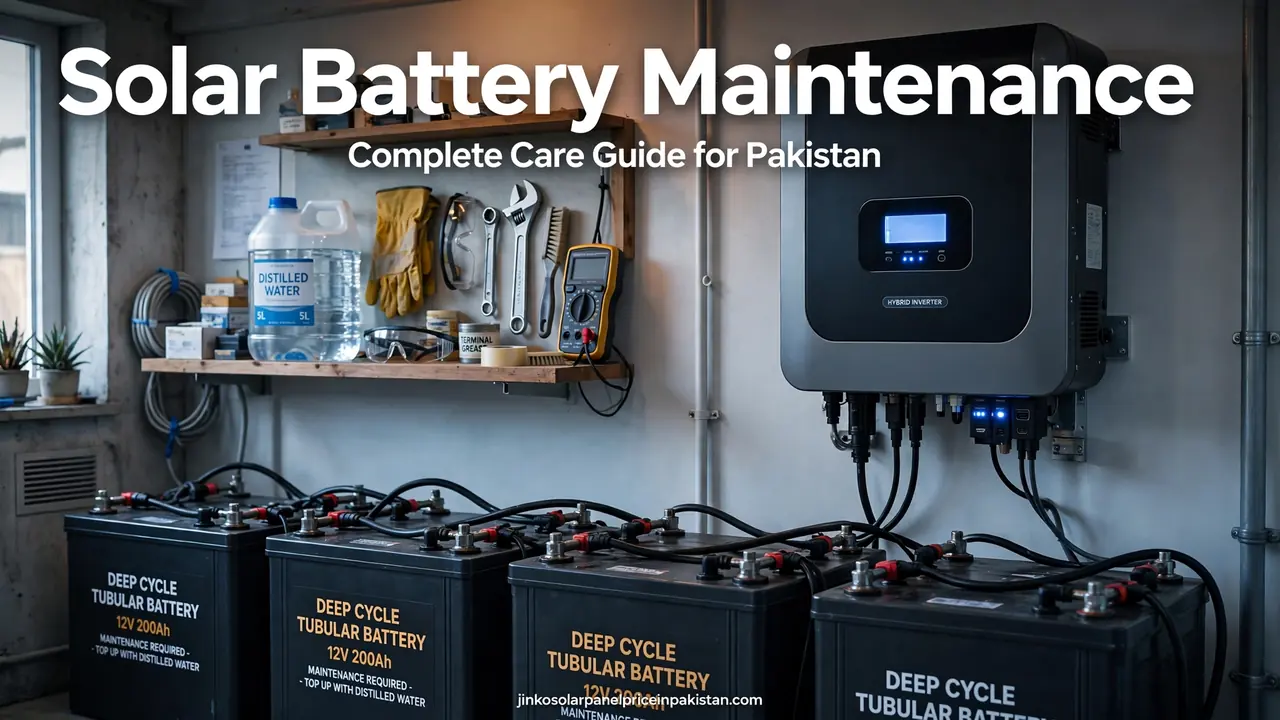
Solar Battery Maintenance: Complete Care Guide for Pakistan

Solar battery maintenance is simple, scheduled care that keeps your backup power reliable for years: check and top up distilled water in flooded batteries, keep terminals clean and tight, recharge the bank fully every day, and give the batteries a cool, ventilated place to work. This guide breaks each job into practical steps for Pakistani homes, covering both flooded deep-cycle batteries and sealed maintenance-free types. For today’s battery and system prices, check the daily updated price tables on our homepage.
Why Solar Batteries Need Regular Maintenance
The battery bank is the hardest-working part of a home solar system. While the panels sit quietly in the sun, the batteries charge and discharge every single day — and that daily cycling slowly wears them down. Maintenance cannot stop wear, but it slows the processes that kill batteries early: water loss from the electrolyte, terminal corrosion, sulfation on the plates, and cell imbalance across the bank.
What maintenance your batteries need depends on the battery type:
- Flooded lead-acid batteries (tall tubular, deep-cycle): need the most attention — water top-ups, terminal cleaning, equalization charges and specific-gravity checks. They reward care with long service.
- Sealed batteries (dry, AGM, gel, maintenance-free): need no water, but still need clean terminals, visual inspections, correct charging and a cool location.
- Lithium batteries (LiFePO4): need almost no physical maintenance, but still benefit from correct charging settings and a suitable environment.
If you are still deciding which battery type to buy, our types of solar batteries guide compares all the options, and the best battery for solar system in Pakistan guide walks through the full buying decision.
Your Solar Battery Maintenance Schedule at a Glance
Put these checks on a calendar — and in Pakistan’s hot summers, check water more often than the baseline below.
| How often | Task | Applies to |
|---|---|---|
| Daily (passive) | Let the bank recharge fully; avoid heavy loads after sunset | All types |
| Every 3–4 weeks | Check electrolyte in each cell; top up distilled water if low | Flooded only |
| Monthly | Inspect terminals and cables for corrosion, looseness, heat marks | All types |
| Monthly | Check the inverter’s battery voltage readings | All types |
| Every 2–3 months | Clean terminals, apply petroleum jelly, wipe battery tops | Flooded and sealed |
| Quarterly | Check specific gravity with a hydrometer; note weak cells | Flooded only |
| Quarterly | Equalization charge if cells are unbalanced | Flooded only |
| Twice a year | Inspect battery room: ventilation, temperature, wiring, stand | All types |
Flooded Battery Care: Checking and Topping Up Electrolyte
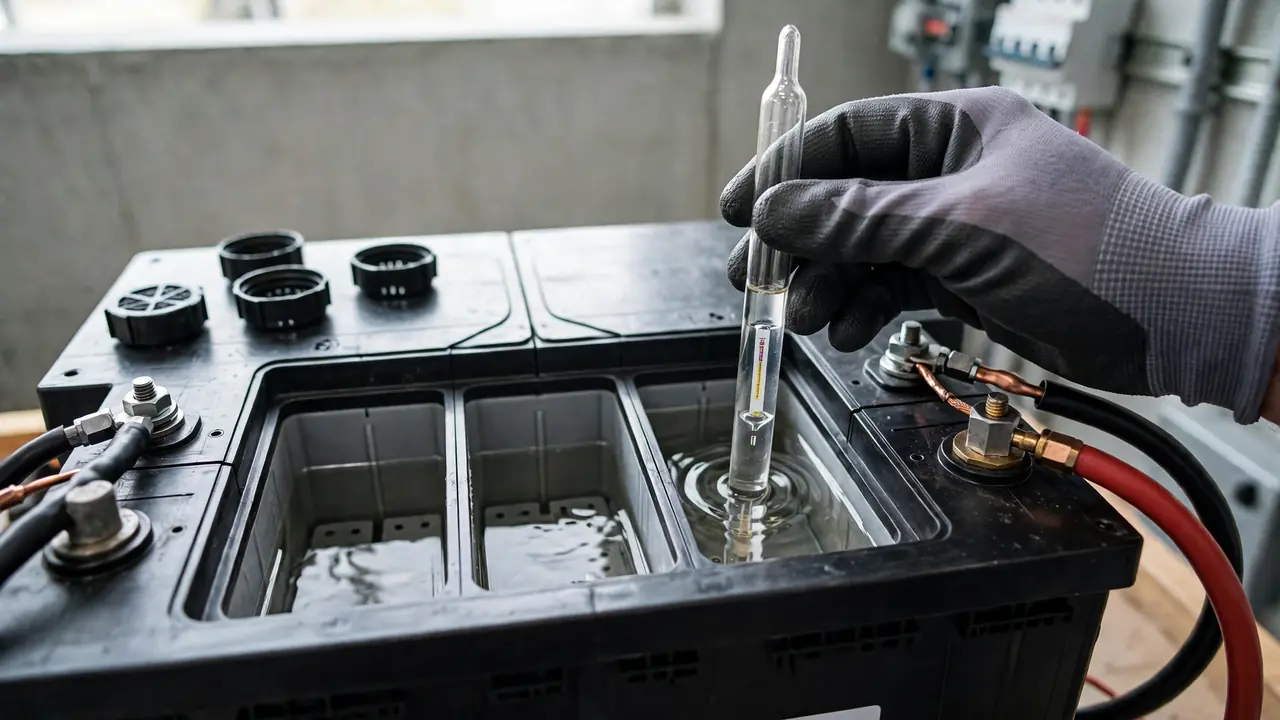
This is the single most important job for flooded lead-acid batteries — still the most common solar batteries in Pakistani homes. During charging, water in the electrolyte evaporates and gasses off. If the level drops below the top of the plates, the exposed plate area sulfates permanently, and that capacity never comes back.
How to check and top up correctly
- Check every 3–4 weeks, more often in hot months. Open each cell cap — the plates must be fully submerged, with the level at or just below the cell’s fill mark.
- Use distilled or deionized water only. Tap water, mineral water and even filtered drinking water carry minerals that contaminate the electrolyte and accelerate internal corrosion. Distilled water is cheap and widely available at battery shops.
- Top up after a full charge, not before. The electrolyte expands and rises during charging — adding water to a discharged battery can push electrolyte out of the cell, making a corrosive mess and diluting the acid.
- Never overfill or add acid. Fill only to the marked level; overfilled cells spit electrolyte during charging. Only water is lost in service, never acid, so acid must never be added.
Our tall tubular battery guide explains why flooded tubular designs dominate Pakistani home solar and how their construction affects maintenance needs.
Keeping Terminals Clean and Connections Tight
Corroded or loose terminals are a quiet battery killer. Corrosion adds electrical resistance — voltage drop, uneven charging across the bank, wasted energy as heat, and in bad cases melted cable lugs or arcing. Check terminals monthly; it takes two minutes.
How to clean corroded terminals safely
- Switch the inverter off and disconnect the battery cables, starting with the negative (–) terminal first.
- Apply a baking soda and water paste to the corroded areas with an old toothbrush or wire brush — it neutralizes acid and loosens corrosion.
- Scrub the terminals and cable lugs until the metal is bright again.
- Rinse off the residue with a damp cloth and dry everything completely.
- Apply a thin layer of petroleum jelly to the clean metal.
- Reconnect the cables, positive (+) first, and tighten firmly — the connection should not wiggle.
Watch for warning signs while you clean: a terminal that runs hot during normal use, crusty buildup returning within weeks, or cracked cable insulation near the lugs. In a series-connected bank, one bad connection drags the whole string down — our series vs parallel wiring guide explains why every link in the chain matters.
Charging Habits That Add Years to Battery Life
More solar batteries die from bad charging than from old age. The three habits that matter most:
- Recharge fully every day. Leaving a lead-acid battery at partial charge causes sulfation — hard lead-sulfate crystals form on the plates and permanently reduce capacity. Size your panels and bank so a full charge completes on a normal sunny day; if it routinely does not, the bank is oversized for the array or your backup load has outgrown the original design. Our battery-count guide shows how to size the bank so daily full charges stay realistic.
- Don’t drain the bank too deeply, too often. Flooded lead-acid batteries last far longer when daily discharge stays around half of rated capacity. Set the inverter’s low-voltage disconnect so the load cuts off before deep discharge — occasional deep discharges are survivable, nightly ones are not.
- Use the right charge settings. Every battery type needs its own bulk, absorption and float voltages, and the inverter must be programmed for the battery you actually own. When you change battery type, update the inverter settings. The solar inverter buying guide for Pakistan covers charger compatibility.
Equalization Charge: What It Is and When to Use It
An equalization charge is a controlled, deliberate overcharge applied to flooded batteries. It breaks down sulfate crystals on the plates and reverses acid stratification — the condition where heavier acid settles at the bottom of the cell and weak acid sits at the top, making the battery behave smaller than it is.
How to know when equalization is due: after a full charge, check each cell’s specific gravity with a hydrometer. If any cell reads about 0.030 points lower than the others, that cell is lagging and the bank needs equalizing. Battery University’s guide to equalizing charge explains the process, the voltage levels and the safety precautions in detail.
Three rules to follow:
- Flooded batteries only. Never equalize sealed, AGM, gel or lithium batteries unless the manufacturer explicitly instructs it — you will dry out or damage them.
- Equalize after a full charge, on a sunny day — the bank must be fully charged first, with enough solar input to sustain the process.
- Ventilate and watch. Equalization produces flammable hydrogen gas. Keep the area ventilated, keep sparks and flames away, top up distilled water afterward if levels dropped, and stop if any battery gets unusually hot.
Dry, AGM and Sealed Batteries: The Low-Maintenance Routine
“Maintenance-free” does not mean “attention-free.” Sealed batteries still need:
- Visual inspection every couple of months: look for a swollen or bulging case, cracks, leaks or a case that feels hot. A swollen sealed battery has been overcharged or overheated — have it checked.
- Clean, tight, protected terminals — corrosion behaves the same on every battery type.
- Exact charger settings: sealed batteries cannot vent excess gas the way flooded batteries do, so overcharging dries them out permanently. The inverter’s charge profile must match the battery specification exactly.
- Cool placement: sealed batteries are more sensitive to heat damage than flooded ones, so ventilation and shade matter even more.
For the chemistry differences behind these routines, see our dry vs tubular battery comparison and the tubular vs lithium battery comparison.
Temperature, Ventilation and Where to Install Your Battery Bank
Battery maintenance starts with the room, not the battery. Three environmental rules decide how long any battery bank lasts in Pakistan:
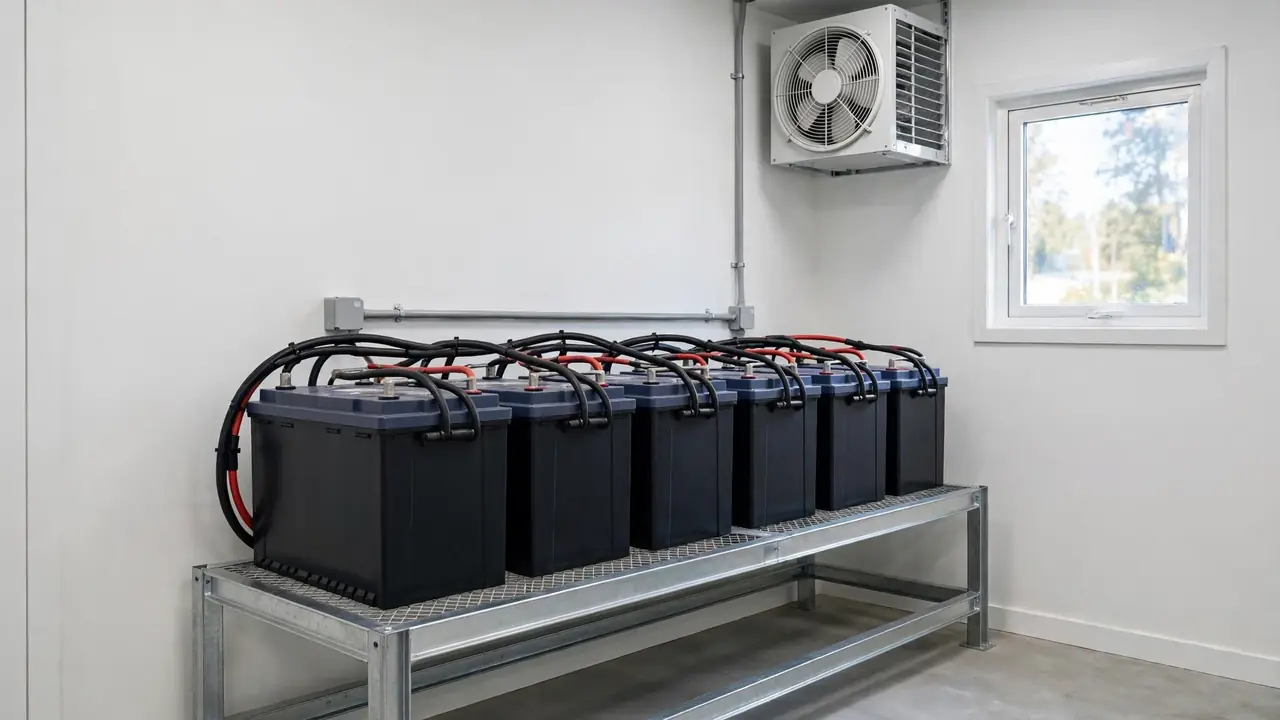
- Keep the bank cool. Heat accelerates battery aging — faster water loss, corrosion and self-discharge. Never install batteries where afternoon sun hits them directly, next to a heat source, or in a closed metal box on a rooftop. A shaded, airy spot on the ground floor or in a ventilated store room is ideal.
- Ventilate — hydrogen is flammable. Charging lead-acid batteries releases hydrogen gas. The battery area needs airflow so gas cannot accumulate: a vent, a small exhaust fan, or simply a room that is not airtight. No smoking, no open flames, no sparking tools near the bank.
- Use a proper stand. Batteries should sit on a raised, level, acid-resistant stand — not directly on a damp floor. Leave a few inches of space between batteries so air circulates and you can reach every cell cap and terminal.
Keep the bank away from living spaces where possible, and always out of reach of children.
Seasonal Battery Care Tips for Pakistan
Pakistan’s climate swings demand small seasonal adjustments to the routine:
- Summer (May–August): check water every 2–3 weeks — heat dramatically increases water loss. Keep the battery room shaded and ventilated; rooftop battery boxes can become ovens in June. Watch for swelling in sealed batteries.
- Monsoon (July–September): humidity accelerates terminal corrosion. Inspect terminals more often, keep battery tops dry, and make sure rain cannot reach the bank or inverter.
- Winter (December–February): fog and shorter days mean less charging — the sulfation-risk season. Reduce backup loads on long foggy stretches and make sure the bank still reaches full charge regularly.
Safety Rules for Battery Maintenance
Battery maintenance is safe DIY work as long as you respect the chemistry. Non-negotiable rules:
- Wear safety glasses and gloves when opening cell caps or handling terminals — battery acid burns and blinds.
- Never create sparks near the bank: no smoking, no grinding, no loose cable ends touching metal. Hydrogen from charging is invisible and flammable.
- Disconnect negative (–) first when removing cables; reconnect positive (+) first.
- Keep baking soda and clean water nearby to neutralize acid splashes immediately. If acid contacts skin or eyes, flush with plenty of water and seek medical help.
- Use insulated tools, remove metal jewelry before working, and never lay tools on top of batteries.
- Keep children and pets away from the battery area at all times.
Signs Your Battery Needs Professional Help
Some symptoms mean the battery — or the system design — needs an expert:
- Backup time keeps shrinking even though your load has not changed
- One battery in the bank runs noticeably hotter than the others
- Specific gravity stays low in one cell even after equalization
- A sealed battery case is swollen, cracked or leaking
- Terminals corrode again within days of cleaning
- The inverter shows battery-related fault codes repeatedly
Do not keep nursing a failing battery with repeated equalizations and water top-ups — a shorted cell can overheat and becomes a safety risk. A technician can load-test each battery and tell you whether one unit or the whole bank needs replacing.
Check Current Prices
Battery and system prices in Pakistan move with currency rates, import duties and seasonal demand — which is exactly why this guide carries no price figures. For today’s battery prices, panel prices and complete system costs, check the daily updated price tables on our homepage. If you are still choosing a battery, our best battery buying guide, battery types guide and lithium battery guide will help you compare before you buy.
Frequently Asked Questions (FAQs)
How often should I check my solar battery’s water level?
For flooded lead-acid batteries in Pakistan, check the electrolyte level every 3-4 weeks – and every 2-3 weeks during the hot summer months when water loss speeds up. Top up with distilled water only, and always after a full charge rather than before.
Can I use tap water in a solar battery?
No. Tap water contains minerals that contaminate the electrolyte and accelerate internal corrosion, permanently reducing capacity. Use distilled or deionized water only – it is inexpensive and available at battery shops.
Do dry or sealed solar batteries need maintenance?
Sealed batteries need no water top-ups, but they still need care: clean tight terminals, regular visual checks for swelling or cracks, correct charger settings matched to the battery specification, and a cool ventilated location.
What causes a solar battery to die early?
The most common killers are daily deep discharges, chronic undercharging (which causes sulfation), letting the electrolyte drop below the plates, corroded or loose terminals, heat, wrong charger settings, and mixing old and new batteries in one bank.
How do I clean corroded battery terminals safely?
Switch the inverter off and disconnect the cables (negative first), scrub the terminals and lugs with a baking soda and water paste and a wire brush, rinse and dry fully, apply a thin layer of petroleum jelly, then reconnect (positive first) and tighten firmly.
Should I equalize my solar battery?
For flooded lead-acid batteries, yes – periodically, per the battery manufacturer’s guidance. Equalization removes sulfate crystals from the plates and reverses acid stratification. Never equalize sealed, AGM, gel or lithium batteries unless the manufacturer explicitly allows it.
How long does a well-maintained solar battery last?
It depends on the type, usage and care. Flooded deep-cycle tubular batteries that get regular water top-ups, full daily recharges and limited depth of discharge last dramatically longer than neglected ones – proper maintenance adds years of service life.
Where should I install my solar battery bank?
In a ventilated, shaded spot away from direct sun and heat – ideally on a raised stand on the ground floor or in a ventilated store room. Charging releases flammable hydrogen gas, so the area needs airflow, and the bank must stay out of reach of children and away from living spaces.
