
Itel Lithium Battery in Pakistan: Complete Guide

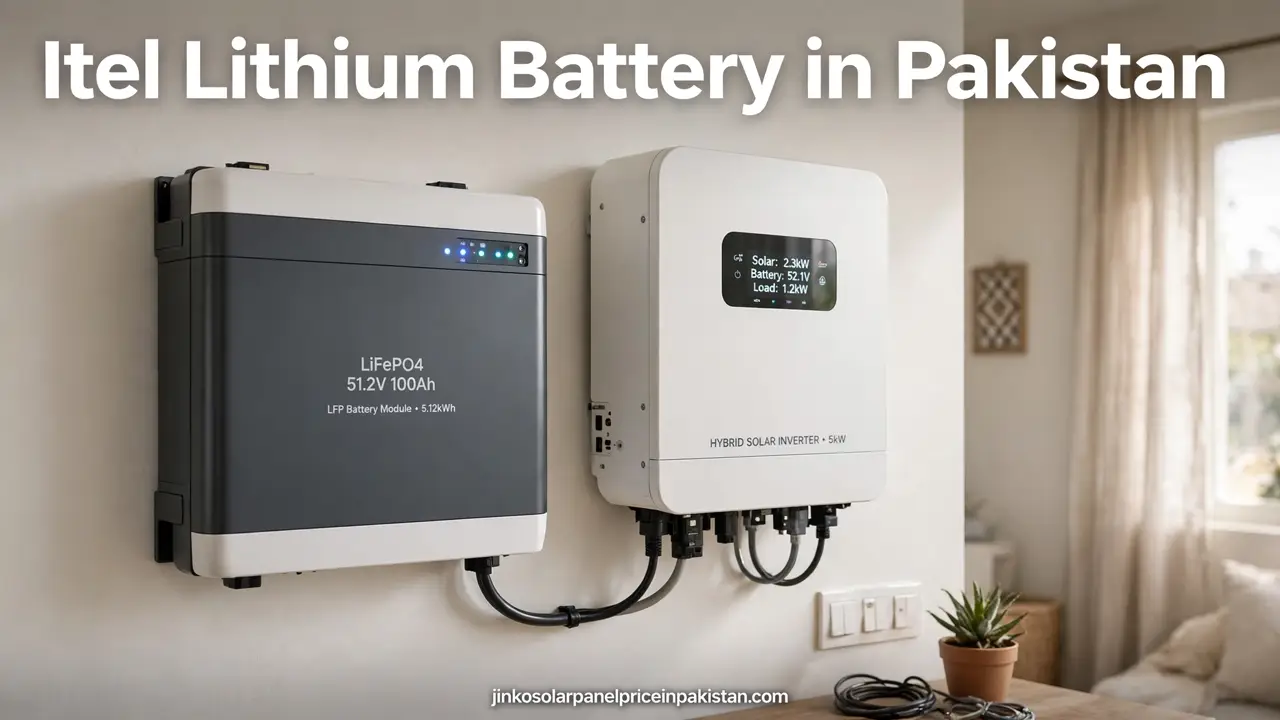
An itel lithium battery is a lithium iron phosphate (LiFePO4) energy-storage battery made by itel Energy for solar systems and backup power. In Pakistan, dealers commonly list itel models from a compact 12.8V 100Ah unit (1.28 kWh) up to 48V 200Ah wall-mounted and standing modules (10.24 kWh), with popular 25.6V mid-size options in between. It is positioned as an affordable lithium option: sealed LiFePO4 cells, a built-in battery management system, and monitoring over Bluetooth or inverter communication — without the premium price tag of top-tier imported brands. This guide explains the brand, the models you will see in the Pakistani market, how to pick the right voltage and size, and what to check before you buy.
What Is the Itel Lithium Battery?
itel Energy is a solar brand with a growing footprint in Pakistan. The company has exhibited at the Solar Pakistan Expo in Karachi — including the October 2026 edition, where it announced a new Gen-2 residential battery line developed with cell manufacturer REPT BATTERO — and it also sells its Sparta series hybrid inverters locally. Its battery range focuses on one idea: bringing lithium storage within reach of ordinary homeowners and small businesses.
Unlike the lead-acid tubular batteries that dominated Pakistani rooftops for years, itel’s lithium models are sealed, maintenance-free units designed to pair with modern hybrid inverters. If you are deciding between battery chemistries in general, our types of solar batteries guide lays out the full landscape, and our tubular vs lithium comparison explains why many households are switching.
Key Features of Itel Lithium Batteries
LiFePO4 Cell Chemistry
Every itel lithium battery sold in Pakistan uses lithium iron phosphate (LiFePO4) cells — the chemistry most solar installers recommend for home storage. LiFePO4 is thermally stable, tolerates Pakistan’s hot summers better than older lithium chemistries, and does not need the watering and equalization that flooded lead-acid batteries demand. Published specifications for the range describe Class-A (Grade-A) cells, the top quality grade in the cell market. For a deeper explanation of why this chemistry dominates solar storage, see our lithium battery for solar in Pakistan guide.
Built-in Battery Management System (BMS)
Each module ships with an intelligent Battery Management System that guards against over-charge, over-discharge, over-current, short circuits and temperature extremes. The BMS also balances the cells during charging, which is what lets the battery deliver its rated cycle life in real-world use. If you want to understand what a BMS actually does inside the pack, our lithium battery BMS explainer walks through it in plain language.

Cycle Life
Published specifications for the larger itel models rate the cells at more than 6,000 cycles at 25°C, 0.5C charge/discharge rates and 80% depth of discharge — the standard test conditions the whole industry uses. The compact 12.8V model is listed at more than 3,000 cycles under the same style of conditions. In practice, actual life depends on your ambient temperature, how deeply you discharge the battery each day, and how well the installation is ventilated. Treat the 6,000-cycle figure as a lab rating, not a promise: good installation and sensible depth-of-discharge settings are what turn a rating into real years of service.
Monitoring and Communication
itel batteries support CAN, RS485 and RS232 communication with compatible inverters, so the inverter and battery can exchange state-of-charge and protection data automatically. Select models — including the 12.8V 100Ah unit — add Bluetooth connectivity with a digital state-of-charge indicator and the itel Energy app, letting you check the battery from your phone. When your inverter and battery talk to each other properly, you get cleaner charging, better fault reporting, and fewer nuisance shutdowns.
Itel Lithium Battery Models Available in Pakistan
Dealers in Pakistan list several itel models. The exact lineup shifts with imports, so confirm the model number on the nameplate before you pay — but these are the configurations you will most often see (current models are also listed on the brand’s official solar product website).
- 12.8V 100Ah (1.28 kWh) — the entry model, aimed at small backup and low-voltage solar setups. Includes Bluetooth and the itel Energy app on current listings.
- 25.6V 100Ah (2.56 kWh) — the 24V-class workhorse for mid-size systems.
- 25.6V 200Ah (5.12 kWh) — a larger 24V-class module for homes with heavier evening loads.
- 48V 100Ah (5.12 kWh) — wall-mounted 48V module, the standard pairing for 48V hybrid inverters.
- 48V 200Ah (10.24 kWh) — standing-format module for larger homes and small commercial setups.
- Gen-2 residential (2.5 kWh and 5 kWh) — announced at the October 2026 Karachi expo, built with REPT’s Grade-A cells and designed to scale by paralleling multiple units.
Note the voltage classes carefully: a 25.6V battery belongs to a 24V system, and a 48V battery belongs to a 48V system. Mixing voltage classes with the wrong inverter is one of the most common — and most avoidable — buying mistakes.

Choosing the Right Voltage: 12V, 24V or 48V
The single most important choice is the voltage class, because it must match your inverter:
- 12.8V models suit small backup systems, caravans, shops with light loads, and DC-direct setups. They are not a fit for a full home solar system.
- 25.6V models suit 24V hybrid inverters, common in mid-size residential systems (roughly 1–3 kW of panels).
- 48V / 51.2V models are the standard for modern hybrid inverters (3 kW and up). Most new home installations in Pakistan are 48V, and this is the class most buyers should default to.
A 25.6V battery will not work properly on a 48V inverter, no matter how good the price looks. If you are unsure which class your system needs, read our inverter and battery pairing guide before shortlisting any battery.
Inverter Compatibility and Pairing
itel batteries are designed to pair with hybrid inverters over CAN or RS485, and they naturally work with itel’s own Sparta hybrid inverter line. With third-party inverters — Inverex, Growatt, Solis, Knox and others — compatibility depends on the exact inverter model and its battery communication settings. Lithium batteries are far less forgiving of mismatched settings than old tubular batteries were: wrong charge voltages can trigger BMS protection cutoffs or, worse, quietly shorten battery life.
Practical advice: ask your installer to confirm your exact inverter model is on the battery’s tested compatibility list, and ask to see the communication working (state-of-charge syncing on the inverter display) before the job is signed off. Our solar inverter buying guide for Pakistan covers what to check on the inverter side of the pair.
Installation Considerations
Lithium batteries are easier to live with than tubular batteries, but installation quality still decides how long they last:
- Mounting: wall-mounted models save floor space and keep terminals away from dust and moisture; standing models suit garages and utility rooms. Follow the manual’s clearances.
- Ventilation and heat: LiFePO4 tolerates heat well, but a shaded, ventilated spot away from direct sun extends life — important in cities where summer rooms cross 40°C.
- Cabling and protection: use the recommended cable sizes, torque terminals properly, and install DC breakers/fuses between battery and inverter. Undersized cables are a common cause of voltage-drop complaints.
- Installer: use a certified installer who has commissioned lithium systems before, not just tubular ones. Lithium commissioning includes BMS settings the old lead-acid playbook never had.
To estimate how much storage your household actually needs before you buy, our solar battery backup time calculator guide walks through the math.
Maintenance and Care
Maintenance is where lithium pulls furthest ahead of tubular batteries: there are no distilled-water top-ups, no specific-gravity checks, and no equalization charges. Your routine is short:
- Check the monitoring app or inverter display periodically for state-of-charge trends and any fault flags.
- Keep terminals clean and tight, and keep the area around the battery clear for airflow.
- If the battery sits unused for weeks (a vacant property, for example), follow the installer’s guidance on periodic top-up charges — lithium prefers not to sit at 0% or 100% for long stretches.
For the full routine across all battery types, see our solar battery maintenance guide.
Itel vs Other Solar Battery Options
How does itel stack up against the alternatives Pakistani buyers usually consider?
- Vs tubular lead-acid: lithium wins on usable capacity per rupee of lifetime value, cycle life, and maintenance — the tubular vs lithium comparison has the full breakdown. Tubular still wins on upfront cost alone.
- Vs premium lithium brands: brands like Dyness sit a tier above on certifications and inverter compatibility lists; our Dyness lithium battery guide covers that segment. itel competes on price while offering the same core LiFePO4 chemistry.
- Vs local lead-acid brands going lithium: established names like Phoenix are also in the lithium game — see our Phoenix battery guide. Compare cycle-life ratings and warranty terms side by side rather than going on brand familiarity alone.
If you are still narrowing down the shortlist, our best battery for solar system in Pakistan guide compares the main options by use case.
Warranty and After-Sales Support in Pakistan
Distributor listings in Pakistan describe a five-year official replacement warranty on the larger itel battery models, subject to the warranty terms — always get the exact terms in writing from your dealer, including what counts as a warranty claim and who handles it. On the service side, the brand has announced a network of 40+ service centers across Pakistan with a 48-hour replacement policy, developed with its local service partner, plus an experience center and testing lab in Karachi.
Before you buy, do three things: verify the serial number and full model number on the nameplate, buy from a dealer who can name the importer, and keep your invoice and warranty card. Grey-import units without local warranty support are the main risk with any imported battery brand.
Who Should Consider an Itel Lithium Battery?
An itel lithium battery makes most sense if you want genuine lithium storage — sealed LiFePO4, a BMS, app monitoring — at a friendlier budget than premium imported brands, and you are pairing it with a compatible hybrid inverter in a 24V or 48V setup. It is a weaker fit if you need a brand with the longest published inverter compatibility list, if your installer has never commissioned a lithium system, or if you are trying to run a full home on a 12V-class battery. Match the voltage class to your inverter, size the bank for your evening load, and buy through a dealer who stands behind the warranty.
Frequently Asked Questions (FAQs)
Is the itel lithium battery good for solar systems in Pakistan?
Yes, for the right setup. itel lithium batteries use LiFePO4 cells with a built-in battery management system, and dealers in Pakistan list models from 12.8V 100Ah up to 48V 200Ah. They suit buyers who want genuine lithium storage at a friendlier budget than premium imported brands — provided the battery’s voltage class matches the inverter and a competent installer commissions the system.
Which battery chemistry does itel use in its lithium batteries?
itel uses lithium iron phosphate (LiFePO4) in its solar batteries — the chemistry most installers recommend for home energy storage. Published specifications describe Class-A (Grade-A) cells, and every module includes an intelligent Battery Management System protecting against over-charge, over-discharge, over-current, short circuits and temperature extremes.
What sizes and voltages are itel lithium batteries available in?
Dealers in Pakistan list a 12.8V 100Ah model (1.28 kWh), 25.6V 100Ah and 200Ah models (2.56 and 5.12 kWh), 48V 100Ah and 200Ah modules (5.12 and 10.24 kWh), plus a newer Gen-2 residential line in 2.5 and 5 kWh sizes announced at the October 2026 Karachi expo. Availability varies by dealer, so confirm the exact model number on the nameplate before buying.
Can I add more itel batteries later to increase backup?
Yes — that is one of lithium’s advantages over fixed lead-acid banks. Published specifications for itel models describe parallel expansion (for example, up to 16 units in parallel on the 12.8V model), and the Gen-2 line is designed to scale by paralleling multiple units. Keep all paralleled modules the same model and age, and have the installer configure the bank correctly.
Will an itel lithium battery work with my existing hybrid inverter?
Only if the voltage class and communication match. itel batteries are designed to pair with hybrid inverters over CAN or RS485 and work naturally with itel’s own Sparta inverters. With third-party inverters, have your installer confirm your exact inverter model is on the battery’s tested compatibility list — and check that state-of-charge syncs on the inverter display before the job is signed off.
How do I monitor my itel lithium battery?
itel batteries support CAN, RS485 and RS232 communication with compatible inverters, so charge and fault data sync automatically. Select models also offer Bluetooth with a digital state-of-charge indicator and the itel Energy app, letting you check the battery’s status from your phone.
What warranty do itel lithium batteries carry in Pakistan?
Distributor listings in Pakistan describe a five-year official replacement warranty on the larger itel battery models, subject to the warranty terms. The brand has also announced a 40+ service-center network with a 48-hour replacement policy. Get the exact terms in writing from your dealer — including who handles claims — and keep your invoice and warranty card.