
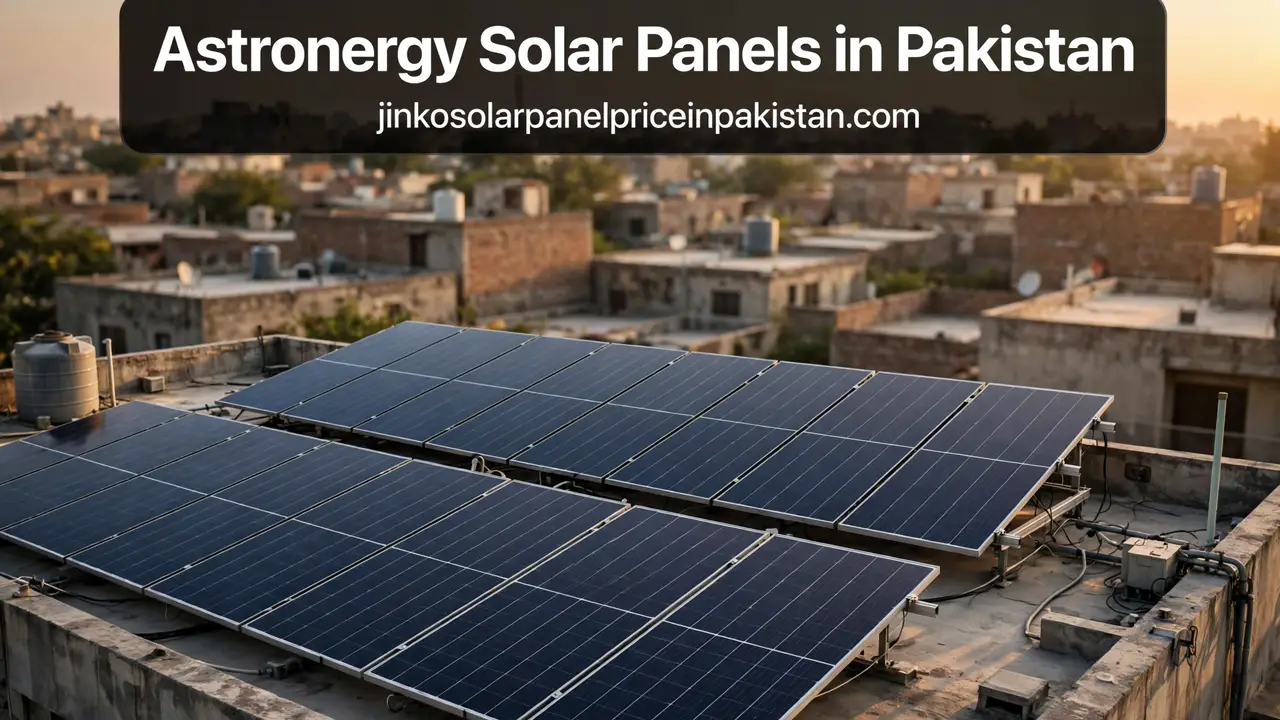
Astronergy Solar Panels in Pakistan: Complete Brand Guide (2026)

Quick answer: Astronergy — the solar module arm of China’s CHINT Group, founded in 2006 — is a BloombergNEF Tier-1 PV module maker whose ASTRO N-series n-type TOPCon bifacial panels (the ASTRO N5, N7 and N8 lines) are increasingly quoted by Pakistani dealers. This guide to Astronergy solar panels in Pakistan explains the lineup, how each series differs, which technology suits Pakistan’s heat, what the warranty terms typically look like, and how to verify a genuine panel before you pay. It carries no prices — rates change too often for print, so check the live tables instead.
Check Current Astronergy Panel Prices
Solar panel prices in Pakistan move with the dollar rate, import costs and dealer stock. Our daily updated price tables on the homepage track Astronergy models alongside Jinko, Longi, Canadian Solar and Trina.
Why Astronergy Matters in the Global Solar Market
Astronergy is the solar module business of CHINT Group — founded in 2006, one of China’s earliest private PV enterprises, and a self-described pioneer in n-type TOPCon modules. That profile matters for buyers: a 25-year asset on your roof is only as solid as the manufacturer behind the warranty.
The third-party credentials are the useful part: BloombergNEF Tier-1 PV module maker, honoured as a Kiwa PVEL Top Performer nine times, more than 130 GW of cumulative global shipments by end-2024, and a Top-6 position in 2024 shipment rankings compiled by InfoLink. These independent markers place Astronergy in the same credibility tier as the brands Pakistani buyers already know. Its modules also have real-world proof on large projects — from Germany’s 154.4MW Döllen solar farm (Europe’s largest n-type TOPCon farm) to high-altitude plants in China’s Sichuan plateau.
Read this guide alongside our Jinko brand guide and the Jinko vs Longi comparison — the same buying logic applies across Tier-1 brands.
Astronergy Panel Series Explained
What Pakistani dealers quote is the ASTRO N-series — Astronergy’s n-type TOPCon lineup: N5, N7 and N8. They share the same core technology but target different system sizes, so always get the series and model number in writing.
ASTRO N5 — the Mainstream Residential Series
The N5 is Astronergy’s volume residential line: n-type TOPCon bifacial dual-glass modules with 144 half-cut cells. A representative 585W model (CHSM72N(DG)/F-BH-585W) publishes about 22.6% efficiency, a -0.29%/°C temperature coefficient, and a 15-year product warranty with a 30-year linear power warranty. For most Pakistani homes, the 580–620W N5 models are the ones you will actually be offered — sized for standard residential inverters. If a dealer quotes an “Astronergy panel” without a series name, it is most likely an N5; ask for the exact model number so you can look up its datasheet.
ASTRO N7 and N7 Pro — the Efficiency Flagship
The N7 line is Astronergy’s premium offering, built on TOPCon 5.0+ cell technology and reaching up to 670W with efficiency up to 24.8%. Its quarter-cut cell design lowers internal current and hotspot temperatures and improves partial-shade behaviour, while published specs show a temperature coefficient of -0.26%/°C and bifaciality of 85% ±5%. Warranty terms run stronger too: 15-year product warranty with a 30-year linear power warranty (≤1% first-year degradation, ≤0.35%/year after). This is the series for buyers who want maximum output per square metre on limited roof space.
ASTRO N8 and N8 Pro — Large-Format Power
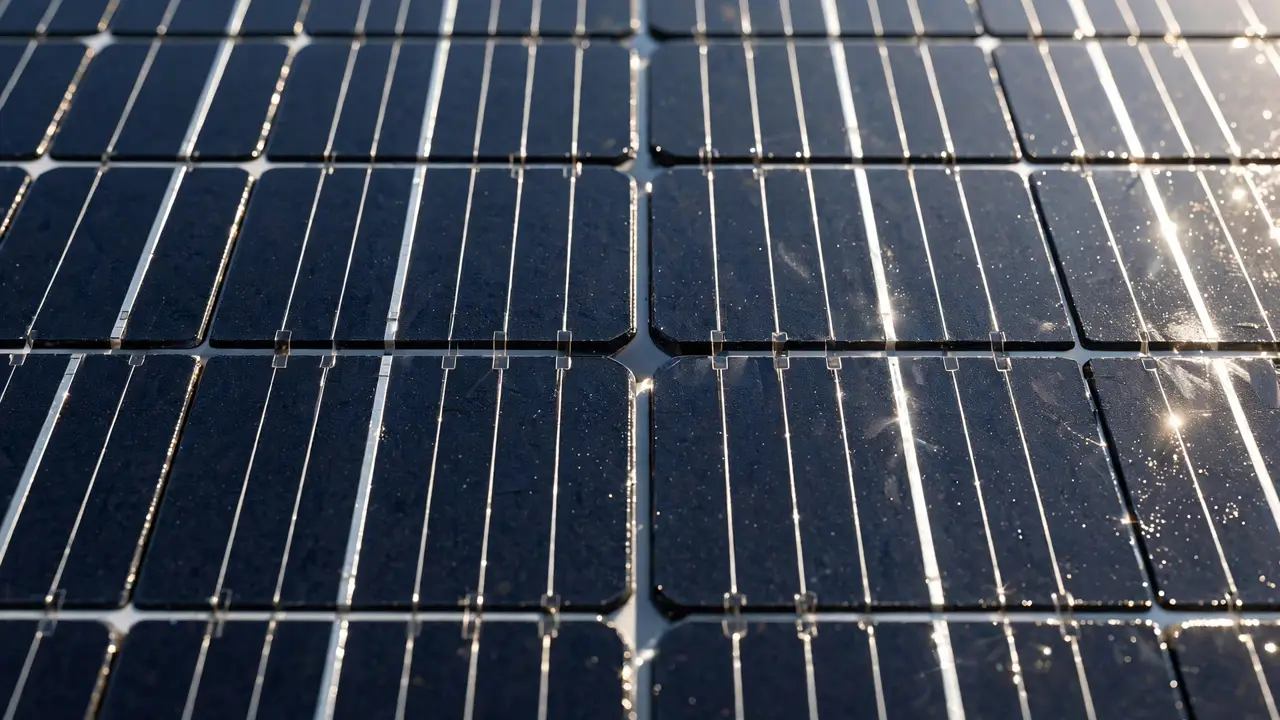
The N8 line, unveiled at SNEC 2026, pushes power ratings to up to 825W with efficiency up to 24.5% — built on the TOPCon 5.0+ platform with 210mm wafers, quarter-cut cells and multi-busbar layout. Be realistic: these large formats target commercial rooftops and utility projects and can complicate a typical home roof. Confirm with your installer before committing.
The takeaway: do not compare “Astronergy” as one thing — an N5 mainstream panel and an N8 Pro flagship are different products. Always get the series and model number in writing; the technology background is in our N-type vs P-type guide.
Which Astronergy Series Suits Pakistan’s Climate?
Heat is the defining stressor for solar panels in Pakistan. Panel temperatures on a Punjabi or Sindhi roof run far above air temperature, and every panel loses output as it heats — the rate is its temperature coefficient, where lower is better. This is where Astronergy’s newer series earn their keep: the N7 Pro and N8 Pro’s published -0.26%/°C is among the lowest in mainstream modules, meaning measurably less loss on scorching afternoons.
A second climate advantage is the bifacial design: on a light-coloured roof — common on Pakistani homes — the rear side captures reflected sunlight and adds free extra yield.
Whatever series you pick, three installation basics matter as much as the cell technology:
- Ventilation gap: panels mounted with airflow underneath run cooler than panels laid nearly flat on the roof.
- Correct tilt: proper tilt angle for your city sheds heat and dust while catching winter sun. See our mounting structures guide.
- Realistic expectations: every panel produces less than its nameplate rating on a scorching afternoon — that is physics, not a defect. Size your system with summer derating in mind, not nameplate watts alone.
How to Choose the Right Astronergy Wattage
Higher wattage is not automatically better — it is a sizing tool. The right wattage depends on your system size, roof space and inverter limits:
- Small roofs: higher-wattage panels (620W-class and above) build the same system capacity with fewer panels, rails and wire runs.
- Large roofs: mid-range wattages are easier to handle and give your installer more layout flexibility.
- Inverter compatibility: the inverter’s voltage and current limits must suit the panel size — larger panels carry higher current that some older inverters cannot handle in long strings.
As a rule of thumb, a 5 kW system needs about nine 585W-class or eight 620W-class panels — have your installer confirm the exact count against your sanctioned load and inverter input limits, and benchmark your budget on our daily price tables.
Bifacial and Double-Glass Astronergy Panels
The entire ASTRO N-series is bifacial — modules generate electricity from both the front and the back. Mounted at a height over a light-coloured roof, the rear side captures reflected sunlight for extra output. Dual-glass construction (2.0mm glass on both sides instead of a plastic backsheet) protects the cells over decades. For the full concept, read our bifacial solar panel guide.
One practical note: dual-glass modules are heavier and stiffer than single-glass equivalents. On fragile or old roofs, have your installer check the structure’s load capacity before committing — our mounting structures guide explains what to look for.
Astronergy Solar Panel Warranty in Pakistan
Published Astronergy specifications for the ASTRO N-series typically show a 15-year product warranty and a 30-year linear power warranty (≤1% first-year degradation, ≤0.35–0.4%/year after) — but always confirm the datasheet for your exact model.
Two things matter more than the headline numbers, and they are the same for every brand:
- The warranty must be in the importer’s name, with the distributor’s stamp. A warranty card from an unknown seller is difficult to claim against years later.
- Your panel serial numbers should be listed on the invoice. Without serial numbers on paper, proving your panels are covered is much harder down the line.
Keep the invoice, warranty card and the model’s datasheet together in one file. For a brand-by-brand look at how warranty claims work in practice, see our Jinko warranty guide — the process logic (documents, serials, importer backing) applies to Astronergy identically.
How to Verify an Original Astronergy Panel
Astronergy is a widely copied brand name in the Pakistani market. Run these checks at the shop, before money changes hands:
- Check the serial number on the back label. Every genuine Astronergy panel carries a unique serial number. Verify it through Astronergy’s official website or the authorised dealer channel — the returned model and wattage must match the label.
- Read the back label carefully. Model number, wattage, cell technology (n-type TOPCon for the ASTRO N-series), voltage and current ratings should match the published datasheet for that exact model. Blurry printing, spelling errors or mismatched specs are red flags.
- Buy from an authorized distributor. Genuine stock flows through documented channels — see our authorized distributor guide.
- Insist on serial numbers on the invoice and keep the flash-test report if the dealer provides one.
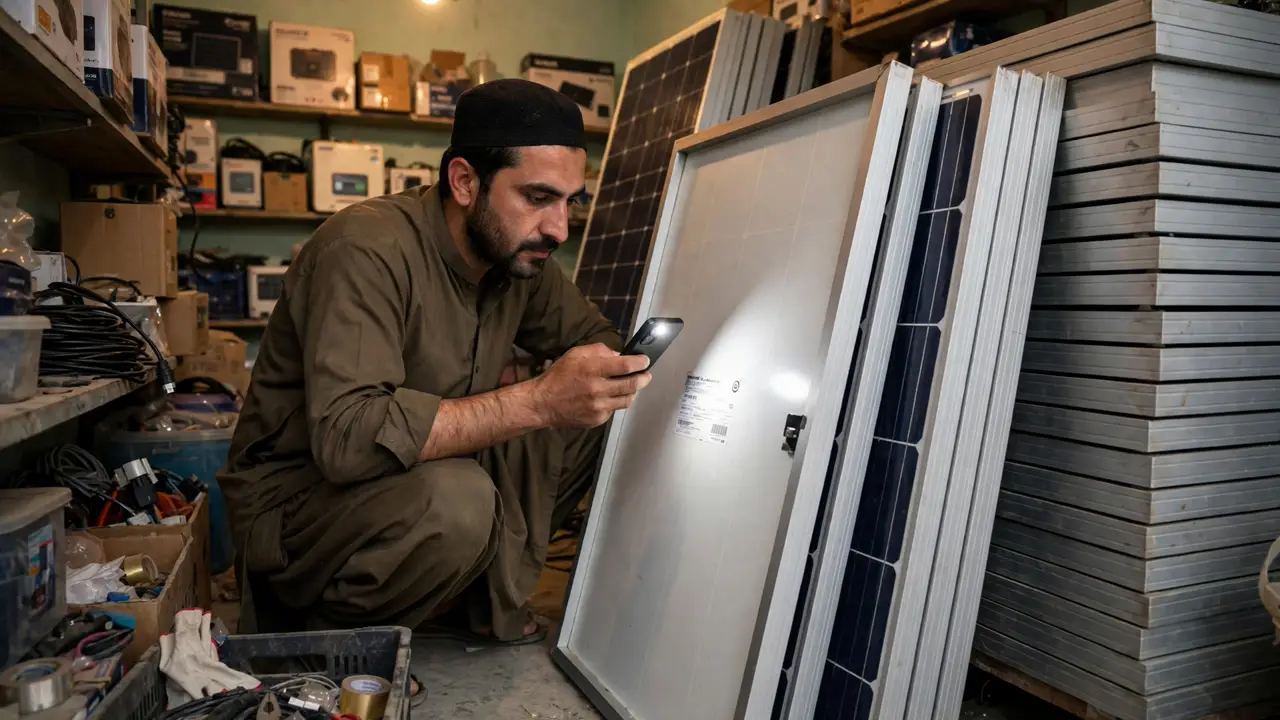
Our solar panel verification guide and the step-by-step Jinko serial number check walkthrough show the same checking method applied to another brand — the technique transfers directly.
Astronergy vs Jinko, Longi and Other Tier-1 Brands
Buyers often ask which brand is “best”. The honest answer: Astronergy, Jinko, Longi, Canadian Solar and Trina are all established Tier-1 manufacturers, and the differences that matter are at the series and model level, not the logo level. Compare datasheets, not brand names: an Astronergy N7 Pro will beat a competitor’s older P-type panel, and vice versa.
What should genuinely influence your choice between them:
- Local availability and support: which brands your city’s importers stock and service well. Jinko and Longi currently have the deepest dealer networks in Pakistan; Astronergy availability varies by city, so confirm local stock before finalising your system design.
- Series, not brand: match the cell technology (n-type TOPCon for hot climates) to your roof.
- Documentation: whichever brand you pick, genuine serials and an importer-backed warranty card matter more than the badge.
Current market rates for all these brands sit side by side in our daily price tables — compare total system economics there once you have shortlisted models.
Check Current Prices
Astronergy’s lineup spans mainstream to large-format flagship, and market rates move with the dollar, import costs and dealer stock — too fast for any article to track. Our homepage maintains daily updated price tables for Astronergy alongside every major brand.
Check today’s updated Astronergy panel prices →
Frequently Asked Questions (FAQs)
Are Astronergy solar panels good?
Astronergy is CHINT Group’s solar module arm (founded 2006) — a BloombergNEF Tier-1 maker and nine-time Kiwa PVEL Top Performer with 130+ GW of global shipments. Its modules sit in the same Tier-1 peer group as Jinko, Longi, Canadian Solar and Trina. Quality depends on the series and — critically — on buying genuine, documented stock.
Which Astronergy series is best for homes in Pakistan?
For most homes, the ASTRO N5 series is the practical choice — residential-sized, widely quoted, and compatible with standard inverters. If your roof is small or runs very hot, the N7 series offers higher efficiency and a lower temperature coefficient. Confirm local availability with dealers before finalising your design.
Are Astronergy panels N-type or P-type?
The current ASTRO N-series (N5, N7, N8) are all n-type TOPCon. Older Astronergy lines such as the ASTRO 5 series used different cell technologies. Check the cell technology on the back label and datasheet for your exact model rather than assuming.
What warranty comes with Astronergy panels?
Published Astronergy specifications for ASTRO N-series modules typically list a 15-year product warranty and a 30-year linear power warranty (≤1% first-year degradation, ~≤0.35%/year after). The warranty must be backed by the importer’s stamped warranty card, with your panel serial numbers on the invoice.
How can I check if my Astronergy panel is genuine?
Verify the unique serial number on the back label through Astronergy’s official website or the authorised dealer channel — the returned model and wattage must match. Cross-check the label against the published datasheet and insist on serial numbers on your invoice.
How many Astronergy panels do I need for a 5 kW system?
Divide 5,000W by the panel wattage and round up: about nine 585W-class panels, or about eight 620W-class panels. Have your installer confirm the exact count against your sanctioned load and inverter input limits.
Do Astronergy panels handle Pakistan’s summer heat well?
Yes — heat handling is an N-series strength. The N7 and N8 series publish a temperature coefficient of -0.26%/°C, among the lowest in mainstream modules. Pair them with a ventilation gap under the panels and the correct tilt for your city.
