
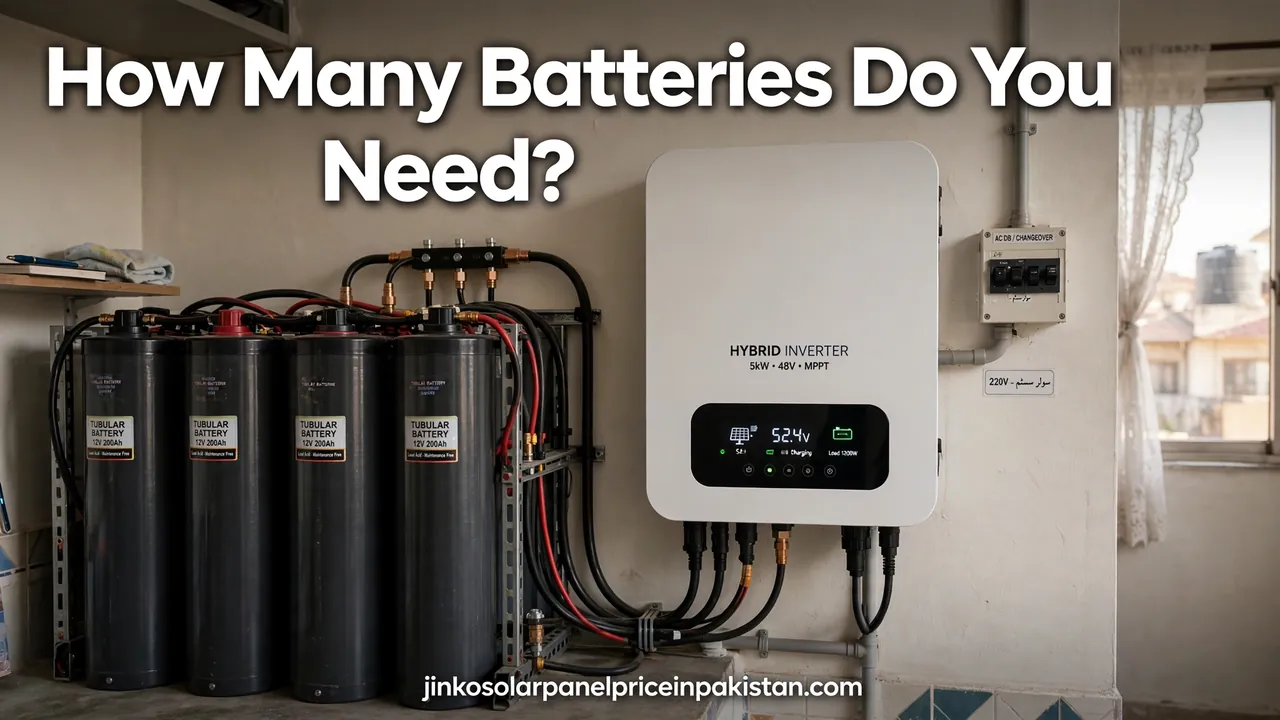
How Many Batteries Do You Need for a Solar System in Pakistan?

If you are asking how many batteries you need for a solar system in Pakistan, here is the direct answer: there is no single number that fits every home, because the count depends on three things — how much electricity you use after sunset, how many hours of backup you want, and the voltage and usable capacity of the batteries you choose. A small home that runs a few fans, lights and a fridge overnight may need only a modest battery bank, while a larger home with an air conditioner on backup can need two or three times as many batteries. The good news is that you do not need to guess. There is a simple formula: add up your night-time load in watt-hours, convert it to amp-hours at your system voltage, adjust for how deeply your battery type can be discharged, and divide by the rating of one battery. This guide walks you through that calculation step by step, with worked examples for 12V, 24V and 48V systems.
The Battery-Count Formula in 5 Steps
Counting batteries is really an energy calculation wearing a disguise. You are not really counting batteries — you are calculating how much stored energy your nights require, then translating that energy into a number of battery units. Follow these five steps in order.
Step 1: Add Up Your Night-Time Load
List every appliance the batteries must run after sunset — ceiling fans, LED lights, fridge, TV, Wi-Fi router, and anything else on your backup circuit. For each one, multiply its wattage by the hours it runs at night. A fan rated at 75 watts running for 8 hours uses 600 watt-hours (Wh). Add all of these together to get your total night-time energy in watt-hours.
Only count what actually runs on battery power. Your daytime load is handled directly by the solar panels while the sun is up, so including it here inflates the battery count. If you are unsure which circuits are on backup, ask your installer for the backup load list — every properly designed system has one. Our best battery for a solar system in Pakistan guide explains how the battery bank fits into the rest of the system.
Step 2: Decide Your Backup Hours
Backup hours are not the same as night-time hours. If your area gets reliable grid supply at night and you only need the batteries to ride through load shedding, your backup hours might be far fewer than the full night. If outages are frequent or you are sizing for an off-grid setup, plan for the whole night — typically 10 to 12 hours in Pakistan depending on the season.
Also consider days of autonomy: how many consecutive cloudy days should the bank survive without sunshine? For grid-connected hybrid systems, one day of autonomy is the usual starting point. We cover this in more detail below.
Step 3: Convert Watt-Hours to Amp-Hours
Batteries are rated in amp-hours (Ah) at a specific voltage, so convert your energy figure: divide the watt-hours from Step 1 by your system voltage. A 3,600 Wh night-time load on a 48V system needs 75 amp-hours of usable capacity (3,600 ÷ 48 = 75). On a 24V system the same energy needs 150 Ah, and on a 12V system it needs 300 Ah. The energy is identical — only the voltage changes the amp-hour figure.
Step 4: Adjust for Usable Capacity
Not all of a battery’s rated capacity should be used every day. Tall tubular and dry lead-acid batteries last far longer when only about half of their rated capacity is discharged daily; pushing them deeper every night shortens their life noticeably. Lithium (LiFePO4) batteries are different — most of their rated capacity is usable on a daily basis. So take your usable amp-hours from Step 3 and divide by the usable fraction: for tubular or dry batteries, roughly double the figure; for lithium, use a figure close to the usable number itself. If you have not chosen a battery type yet, read our overview of the types of solar batteries in Pakistan first.
Step 5: Divide by One Battery’s Rating — Then Round Up
Divide the required rated capacity by the amp-hour rating of the battery model you plan to buy, then round up to the next whole battery. Batteries also have to fit your system voltage in whole units: on a 48V system built from 12V batteries, you need multiples of four wired in series; on 24V, multiples of two. Always round up, never down — a bank that is slightly oversized runs cooler, cycles shallower and lasts longer than one that is constantly pushed to its limit.
Worked Example: A Typical Pakistani Home on 48V
Let us run the formula with stated assumptions so you can see exactly how the numbers move. Take a typical home where the backup circuit carries four ceiling fans, six LED lights, one fridge and a TV:
- 4 fans × 75 W × 8 hours = 2,400 Wh
- 6 LED lights × 12 W × 6 hours = 432 Wh
- Fridge (average draw while cycling) ≈ 150 W × 8 hours = 1,200 Wh
- TV + router ≈ 120 W × 4 hours = 480 Wh
Total night-time load ≈ 4,512 Wh, which we will round to 4,500 Wh for the calculation.
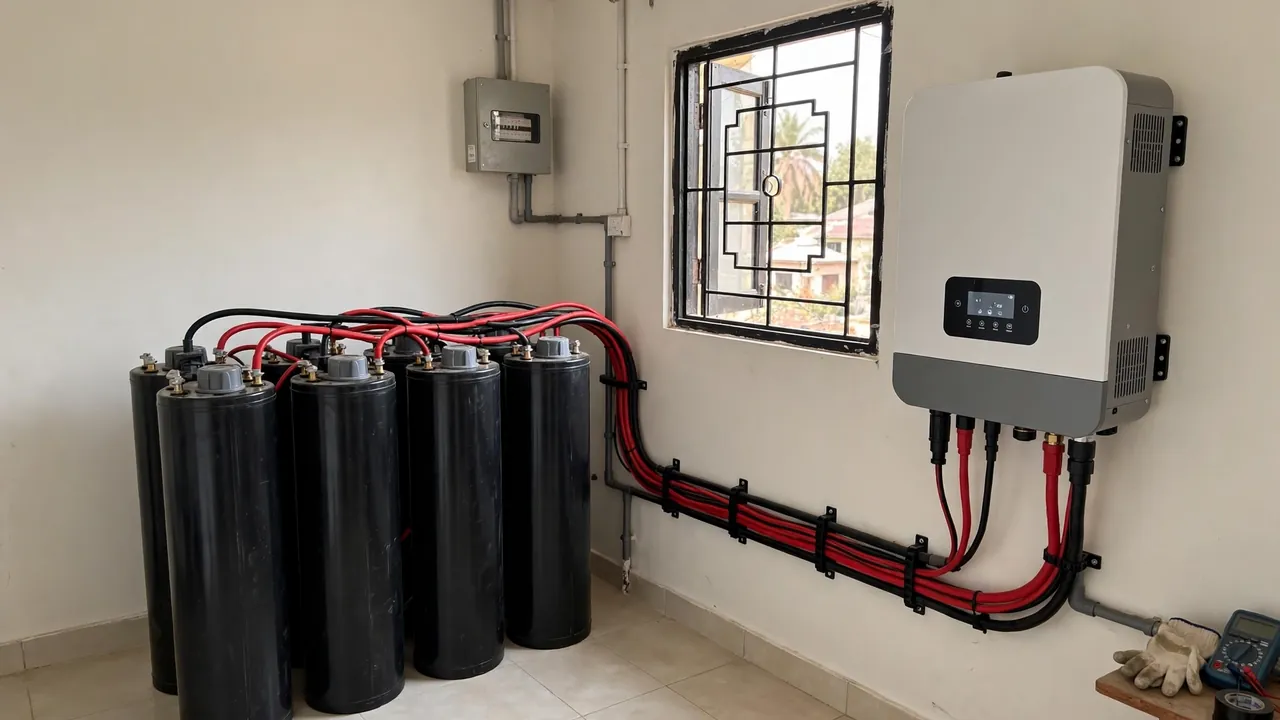
On a 48V system: 4,500 ÷ 48 = 94 Ah of usable capacity needed. With tall tubular batteries, only about half the rated capacity should be used daily, so the bank needs roughly 188 Ah of rated capacity. Using common 12V 200Ah tubular batteries: 188 ÷ 200 = 0.94 of one battery’s worth of capacity — but the 48V system needs batteries in series strings of four (4 × 12V = 48V), and four 200Ah batteries in series give 48V at 200Ah, comfortably covering the 188 Ah requirement. Answer: 4 batteries.
Notice how the series requirement decided the final count as much as the energy math did. This is why the formula and the voltage configuration must be worked through together.
Same Home With Lithium: Why the Count Changes
Run the same 4,500 Wh example with lithium (LiFePO4) batteries, where most of the rated capacity is usable daily. The usable need is still 94 Ah at 48V, but now the rated bank only needs to be a little above that — say around 100 to 110 Ah at 48V after a safety margin. A single 48V lithium battery rated near that capacity (about 5 kWh of storage) covers the whole night-time load with room to spare. Answer: 1 battery unit (plus the margin already built in).
The count drops not because lithium is magic, but because you can use most of what you pay for, while a tubular bank must be roughly twice the usable size. Fewer units also means less wiring, less floor space and no distilled-water maintenance — which is exactly the trade-off our lithium battery vs dry battery comparison explores in detail.
How System Voltage Changes the Battery Count
The same energy need produces very different battery counts at different voltages, because lower-voltage systems need more parallel capacity to hold the same energy:
- 12V systems (small UPS-style or single-room backup): the 4,500 Wh example needs 375 Ah usable — that is a lot of parallel 12V batteries, with heavy cables. Practical only for very small loads.
- 24V systems (mid-size homes): the same load needs about 188 Ah usable, so two 12V batteries in series per string. A common setup is 2 to 4 batteries.
- 48V systems (standard for whole-home hybrid setups): 94 Ah usable, typically 4 × 12V batteries in series or a single 48V lithium unit. Lower current means thinner cables, less heat and better efficiency.
This is one reason installers in Pakistan now recommend 48V hybrid systems for whole-home backup: the battery count stays manageable and the wiring stays sane. Your inverter’s battery voltage must match the bank, so decide the voltage with your inverter choice — see our solar inverter buying guide for Pakistan for how to pair the two correctly.
Series vs Parallel: What Actually Changes the Count
Wiring batteries in series adds their voltages while the amp-hour rating stays the same: four 12V 200Ah batteries in series make a 48V 200Ah bank. Wiring in parallel adds their amp-hours while voltage stays the same: two 12V 200Ah batteries in parallel make a 12V 400Ah bank. Series strings set the system voltage; parallel strings add capacity.
Two rules matter for counting. First, every series string must contain identical batteries — same brand, same model, same age. A single weaker battery drags its whole string down. Second, keep parallel strings to a sensible number; very large parallel banks are harder to keep balanced and charge evenly. When your calculation lands between two counts, add a parallel string rather than mixing battery sizes.
Days of Autonomy: Sizing for Cloudy Days
The examples above size the bank for a single night with full recharge the next day. Days of autonomy multiply that: if you want the system to survive two consecutive cloudy days, double the night-time energy in Step 1 before running the formula. For grid-connected hybrid homes in Pakistan, where the grid or the next sunny day covers the gap, one day of autonomy is the normal and economical choice. For off-grid homes or areas with long outages, sizing for two days is worth discussing with your installer — it roughly doubles the battery count, so it is a deliberate cost decision, not an accident.
7 Mistakes That Give You the Wrong Battery Count
- Counting daytime load. Only night-time and outage load belongs in the formula. Daytime appliances run straight off the panels.
- Ignoring usable capacity. Sizing a tubular bank at its full rated amp-hours guarantees early failure — only about half is usable daily.
- Forgetting the series requirement. A 48V system needs multiples of four 12V batteries. A calculation that says “3.2 batteries” really means 4.
- Adding mismatched batteries later. Bolting new batteries onto an ageing bank wastes the new ones — the weakest battery sets the pace for all.
- Trusting rules of thumb. “One battery per kilowatt of panels” ignores your actual night load. Two identical 5kW systems can need very different banks.
- Undersizing the cables. Thin DC cables between batteries and inverter waste energy as heat and can trip the inverter on voltage drop under load.
- Ignoring the inverter’s charger. A bigger bank needs longer to recharge; confirm your inverter’s charger can refill the bank within your sunshine hours. EnergySage’s three-step battery sizing guide makes the same point: size the storage and the charging source together.
Check Current Battery Prices in Pakistan
Battery prices in Pakistan move with the dollar rate, import costs and demand, so this guide deliberately avoids quoting figures that would go stale within weeks. Once you know your battery count from the formula above, check today’s updated prices for batteries and complete solar systems on our homepage, where the price tables are refreshed every morning.
Frequently Asked Questions (FAQs)
Can I add more batteries to my solar system later?
Yes, but only if the new batteries match the existing bank in brand, model, voltage and age. Mixing new batteries with an ageing bank drags the new ones down to the weakest battery’s level, so most installers recommend planning the full bank size upfront rather than expanding later.
Is it better to use one big battery or several smaller batteries?
It depends on your system voltage and available space. Several smaller batteries give you flexible series-parallel configurations and easier replacement of a single failed unit. One large battery means simpler wiring and less floor space. In Pakistan, commonly available sizes often make the multi-battery bank the practical choice.
Does a bigger solar panel array mean I need more batteries?
No. More panels mean faster daytime charging, but the battery count is set by your night-time energy use, not the array size. An oversized array with a small bank wastes daytime generation; a big bank with too few panels may never fully recharge. Size both sides of the system together.
How do I know if my current battery bank is too small?
Backup hours shrink, the inverter throws low-voltage warnings near the end of the night, and lead-acid batteries run hot or need frequent water top-ups. These are signs the bank is being discharged too deeply every night and either the count or the battery type needs revisiting.
Can I mix old and new batteries in one bank?
No. In a series-parallel bank, the weakest battery limits the whole bank — old batteries pull new ones down to their level and the new batteries age prematurely. If expansion is unavoidable, replace the full bank or build a separate new bank with its own charge controller.
Why does my installer recommend more batteries than my own calculation?
Installers usually add a safety margin for battery ageing, deeper-than-expected discharge, and future load growth — and they must round up to complete series strings for your system voltage. Ask them to show the calculation; a transparent installer will walk you through the watt-hours, voltage and usable-capacity steps.
What happens if I install fewer batteries than my system needs?
It runs out of backup earlier each night, forcing deeper discharges that shorten the life of lead-acid batteries quickly. Chronic undersizing is one of the most common reasons batteries in Pakistan fail within a year or two instead of serving their full expected life.
