
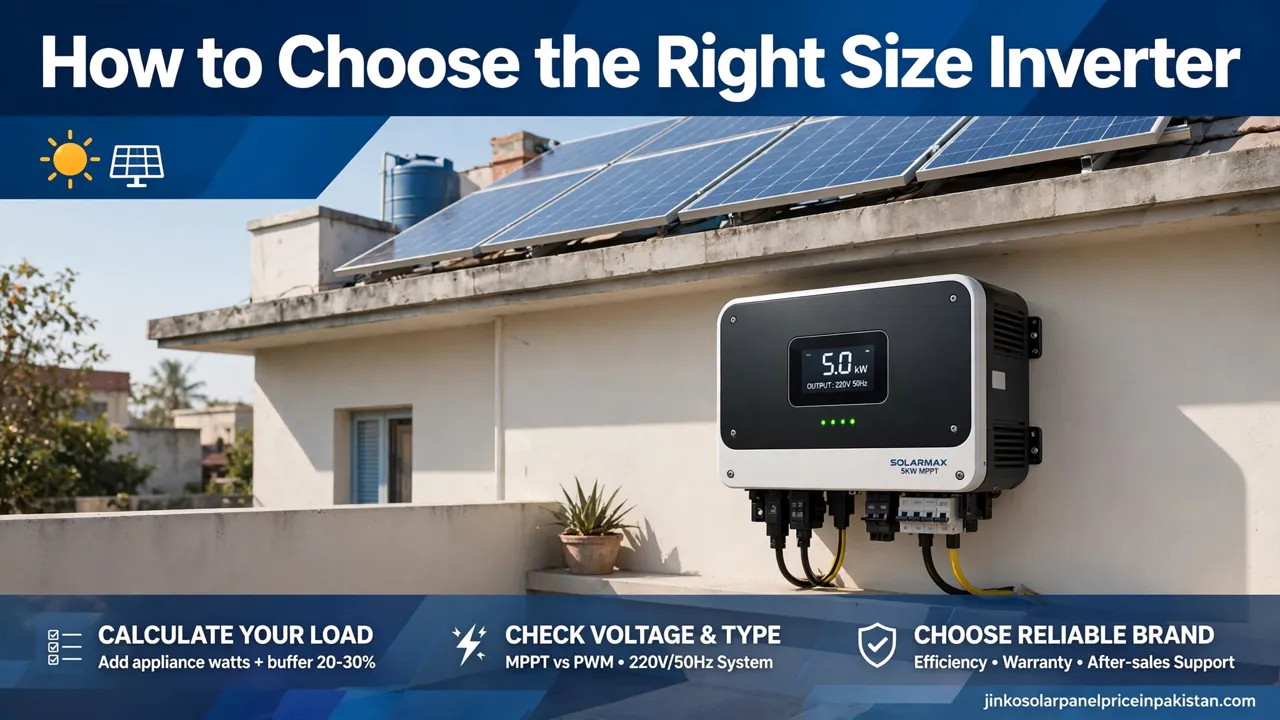
How to Choose the Right Size Inverter for Your Solar System

Choosing the right size inverter for your solar system comes down to two checks: your inverter should be roughly the same size as your solar panel array (a DC-to-AC ratio between 1.1 and 1.25 is the industry rule of thumb), and it must cover the highest load you will run at one time — including the short power surge that motors like fridges, pumps and air conditioners draw at startup. This guide walks you through both methods step by step, with worked examples, so you can size an inverter confidently for any home in Pakistan. For today’s inverter and system prices, check the daily updated price tables on our homepage.
What “Inverter Size” Actually Means
When installers talk about a “5kW inverter”, they mean the inverter’s continuous AC output rating — the maximum power it can deliver non-stop. But that number is only one of several ratings on the spec sheet:
- Continuous output (kW): the power the inverter can supply indefinitely. This is the size you shop by.
- Surge / peak output (kW): a higher power level the inverter can sustain for a few seconds to start motors. A 5kW inverter might handle a 10kW surge for five seconds.
- kVA vs kW: some inverters are rated in kVA (apparent power) instead of kW (real power). For most homes the numbers are close, but always compare kW to kW when matching an inverter to your array.
- PV input capacity (kWp): the maximum solar panel wattage the inverter’s MPPT inputs accept. This can be higher than the AC output — that is exactly what makes the ratio method in the next section work.
- Battery charger rating (hybrids): on a hybrid inverter, the built-in charger’s current limit decides how fast batteries refill from solar or grid — a separate number from the AC output rating.
Undersizing and oversizing both waste money in different ways, which is why the two sizing methods below exist. Our solar inverter buying guide for Pakistan covers the other half of the decision — inverter types, MPPT, warranty and checks before you buy — while this article goes deep on the sizing math itself.
Step 1 — Size From Your Solar Array: The DC-to-AC Ratio Method
For grid-tied and hybrid systems, the standard professional method starts from your panels, not your appliances. It uses the array-to-inverter ratio (also called the DC-to-AC ratio): total solar panel wattage divided by the inverter’s AC output rating.
Here is the step-by-step method:
- Add up your panel wattage (DC). Multiply the number of panels by each panel’s wattage. Example: 10 panels of 585W = 5,850W (5.85kW) of DC capacity.
- Pick your ratio. Most residential designs target a DC-to-AC ratio between 1.1 and 1.25 — this is the range the majority of installers use, and ratios above about 1.55 are generally considered poorly sized. A sunnier, hotter site like much of Pakistan sits comfortably in the middle of this range.
- Divide. Inverter size = array wattage ÷ ratio. For our example: 5,850 ÷ 1.2 = 4,875W — so a 5kW inverter is the natural match.
- Round to the nearest standard size. Inverters come in standard ratings (3kW, 5kW, 6kW, 8kW, 10kW and so on). Pick the closest size at or just above your calculated figure.
Notice the inverter ends up slightly smaller than the panel array. That is deliberate, not a mistake: solar panels rarely produce their full rated power. Heat, dust, wiring losses and the angle of the sun mean a “5.85kW” array typically delivers less than that in real conditions, so the inverter spends more of its time running near its efficient sweet spot instead of idling at half capacity. Angi’s solar inverter size calculator guide confirms the same ratio range and the same reasoning.
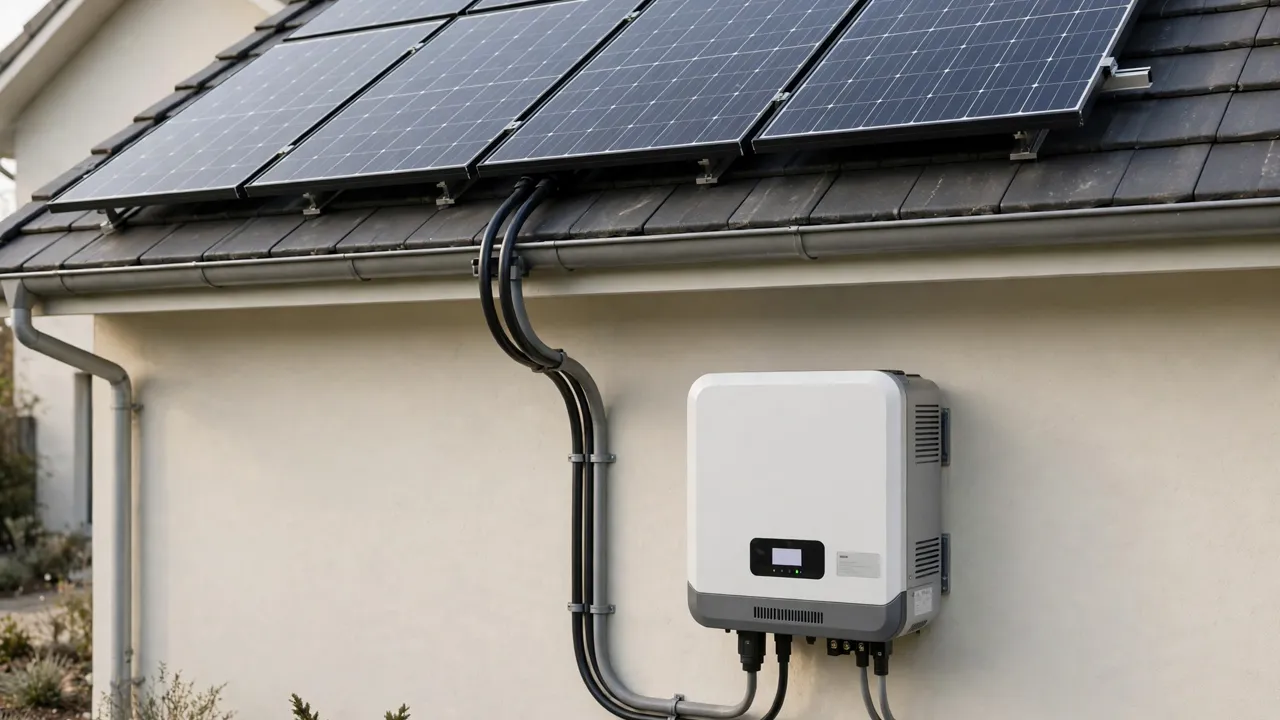
What about clipping?
If your panels briefly produce more DC power than the inverter can convert, the inverter “clips” the excess — it simply caps its output and the extra potential energy is lost. A little clipping on the sunniest hours of the year is normal and cheap; excessive clipping from a badly undersized inverter means you are throwing away free electricity every day. This is why the ratio has an upper limit: keep it at or below roughly 1.3 and clipping stays negligible.
Step 2 — Size for Your Peak Load (Backup and Load Shedding)
The ratio method sizes the inverter for your panels. But in Pakistan, where load shedding makes backup the whole point of the system for many homes, you must also size for your loads — especially on a hybrid inverter running from batteries.
Do this exercise:
- List everything that could run at the same time during an outage, with each appliance’s running wattage. Use the nameplate on the appliance or a typical value.
- Identify the motor loads — fridge, water pump, air conditioner, washing machine. Motors briefly draw two to four times their running power at startup (compressor inrush). Your inverter’s surge rating must cover this spike, not just the running total.
- Add them up, then add headroom. Add roughly 20–25% on top of your simultaneous running total so the inverter is not constantly running at its limit.
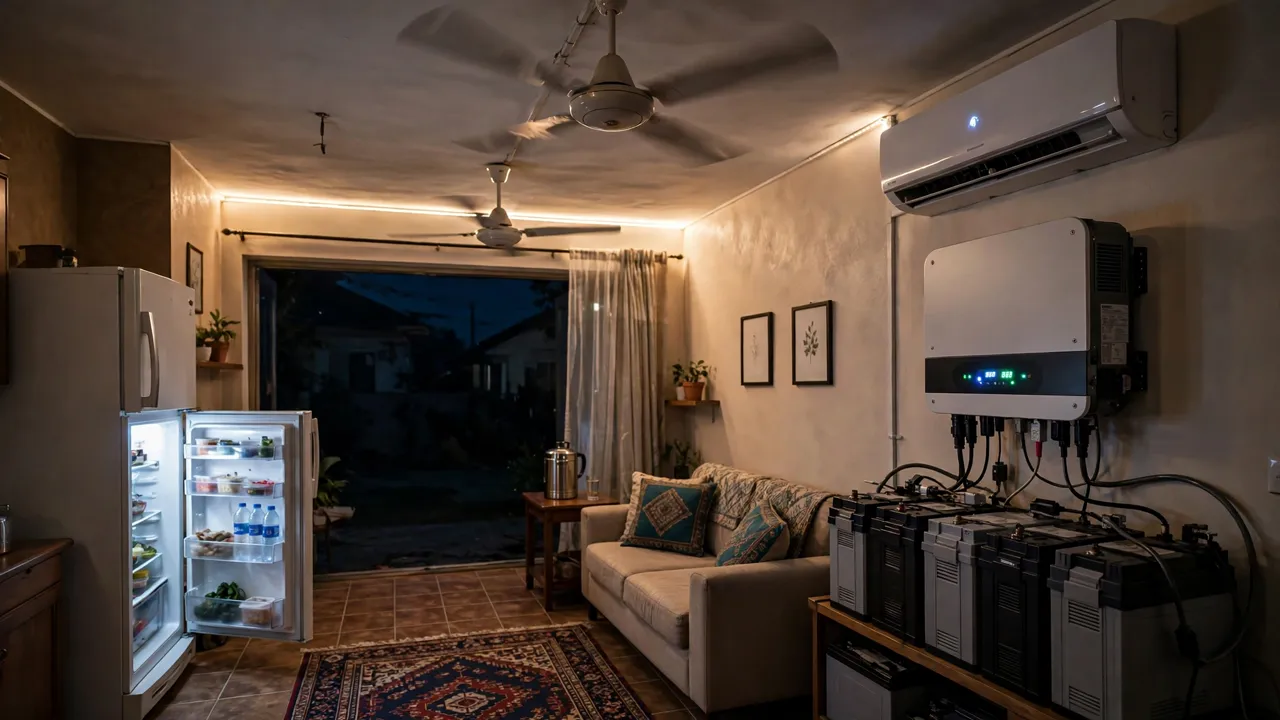
A worked example for a typical evening during load shedding:
- LED lights: 60W
- 4 ceiling fans: 300W
- Fridge (running): 200W — surges to about 800W at compressor startup
- TV + WiFi router + laptop: 200W
- Running total: ~760W · Worst-case surge: ~1,360W
A 2kW hybrid inverter handles this comfortably, with its surge rating absorbing the fridge startup. But add a 1.5-ton inverter AC (roughly 1,600W running, surging past 3,000W at startup) and you need a 5kW-class inverter instead. That one appliance changes the answer completely — which is why installers always ask about air conditioners first. If you are planning backup, read our guide on how many batteries you need next, because the battery bank must be sized to match whatever the inverter can deliver.
Quick Reference: Inverter Size by System Size
If you already know your planned array size, this table gives the standard pairing range. Treat these as starting points, then confirm with the peak-load check above:
| Solar array (DC) | Typical inverter size (AC) | Ratio range |
|---|---|---|
| 3 kW | 2.5 – 3 kW | 1.0 – 1.2 |
| 5 kW | 4 – 5 kW | 1.0 – 1.25 |
| 7 kW | 5.5 – 7 kW | 1.0 – 1.27 |
| 10 kW | 8 – 10 kW | 1.0 – 1.25 |
| 15 kW | 12 – 15 kW | 1.0 – 1.25 |
Larger homes on a three-phase electricity connection need a three-phase inverter in a matching size — confirm your connection type with your electricity bill or installer before buying, since single-phase and three-phase units are not interchangeable.
6 Inverter Sizing Mistakes to Avoid
1. Undersizing the inverter too far
An inverter far smaller than the array clips away your peak production daily. The ratio ceiling exists for a reason — stay within it.
2. Oversizing the inverter too far
An inverter much larger than the array runs at low load most of the day, where conversion efficiency is worse, and you paid for capacity you never use. Oversizing only makes sense as a deliberate plan to add panels later.
3. Ignoring the surge rating
The most common cause of nuisance tripping in Pakistani homes: the continuous rating covers the running load, but the first fridge or pump startup overloads the inverter. Always check the surge figure on the spec sheet against your motor loads.
4. Forgetting future expansion
If you might add panels or batteries in a year or two, choose a hybrid inverter that supports parallel stacking — two units wired together to double capacity — so you add a second inverter instead of replacing the first. Our hybrid solar inverter guide explains how parallel expansion works.
5. Undersizing the battery charger on a hybrid
On hybrid inverters the battery charger’s current rating is separate from the AC output. An undersized charger means batteries refill slowly from solar or grid — check that the charger current suits your battery bank size. See our best battery for solar systems guide and the battery wiring guide for the storage side of the equation.
6. Copying someone else’s system size
Two identical 5kW arrays can need different inverters: one home runs a single AC on backup, the other runs two. Array size sets the starting point; your loads set the final answer. Compare against the top-5 hybrid inverter list only after you know the size you need.
Special Cases: Hybrid Inverters, Batteries and Net Metering
A few situations change the sizing logic:
- Hybrid with batteries: the inverter must handle the array and charge the batteries within its charger rating. If you plan to add batteries later, buy the hybrid inverter now — retrofitting storage onto a basic on-grid inverter usually means replacing it.
- Net metering: your on-grid or hybrid inverter’s export capacity should sit within your sanctioned load and your DISCO’s net metering rules. Read our net metering policy guide before finalizing a grid-tied design.
- MPPT input limits: the inverter’s spec sheet lists maximum string voltage and current per MPPT input. Your panel strings must stay inside those limits — the ratio math assumes they do. Our buying guide’s MPPT section explains what to check.
- Partial shading or split orientations: an inverter with two or more independent MPPT inputs handles differently-oriented panel groups better than a single-MPPT unit of the same size.
Check Current Prices
Once you know the size you need, compare models and current market rates on our homepage, where inverter and solar system price tables are updated daily. Sizing right the first time is the cheapest upgrade you will ever make to a solar system — an hour with these two methods beats years of clipped production or tripped breakers.
Frequently Asked Questions (FAQs)
What size inverter do I need for a 5kW solar system?
A 5kW solar array typically pairs with a 4–5kW inverter, using a DC-to-AC ratio between 1.1 and 1.25 (5,000 ÷ 1.2 ≈ 4,200W, so 4 or 5kW depending on available sizes). Confirm with the peak-load check too: if you run heavy appliances on backup, the larger size is the safer pick.
Should the inverter be the same size as my solar panels?
Not exactly. Standard practice is to size the inverter slightly smaller than the panel array, because panels rarely produce their full rated power due to heat, dust and sun angle. A DC-to-AC ratio of 1.1–1.25 keeps the inverter running in its efficient range; going much above 1.3 causes excessive clipping.
What is the DC-to-AC (array-to-inverter) ratio?
The DC-to-AC (array-to-inverter) ratio is your total solar panel wattage divided by the inverter’s AC output rating. For example, a 6,000W array on a 5,000W inverter gives a ratio of 1.2. Most residential systems target 1.1–1.25; ratios above about 1.55 are considered poorly sized.
What happens if my solar inverter is too small?
A too-small inverter ‘clips’ your production — whenever the panels generate more DC power than the inverter can convert, the excess is lost. A little clipping at midday is normal and cheap, but a badly undersized inverter wastes free electricity every sunny day and may run hot.
Is it better to oversize or undersize a solar inverter?
Slight undersizing is usually better than large oversizing. A modestly smaller inverter runs near its efficient sweet spot and clips only a little at peak hours. A much oversized inverter idles at low load (where efficiency drops) and costs more for capacity you never use — unless you plan to add panels later.
How do I size an inverter for load shedding backup?
List every appliance that could run at once during an outage, note motor loads (fridge, pump, AC) that surge to two to four times their running power at startup, add the totals, then add about 20–25% headroom. The inverter’s continuous rating must cover the running total and its surge rating must cover the worst startup spike.
What is surge rating on a solar inverter?
Surge (peak) rating is the short burst of extra power an inverter can deliver for a few seconds to start motors — for example, a 5kW inverter might handle a 10kW surge for five seconds. It matters because compressor motors briefly pull several times their rated power at startup, and without enough surge capacity the inverter trips.
Can I upgrade my inverter later if my system grows?
Yes, if you plan ahead. Many hybrid inverters support parallel stacking — wiring a second identical unit alongside the first to double capacity later. If expansion is likely, choose a parallel-capable hybrid from the start; otherwise upgrading usually means replacing the inverter entirely.
