
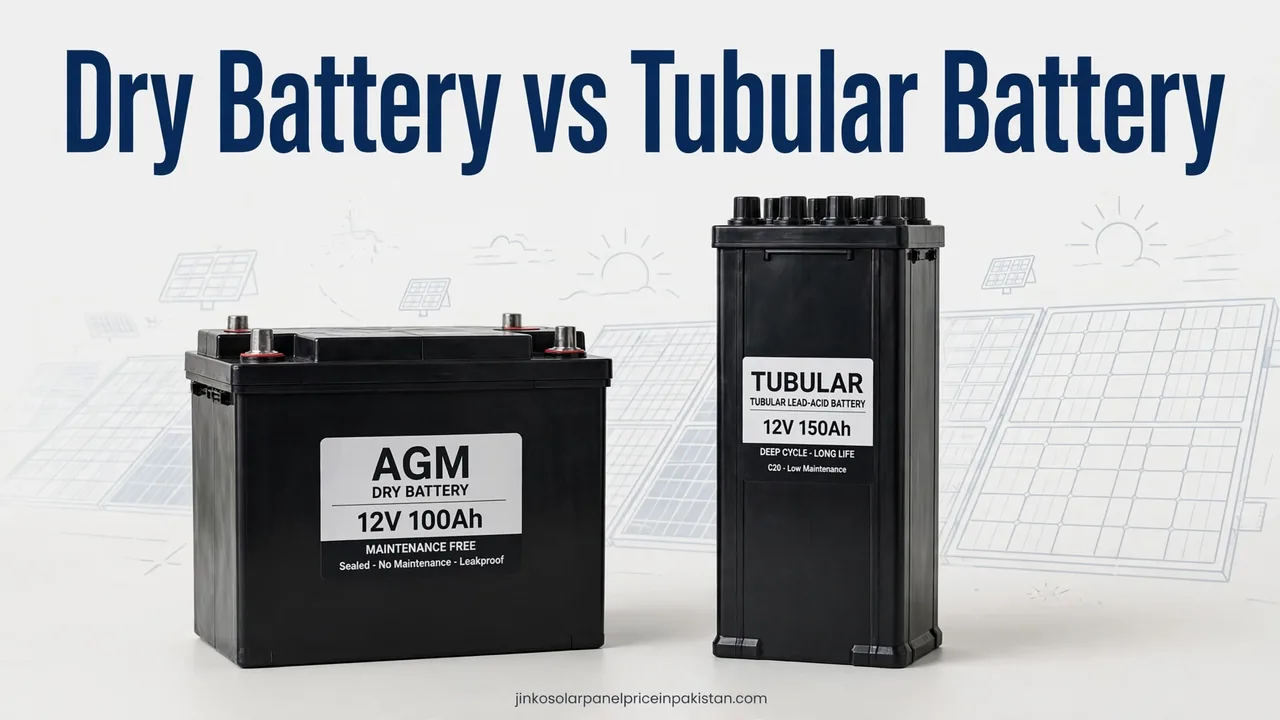
Dry Battery vs Tubular Battery for Solar: Key Differences

If you are deciding between a dry battery vs tubular battery for solar in Pakistan, here is the short answer: a tall tubular battery is the better deep-cycle workhorse for a solar system that charges and discharges almost every day, while a dry (sealed, maintenance-free) battery is the more convenient choice when you want zero upkeep and outages are only occasional. Tubular batteries use thick tube-shaped plates built to survive repeated deep discharges, and they are widely available and easy to service across Pakistan. Dry batteries — usually AGM or gel sealed lead-acid types — need no distilled-water top-ups, charge faster and can sit in more places, but they are more sensitive to overcharging and sustained heat. This guide compares their construction, lifespan, maintenance, charging behaviour and real-world suitability so you can match the battery to your load-shedding pattern and habits.
What Is a Dry Battery?
A “dry battery” in the Pakistani solar market usually means a sealed, maintenance-free lead-acid battery — technically a valve-regulated lead-acid (VRLA) battery. The two common designs are AGM (absorbent glass mat), where the acid is soaked into a fine fibreglass mat between the plates, and gel, where the acid is set in a silica gel. Because the electrolyte cannot spill, the battery is sealed: no caps to open, no water to top up, and no acid fumes during normal charging.
As Battery University’s guide to AGM (sealed lead-acid) batteries explains, this technology became popular for applications that need reliability and low maintenance. AGM batteries have very low internal resistance, deliver high currents on demand and charge up to five times faster than the flooded version. They are less prone to sulfation when left standing and handle cold temperatures well — though they do not like heat: manufacturers recommend halting charge if the battery core reaches about 49°C, which matters in a Pakistani summer.
In practice, dry batteries suit users who want a fit-and-forget battery: offices, shops and homes where nobody wants the chore of checking water levels. The trade-off is that the sealed design is less forgiving of abuse — overcharging dries out the electrolyte permanently, since you cannot top it up.
What Is a Tall Tubular Battery?
A tall tubular battery is a flooded (wet-cell) lead-acid battery with a special plate design. Instead of flat pasted plates, its positive plates are built as a series of tubes — spines of lead alloy wrapped in a gauntlet of fabric, packed with active material. This tubular construction resists the shedding of active material that happens every time a lead-acid battery is deeply discharged, which is why tubular batteries survive thousands of repeated cycles far better than flat-plate designs.
Tall tubular batteries are the classic deep-cycle battery of the Pakistani solar and UPS market. Their tall, narrow case gives the plates room to work and makes the most of the electrolyte volume. They are an open, flooded design, so they need periodic distilled-water top-ups as water is lost during charging, and they should sit in a ventilated spot because they release small amounts of hydrogen gas while charging.
The practical advantage is serviceability: almost every battery shop in Pakistan understands tubular batteries, spare parts and expertise are everywhere, and a well-kept tubular battery delivers years of daily cycling. If you want the full picture of this type on its own, see our tall tubular battery guide.
Dry Battery vs Tubular Battery: Key Differences at a Glance
The table below summarizes how the two types compare on the factors that matter most for a home solar system. The sections that follow explain what each difference means in practice.
| Factor | Dry (AGM / Sealed) Battery | Tall Tubular Battery |
|---|---|---|
| Construction | Sealed lead-acid; electrolyte absorbed in glass mat or gel | Flooded lead-acid; tubular positive plates in liquid electrolyte |
| Maintenance | None — no water top-ups, no equalization | Regular distilled-water top-ups and terminal checks |
| Deep-cycle tolerance | Good; but overcharging and deep heat exposure shorten life | Excellent — tubular plates are built for repeated deep discharges |
| Usable depth of discharge | Higher usable range for the same cycle life (Battery University cites 80% DoD for AGM vs 50% for flooded to attain the same cycle life) | Best kept to moderate daily discharges for long life |
| Charging speed | Faster — low internal resistance accepts high charge currents | Slower — needs a full absorption charge to reach 100% |
| Ventilation needs | Minimal — sealed, no routine gassing | Needs a ventilated spot; releases hydrogen while charging |
| Heat sensitivity | High — sustained heat is the main enemy of sealed batteries | Moderate — tolerates warm battery rooms better, though heat still ages any battery |
| Local serviceability | Growing, but fewer repair options than tubular | Excellent — serviced by nearly every battery shop in Pakistan |
| Best for | Occasional backup, users who want zero maintenance | Daily solar cycling and areas with regular load shedding |
Lifespan and Daily Cycling Performance
A solar battery’s real job is not sitting fully charged — it is cycling. In most Pakistani homes with load shedding, the battery discharges every evening and recharges every day. This is exactly the duty tubular batteries were designed for: the tubular plate structure holds the active material in place through repeated expansion and contraction, so the battery keeps its capacity through years of daily use.
Dry (AGM) batteries also cycle well — Battery University notes their relatively long service life even when deep cycled — but they ask for stricter conditions. Two things shorten a sealed battery’s life faster than a tubular one: overcharging, which dries the immobilized electrolyte with no way to replace it, and sustained heat, which accelerates the internal corrosion that ends every lead-acid battery’s life. A tubular battery in a warm battery room forgives more; a sealed battery in the same spot needs correct charging voltages and, ideally, a cooler location.
The practical takeaway: if your battery will cycle nearly every day of the year, the tubular battery’s forgiving nature usually wins on lifetime. If your grid is reliable and the battery only steps in occasionally, the dry battery’s maintenance-free convenience is hard to beat — and it will spend most of its life in float, where sealed batteries are very comfortable.
Maintenance: What Each Battery Asks of You
This is the most visible day-to-day difference between the two types.
Tubular battery maintenance
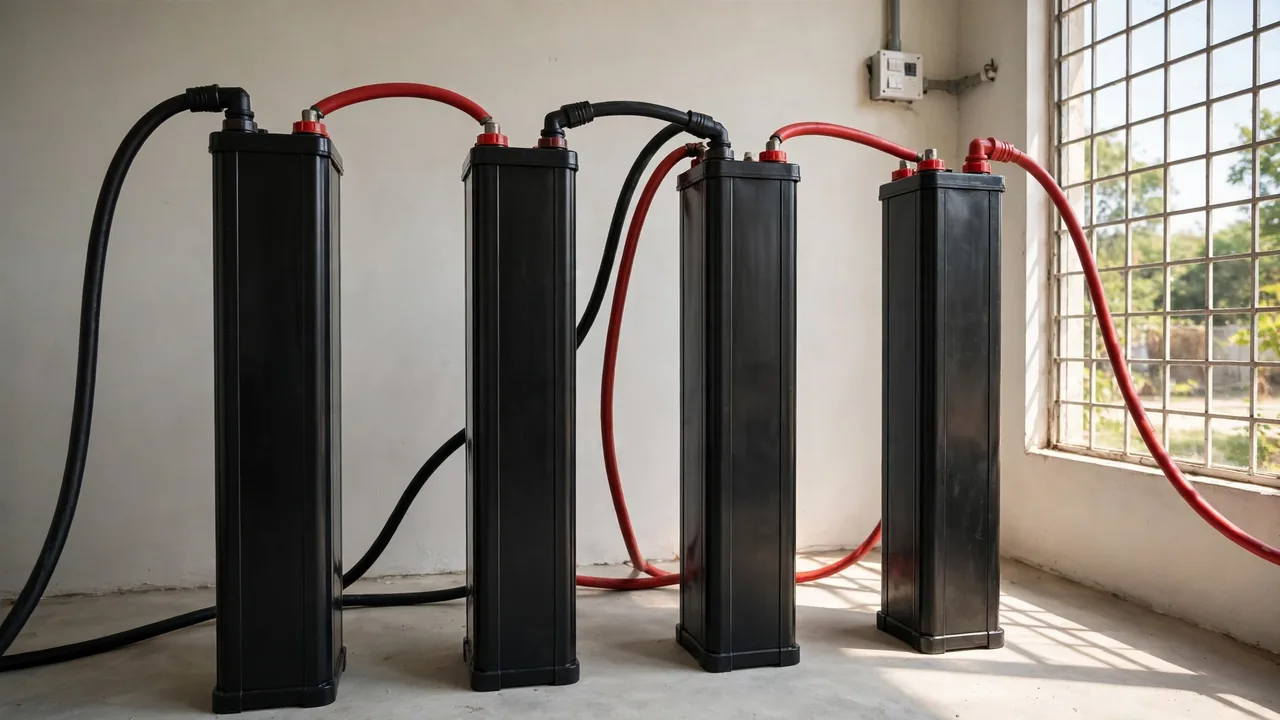
A tubular battery needs a small but regular routine: check the electrolyte level every month or two and top up with distilled water only (never tap water, whose minerals poison the plates), keep the terminals clean and tight, and make sure the battery room has some airflow. Most hybrid inverters can run a periodic equalization charge that helps keep the cells balanced — your installer can set this up. Skip the water top-ups for a season and exposed plates sulfate permanently, so this routine is not optional.
Dry battery maintenance
A sealed dry battery needs essentially no routine maintenance: no water, no equalization, no specific-gravity checks. What it needs instead is correct setup: the charger must use a sealed/AGM charging profile with the right voltage limits, because overcharging is the fastest way to kill it. Keep the terminals clean and tight, keep it out of sustained extreme heat, and make sure it is stored in a charged condition if it will sit unused.
Be honest with yourself about which routine you will actually follow. A tubular battery with neglected water levels dies early; a dry battery with the wrong charge profile dies early too. The “maintenance-free” label only holds if the charging setup is right from day one.
Charging and Inverter Compatibility
Both battery types work with standard solar inverters and charge controllers, but they want different charging behaviour. A tall tubular (flooded) battery needs a full multi-stage charge — bulk, absorption and float — and benefits from occasional equalization. Most solar inverters sold in Pakistan ship with flooded/tubular presets, and installers know these settings by heart.
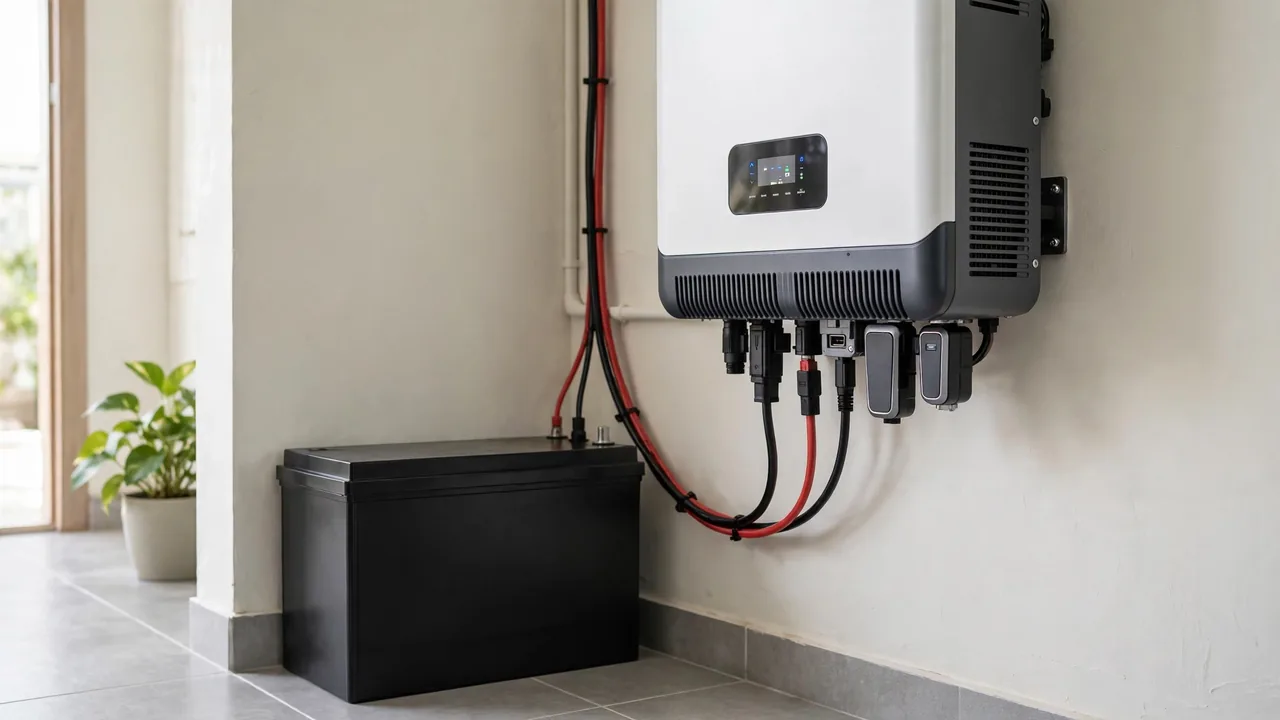
A dry (AGM) battery charges faster thanks to its low internal resistance, but its voltage limits are tighter. It must not be equalized like a flooded battery, and it needs a sealed/AGM profile with lower absorption voltage. Many modern hybrid and off-grid inverters include dedicated AGM or sealed-battery modes — check that yours does before buying, and confirm the settings with the battery’s datasheet rather than guessing. If you are still choosing the inverter side of your system, our solar inverter buying guide walks through the types and the settings that matter.
Which Battery Should You Choose?
Match the battery to your situation, not to what your neighbour bought:
Choose a tall tubular battery if…
- Your area has daily load shedding and the battery will cycle almost every day.
- You (or someone at home) will reliably do the distilled-water top-ups.
- You value local serviceability — any battery shop can test, service and replace a tubular battery.
- Your battery bank will sit in a warm, ventilated battery room or outdoor enclosure.
- You want the most forgiving battery for deep daily discharges.
Choose a dry (AGM) battery if…
- Outages are occasional and the battery will mostly sit in float or standby.
- You want zero maintenance — no water, no checks, no battery-room chores.
- Space is tight or the battery must sit indoors, in a cabinet or at an angle a flooded battery cannot take.
- Your inverter has a proper AGM/sealed charging profile and the battery will stay out of extreme heat.
- You need faster recharge between short daytime outages.
If you are comparing across all storage options rather than just these two, our best battery for solar system in Pakistan guide covers every type — including lithium — and our types of solar batteries guide maps the whole landscape. For the other classic pairing, see our lithium vs dry battery comparison and the lithium battery guide.
Can You Mix Dry and Tubular Batteries in One Bank?
No — do not mix them. Dry and tubular batteries use different charging voltages and profiles: what fully charges a tubular battery overcharges a sealed dry battery, and what suits a dry battery undercharges a tubular one. A mixed bank charges unevenly, the weakest battery drags the rest down, and the whole bank dies early. The same rule applies within one type: build each bank from identical batteries of the same capacity and age. If you are expanding an old bank, replacing the whole bank usually outlasts adding fresh batteries alongside tired ones.
Check Current Prices
Battery prices in Pakistan move with the dollar rate, import duties and demand, so any figure printed in an article is outdated within weeks. For today’s dry battery and tubular battery prices — updated every morning from the live market — see the price tables on our homepage. When you are ready to buy, compare a few authorized dealers, confirm the manufacturing date on the battery, and make sure the warranty card is stamped.
Frequently Asked Questions (FAQs)
What is a dry battery?
A dry battery — usually called a maintenance-free, sealed lead-acid or VRLA battery — is a lead-acid battery in which the electrolyte is absorbed in a glass-fibre mat (AGM) or set in a gel, instead of flowing freely as liquid. Nothing spills, so the battery needs no distilled-water top-ups and can be installed in more positions. Battery University notes that AGM technology became popular as a sealed lead-acid design for applications that need reliability and low maintenance.
What is a tubular battery?
A tall tubular battery is a flooded (wet-cell) lead-acid battery whose positive plates are built as tubes of active material held in a gauntlet, rather than flat pasted plates. The tubular construction resists shedding of the active material during repeated deep discharges, which is why it is the classic deep-cycle choice for daily solar and UPS duty in Pakistan.
Which lasts longer for solar: a dry battery or a tubular battery?
Under daily solar cycling, a tall tubular battery generally delivers a longer service life, because its tubular plates are engineered to survive repeated deep discharges. A sealed dry (AGM) battery charges faster and needs no water top-ups, but it is more sensitive to overcharging and sustained heat — and it must be stored in a charged condition. For a system that cycles every day, tubular is usually the more forgiving choice; for occasional backup where maintenance is unwelcome, dry is convenient.
Do dry batteries need any maintenance?
Almost none. Sealed dry batteries need no distilled-water top-ups and no equalization charges. You should still keep the terminals clean and tight, make sure the charger uses the correct sealed-battery profile (overcharging damages them), and keep the battery away from sustained heat — Battery University recommends halting charge if the battery core reaches about 49°C.
Can I use a dry battery with my solar inverter?
Yes, provided the inverter or charge controller is set to a sealed lead-acid charging profile. Dry (AGM) batteries are more sensitive to overcharging than flooded tubular batteries, so the charging voltages must match the battery’s specification. Many modern hybrid and off-grid inverters include dedicated AGM or sealed-battery modes.
Which battery is better for areas with daily load shedding?
If your area faces daily load shedding and the battery will cycle almost every day, a tall tubular battery is usually the better fit — its construction is designed for exactly that duty. If outages are occasional and you want a fit-and-forget battery with no water top-ups, a dry (AGM) battery is the more convenient option. Either way, size the bank so your normal nightly use stays within a moderate depth of discharge.
Can I mix dry and tubular batteries in one battery bank?
No. Dry and tubular batteries use different charging voltages and profiles, and mixing them — or mixing old and new batteries of any type — leads to uneven charging, with the weaker unit dragging the whole bank down. Build each bank from identical batteries of the same type, capacity and age.
