
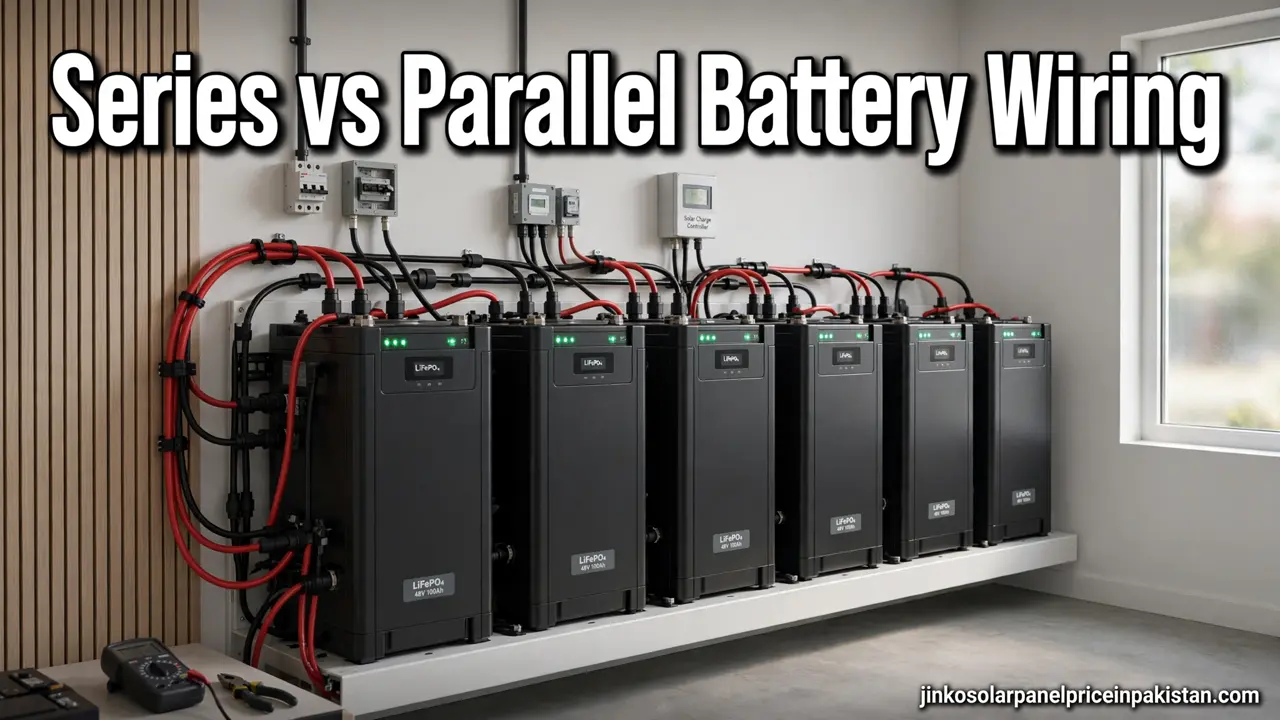
Solar Battery Wiring: Series vs Parallel Connection Guide

If you are wondering how to wire your solar battery series vs parallel connection, here is the short answer: series wiring adds voltages while keeping capacity (amp-hours) the same — two 12V 200Ah batteries in series give you 24V 200Ah. Parallel wiring adds capacity while keeping voltage the same — the same two batteries in parallel give you 12V 400Ah. The right choice depends on your inverter’s battery voltage and how much backup capacity you need: wire the wrong way and the system simply will not start — or worse, you can damage the inverter or batteries. This guide explains both methods with simple diagrams, shows when to use each one, covers series-parallel combination banks, and lists the safety rules and common mistakes to avoid. For current battery and system prices, check the daily updated price tables on our homepage.
Why Battery Wiring Configuration Matters
A solar battery bank is rarely a single battery. Most home systems use two, four or more batteries working together, and how you connect them decides the bank’s total voltage and total capacity. Your inverter is designed for a specific battery voltage — common options are 12V, 24V and 48V — and the bank you build must match it exactly. A 48V hybrid inverter will not run correctly on a 12V bank, no matter how many amp-hours it holds.
Wiring also affects cable thickness, charge balance between batteries, fusing and long-term battery health. Getting it right at installation time avoids most of the battery problems that show up a year or two later. Note: this guide covers battery-bank wiring — connecting your storage batteries together. Wiring the solar panels themselves into series/parallel strings is a separate topic. If you are still choosing the batteries themselves, our best battery for solar system in Pakistan guide covers types, sizing and selection basics first, and our battery-count guide helps you work out how many batteries your system needs before you wire them.
What Is a Series Connection?
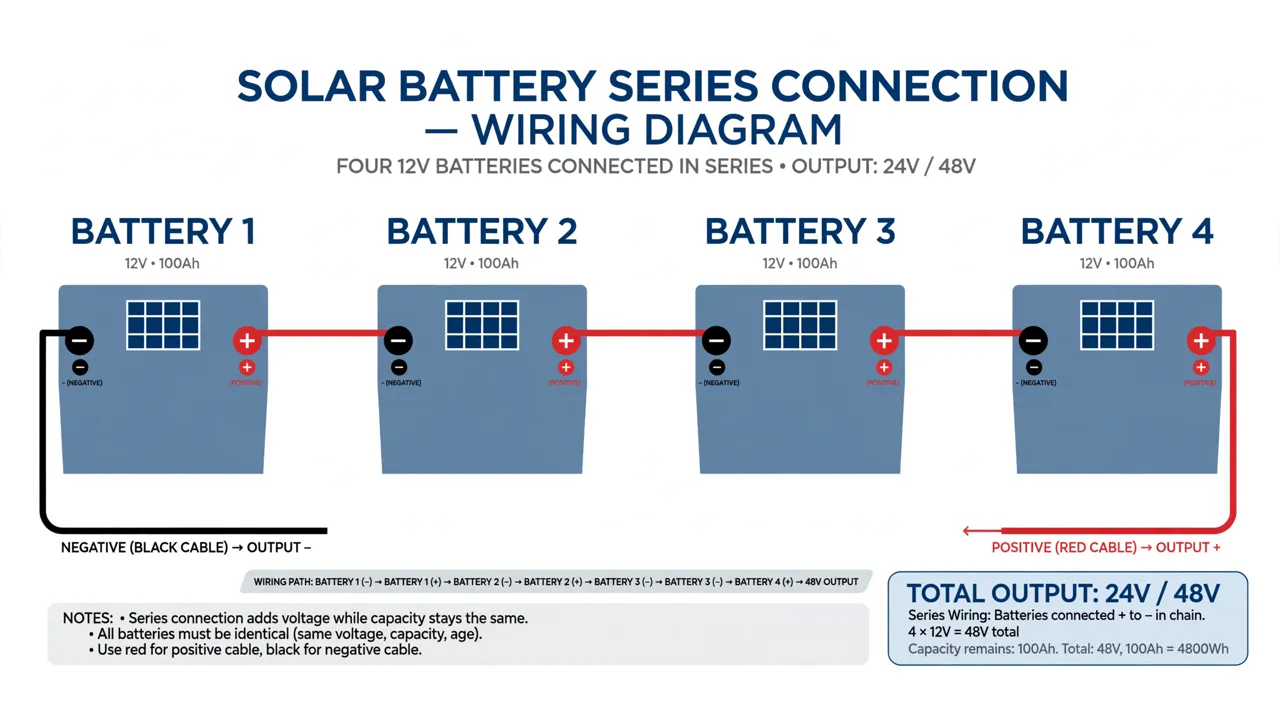
In a series connection, you link batteries end to end: the positive (+) terminal of one battery connects to the negative (−) terminal of the next, like train cars in a line. The system then draws power from the remaining free positive and negative terminals at the two ends of the chain.
The effect is simple: voltages add up, amp-hour capacity stays the same. Two 12V 100Ah batteries in series become a 24V 100Ah bank; four become a 48V 100Ah bank.
- Voltage: adds — 12V + 12V = 24V, and so on for each battery in the string.
- Capacity (Ah): stays equal to a single battery’s rating — but total energy (Wh = volts × amp-hours) still rises with each battery.
- Current: the same current flows through every battery, which is why higher-voltage banks can use thinner cables.
The rule to remember: the chain is only as strong as its weakest battery. If one battery in a series string is older, weaker or a different capacity than the rest, it limits the entire string and can be over-charged or over-discharged by the stronger batteries around it. Series strings must always use identical batteries — same brand, model, capacity, chemistry and, ideally, the same purchase batch and age.
What Is a Parallel Connection?
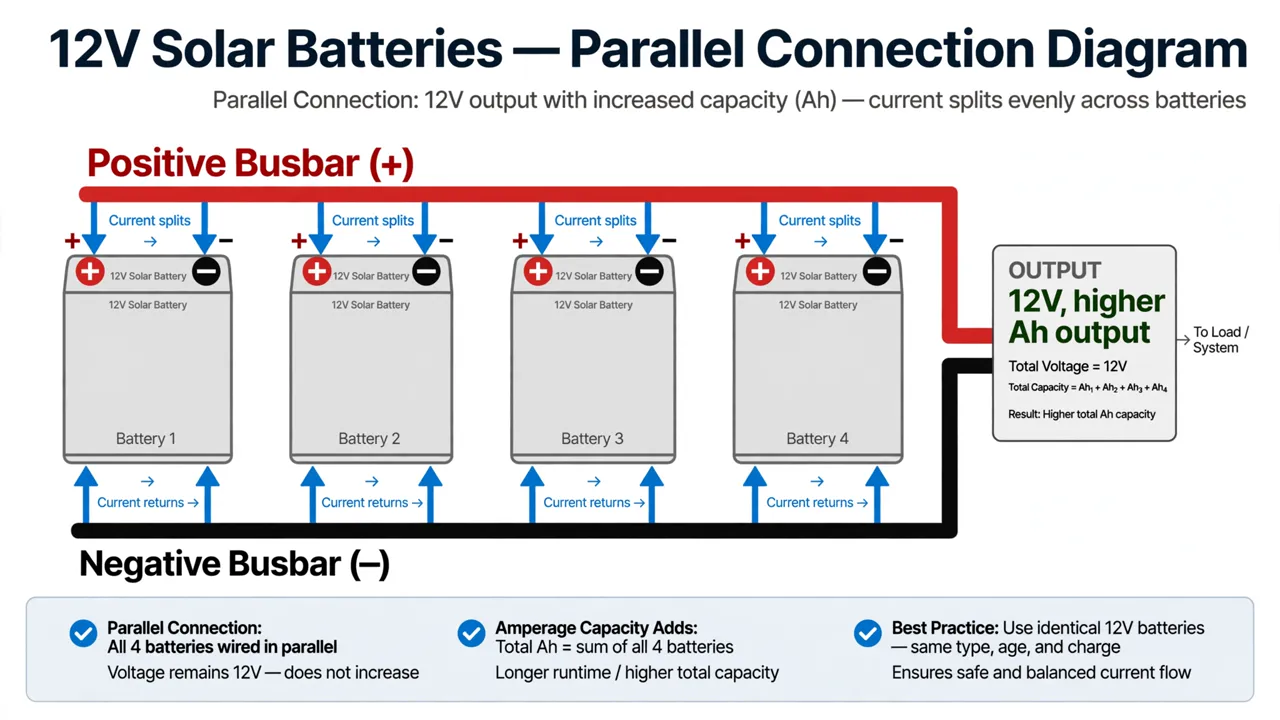
In a parallel connection, you link batteries side by side: all positive (+) terminals connect together, and all negative (−) terminals connect together. The bank behaves like one big battery of the same voltage.
The effect is the mirror image of series: capacity adds up, voltage stays the same. Two 12V 200Ah batteries in parallel become a 12V 400Ah bank — a wider tank of the same height: more stored energy at the same voltage.
- Voltage: stays equal to a single battery’s voltage — 12V in parallel is still 12V.
- Capacity (Ah): adds — 200Ah + 200Ah = 400Ah — so total energy and backup time grow with each battery.
- Current sharing: the load current splits across the batteries, so each one works less hard — but only if the wiring gives each battery an equal path.
The identical-battery rule matters even more in parallel: batteries continuously exchange small currents with each other, so a mismatched battery wastes energy and shortens the life of the whole bank. Always parallel identical batteries, and charge every battery to the same full state before connecting them together.
Series vs Parallel: Key Differences at a Glance
| Feature | Series connection | Parallel connection |
|---|---|---|
| Voltage | Adds up (12V + 12V = 24V) | Stays the same as one battery |
| Capacity (Ah) | Stays the same as one battery | Adds up (200Ah + 200Ah = 400Ah) |
| Total energy (Wh) | Increases with each battery | Increases with each battery |
| Matching inverter voltage | The way to reach 24V/48V from 12V batteries | Keeps 12V systems at 12V |
| Cable size | Higher voltage = lower current = thinner cables possible | Higher current = thicker cables and bigger fuses needed |
| Weak-battery effect | One weak battery limits the whole string | One weak battery drags down the others |
| Adding capacity later | Add a matched full string, not one battery | Add identical batteries, fully charged first |
Both methods store the same total energy with the same batteries — series and parallel are not about “more power”, they are about shaping the same energy into the voltage and capacity your system needs. The educational resource Battery University explains the principle in its guide to series and parallel battery configurations: series raises voltage, parallel raises amp-hour capacity, and mixing both builds larger banks.
When to Wire Solar Batteries in Series
Series wiring is the answer whenever your inverter needs a higher battery voltage than a single battery provides:
- Building 24V banks: many small and mid-size inverters run on 24V. Two 12V batteries in series is the standard way to build that bank.
- Building 48V banks: most modern hybrid inverters are 48V systems. Four 12V batteries in series — or a single 48V lithium module — feeds them correctly. Our solar inverter buying guide for Pakistan explains how battery voltage and inverter choice are linked.
- Reducing cable costs and losses: for the same power, a 48V bank carries a quarter of the current of a 12V bank. Lower current means thinner, cheaper copper cables and less energy lost as heat over long cable runs.
When to Wire Solar Batteries in Parallel
Parallel wiring is the answer whenever your system voltage is already correct but you need more backup hours. Typical situations:
- Extending night-time backup: a 12V system with one battery that dies by midnight gets a second battery in parallel — voltage stays 12V, backup time roughly doubles.
- Growing capacity over time: parallel banks are the natural way to add storage later, provided the new batteries are identical in brand, model, capacity and age to the existing ones (ideally bought together).
- 12V DC loads: systems that run 12V appliances directly stay in parallel so the voltage never changes.
- Lithium module expansion: most 48V LiFePO4 wall-mounted modules are designed to be paralleled — the manufacturer builds in the balancing and communication, and you add modules side by side as needs grow. See our lithium battery guide for how module paralleling works.
One practical tip for parallel banks: take the positive feed from one end of the bank and the negative from the other (diagonal wiring), so current shares evenly instead of overworking the nearest battery.
Series-Parallel Combination Banks: Getting Both
You are not limited to one method. Larger systems combine both: batteries are wired in series strings to reach the required voltage, and those strings are then paralleled to increase capacity. This is called a series-parallel bank.
Combination banks follow both sets of rules at once, which makes them less forgiving of mistakes:
- Every series string must contain the same number of identical batteries, so both strings have exactly the same voltage before they are paralleled.
- Charge both strings to the same full state before connecting them in parallel — a voltage difference between strings causes a heavy equalizing current.
- Fuse each string individually. If one string develops a fault, its fuse isolates it while the other string keeps the system running safely.
- Keep cable lengths symmetric between strings so neither string is favoured.
Balancing in larger banks
In banks with parallel strings, small voltage differences compound over months. Periodic checks of resting voltage, terminal tightness and temperature catch imbalance early. A single persistently low battery is a replacement candidate.
Safety Rules for Wiring Solar Batteries
Battery banks store serious energy — treat these rules as non-negotiable:
- Match everything: same brand, model, capacity (Ah), chemistry and age in every bank. Never mix tubular, dry and lithium batteries in one bank — their charging voltages and behaviours are fundamentally different.
- Equal state of charge before paralleling: fully charge each battery individually before joining them, or the voltage difference will drive a large surge current through the connecting cables.
- Fuse the bank: install a properly rated fuse or DC breaker on the bank’s main positive cable, close to the batteries — and fuse each string individually in series-parallel banks.
- Right-size the cables: undersized cables overheat and drop voltage. Parallel banks carry the highest currents, so they need the thickest cables. When in doubt, go one size thicker.
- Ventilation matters: flooded tubular batteries release hydrogen gas while charging — the battery area needs airflow and no sparks or flames nearby. Keep every bank cool and shaded, since heat shortens battery life. Our tall tubular battery guide covers placement in more detail.
- Tight, clean terminals; safe servicing: loose terminals arc and waste energy — clean, tighten firmly, and re-check after the first month. When servicing, remove metal jewellery, use insulated tools, and make the final connection (and first disconnection) on the negative side to avoid accidental shorts.
Common Battery Wiring Mistakes to Avoid
The errors installers and DIY owners make most often — all easy to prevent once you know to look for them:
- Mixing old and new batteries: adding one fresh battery to a two-year-old bank does not rejuvenate the bank — the old batteries drag the new one down to their level within months. Replace banks as a matched set.
- Wrong voltage for the inverter: connecting a 12V bank to a 24V or 48V inverter (or vice versa) is the single most common wiring failure. Confirm the inverter’s battery voltage in its datasheet before wiring.
- Forgetting the inverter’s battery type setting: many inverters need to be told which battery chemistry they are charging. The wrong profile chronically under- or over-charges the bank.
- Uneven parallel wiring: taking both feeds from the same end of a parallel bank overworks the nearest battery. Use diagonal wiring — positive from one end, negative from the other — so current shares evenly.
- Skipping fuses on parallel strings: a shorted battery in an unfused parallel bank can draw the full combined current of all the healthy batteries — exactly the scenario fuses exist to prevent.
- Ignoring the manual for lithium modules: lithium batteries with built-in BMS have manufacturer-specific paralleling limits (maximum module count, required communication cables). The generic rules above do not override the module’s manual.
Check Current Battery and System Prices
Wiring knowledge keeps your system safe and efficient — but the final buying decision always comes down to today’s market. Battery and inverter prices in Pakistan move with the dollar rate, import duties and demand, so any figure printed in a guide goes stale quickly. For today’s actual prices, visit our homepage, where battery, inverter and solar panel price tables are updated daily. If you are comparing battery types before you buy, our types of solar batteries guide and the lithium vs dry battery comparison will help you shortlist the right chemistry first.
Frequently Asked Questions (FAQs)
Can I wire batteries in both series and parallel at the same time?
Yes — that is called a series-parallel bank. Batteries are first wired in series strings to reach the required voltage (for example, four 12V batteries in series for 48V), and then those identical strings are connected in parallel to increase capacity. Every string must have the same voltage and use identical batteries, and each string should be individually fused.
Does wiring batteries in series increase backup time?
Not directly. Series wiring raises voltage while amp-hour capacity stays the same, so backup time at a given load does not increase from series wiring alone. Total stored energy (watt-hours) does grow with each added battery either way — but if your goal is longer backup hours at the same system voltage, parallel wiring is the method that adds usable capacity.
Can I add a new battery to an old battery bank?
It is strongly discouraged. Mixing a new battery with older ones means the aged batteries drag the new one down to their level — through constant charge exchange in parallel or by limiting the whole string in series. For best performance and lifespan, replace battery banks as a matched set of identical batteries bought together.
What happens if I connect batteries in series incorrectly?
Reversed polarity in a series string subtracts voltage instead of adding it, and in the worst case creates a short circuit when the bank is connected to the inverter — which can blow fuses, damage the inverter or overheat cables. Always double-check + to − order with a multimeter before connecting the bank to any equipment.
Do all batteries in a bank need to be identical?
Yes. Every battery in a bank should be the same brand, model, capacity, chemistry and age — ideally from the same purchase batch. Mixed batteries charge and discharge unevenly: in series the weakest battery limits the whole string, and in parallel the stronger batteries constantly cycle energy into the weaker ones, shortening everyone’s life.
Does parallel wiring increase voltage?
No. Parallel wiring keeps voltage exactly the same as a single battery — four 12V batteries in parallel still give 12V. What parallel wiring increases is capacity (amp-hours) and therefore total stored energy and backup time. If you need a higher voltage, series wiring is the correct method.
How do I know if my inverter needs a 12V, 24V or 48V battery bank?
Check the inverter’s datasheet or its battery terminals label — the required battery voltage (12V, 24V or 48V) is always specified there. Small inverters are usually 12V or 24V, while most modern hybrid inverters are 48V. Wire your battery bank to match that voltage exactly; capacity (how many batteries) then depends on your backup needs.
