
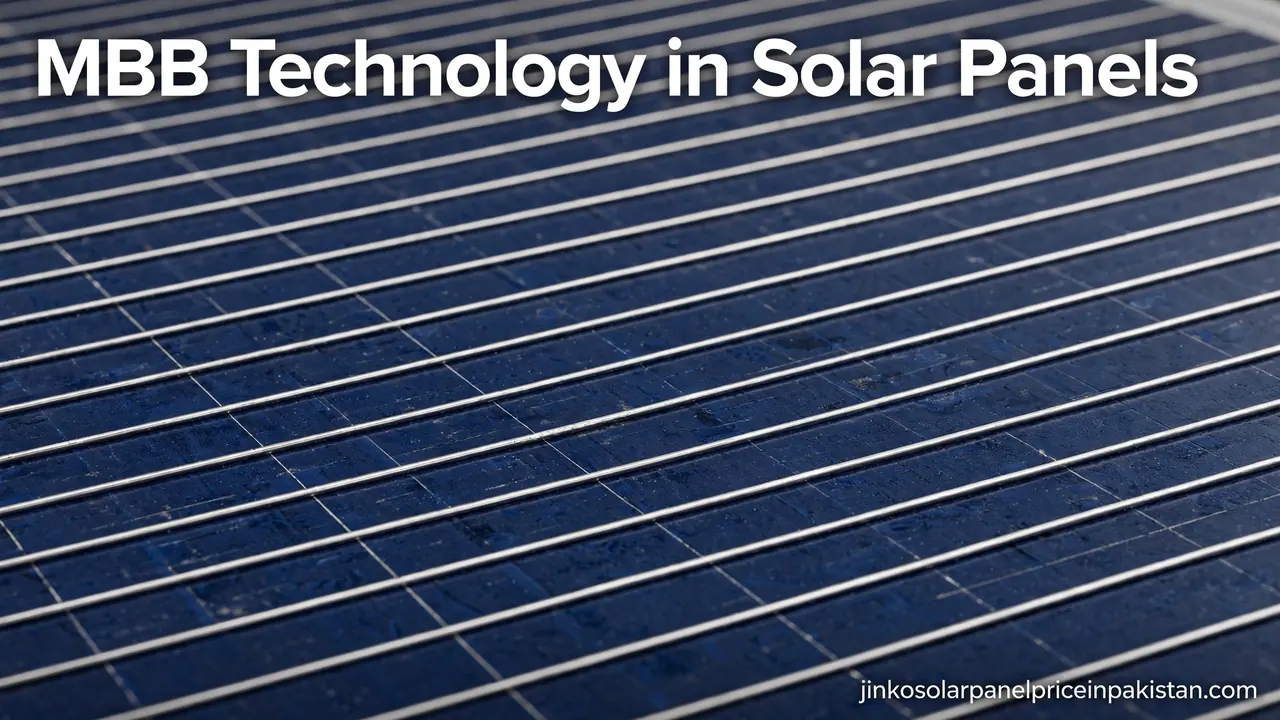
MBB Technology in Solar Panels: Multi-Busbar Explained

MBB technology in solar panels stands for Multi-Busbar — a cell design that replaces the few wide, flat metal ribbons on a solar cell with many thin, round wires. Where older panels used 3 or 5 flat busbars to collect electricity, a modern MBB panel uses 9, 12 or even 16 fine wires spread across each cell. The extra wires shorten the path electricity must travel, waste less of it as heat, and shade less of the cell surface, so the panel produces slightly more power and handles shade and micro-cracks better. If you are shopping for solar panels in Pakistan today, you will see MBB (often written as 9BB, 12BB or 16BB) in the specifications of most current-generation Tier-1 modules — it has quietly become the industry standard.
What Is a Busbar in a Solar Panel?
To understand MBB, start with what a busbar actually does. The front of a solar cell is printed with a fine silver grid of hair-thin lines called fingers. These fingers collect the electric current the cell generates from sunlight. But the fingers are too thin to carry that current off the cell by themselves, so they feed into thicker conductors — the busbars — which gather the current and carry it to the ribbons that connect one cell to the next, and eventually to the junction box at the back of the panel.
For years, the standard design used a small number of busbars: first 2, then 3, then 5. These were flat silver ribbons, screen-printed onto the cell and soldered to flat interconnect ribbons. The system worked, but it had three built-in weaknesses: the flat ribbons shaded part of the cell from sunlight, current had to travel relatively long distances through the thin fingers (losing energy as resistive heat along the way), and if a crack broke a ribbon, a large area of the cell could go dead. Our guide on how solar panels are made walks through where busbars fit into the full manufacturing process.
What Is MBB Technology in Solar Panels?
Multi-busbar technology flips the old formula: instead of a handful of wide, flat busbars, it uses many thin, round wires — typically 9, 10, 12 or 16 per cell, with some designs going higher still. The wires are usually made of copper, embedded in the panel’s encapsulant layer, and bonded to the cell’s fingers without the heavy soldering that flat ribbons required.
The round shape matters as much as the number. A flat ribbon casts a shadow on the cell beneath it — sunlight hitting the ribbon is lost. A round wire, by contrast, reflects a portion of the incoming light sideways and back down onto the cell surface, a light-trapping effect that recovers energy a flat ribbon would have blocked, as described in pv magazine’s long read on cell interconnection. Combined with smaller, finer grid fingers (possible because each finger only has to carry current a short distance to the nearest wire), the cell ends up with more of its surface actually exposed to sunlight.
In short: MBB collects the same current through more, better-shaped pathways. The result is lower electrical resistance, less wasted energy, and a measurable bump in panel efficiency compared with the 5-busbar designs it replaced.
MBB vs 5BB: What’s the Difference?
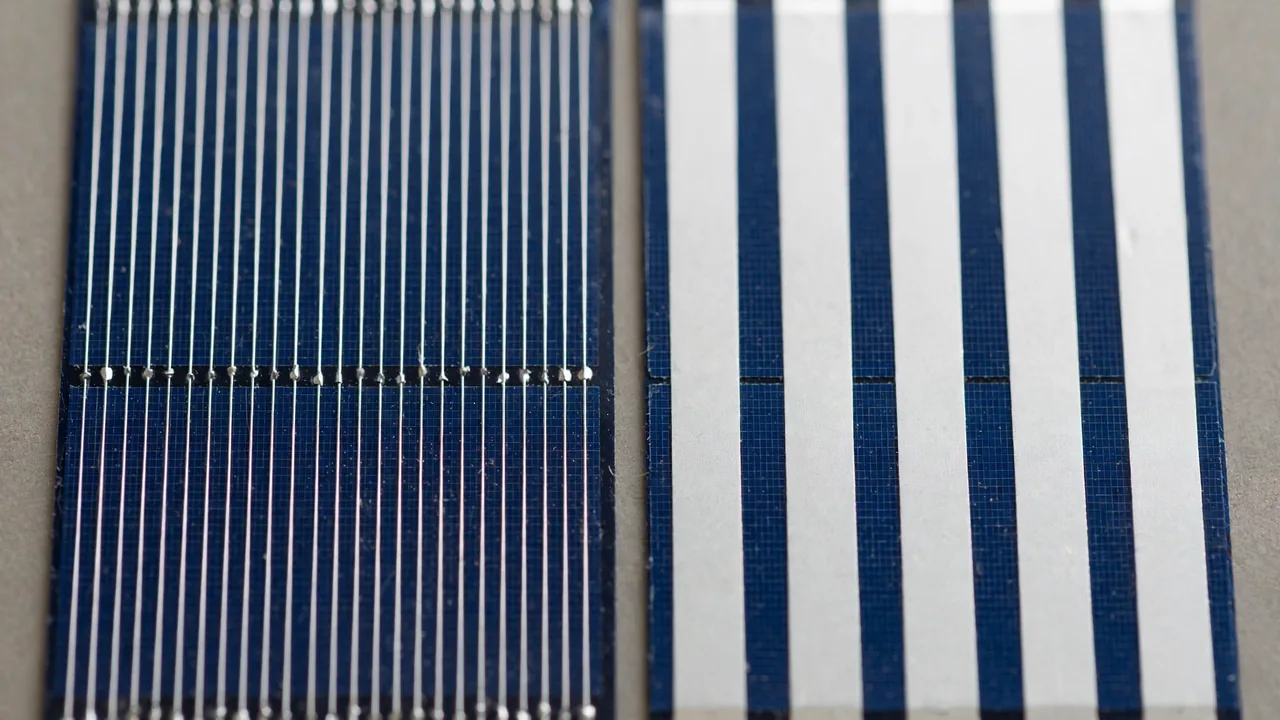
Here is how the two designs compare side by side:
| Feature | 5BB (5-busbar) | MBB (multi-busbar) |
|---|---|---|
| Number of busbars | 5 | 9 to 16+ |
| Conductor shape | Flat ribbons | Thin round wires |
| Shading of the cell | Higher — flat ribbons block light | Lower — round wires reflect light back onto the cell |
| Current path in fingers | Longer | Shorter |
| Resistive (heat) losses | Higher | Lower |
| Silver usage | Higher — wider fingers and ribbons | Lower — finer fingers possible |
| Shade and crack tolerance | Lower | Higher — current has more alternate paths |
| Market position | Older mainstream, now fading | Current mainstream standard |
The headline difference is simple: 5BB was the practical limit of the flat-ribbon era, and MBB is what replaced it. The gains are not dramatic on any single metric, but together — less shading, less resistance, less silver, better reliability — they add up to a meaningfully better panel.
How MBB Improves Panel Performance
MBB’s advantages come from a few distinct mechanisms, and it helps to understand each one separately:
1. Lower resistive losses
Electrical resistance in a solar cell converts some of the generated power into heat instead of usable electricity. Because MBB wires sit closer together, current travels a shorter distance through the thin fingers before reaching a conductor. Shorter path means lower resistance, and lower resistance means more of the cell’s power actually makes it out of the panel.
2. Light trapping
This is the round-wire trick. Sunlight striking a flat ribbon is absorbed or reflected uselessly upward. Sunlight striking a round wire is scattered at angles, and a good share of it bounces back down onto the active cell surface around the wire. The wire still shades a thin line of the cell, but it recovers part of what it blocks — something a flat ribbon cannot do.
3. Better shade tolerance and fewer hot spots
When part of a conventional cell is shaded, current is forced through the remaining lit area, which can create hot spots — localized overheating that stresses the cell. With 12 or 16 wires instead of 5 ribbons, current has many more parallel paths, so partial shading is handled more gracefully and the risk of damaging hot spots drops.
4. Micro-crack resilience
Solar cells can develop microscopic cracks during manufacturing, transport, handling or installation. On a 5BB cell, a crack that severs a ribbon can isolate a large region of the cell. On an MBB cell, the dense web of wires gives current plenty of alternate routes around the damaged area, so the power loss from a micro-crack is typically much smaller.
5. Less silver, same or better output
Silver is one of the most expensive materials in a solar cell. Because MBB allows finer fingers and replaces wide printed busbars with thin wires, manufacturers use significantly less silver per cell while producing a more powerful panel — a genuine win on both cost and performance.
MBB and Half-Cell Technology: Why They Appear Together
If you read panel datasheets, you will notice MBB almost always appears alongside half-cut cells — cells sliced in two before being assembled into the panel. This is no coincidence: both technologies attack the same enemy, resistive loss. Halving the cell halves the current each half-cell carries, and since resistive loss grows with the square of current, the loss drops sharply. MBB then shortens the remaining current paths with its dense wire grid. The two technologies stack, which is why the combination has become the default recipe for modern high-efficiency panels — you can see it in the spec sheets of current models like those covered in our Jinko 580W solar panel guide.
Are There Any Downsides to MBB?

Honestly, very few from a buyer’s perspective. The challenges were on the manufacturing side: aligning and bonding a dozen hair-thin wires per cell demands more precise equipment than soldering five flat ribbons, and early MBB production lines had to prove their yield rates and cost structure. That was the industry’s concern a few years ago, not the buyer’s.
Today those manufacturing questions are settled — MBB is a mature, mass-produced technology, and it ships on the majority of Tier-1 panels sold worldwide. There is no maintenance difference, no special inverter requirement, and no compatibility concern. If anything, the “downside” is only that MBB is now so standard that it is no longer a differentiator: it is simply what a modern panel looks like.
What Comes After MBB: SMBB and 0BB
The busbar story does not stop at MBB. Two evolutions are already appearing in the market:
- SMBB (Super Multi-Busbar): pushes the wire count to 16 or more per cell, extending the same benefits — shorter paths, more redundancy — further.
- 0BB (Zero Busbar): removes visible busbars entirely, using an adhesive or patterned back-contact structure to collect current. Early 0BB modules promise even less shading and simpler cell processing, though the technology is still proving itself at scale.
For now, MBB and SMBB are the safe mainstream; 0BB is one to watch rather than one to demand.
How to Tell If a Panel Uses MBB
Checking is straightforward:
- Read the datasheet. Look for “MBB”, “multi-busbar”, “9BB”, “10BB”, “12BB” or “16BB” in the cell technology or features section. This is the definitive answer.
- Look at the cell. On a 5BB panel you can see five wide, flat silver lines running across each cell. On an MBB panel you will see many fine, hair-like lines instead — visibly denser and thinner.
- Ask the dealer. A competent solar dealer in Pakistan should be able to confirm the busbar count from the datasheet on the spot. If they cannot, treat it as a warning sign about the dealer, not the technology.
- Check the brand’s lineup. Most current Tier-1 panel series are MBB by default; older or budget lines may still be 5BB. Our comparison of the best solar panel brands in Pakistan notes which manufacturers have moved their full lineups to multi-busbar designs.
MBB Panels in the Pakistani Market
In Pakistan’s market, MBB is no longer a premium feature you pay extra for — it is the baseline for current-generation panels from the major brands. When you compare models, busbar count is worth a glance, but do not let a dealer sell you “MBB” as if it were rare or special; the real differentiators between panels today are cell technology (PERC vs TOPCon), wattage class, warranty terms and — most importantly — whether you are getting genuine A-grade stock from an authorized channel.
One practical tip for Pakistani buyers: because MBB panels have been standard for a few years now, a “new” panel still using 5BB flat ribbons is likely old stock. That does not automatically make it bad, but it should make you check the manufacturing date and warranty start terms carefully before agreeing to anything.
MBB panels can cost slightly more than older designs — compare the solar panel price in pakistan and the solar plate price in pakistan per watt on our homepage’s daily tables.
Frequently Asked Questions (FAQs)
What does MBB mean in solar panels?
MBB stands for Multi-Busbar. It is a solar cell design that uses many thin, round wires (typically 9, 12 or 16 per cell) to collect electricity, instead of the 3 or 5 flat metal ribbons used on older panels. The extra wires reduce electrical resistance and shade less of the cell, so the panel produces more power.
What is the difference between MBB and 5BB solar panels?
5BB panels use 5 flat ribbon busbars per cell, while MBB panels use 9 or more thin round wires. MBB shades less of the cell (round wires reflect light back onto it), loses less energy to electrical resistance, uses less silver, and handles partial shading and micro-cracks better. MBB is the current mainstream standard; 5BB is older technology.
Does MBB technology increase solar panel efficiency?
Yes, modestly. By shortening the distance current travels through the cell’s thin fingers, MBB cuts resistive losses, and the round wires’ light-trapping effect recovers sunlight that flat ribbons would block. Combined with half-cut cells, which most MBB panels also use, the gains add up to a noticeably more powerful panel in the same size.
Do MBB solar panels cost more than regular panels?
MBB is no longer a premium feature — it is the standard design on most current-generation Tier-1 panels, so you should not pay extra just for the MBB label. What matters more is the panel’s cell technology, wattage class, warranty terms and whether you are buying genuine A-grade stock. Check the daily updated price tables on our homepage for today’s market rates.
How can I tell if a solar panel uses MBB?
Check the datasheet for terms like MBB, multi-busbar, 9BB, 12BB or 16BB — that is the definitive answer. Visually, an MBB cell shows many fine, hair-like lines across the cell, while a 5BB cell shows five wide, flat silver strips. You can also ask the dealer to confirm the busbar count from the datasheet.
Does MBB help in hot weather or partial shade?
Yes, particularly with partial shade. With 12 or 16 wires instead of 5 ribbons, current has many more parallel paths across the cell, so a shaded or slightly damaged area disrupts output less and the risk of damaging hot spots drops. The efficiency gain from lower resistance also helps in all conditions, including Pakistan’s hot summers.
What is SMBB and is it better than MBB?
SMBB (Super Multi-Busbar) pushes the wire count to 16 or more per cell, extending MBB’s benefits — shorter current paths and more redundancy — further. It is a genuine improvement, but the step from 5BB to MBB was the big leap; SMBB is a smaller incremental gain. For buyers, any modern MBB or SMBB panel is a sound choice.