
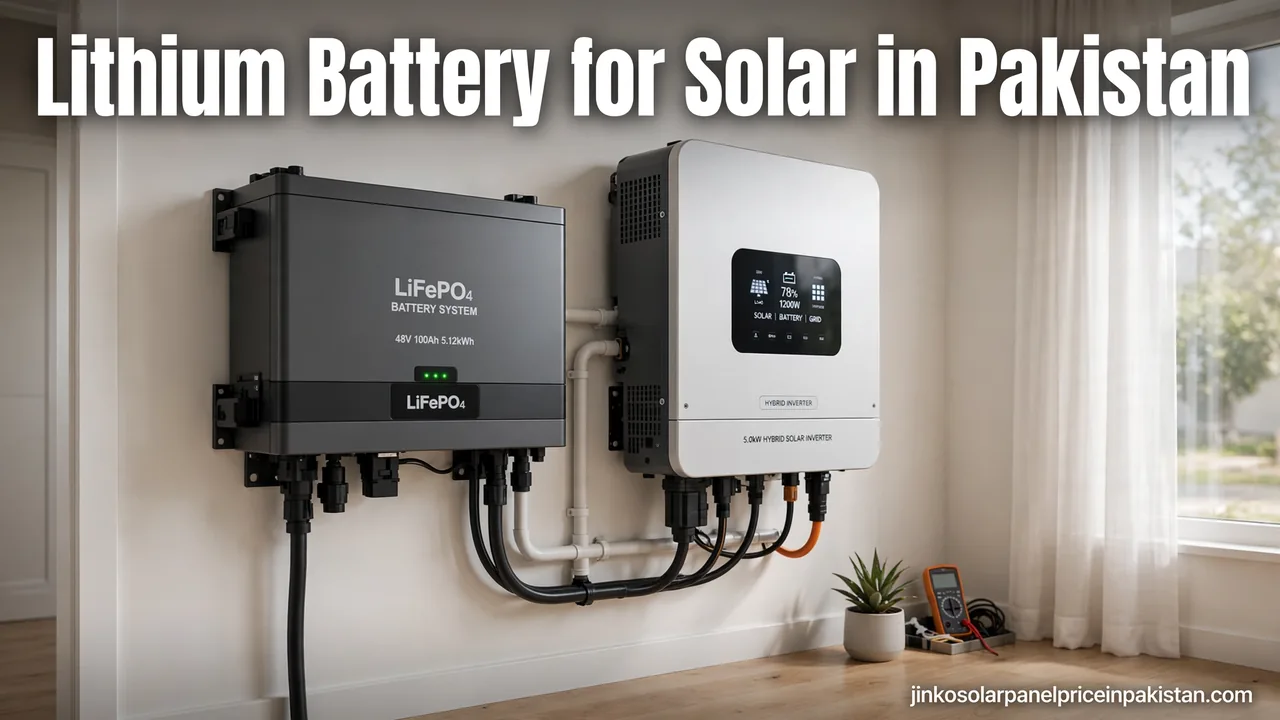
Lithium (LiFePO4) Battery for Solar in Pakistan: Complete Guide

If you are researching a lithium battery for solar in Pakistan, here is the short answer: lithium iron phosphate (LiFePO4) batteries are deep-cycle batteries purpose-built for daily solar use, and they are the longest-lasting, most maintenance-free storage option you can pair with a home solar system. They let you use most of their rated capacity every day, charge faster and more efficiently than tubular or dry batteries, need no distilled water or equalization, and are typically rated for thousands of charge-discharge cycles. Their trade-offs are real too: a higher upfront cost, the need for a lithium-compatible inverter, and fewer local repair options than familiar lead-acid batteries. This guide explains how they work, their benefits and limitations, how to choose and size one, and how to keep one running for years.
What Is a Lithium (LiFePO4) Battery?
“Lithium battery” is a family name. Several lithium chemistries exist, but solar energy storage overwhelmingly uses one of them: lithium iron phosphate, usually written as LiFePO4 or LFP. Its cathode is made of iron phosphate instead of cobalt or nickel blends, which gives it three properties that matter for solar: high thermal stability, tolerance of full-charge conditions, and a long cycle life. As the educational resource Battery University explains in its guide to lithium-ion types, Li-phosphate stands out for good thermal stability and tolerance if abused — the reason it, rather than phone-style lithium chemistries, dominates stationary storage.
For home solar use, LiFePO4 batteries come in a few common forms:
- 12V drop-in modules — shaped like a conventional battery, intended as direct replacements in 12V systems.
- 48V (51.2V nominal) wall-mounted or rack-mounted modules — the standard for modern hybrid solar systems, where one or more units are paralleled to build the required capacity.
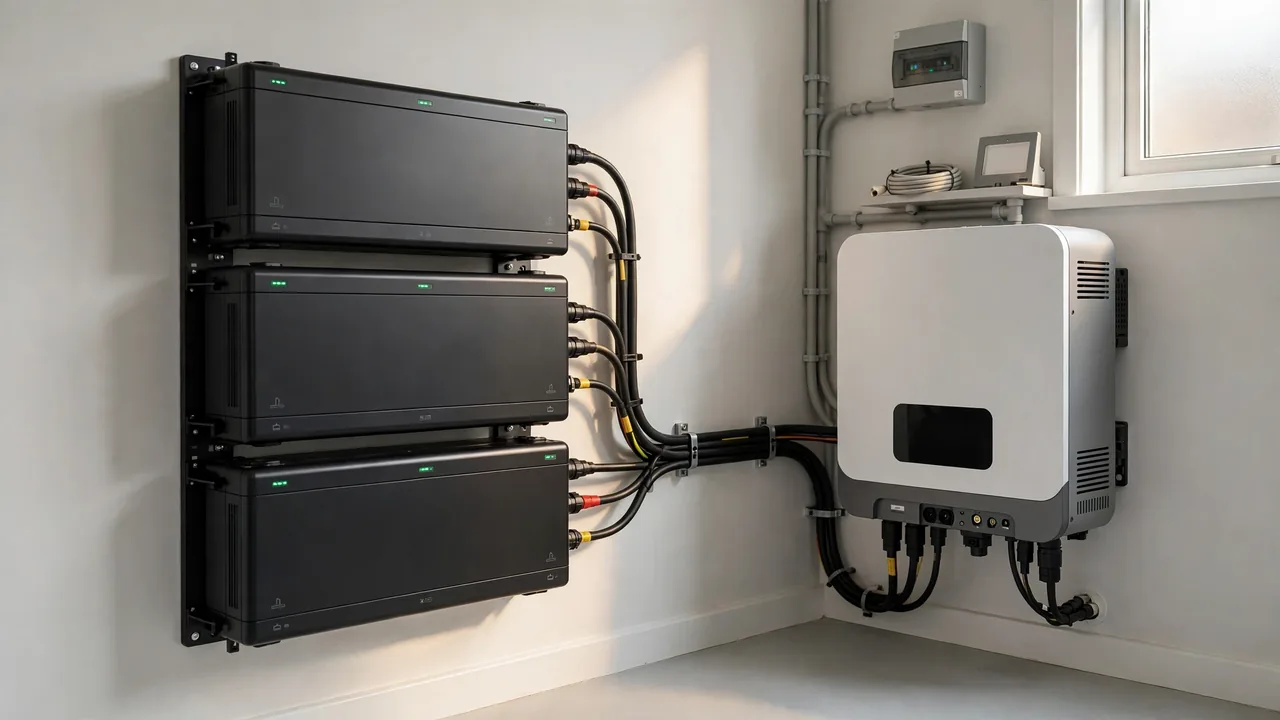
- All-in-one and stackable units — modular blocks designed to be added in parallel as needs grow.
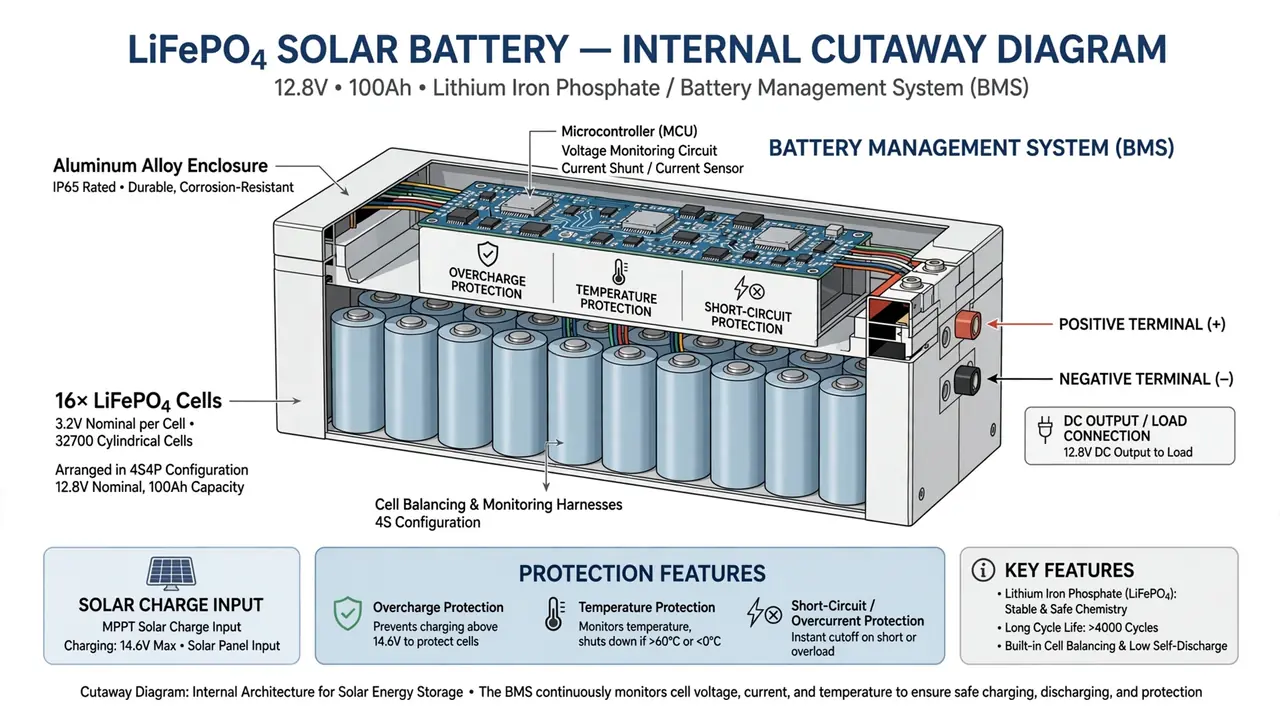
Almost every unit sold for solar includes a built-in Battery Management System (BMS) — a circuit board that watches every cell and protects the battery from over-charging, over-discharging, over-current, short circuits and temperature extremes. Think of it as the battery’s onboard guardian: it is what makes lithium batteries safe for unattended daily cycling in a home.
How Lithium Batteries Work in a Solar System
In a solar setup, the battery bridges daytime generation and night-time use. During the day, your panels produce DC power; the inverter’s MPPT charger (or a separate charge controller) feeds that energy into the battery. After sunset — or during load shedding — the inverter draws from the battery to run your essential load. Because this cycle repeats almost daily, solar needs deep-cycle batteries, not starter batteries.
Lithium batteries fit this duty cycle naturally, and the BMS handles most of the complexity for you:
- Charge acceptance: LiFePO4 accepts high charge currents, so it can absorb the full output of your panels on sunny days and reach full charge quickly.
- Cell balancing: the BMS keeps every cell at the same voltage, which is what allows thousands of repeated cycles without one weak cell dragging the pack down.
- Inverter communication: many lithium modules talk to compatible hybrid inverters (over CAN or RS485), so the inverter reads the battery’s state of charge directly and charges it with exactly the right profile — no manual voltage tuning.
- Automatic protection: if anything goes out of range — voltage, current, temperature — the BMS disconnects the battery before damage occurs, then reconnects when conditions are safe.
Lithium batteries pair with hybrid or off-grid inverters that support lithium mode. Compatibility is the single most important purchase check — a good inverter with the wrong charging profile will shorten even the best battery’s life, while a lithium-aware inverter manages everything automatically.
LiFePO4 vs Other Lithium Chemistries
Not all lithium batteries are the same, and the distinction matters when you shop:
LiFePO4 — the solar standard
Lithium iron phosphate is the chemistry purpose-made for this job. It is thermally stable, tolerates being held at full charge, and delivers a long service life under daily cycling. Virtually all lithium batteries marketed for home solar storage in Pakistan are LiFePO4 — if a solar battery is lithium, assume LFP unless the label says otherwise.
NMC and other blends
Nickel-manganese-cobalt (NMC) and similar blends pack more energy into a smaller, lighter package, which is why they dominate electric vehicles and phones. The trade-off is lower thermal stability and a shorter cycle life under stationary duty. For home solar, where safety and decades of daily cycling matter more than compactness, LFP is the better-engineered choice.
If you are comparing lithium against lead-acid options rather than against other lithium types, our lithium vs dry battery comparison and the best battery for solar system in Pakistan guide walk through the full cross-type picture. For a map of every storage chemistry on the market, see our types of solar batteries guide.
Key Benefits of Lithium (LiFePO4) Batteries for Solar
- Far more usable capacity: a LiFePO4 battery can safely use most of its rated capacity every day — commonly around four-fifths or more — while a tubular lead-acid battery should only use about half. A lithium bank of the same headline rating therefore delivers roughly twice the usable backup.
- Thousands of daily cycles: manufacturers typically rate LiFePO4 for several thousand charge-discharge cycles — several times the deep-cycle life of lead-acid batteries — which is why they suit a job that cycles the battery nearly every day of the year.
- Zero maintenance: no distilled-water top-ups, no equalization charges, no specific-gravity checks. Sealed construction and the BMS handle everything.
- Faster, more efficient charging: high charge acceptance and low internal losses mean more of your panels’ daytime energy actually reaches storage, which matters most on short winter days.
- Compact and light: lithium packs weigh roughly half of an equivalent lead-acid bank and many models mount on the wall, freeing the floor space a tubular bank would occupy.
- Stable voltage through discharge: LiFePO4 holds a flat voltage across most of its discharge, so fridges, pumps and inverters run smoothly without early low-voltage cut-outs.
- No ventilation burden: sealed lithium batteries release no hydrogen during normal charging, so they don’t demand the ventilated battery room that flooded tubular batteries need.
Limitations You Should Know
No battery is perfect, and honest expectations prevent disappointment:
- Higher upfront cost: lithium is the most expensive battery chemistry to buy. The economics work over the battery’s long life, not on day one.
- Inverter must be lithium-compatible: older or basic inverters may lack a lithium charging profile or the communication ports the BMS expects. Factor a compatible inverter into the plan.
- Charging below freezing: LiFePO4 should not be charged at sub-zero temperatures (most of Pakistan rarely sees these, but high-altitude areas should note it). Quality BMS units block charging in the cold automatically.
- Limited local repair: a faulty tubular battery can often be serviced locally; a faulty lithium module is usually a swap-out handled through the dealer’s warranty channel.
- Expansion needs planning: adding capacity later works best with the same model and similar age — check the manufacturer’s paralleling guidance before assuming you can mix and match.
- Recycling infrastructure is still developing: lead-acid has a mature buyback chain; lithium recycling channels in Pakistan are newer. Keep the warranty and dealer paperwork so end-of-life take-back is traceable.
How to Choose the Right Lithium Battery
When comparing lithium batteries for solar use, work through these checks in order:
1. Confirm inverter compatibility first
Before looking at any battery, confirm your inverter supports lithium — either a dedicated lithium charging profile, BMS communication, or both. This one check eliminates most bad purchases. See our solar inverter buying guide for what to look for.
2. Match the system voltage
The battery voltage must match your inverter: 12V, 24V or 48V systems each take their own battery configuration. Most modern hybrid setups use 48V (51.2V nominal) modules — do not mix voltages in one bank.
3. Check what the BMS actually protects
Not all BMS boards are equal. A proper solar-duty BMS protects against over-charge, over-discharge, over-current, short circuit and temperature extremes, and supports communication with your inverter brand. Ask the dealer for the BMS specification sheet rather than taking “it has BMS” at face value.
4. Size capacity to your night-time load
Work out your night-time energy need in watt-hours (appliance watts × hours of use after sunset), then choose a battery whose usable capacity covers it. Because lithium lets you use most of the rated capacity daily, the rated figure you need is much closer to your usable need than with lead-acid — but always leave headroom for cloudy-day stretches.
5. Read the warranty terms carefully
Lithium warranties are usually expressed in years and cycle counts, with conditions attached: approved inverter list, installation by a qualified technician, operating temperature ranges. Read what voids the warranty before you buy, and keep the stamped warranty card safe.
6. Buy from an authorized dealer and verify authenticity
Counterfeit and refurbished-as-new batteries are a real problem in the market. Buy from an authorized dealer who provides a proper bill and stamped warranty, verify the unit’s serial number and authenticity markings before installation, and see our solar panel verification guide for the general mindset of checking genuine products (the same caution applies to batteries).
Installation Basics
Lithium installation is simpler than lead-acid in some ways — no acid handling, no ventilation room — but the electrical work still demands care:
- Location: a cool, dry, shaded spot indoors. Wall-mount models need a solid wall and the clearances the manual specifies; keep the BMS display and terminals accessible.
- Cabling and protection: use the cable size the manual or installer specifies, with a properly rated DC breaker or fuse on the battery circuit. Undersized cables waste energy as heat and confuse the BMS.
- Commissioning: set the inverter to lithium mode (or the exact profile the battery maker recommends), connect the communication cable if supported, and let the system run a full charge so the BMS balances the cells.
- Professional installation: battery circuits carry large currents. Unless you are experienced with DC wiring, have a qualified installer do the commissioning — it also keeps the warranty valid.
Care and Maintenance
This is the shortest maintenance section of any battery guide, because there is genuinely little to do:
- No watering, no equalization — the sealed cells and BMS manage chemistry automatically.
- Check the monitoring app occasionally — most lithium systems report state of charge, cell voltages and temperature to a phone app. A cell drifting out of balance or a temperature warning is your early signal to call the dealer.
- Keep terminals clean and tight — an annual visual check is enough; corrosion is rare but a loose terminal still causes trouble.
- Avoid sustained extreme heat — lithium tolerates heat better than its reputation suggests, but a shaded indoor spot still outlasts a sun-baked wall.
- Long idle periods: if the system will sit unused for months, leave the battery at a partial charge in a cool place, per the manual — not fully charged and not empty.
Check Current Battery Prices in Pakistan
Battery prices in Pakistan change frequently with the dollar rate, import costs and demand, so this guide intentionally does not quote figures that would go stale. For today’s updated solar panel and system component prices, visit our homepage, where price tables are refreshed daily.
Frequently Asked Questions (FAQs)
What is a LiFePO4 battery?
A lithium iron phosphate (LiFePO4 or LFP) battery is a rechargeable lithium battery whose cathode is made of iron phosphate instead of cobalt or nickel blends. It is thermally stable, tolerates full-charge conditions, and delivers a long cycle life under daily charging and discharging — which is why it is the standard chemistry for home solar energy storage.
Are lithium batteries good for solar systems?
Yes. LiFePO4 batteries are built for the daily charge-and-discharge cycles that solar systems demand. They offer far more usable capacity than lead-acid batteries of the same rating, charge faster, need zero maintenance, and are typically rated for thousands of cycles. The main trade-offs are a higher upfront cost and the need for a lithium-compatible inverter.
How long does a lithium solar battery last?
Many years of daily use when sized and installed correctly. Lifespan depends on daily depth of discharge, operating temperature, correct inverter settings, and a quality Battery Management System. Shallow daily discharges and a cool installation spot extend its service life noticeably.
Do lithium batteries need maintenance?
Essentially none. Sealed LiFePO4 batteries need no distilled-water top-ups, no equalization charges and no specific-gravity checks. Occasional checks of the monitoring app, keeping terminals clean and tight, and avoiding sustained extreme heat are all that is normally required.
How many lithium batteries do I need for my solar system?
It depends on your night-time load, not your panel size. Add up the watts you run after sunset, multiply by the hours to get watt-hours, then choose a battery whose usable capacity covers it — remembering that a lithium battery lets you safely use most of its rated capacity each day, unlike lead-acid types.
Can I use a lithium battery with my existing inverter?
Only if the inverter supports lithium. It needs a lithium charging profile or a dedicated lithium mode, and ideally BMS communication (CAN or RS485). Inverters without lithium support can under- or over-charge the battery, so confirm compatibility with the battery maker or dealer before buying.
Which is better for solar: a lithium battery or a tubular battery?
Lithium (LiFePO4) lasts much longer, needs zero maintenance and delivers far more usable capacity per charge, but costs more upfront and needs a compatible inverter. Tall tubular batteries are proven in Pakistani conditions, easy to service locally and more affordable to buy. Choose based on budget, maintenance willingness and whether your inverter supports lithium.
Is LiFePO4 safe for home use?
LiFePO4 is the safest common lithium chemistry for home storage: its iron-phosphate cathode is thermally stable and each unit includes a Battery Management System that guards against over-charge, over-discharge, over-current, short circuits and temperature extremes. Buy from an authorized dealer, follow the installation manual, and verify the unit’s authenticity markings.
