
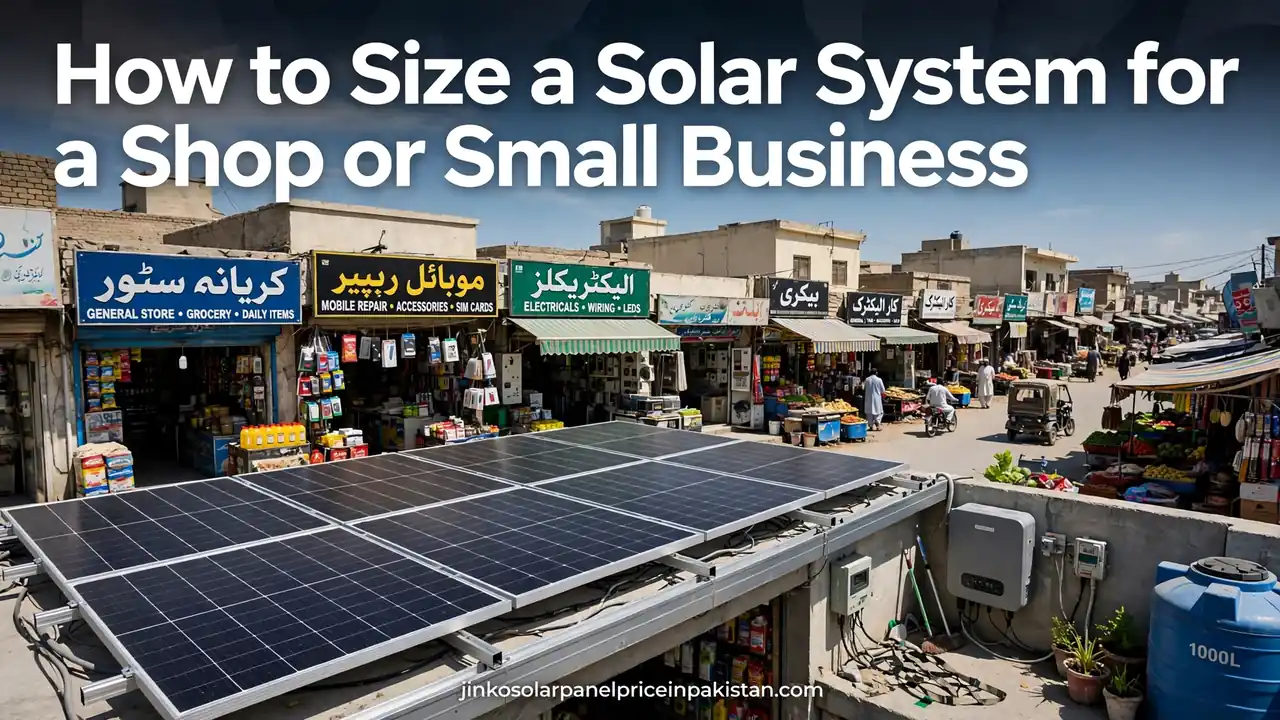
How to Size a Solar System for a Shop or Small Business

To size a solar system for a shop or small business in Pakistan, list every electrical appliance the shop runs during the day, multiply each appliance’s wattage by the hours it runs, and add them up to get your daily energy need in kilowatt-hours (kWh). Then divide that daily figure by the usable peak sun hours for your city — typically 4 to 5 in most Pakistani cities — and add a 20 to 25 percent buffer for system losses and future growth. That gives you the solar array size in kilowatts (kW) your shop needs.
Shops are actually among the best candidates for solar because their operating hours line up with the sun. Unlike homes, where most electricity is consumed in the evening, a shop’s peak load — lights, fans, air conditioning, refrigerators, computers, CCTV — runs right through the solar production window. This guide walks you through the full sizing process, step by step.
Why sizing a shop’s solar system is different from a home’s
Most sizing guides assume a household load curve: low daytime use, high evening use, and a strong need for batteries to cover the night. Shops work the other way round. A typical retail shop in Pakistan opens around 9 or 10 in the morning and closes around 9 or 10 at night, which means 70 to 80 percent of its electricity is consumed while the panels are generating power.
This has three practical consequences for sizing:
- Better self-consumption. More of the solar electricity is used directly, which improves the economics of the system even without net metering.
- Less battery need. If you only need backup for load shedding during the day, you can size a much smaller battery bank than a home with night loads would need — or skip batteries entirely with the right inverter setup.
- Steadier loads. Shops tend to run the same equipment at predictable hours, which makes load calculations more reliable than the variable usage of a household.
That said, shops also introduce complications homes do not have: three-phase supply is common in commercial setups, starting currents of commercial refrigerators and motors are higher, and seasonal variations in business hours (summer versus winter) change the load profile.
Step 1: List every electrical load in your shop
Start with a walkthrough of your shop and write down every electrical device: tube lights or LED panels, ceiling or bracket fans, air conditioners, deep freezers and display refrigerators, computers or POS machines, CCTV cameras and DVR, signboards, water dispenser, and anything else plugged in. For each device, note two numbers: its rated wattage (printed on the nameplate or in the manual) and the approximate hours it runs per day.
Do not guess the wattage from memory — check the nameplate. A common mistake is underestimating display lighting and signage, which run the full business day, or forgetting the CCTV setup, which runs 24 hours a day even after the shop closes.
Step 2: Calculate your daily energy consumption in kWh
For each device, multiply wattage by daily running hours, then divide by 1,000 to convert watt-hours to kilowatt-hours. Add up all the results. The total is your shop’s daily energy requirement.
For example, consider a small general store: ten LED lights of 20 watts each running 12 hours (2.4 kWh), two ceiling fans of 75 watts each running 12 hours (1.8 kWh), one 1.5-ton air conditioner of about 1,800 watts running 8 hours (14.4 kWh), two display refrigerators of 200 watts each running 12 hours (4.8 kWh), a POS computer and printer of 150 watts running 12 hours (1.8 kWh), and a CCTV setup of 60 watts running 24 hours (1.44 kWh). The daily total comes to roughly 26.6 kWh. Your own numbers will differ, but this is exactly the kind of table you should build for your shop.
If you want a broader refresher on load math for different building types, our guide on how many solar panels you need covers the same calculation method in more detail.
Step 3: Account for peak sun hours in your city
One kilowatt of solar panels does not produce one kilowatt-hour every hour. Panels only produce their rated output under ideal conditions, and the useful measure is peak sun hours — the number of hours per day the sun is effectively strong enough to generate full output.
Most cities in Pakistan average between 4 and 5 peak sun hours per day across the year, with higher values in summer and lower in winter. For a conservative, year-round sizing figure, divide your daily energy requirement by 4.5. Using the example above: 26.6 kWh ÷ 4.5 = about 5.9 kW of panels.
Remember that winter output is noticeably lower than summer output. If your shop runs its full load through winter, size for the weaker season rather than the average, or at least be aware of the seasonal dip before you finalize the system size.
Step 4: Add a buffer for losses and future growth
System losses (derating)
A real solar installation never delivers 100 percent of its rated capacity. Inverter conversion, cable losses, dust on panels, high summer temperatures, and gradual panel degradation all shave off output. A practical rule is to add 20 to 25 percent to the raw panel figure calculated in Step 3. For the example shop: 5.9 kW × 1.25 = about 7.4 kW, which would round up to a 7.5 or 8 kW system.
Plan for business growth
Shops change faster than homes. You may add another freezer, extend your hours, or install a second air conditioner next summer. If you expect your load to grow, size the inverter one step larger than today’s need (for example, a 10 kW inverter for an 8 kW panel array) so you can add panels later without replacing the inverter. Planning ahead is far cheaper than rebuilding the system in two years.
Step 5: Size the inverter for your shop
The inverter converts the panels’ DC power into the AC power your shop uses, and its rating should roughly match — or slightly exceed — the panel array size. But shops need to think about two extra factors:
- Starting (surge) loads. Refrigerators, freezers, and motors draw several times their rated wattage for a few seconds when they start. A good hybrid inverter handles this surge, but an undersized one will trip. Add up the surge requirements of your largest motor-driven appliances and make sure the inverter’s surge rating covers them.
- Single-phase versus three-phase. Many shops in Pakistan run on a single-phase connection, but larger shops and workshops use three-phase supply. Your inverter must match your connection type — a three-phase shop needs a three-phase inverter, and sizing each phase matters.
For a detailed walkthrough of inverter types and ratings, see our solar inverter buying guide for Pakistan.
On-grid, off-grid, or hybrid for a shop?
A hybrid inverter is usually the most practical choice for a shop: it runs loads directly on solar during the day, exports surplus to the grid where net metering is available, and keeps the shop running during load shedding from batteries. A pure on-grid inverter shuts down during power cuts, which is a real drawback for a shop that loses business every time the grid goes down. A fully off-grid setup is rarely needed for an urban shop with grid access. Net metering rules and paperwork for commercial connections are covered in our net metering policy guide.
Step 6: Decide whether your shop needs batteries
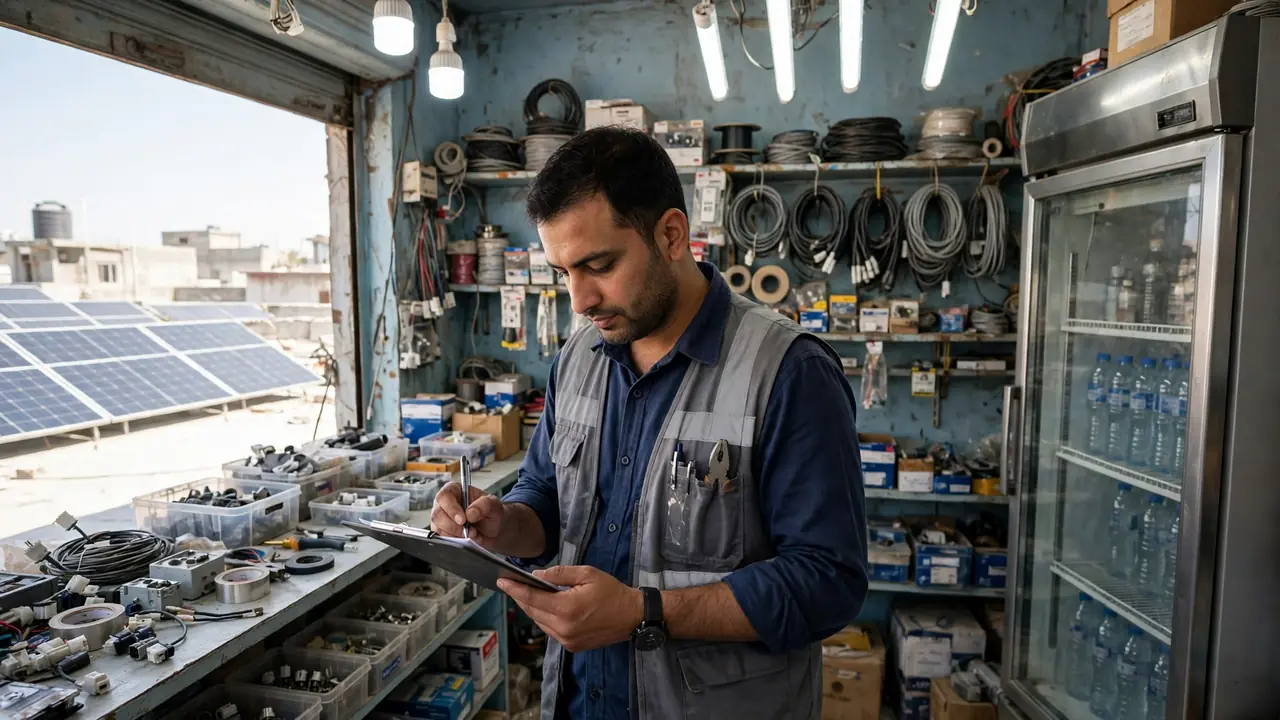
This is where shops have an advantage. Because your main loads run during solar hours, you do not need a battery bank sized for the whole night the way a home does. Batteries in a shop setup serve one main purpose: riding through daytime load shedding.
To size backup, decide how many hours of load shedding you need to cover and which loads are critical during those hours (usually lights, fans, POS, CCTV, and one freezer — not the air conditioner). Multiply the critical load in watts by the backup hours to get the required battery capacity in watt-hours, then size the battery bank accordingly. Our battery buying guide for solar systems explains battery types and sizing math in depth.
If your area has minimal load shedding, you can start with a hybrid inverter and add batteries later — one more reason to choose an inverter with battery support from day one.
Step 7: Check your roof space and mounting
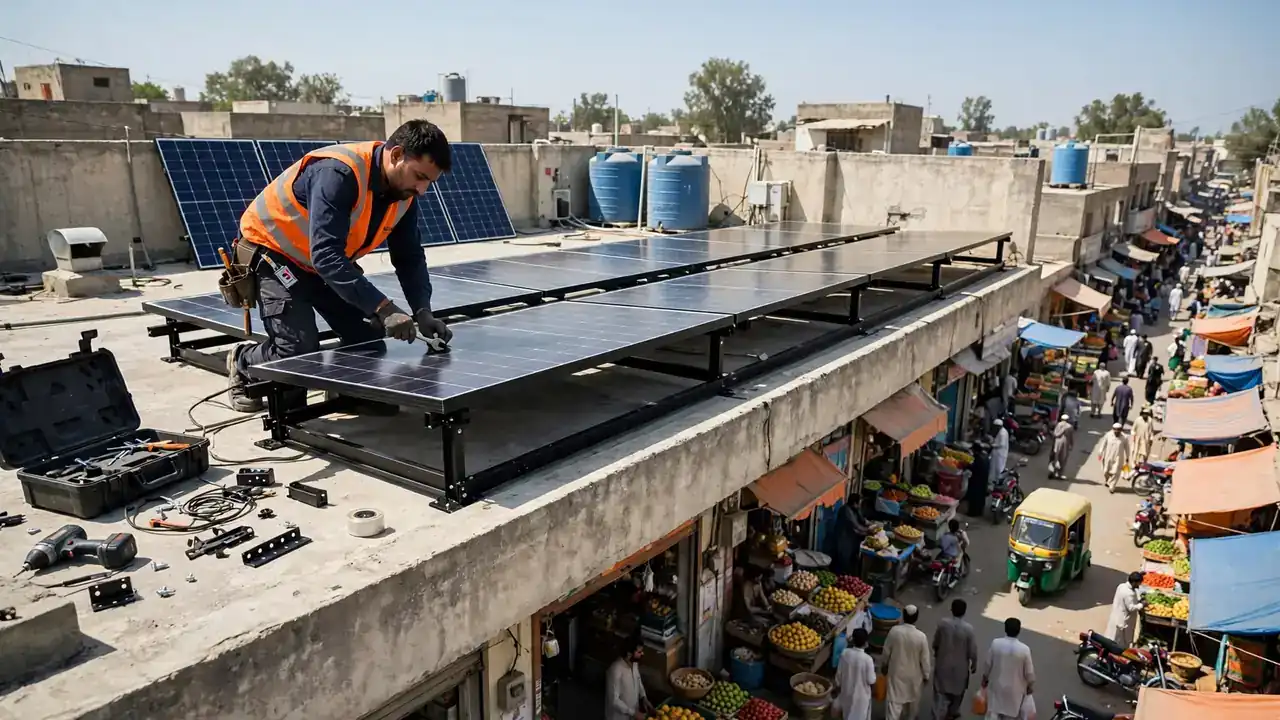
Panel count follows from the array size: divide the total panel wattage by the wattage of one panel. An 8 kW array using 580-watt panels needs about 14 panels. Each panel occupies roughly 2.5 to 3 square metres including mounting gaps, so that array needs around 35 to 42 square metres of clear, shade-free roof space.
Shop rooftops often have obstacles — water tanks, stairwells, signage structures, neighboring buildings casting shadows. Walk the roof at different times of day and note where shadows fall, because even partial shading of one panel can drag down a whole string. Australia’s government solar sizing guide confirms that available sunny roof area is often the limiting factor in system size — a principle that applies just as much in Pakistan. If roof space is tight or shaded, elevated or customized solar panel mounting structures can free up space and improve the panel angle.
Common sizing mistakes shops make
- Sizing for the monthly bill instead of the load list. The electricity bill hides which appliances consume what. Always size from the appliance-by-appliance calculation.
- Ignoring the evening tail. If your shop stays open after sunset, that evening load comes from the grid or batteries — plan for it explicitly instead of assuming solar covers it.
- Undersizing the inverter for surge loads. A system that runs fine on paper can trip repeatedly when two freezers start at once. Check surge ratings.
- Forgetting seasonal change. Summer output is higher, but so is the air-conditioning load. Winter has weaker sun with a different load mix. Size for your worst-case season.
- Skipping a site survey. Shading, roof orientation, and structure strength cannot be measured from a desk. A proper site survey before purchase prevents most sizing regrets.
Check current solar prices
Solar panel and inverter prices in Pakistan change frequently, and a sizing plan is only half the picture without current market rates. Visit the homepage for today’s updated solar panel prices, brand-wise tables, and current deals before you finalize your shop’s system budget.
After sizing the system for your shop, compare the solar system price in pakistan for commercial setups with the solar panel price in pakistan on our daily-updated homepage tables.
Frequently Asked Questions (FAQs)
How do I calculate my shop’s daily electricity consumption?
Add up the wattage of every appliance, multiply each by its daily running hours, and divide the total by 1,000 to get kilowatt-hours (kWh) per day. This daily kWh figure is the foundation of your solar system size.
What size solar system does a small shop need?
Divide your daily kWh by the peak sun hours for your city (typically 4 to 5 in Pakistan), then add 20 to 25 percent for system losses and future growth. For example, a shop using 27 kWh per day needs roughly a 7.5 to 8 kW system.
Which inverter is best for a shop — on-grid, off-grid, or hybrid?
A hybrid inverter is usually the best choice for a shop in Pakistan. It runs daytime loads directly on solar, exports surplus through net metering, and keeps the shop running during load shedding with battery backup.
Does a shop need batteries with solar panels?
Not necessarily. Because a shop’s main loads run during solar hours, a small battery bank sized only for daytime load shedding is often enough. You can also start with a hybrid inverter and add batteries later.
How much roof space is needed for a shop’s solar system?
Each panel occupies about 2.5 to 3 square metres including mounting gaps. A 14-panel array needs roughly 35 to 42 square metres of clear, shade-free roof space. A site survey should confirm shading and structure strength.
What are common mistakes when sizing solar for a shop?
The most common mistakes are sizing from the electricity bill instead of an appliance list, ignoring evening loads after sunset, undersizing the inverter for refrigerator surge currents, and skipping a proper site survey for shading.
How many peak sun hours should I use when sizing solar in Pakistan?
In Pakistan, 4 to 5 peak sun hours per day is a reasonable year-round average for sizing, with higher values in summer and lower in winter. Size for the weaker season if your shop runs its full load through winter.