
Solar Panel Degradation Rate Explained

Solar panel degradation rate is the percentage of power output a solar panel loses each year. For modern panels it is well under 1% per year, which means a panel working at full capacity today will still deliver roughly 80–90% of its original output after 25 years — and most manufacturers guarantee at least 80% through their performance warranty. If you are buying panels in Pakistan, understanding this number matters: it tells you how much electricity your system will still produce a decade or two from now, long after the installer has left.
What Is Solar Panel Degradation Rate?
The solar panel degradation rate explained in the simplest terms: every solar panel slowly loses a small fraction of its ability to convert sunlight into electricity, year after year. This is normal wear and tear at the material level — the silicon cells, the encapsulant, the backsheet and the electrical connections all age under sun, heat and weather. It is not a fault, and it does not mean the panel is “broken.”
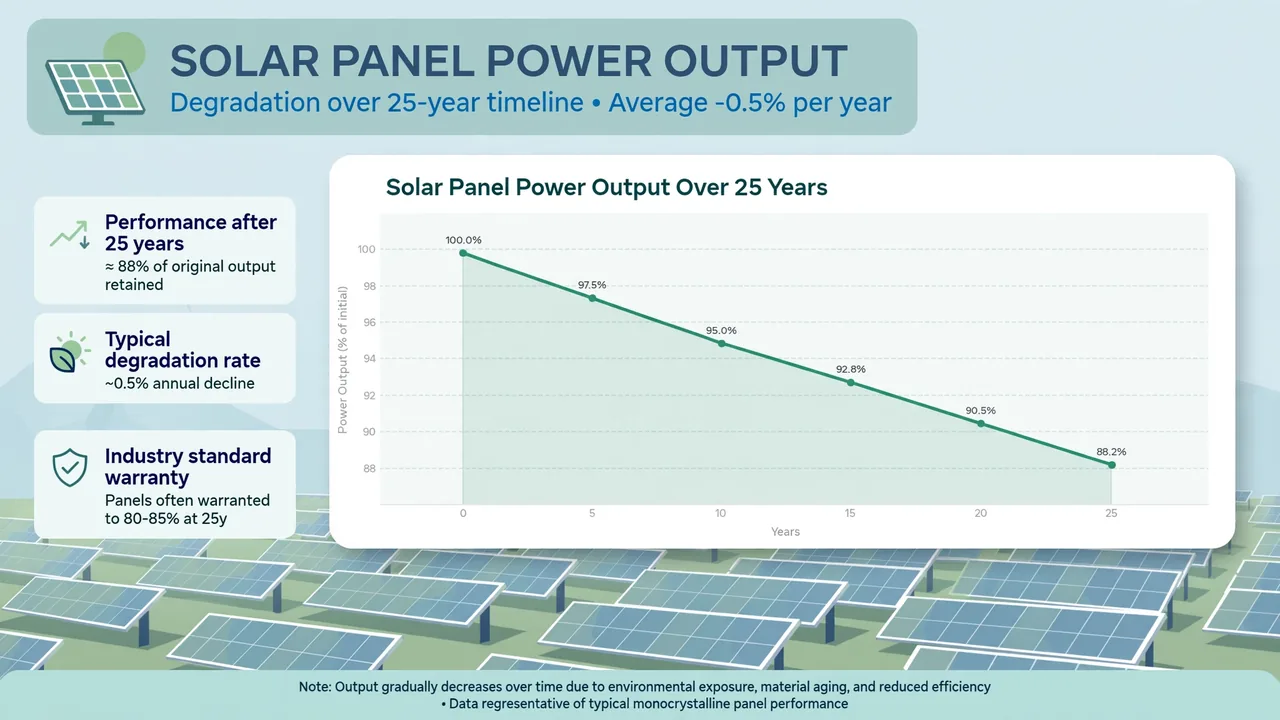
Degradation is expressed as an annual percentage. A 0.5% degradation rate means that if your panels produced a given amount of electricity this year, they will produce about 0.5% less next year, then 0.5% less than that the year after — compounding gently over the system’s life. EnergySage’s solar panel degradation guide notes that most panels degrade at less than 0.8% per year, and that even after 25 years most panels still generate at least 80% of their original output.
How Much Do Solar Panels Degrade Per Year?
There are two different numbers to understand: the actual panel degradation per year in real installations, and the warrantied rate the manufacturer guarantees. The warrantied rate is the conservative promise written into the performance warranty; real-world panels usually do a little better.
According to EnergySage, common warrantied degradation rates look like this: up to 2–3% in the first year, then 0.25% to 0.75% per year for years 2 through 25. Those bands translate into very different 25-year outcomes: at 0.25% per year you would still have about 91% of original output at year 25, at 0.50% about 85%, and at 0.75% about 79%. This is why two panels with the same wattage and a similar product warranty can be worth quite different amounts of electricity over their lifetime.
Why the First Year Is Different
Degradation is slightly faster in the first year of operation. When a new panel is first exposed to sunlight, light-induced effects in the silicon cause a one-time drop — after which the annual rate settles into its long, slow decline. Manufacturers reflect this in the warranty structure: the year-1 allowance (often 1–3%) is separate from the linear annual rate that applies afterwards.
Why Degradation Happens: The Main Causes
Not all panels age at the same speed. EnergySage identifies three big variables: panel technology, climate, and defects. Here is what each means for a buyer in Pakistan.
Heat, UV and Weather Stress
Pakistan’s climate is the single biggest factor working against your panels’ long-term output. Prolonged high temperatures, intense ultraviolet exposure and thermal cycling (panels expanding and contracting between hot days and cooler nights) all accelerate material aging. EnergySage’s degradation guide explicitly flags climate as a key variable: panels exposed to more extreme weather degrade at an accelerated rate. This is one reason panels with a strong temperature coefficient are worth prioritising for cities like Multan, Lahore and Karachi — heat management and degradation resistance go hand in hand.
Cell Technology and Build Quality
How a panel is built matters as much as where it sits. Degradation rates differ by panel type and semiconductor material, the layout of the circuitry inside the module, and the overall composition of the module. Newer cell technologies generally hold up better than older ones — our TOPCon vs PERC vs HJT comparison and the N-type TOPCon technology guide explain why N-type cells typically show lower first-year degradation than conventional P-type PERC cells. Similarly, the monocrystalline vs polycrystalline comparison shows how cell structure affects long-term behaviour. This is also why bankability matters: Tier-1 manufacturers invest more in materials and testing, which shows up in lower degradation figures — see our Tier-1 solar panel explainer.
Defects: Microcracks and Hot Spots
Manufacturing and handling defects — microcracks in cells, poor soldering, hot spots — make individual panels degrade much faster than their spec sheet suggests. Rough transport, careless installation and low-grade materials are common culprits. Buying verified original panels from a reputable dealer and using a certified installer is the practical defence; our system derating guide explains how these hidden losses show up as lower-than-expected output.
What Is NOT Degradation
A few things that look like degradation but are not: dust and soiling (output recovers after cleaning), temporary shading, and inverter issues. Degradation is the slow, permanent, irreversible decline — everything else is a maintenance or equipment problem you can actually fix.
Degradation Warranty: What It Actually Covers
The degradation warranty — properly called the performance or power warranty — is the manufacturer’s promise about how much output your panels will retain over time. It is separate from the product (equipment) warranty, which covers manufacturing defects and physical failure. Understanding the difference saves a lot of confusion at claim time:
- Product warranty (typically 10–15 years): covers defects — delamination, junction-box failure, broken glass. If a panel fails outright, this is the warranty that applies.
- Performance warranty (typically 25–30 years): guarantees the output curve — e.g. no more than 3% loss in year one and no more than 0.5% per year after, ending at 85%+ of rated output at year 25.
Most performance warranties today are linear: they guarantee a straight-line minimum output for every year of the term, which is more transparent than the old step warranties that only promised 90% for 10 years and 80% for 25. When comparing panels, read the linear warranty curve — not just the headline “25-year warranty.” For a concrete example of how these terms read in practice, see our breakdown of Jinko’s solar panel warranty terms.
What Degradation Means for Your System’s Lifetime Output
Solar panel lifespan loss from degradation is gradual, not sudden. A system does not “die” at year 25 — panels keep generating for decades, just at a lower percentage of their original rating. The practical question is how the slow decline interacts with your electricity needs over time.
Think of it this way: at a warrantied 0.5% per year, a system that covers your full bill today will still cover roughly 85–90% of the same load in 20+ years. Many homeowners plan around this by sizing their system with a small margin for future needs — our solar panel lifespan guide walks through how long panels realistically keep producing on a Pakistani rooftop and how to plan for the later years.
How to Slow Down Panel Degradation
You cannot stop degradation, but you can keep your system on the slow end of the range:
- Buy quality, verified panels. Panels from established manufacturers with low warrantied degradation rates (0.4–0.5%/yr linear is a good benchmark) age more gracefully. Always verify originals before paying.
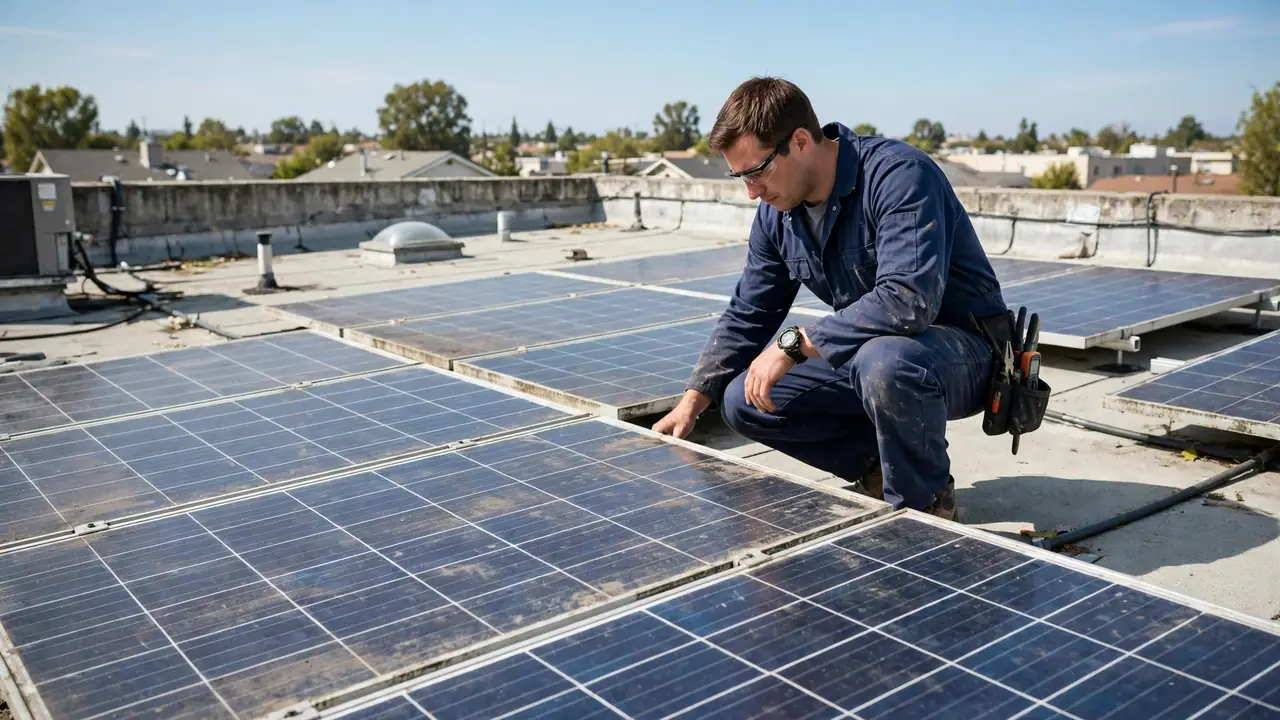
- Use a certified installer. Microcracks from rough handling during installation are a leading cause of premature degradation. Proper mounting torque, correct clamping zones and careful transport matter.
- Leave ventilation space. Panels mounted with an air gap underneath run cooler, and cooler panels degrade more slowly — especially important on Pakistan’s flat concrete rooftops.
- Keep them clean. Dust does not cause permanent degradation, but a dirty panel runs hotter and its true degradation is harder to track. Regular cleaning keeps output — and your monitoring data — honest.
- Monitor production. A monitoring app or inverter portal lets you compare this year’s generation with last year’s, adjusted for weather. A sudden drop is a fault (check the product warranty); a gentle slope is normal degradation.
Frequently Asked Questions (FAQs)
What is a good solar panel degradation rate?
A good degradation rate is under 1% per year — that is now the industry standard. Premium panels warrant 0.25–0.5% per year after the first year, while most mainstream Tier-1 panels warrant 0.45–0.55%. Anything warrantied above 0.8% per year is below today’s market norm.
Do solar panels lose power in the first year?
Yes. New panels lose a little more output in their first year — manufacturers typically warrant up to 2–3% for year one — because light-induced effects in the silicon settle during initial sun exposure. After that the annual rate drops to its long-term level.
How much output will my panels have after 25 years?
Most manufacturers guarantee at least 80% of original output at year 25 through the performance warranty. In practice, a panel warrantied at 0.5% per year retains about 85%, and premium 0.25%/yr panels retain about 91%. Panels usually keep generating well beyond year 25 at a reduced rate.
What is a degradation (performance) warranty?
The degradation (performance) warranty guarantees how much power output your panels retain over time — for example, at least 85% after 25 years. The product (equipment) warranty instead covers physical defects and outright failure, usually for 10–15 years. A panel problem that is sudden is a product-warranty issue; slow decline is a performance-warranty matter.
Can solar panel degradation be stopped or reversed?
No — degradation is permanent and irreversible. But you can slow it down: choose quality verified panels with a low warrantied rate, use a certified installer, leave an air gap under the panels for cooling, keep them clean, and monitor yearly production. Note that dust and shading are recoverable losses, not degradation.
Does Pakistan’s heat make panels degrade faster?
Heat accelerates material aging, so degradation tends to run faster in hot climates than in cool ones. For Pakistan’s summers this means: pick panels with a strong (low) temperature coefficient, ensure good under-panel ventilation on flat concrete roofs, and prefer Tier-1 manufacturers whose warranties are tested for harsh conditions.
Is degradation the same as a panel fault?
No. A fault — like a hot spot, delamination, or PID — causes a sudden or localized drop and is covered by the product warranty. Degradation is the slow, uniform, expected decline across all panels, covered (within limits) by the performance warranty. A sharp year-on-year drop on your monitoring app points to a fault, not normal degradation.