
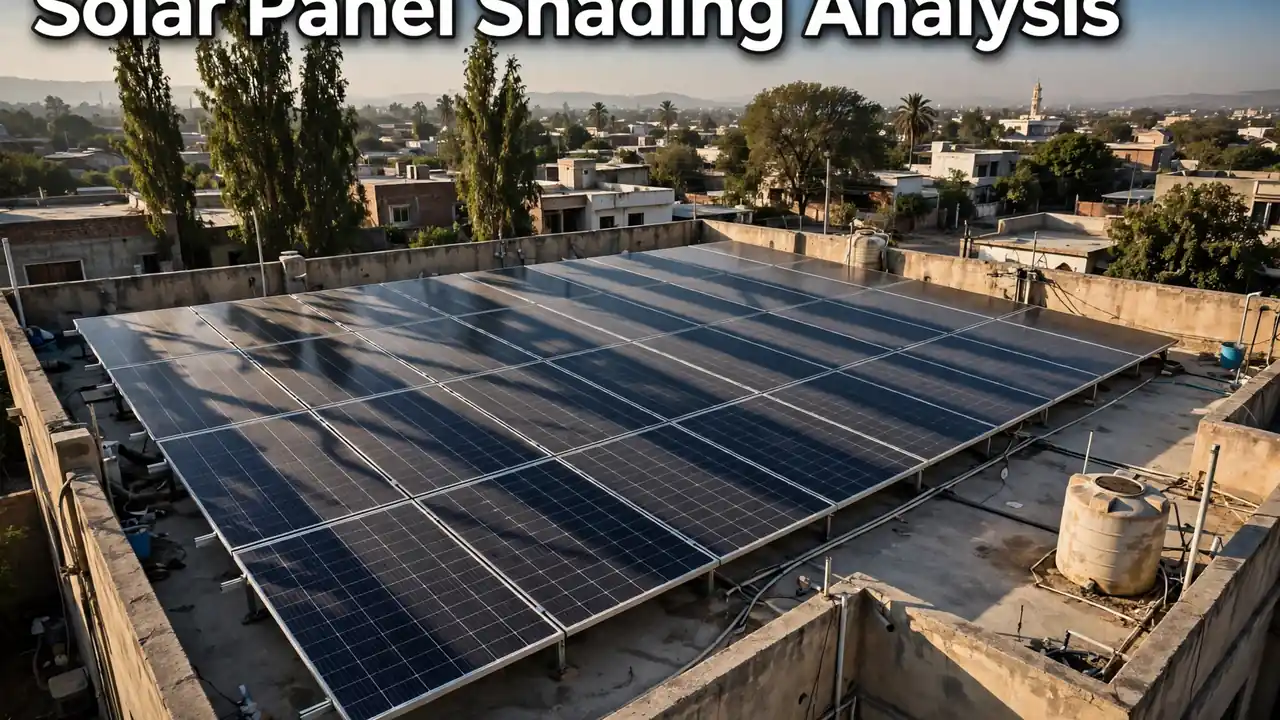
Solar Panel Shading Analysis: How to Check Before Installation

Before you spend money on solar panels for your Pakistani home, there is one check that can save you years of disappointment: a shading analysis — a simple survey of where shadows fall on your roof during the day. Watch which parts of your roof stay sunny between 9 am and 4 pm over a few days, mark the spots shaded by water tanks, trees, parapet walls, and neighbouring buildings, and you will know exactly where panels will actually produce power. This guide shows you how to do that check yourself, what shading really does to a solar system, and how installers work around. Once the roof passes the test, compare the solar panel price in pakistan on our daily-updated homepage tables.
Why Shading Analysis Matters Before You Buy or Install
Shading is the single most common reason a home solar system produces less electricity than expected. Panels are rated in full sunlight, but real rooftops have shadows that move all day. If your installer designs the system around a shaded corner of the roof, your output can fall noticeably short — which is why checking shade before installation, not after, is standard good practice everywhere solar is installed.
How shade affects a solar panel’s output
A solar panel is made of many small cells wired in series — current flows through them like water through a single pipe. When shade covers even one cell, that cell acts like a partially closed valve and drags down the output of every cell connected in series with it. Because most home systems also wire panels themselves in series (a “string”), a shadow on one panel can reduce the output of several neighbouring panels too, not just the shaded one. This is called the mismatch effect, and it is why small shadows cause surprisingly large losses.
To limit this, modern panels include bypass diodes: small components that route current around a shaded group of cells instead of forcing it through them. They reduce the damage, but they do not eliminate it — the shaded section still contributes little or nothing. And inverter choice matters too: with a standard string inverter, the weakest (most shaded) panel limits the whole string, while systems with microinverters or power optimizers let each panel work at its own level so one shaded panel does not drag the rest down.
Hotspots and long-term risks
There is a second reason to care. A shaded cell in a series string does not just go quiet — it can be forced to absorb power from the unshaded cells, heating up. This localised overheating is called a hotspot, and over time it can discolour or damage the panel and shorten its life. Good system design and bypass diodes keep this risk low, but a chronically shaded installation is simply harder on the equipment than a sunny one. Checking shade first is as much about protecting your investment as about output.
How to Do a DIY Shading Check
You do not need special equipment to do a useful shading survey. What you need is a few mornings of observation and a simple sketch. Here is a practical method.
Step 1: Watch the sun path between 9 am and 4 pm
The hours that matter most are roughly 9 am to 4 pm, when the sun is high enough to deliver most of the day’s energy. Pick three or four days and visit your roof at different times — morning, midday, and mid-afternoon. Note which areas are in direct sun at each visit and which are shaded. Areas that stay sunny through this whole window are your prime candidates for panels; areas shaded during midday (11 am–2 pm) are poor candidates no matter how good they look in the morning.
Step 2: Check south, east, and west exposure
In Pakistan’s northern hemisphere, south-facing roof sections get the most direct sunlight through the day, so start your check there. East-facing sections get strong morning sun, west-facing sections get afternoon sun, and north-facing sections generally stay dim. Stand on the roof and orient yourself with a compass or a phone compass app: the clearest south-facing zone with the least shade is usually where your array belongs.
Step 3: Sketch a shade-path diagram
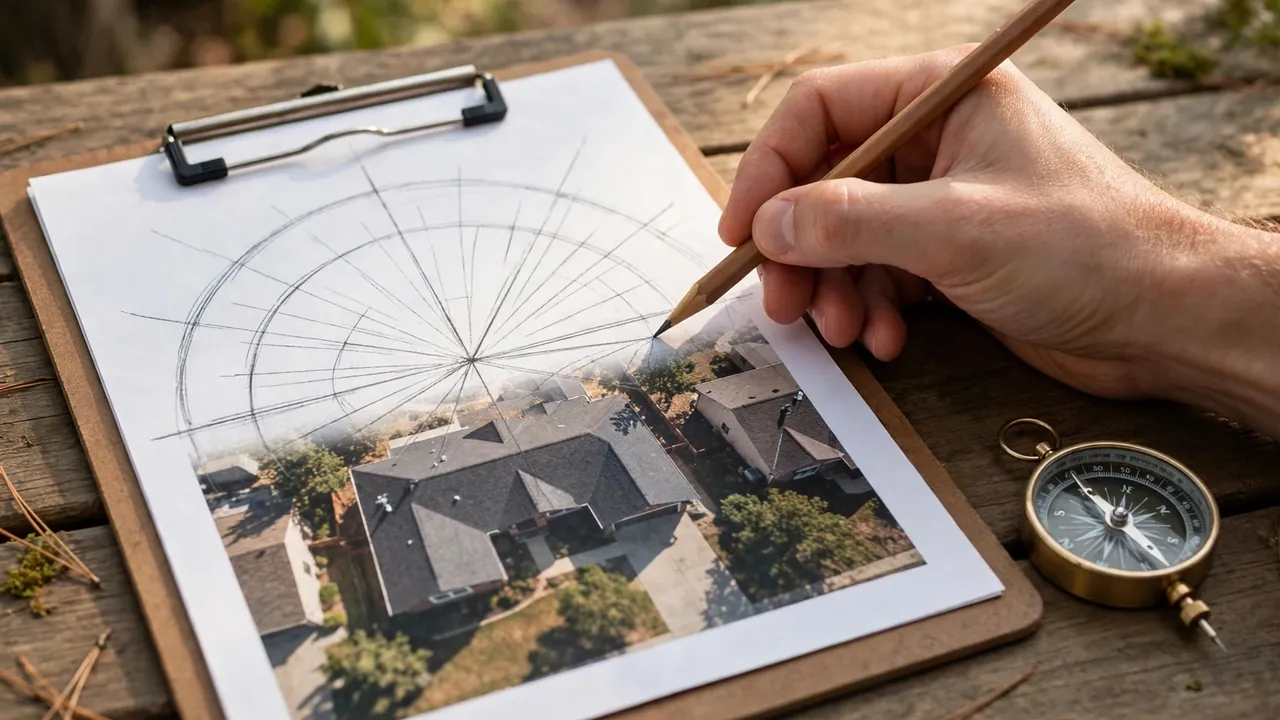
Draw a rough plan of your roof on paper. Mark every fixed object — water tanks, the mumty (staircase room), parapet walls, dish antennas, trees. Then, at each visit, draw where the shadows from these objects actually fall. After a few days you will see a pattern: some zones are almost always clear, others are shaded for hours. This hand-drawn shade map is genuinely useful — a good installer will take it seriously.
Step 4: Use free tools to double-check
Two free tools make your survey more reliable. First, a sun-path smartphone app (search your app store for “sun path tracker”) uses your phone’s compass and GPS to show you the sun’s arc for any day of the year, so you can see whether a tree or building will cast a shadow in December even if you are checking in October. Second, a satellite view of your home on a maps app lets you measure roof dimensions and spot neighbouring buildings that could shade you — especially useful before you commit to an installer’s design.
Common Shading Sources on Pakistani Rooftops
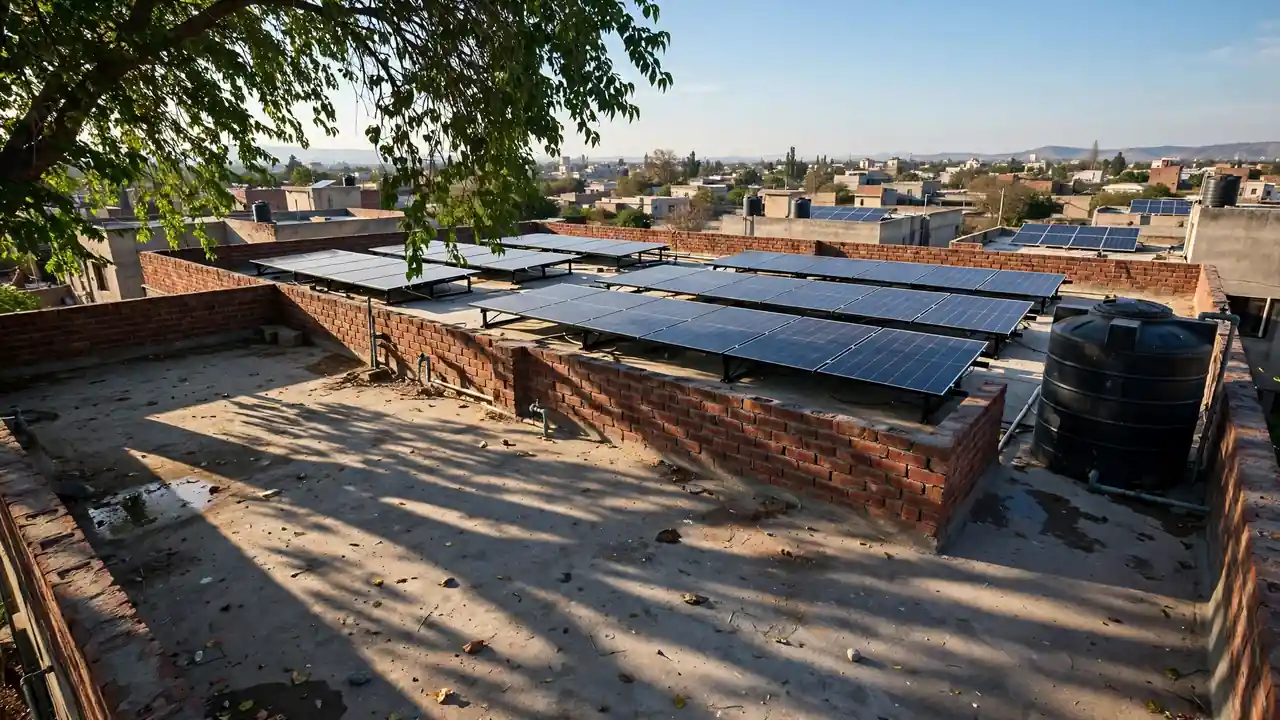
Walk your roof with this checklist and map each one:
- Water tanks: the black plastic tanks on almost every Pakistani roof cast long, moving shadows — especially in the morning and afternoon. Their position often dictates the array layout.
- Mumty (staircase headroom): this solid structure rises above the roof line and shades a significant area, particularly to its north and east.
- Parapet walls: low boundary walls shade a strip along their base in the morning (eastern wall) and afternoon (western wall). Panels need clearance from them.
- Trees: trees grow — a small tree that barely shades your roof today can swallow a corner of it in a few years. Account for growth.
- Neighbouring buildings: in cities like Lahore and Karachi, a taller neighbour to your east or south can shade your roof for hours. Check this carefully; it is the hardest shade to fix.
- Poles, antennas, and dish antennas: small but tall objects cast thin, fast-moving shadows. A single shadow line across a string of panels at midday still costs you output.
How Installers Plan Around Shade
Once you (or the installer) know where the shade falls, there are standard ways to design around it:
- Place the array in the clear zones only. A smaller array in full sun beats a larger array that is half-shaded — every time.
- Leave proper spacing between panel rows. On Pakistan’s flat roofs, panels sit on tilted mounting frames, and the front row can shade the row behind it if they are packed too tight. Read more about solar panel mounting structures in Pakistan to see how proper frames and spacing work.
- Use elevated structures where it helps. Raising the array above low obstructions like parapet walls can clear shadows entirely — though the installer must account for wind load.
- Split panels into separate strings. A skilled installer groups panels that receive the same sun conditions into the same string, so a shadow on one group does not pull down the others.
- Consider microinverters or power optimizers for partly shaded roofs. They cost more than a basic string inverter but let each panel produce independently — exactly the situation shading-resistant inverter choices are designed for.
A proper installer will do their own site survey with professional tools before quoting. If a dealer offers you a system without ever visiting your roof or asking about shade, treat that as a red flag — not a bargain.
Seasonal Shading: Why Winter Shadows Are Longer
Shadows are not fixed. In winter the sun sits lower in the sky, so the same tree or wall casts a longer shadow than it does in summer. A corner of your roof that is clear in June can be shaded in December. This matters because winter sun is already weaker, so extra shade hurts disproportionately. When you do your DIY check, use a sun-path app to look at the December sun arc for your location — it is the worst-case scenario your array must live with. If your roof passes the winter test, it will pass all year.
When Shading Means You Should Downsize or Relocate the Array
Sometimes the honest answer is that your roof cannot support the system size you wanted. That is not a failure — it is the whole point of the analysis. Consider downsizing or relocating when:
- A neighbouring building shades most of the roof for several hours around midday — shade you cannot trim or move.
- Less than half of the required area is reliably sunny between 9 am and 4 pm. Before deciding, confirm how many solar panels your home needs and how much roof space that translates to — then compare with your shaded vs clear zones.
- Trees would need to be removed entirely, and you (or your landlord) are not willing to do it.
- The only clear area is too small, and the installer suggests filling a shaded area “just to reach the kW target” — that is a sign the kW target, not your roof, needs to change.
Alternatives worth discussing with your installer include a smaller system sized to your truly clear area, panels mounted on an elevated structure above low obstructions, or — where the roof is hopelessly shaded — a ground-mounted setup if you have open plot space. Start by knowing your actual loads; our guide on calculating your home’s electricity load for solar helps you size the system honestly before worrying about where it goes.
Frequently Asked Questions (FAQs)
How do I check shading on my roof before solar installation?
Stand on your roof at different times between 9 am and 4 pm over a few days and note which areas stay in direct sunlight. Sketch the roof, mark water tanks, walls, trees and neighbouring buildings, and draw where their shadows fall. Areas sunny through the whole window are your best candidates for panels; midday shade is the deal-breaker.
Does shading stop solar panels from producing electricity?
Shaded panels keep producing at reduced output — they do not switch off completely. But even partial shade on one panel or cell can reduce the output of the whole series string it belongs to, so shade costs you more energy than just the shaded area suggests. Bypass diodes limit the damage but do not remove it.
What time of day should I check for shade on my roof?
The most important hours are roughly 9 am to 4 pm, when the sun delivers most of the day’s energy. Check morning, midday, and mid-afternoon. Areas shaded during midday (11 am to 2 pm) should not hold panels, while morning or evening shade is easier to live with.
Can installers fix the problem if my roof has shade?
Installers cannot remove a neighbour’s building, but they can design around shade: placing panels only in clear zones, spacing rows so they do not shade each other, using elevated structures to clear low obstructions, splitting panels into separate strings, or recommending microinverters or power optimizers for partly shaded roofs. What they cannot do is make shade disappear — so a pre-install survey is still essential.
Do solar panels work in cloudy weather, or is that the same as shade?
No — cloudy weather is not the same as shading. Clouds spread and soften sunlight, and panels still generate useful power under cloud cover, just at lower output. Shading is a hard shadow from a specific object that blocks direct sun, and it reduces output far more sharply on the affected cells. A system sized for your area’s weather will still work fine on cloudy days.
How often should I re-check shading on my roof?
Recheck at least once a year, and after any change nearby. Trees grow and cast longer shadows over time, and new construction on neighbouring plots can shade a roof that was perfectly clear when you installed. A quick midday observation twice a year is enough to catch changes early.