Solar DC Wiring Guide: Cables, Connectors and Safety

Solar DC wiring is the set of cables and connectors that carries direct current from your solar panels to the inverter, and in a hybrid system, between the inverter and the battery bank. In short: use solar-rated DC cable of the right size for the current and the run length, connect it with properly crimped matching connectors, protect it with a DC isolator and appropriate fuses and surge protection, and route it so heat, sunlight and water cannot damage it. Get those four things right and the wiring stays safe and efficient for the life of the system; get any one wrong and you risk lost output, overheating, or a fault that is hard to trace later.
This guide explains each part in plain language: what DC wiring does, cable types, sizing, string wiring, connectors, protection, and mistakes to avoid. It is a homeowner’s guide, not a substitute for a qualified installer or the manufacturers’ instructions, which always take priority.
What DC Wiring Does in a Solar System
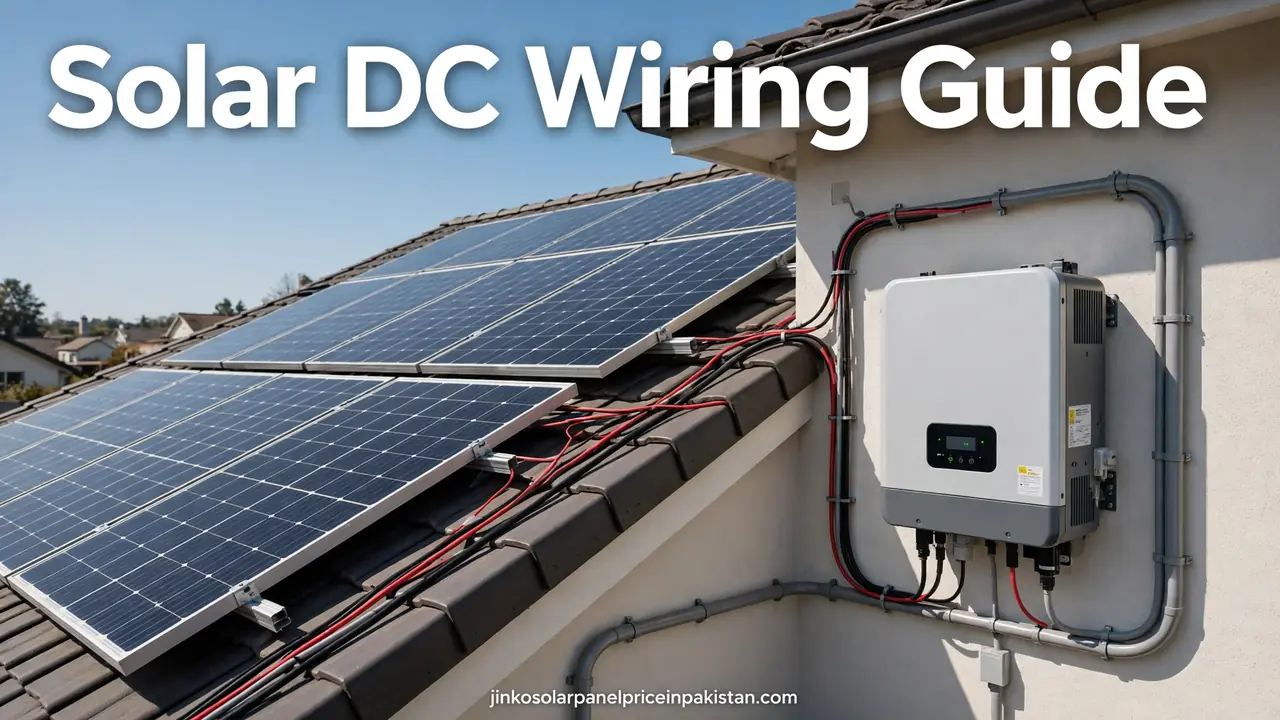
A solar panel produces direct current (DC). That current travels along DC cables from the panel, through the array wiring and any DC distribution board, to the inverter, which converts it to alternating current (AC) for the home. In a hybrid system there is a second DC path: between the inverter and the battery bank, where current flows in both directions as the battery charges and discharges.
DC wiring is therefore not one cable run: it includes panel leads, string cables to the inverter, and, where fitted, battery cables. Each run carries different currents and sits in different conditions — on a hot roof, inside conduit, or indoors — so each needs the right cable for its job. The AC wiring after the inverter is a separate subject with its own rules, and the two sides should never be mixed: AC cable must not be used for DC solar runs.
DC Cable Types Used in Solar Systems
PV Cable for Panel Strings
Panel string wiring normally uses PV cable: a single-core, double-insulated cable with a copper conductor, designed for outdoor solar use. Its insulation resists ultraviolet light, rain, heat and abrasion far better than ordinary indoor cable, and it is rated for the high DC voltages that modern strings operate at. The short leads already attached to a panel are PV cable, and extensions and home runs from the array to the inverter should match that standard. Cable markings show type and size; the core size, not insulation thickness, is what matters.
Battery DC Cables
Battery cables carry much higher currents at much lower voltages than panel strings, so they are typically thick, flexible, finely stranded cables with crimped lugs at each end. Flexible cable matters in tight battery spaces, where a stiff cable strains terminals. Keep these runs short, paired positive-and-negative, and protected by a fuse or breaker rated for the circuit. The inverter manual normally specifies the battery cable size and fuse for that model, and that specification should be followed exactly. See the solar inverter buying guide for inverter types.
How DC Cable Size Is Chosen
Cable size is chosen by two checks, and the larger size that passes both is the one to use. The first check is current-carrying capacity, often called ampacity: the cable must safely carry the maximum current of its circuit without its insulation overheating. The starting point is the short-circuit current printed on the panel datasheet for a string, or the rated current for a battery circuit, with a safety margin applied because a solar circuit can run at its maximum for hours in strong sun.
The second check is voltage drop. Every cable resists current a little, and some voltage is lost along the run as heat. On a long run, or a run carrying a high current, that loss grows. A cable that is safe on current alone can still waste a noticeable share of the array’s output if it is too thin for its length. Keeping runs short, and stepping up a size on long home runs, is how installers control this loss. The calculation uses the full round-trip length — out along the positive conductor and back along the negative — not just the one-way distance.
Three further factors adjust the result: heat reduces capacity, so a cable in a hot roof space or sunlit conduit carries less than in cool, open air; grouped cables heat each other; and the installation method — free air, conduit, or buried — changes how well heat escapes. A size that suits one house cannot simply be copied to another.
String Wiring: Series and Parallel Connections
Panels are joined into strings, and the way a string is wired decides its voltage and current. In a series connection, the positive of one panel joins the negative of the next, so voltages add while the current stays the same as a single panel. In a parallel connection, positives join to positives and negatives to negatives, so currents add while the voltage stays the same. Most home systems use series strings, because a higher voltage at a modest current means thinner cables and lower losses on the run to the inverter — but the string voltage must stay within the inverter’s allowed input range, which is why string length is a design decision, not a guess.
Panels in one series string share the same current, so a heavily shaded or faulty panel can limit the whole string — one reason installers plan string membership around shading. Panel string wiring differs from battery bank wiring; our solar battery series vs parallel wiring guide covers the battery side.
Connectors and Terminations: Where Most DC Faults Begin
Connectors deserve special attention because a poor connection is the most common cause of DC wiring problems. A connection that looks fine can still have high resistance if strands are cut, if insulation is trapped inside the crimp, or if the crimping tool was wrong for the connector. High resistance means heat, and heat over months and years means discoloured connectors, brittle insulation and, in the worst case, arcing.
Panel circuits normally use MC4-style connectors: weatherproof, locking plug-and-socket connectors crimped onto cable ends. Good practice is to use connectors from the same manufacturer family on both sides of a joint, crimped with the matching tool, and fully clicked home until they lock. Mixing connector brands that look alike but are not designed to mate is a known source of trouble, as is reusing a connector whose seal or locking tab is damaged. A connector that can be pulled apart by hand, or that shows heat marks, needs replacing by a professional — never taped over.
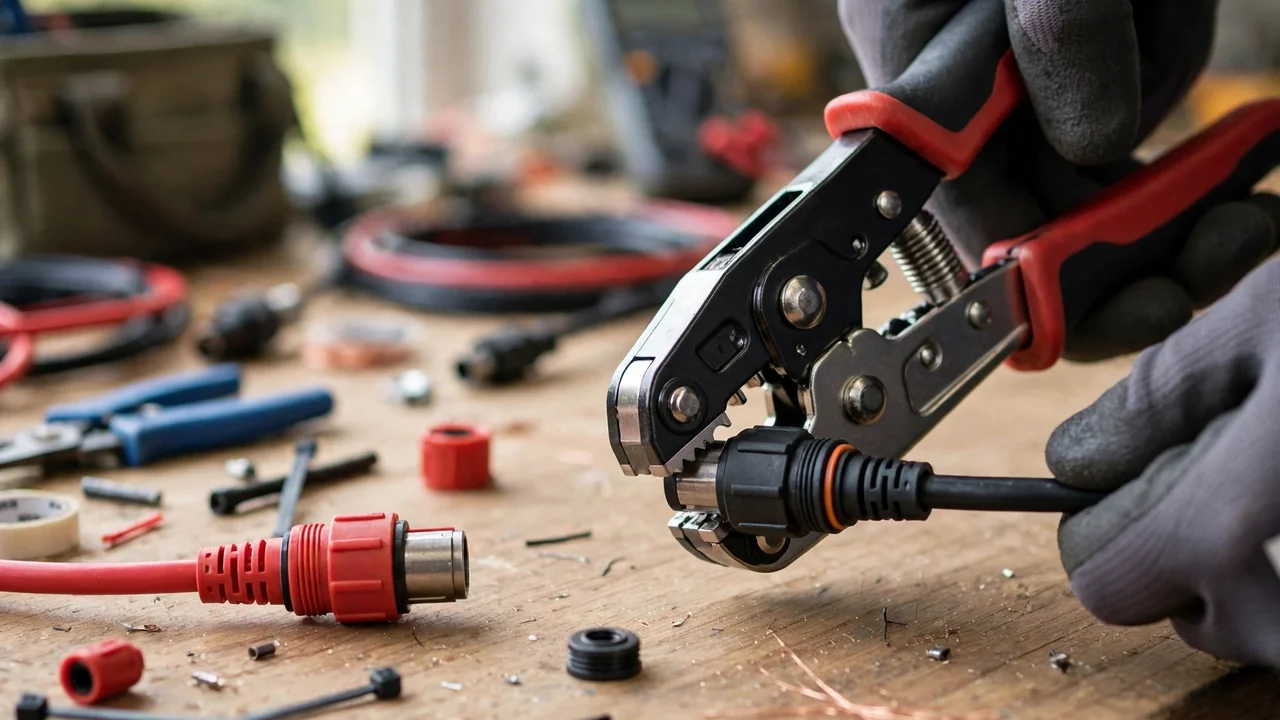
At the inverter, battery and distribution-board ends, cables terminate in lugs, ferrules or screw terminals. The same principles apply: the right lug for the cable size, a proper crimp, no stray strands or trapped insulation, and terminals tightened to the specified torque. Every termination should be labelled.
DC Protection and Isolation
Protection on the DC side has three jobs: letting someone safely isolate the array, interrupting a fault current before it damages cable or equipment, and giving surges a safe path away from the inverter. The DC isolator is the visible part of the first job. It is a switch rated for DC at the string voltage that disconnects the array from the inverter for maintenance. It should be accessible, clearly labelled, and rated for DC — an AC switch must never be substituted, because DC arcs do not extinguish the way AC arcs do.
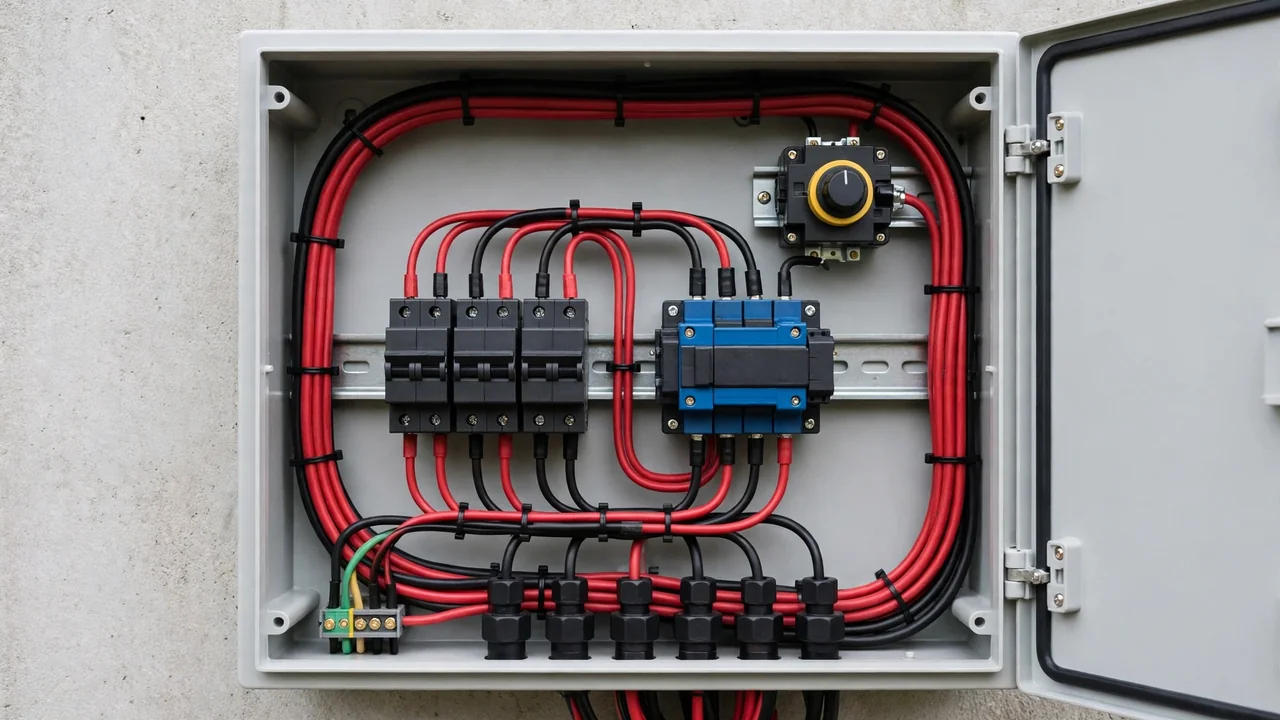
Fuses or breakers on the DC side protect individual strings and the battery circuit. Their ratings follow the circuit current and the cable size, and they must be DC-rated for the system voltage. Surge protection devices, where fitted, sit on the DC side and, in many installations, on the AC side too, and their earth connection must be short and direct to work as intended. These devices work as part of a system with the earthing arrangement, so read this section together with our solar panel earthing and grounding guide, which explains what must be earthed and why a separate unbonded earth rod for the array is a mistake. Protection only works as a coordinated set.
Routing, Conduit and Outdoor Durability
How cables are routed matters as much as their size. On the roof, cables should be clipped neatly to rails or structure, never left loose where wind can rub them against sharp metal edges, and never allowed to sag into standing water. Cable ties used outdoors should be UV-resistant; ordinary ties become brittle in sun and heat and drop cables onto the roof surface. Where cables cross a roof or pass through a wall, they should be protected in conduit or trunking, with drip loops and sealed entries so rainwater cannot track along the cable into the building.
Inside the building, DC cables should run in conduit or trunking, be kept separate from AC cables where the design requires it, and be labelled at both ends and at the distribution board. Conduit protects against damage but also traps heat, so cable size and conduit fill are calculated together. Avoid sharp bends, which can damage insulation and strands. In Pakistan’s hot climate, heat derating is a real factor, not a theoretical one. For roof structure, see our solar panel mounting structures guide.
Common DC Wiring Mistakes to Avoid
Most DC wiring problems come from a short list of avoidable mistakes. Using household AC cable for a solar DC run is the first: it is not rated for outdoor UV exposure or for sustained DC voltage, and its insulation ages quickly on a roof. Undersizing a cable for a long run is the second: the system still works, but output is quietly lost as heat and the cable runs hotter than it should. Mixing connector brands, or crimping with pliers instead of the proper crimp tool, is the third, and it is the mistake most likely to show up years later as a burnt connector. Other mistakes are workmanship: bare strands outside a terminal, insulation trapped in a crimp, over-tightened terminals, and unlabelled strings. Skipping the DC isolator, or fitting an AC-rated switch in its place, removes the safe way to disconnect the array.
Checking Your DC Wiring
A homeowner can safely carry out visual checks without touching live DC conductors. Look for cables that have slipped from their clips, ties that have broken, conduit that has come adrift, connectors that are discoloured or show heat marks, and any cable resting against a sharp metal edge. Inside, check the DC isolator and string labels, and look for cracked insulation. Report any of these findings to the installer promptly.
What a homeowner should not do is open a live DC connector, remake a crimp, or replace a fuse or isolator while the array is producing. DC work on a live string needs the right procedure — covering panels or working in low light, verifying isolation, and using insulated tools — and it belongs to a qualified installer. If the inverter repeatedly reports a DC or earth fault, call a professional rather than resetting it and hoping the fault clears. Keep the wiring diagram and datasheets with your system documents. Our solar inverter installation guide explains what a proper installation and handover should include.
Further reading: Victron Energy, DC wiring — Wiring Unlimited, for cable selection, voltage drop and connections in DC systems.
Frequently Asked Questions (FAQs)
What is solar DC wiring?
DC wiring carries direct current from the solar panels to the inverter, and in a hybrid system between the inverter and the battery bank. It includes the panel leads, the string cables to the inverter, and the battery cables, each sized and protected for its own current, length and location.
Can ordinary household cable be used for solar DC wiring?
No. Household AC cable is not rated for sustained DC voltage or for outdoor UV exposure on a roof. Solar DC runs need solar-rated PV cable with double insulation, UV resistance and a DC voltage rating that suits the string.
How is DC cable size chosen?
By two checks: the cable must safely carry the circuit’s maximum current without overheating, and the voltage lost along the full round-trip run must stay small. The larger size that passes both checks is used, after allowing for heat, grouping and installation method.
What is the difference between series and parallel panel wiring?
In a series string, voltages add and current stays the same as one panel, which keeps cable losses low on the run to the inverter. In a parallel connection, currents add and voltage stays the same. Most home systems use series strings, sized so the string voltage stays within the inverter’s input range.
What are MC4 connectors and how should they be fitted?
MC4-style connectors are locking, weatherproof plug-and-socket connectors crimped onto PV cable ends. Use matching connectors from the same family, crimped with the correct tool, fully clicked home, and never mix brands that only look alike.
Why does a solar system need a DC isolator?
A DC isolator lets the array be safely disconnected from the inverter for maintenance, and it must be rated for DC at the string voltage. An AC switch must never be substituted, because a DC arc does not extinguish the way an AC arc does.
How can I check my DC wiring safely?
Look for cables that have slipped from clips, broken ties, discoloured or heat-marked connectors, cracked insulation, and cables resting on sharp metal edges. Do not open a live DC connector or remake a crimp yourself; report faults to a qualified installer.
What are the most common DC wiring mistakes?
Undersized cable on a long run, household AC cable on a roof, mixed connector brands, poor crimps made without the right tool, unlabelled strings, and cables left loose or unprotected against sun, water and abrasion.